Intel, Santa Clara, California · 15 November 1971 · Hoff, Faggin, Mazor and Noyce
A New Era of Integrated Electronics
A young memory company took a calculator order and turned it into something no one had sold before: a computer’s whole processor on one chip smaller than a fingernail.

The moment · About 6:30 p.m. · January 1971
The new wafers come off the line as the building empties. Federico Faggin is alone in the lab. The first batch was dead. He lowers the probes onto a 4004 and watches the oscilloscope. This time the trace moves. He keeps testing until 3:30 in the morning.
Aha! Signals!Federico Faggin, recalling that night
In 1969 a computer’s processor filled whole circuit boards, and every new calculator needed its own custom chips. Intel was a year old and made memory. When a Japanese calculator maker ordered a set of chips, three Intel engineers proposed something bigger: one general-purpose processor that software could turn into anything. Two years later it was on sale.
A calculator order
Robert Noyce and Gordon Moore founded Intel in July 1968 to make memory chips. Nine months later Busicom, a Japanese calculator maker, asks Intel to build the chips for a new family of desktop calculators. In June three Busicom engineers arrive with their design, Masatoshi Shima among them. Each chip in it does one fixed job. Ted Hoff, Intel’s manager of applications research, is assigned to help them.
One chip that can do anything
Hoff fears the design is too complex for little Intel to build at Busicom’s price. He takes the worry to Noyce, who tells him to find a simpler way. Hoff sees one. A general-purpose processor that reads its program from memory could do all the work. Change the program, and the same chip runs a calculator, a cash register or a traffic light. Four bits at a time is enough: one decimal digit.
Robert Noyce to Ted Hoff, 1969, as Hoff recalled itWell, if you have any ideas to simplify the design, go ahead and pursue them.
Four chips
Stan Mazor joins Intel from Fairchild in September and works out the plan with Hoff. With Shima they answer Busicom’s objections one by one. Mazor writes a short interpreter to handle the calculator’s complex commands, and Shima reworks Busicom’s calculator logic around the new plan. In October Busicom’s executives hear the plan and accept it: four chips. One holds the program, one the data, one handles input and output, and one is the processor.
Faggin takes over
Neither Hoff nor Mazor designs chips, and the project has stalled. Intel hires Federico Faggin from Fairchild, where in 1968 he developed the silicon-gate process Intel builds its chips with. Days later Shima arrives from Japan and finds almost nothing done. Faggin brings two of his own inventions, the buried contact and the bootstrap load, to squeeze the processor onto one chip. He works 70- and 80-hour weeks, and designs all four chips in eight months.
Federico Faggin, on first seeing the scheduleMy jaw dropped: I had less than six months to design four chips, one of which, the CPU, was at the boundary of what was possible.
Signals
The first 4004 wafers come out just after Christmas, and every chip is dead. Under the microscope Faggin finds that the factory left out one layer. In the second half of January a new batch comes out at 6:30 in the evening, as everyone goes home. Faggin lowers the probes and sees signals. He runs a test loop. It passes. He checks every major block until about 3:30 in the morning. Intel has a microprocessor.
It works
Faggin fixes two small faults and in March ships the first fully working 4004 to Shima in Japan. Shima plugs it into his prototype, the Busicom 141-PF printing calculator, and in April the calculator runs. Its brain is one 4004, two memory chips, four program chips and three shift registers. In a corner of the processor, Faggin has etched his initials: F.F.
Buying back the rights
Busicom owns the design, and it is in trouble. It wants a lower price. Faggin urges Noyce to give it one in exchange for the right to sell the chips to everyone else, and Hoff tells marketing the same. Noyce makes the deal. Intel returns Busicom’s $60,000 and cuts the price, and Busicom keeps its rights only for calculators. Faggin builds a chip tester run by a 4004 to show what else it can do.
A computer on a chip
Ed Gelbach, Intel’s new head of marketing, decides to sell the chip to the world. Intel’s ad runs across two pages of Electronic News. It offers the MCS-4: four chips that make a working computer, with the 4004 at its heart. On a sliver of silicon three by four millimeters, 2,300 transistors match the computing power of ENIAC, the room-sized computer of 1946.
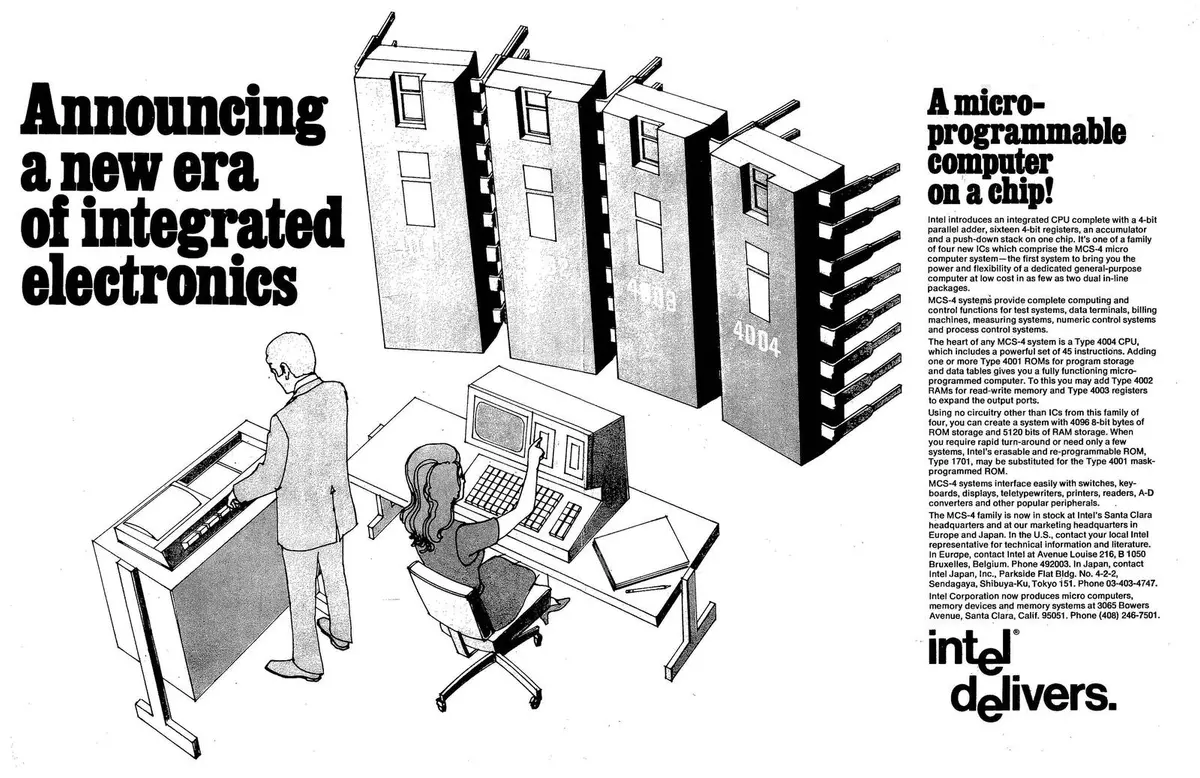
Intel’s two-page advertisement in Electronic News of 15 November 1971, announcing the 4004 and its MCS-4 chip set. Intel Free Press. Intel advertisement, Electronic News, 15 November 1971Announcing a new era of integrated electronics. A micro-programmable computer on a chip!
Doubling, every two years
The 8-bit 8008 follows in April 1972. Its successor, the 8080 of 1974, runs the Altair 8800, the kit that sets off the personal computer boom. In 1981 IBM builds its PC around Intel’s 8088, with 29,000 transistors. The count keeps doubling about every two years, as Gordon Moore predicted. The Pentium of 1993 has 3.1 million. Apple’s M3 Max of 2023 has 92 billion, forty million times the 4004.
The team

Born in Rochester, New York, with a Stanford doctorate in electrical engineering. Joined Intel in 1968. Saw that one programmable processor could replace a set of custom chips and drew up the 4004’s architecture. Named Intel’s first Fellow in 1980.

Born in Vicenza, Italy, with a physics doctorate from Padua. Came to California in 1968 and developed silicon-gate chips at Fairchild. Designed the 4004 and signed it, then led the 8008 and 8080. Founded Zilog. American citizen since 1978.

Born in Chicago and raised in Oakland, California. Learned computing at San Francisco State and designed computers at Fairchild. Joined Intel in September 1969 and worked out the 4004’s architecture and instruction set with Hoff and Shima.

Co-inventor of the integrated circuit. Founded Intel with Gordon Moore in 1968. Told Hoff to pursue the simpler design, then traded back Busicom’s $60,000 for the right to sell the 4004 to the world.
By the numbers
In pictures


Watch, listen, see
Films, photographs and first-hand accounts from across the web. Each opens in a new tab.

Ted Hoff and Federico Faggin tell how the first microprocessor was born, at the 2006 anniversary event.
Computer History Museum
How Intel’s four-chip MCS-4 family, built around the 4004, reached designers in 1971.
Computer History Museum
Ted Hoff and his family on the curiosity and persistence behind the microprocessor.
National Inventors Hall of Fame
Hoff, Mazor and Faggin honored for the conception, design and application of the first microprocessor.
National Science & Technology Medals Foundation
Faggin, Hoff, Mazor, Shima and Hal Feeney recount the 4004 from first idea to launch, recorded in 2007.
Computer History MuseumThe two architects explain how a calculator order became a general-purpose processor.
Computer History Museum
Intel’s own history of the 4004, from the Busicom order to buying back the rights.
Intel
A 141-PF calculator simulator, reverse-engineered schematics and transistor-by-transistor replicas of the 4004.
4004.com“The extraordinary accomplishments of these scientists, engineers, and inventors are a testament to American industry and ingenuity.”
President Barack Obama, announcing the National Medals of Technology and Innovation, among them the medal for the 4004 team, 15 October 2010
After
On 17 November 2010, in the East Room of the White House, President Obama presented Faggin, Hoff and Mazor the National Medal of Technology and Innovation “for the conception, design and application of the first microprocessor, which was commercially adopted and became the universal building block of digital electronic systems.” All three had entered the National Inventors Hall of Fame in 1996.
Faggin went on to found Zilog, whose Z80 powered a generation of early personal computers, and later Synaptics, which brought the touchpad to laptops. Hoff became Intel’s first Fellow. Mazor taught chip design at Stanford and around the world.
Intel, the memory company that almost kept the 4004 to itself, built the processors inside generations of personal computers. Ted Hoff summed up what the team had done: “We democratized the computer.”
Primary sources
- Oral History Panel on the Development and Promotion of the Intel 4004 Microprocessor: Federico Faggin, Hal Feeney, Ted Hoff, Stan Mazor and Masatoshi Shima. Computer History Museum, 25 April 2007.
- Milestone Proposal: Intel 4004 Microprocessor, 1971. IEEE History Center.
- Intel Marks 50th Anniversary of the Intel 4004. Intel Newsroom, 15 November 2021.
Keep exploring
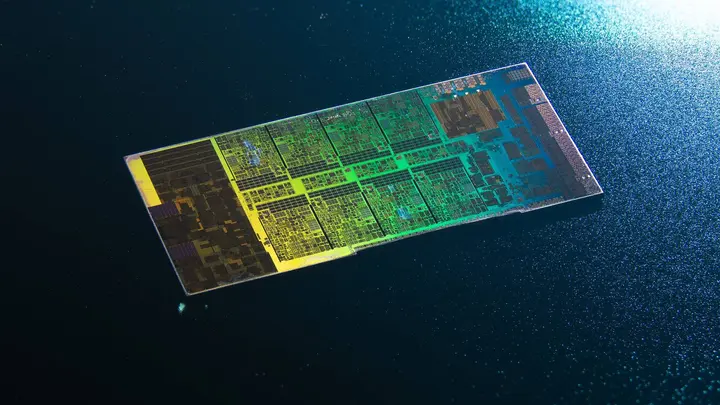
- The Integrated CircuitJack Kilby put a whole circuit on one sliver of germanium, and Robert Noyce made it in silicon. Every computer since runs on it.208Btransistors in one GPU
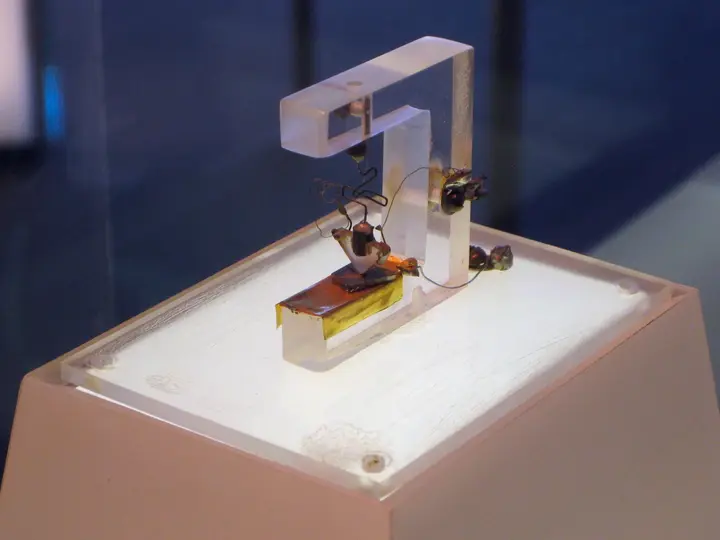
- The TransistorBell Labs, December 1947. The switch inside every chip, phone and computer on earth.3inventors
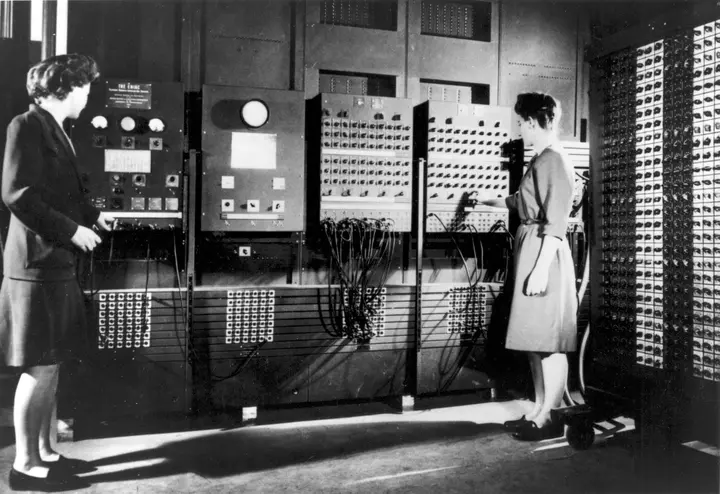
- ENIACPenn’s Eckert and Mauchly built the first general-purpose electronic computer for the Army, a thousand times faster than the calculators before it.5,000additions a second
- ARPANETUCLA tried to send “LOGIN” to SRI in Menlo Park. Two letters got through. That was the start of the internet.“LO”first message


Free, with no ads. Support the museum →