Moore School, University of Pennsylvania · 14 February 1946 · Eckert, Mauchly and the ENIAC programmers
Faster Than a Shell Flies
The Army needed its firing tables faster than people could figure them. Two men at Penn built it a 30-ton machine of vacuum tubes that did in 30 seconds what took a skilled person 20 hours, and six women taught the machine to work.

The moment · February 1946 · Moore School, Philadelphia
The trajectory program starts. Neon lamps flicker across the black panels as ENIAC works a shell’s flight step by step. A skilled person with a desk calculator needs about 20 hours for one such path. ENIAC is done before a real shell would land.
World War II put new guns in American hands faster than the Army could aim them. Every gun and shell needed a firing table, and every table meant long columns of trajectories worked out by hand. At the Ballistic Research Laboratory the requests came in at about six a day. In 1943 the Army bet $61,700 on a machine built of vacuum tubes. It became ENIAC.
Six tables a day
The Army’s Ballistic Research Laboratory at Aberdeen Proving Ground, Maryland, computes the tables gunners aim by. Its human computers work with desk calculators and a Bush differential analyzer, a room-sized machine of shafts and gears. A skilled person needs about 20 hours for one 60-second trajectory. In June 1942 the Army hires Penn’s Moore School to run its analyzer too, and sends Lt. Herman Goldstine, a Chicago mathematician, to run the work there.
The memo
John Mauchly, a physics professor from Ursinus College, has joined the Moore School faculty after a wartime electronics course there in 1941. In that course he met J. Presper Eckert a 22-year-old Penn engineer. Now Mauchly writes a memo, The Use of High Speed Vacuum Tube Devices for Calculating. Vacuum tubes switch thousands of times faster than gears turn. Built right, they could compute at electronic speed.
Give Goldstine the money
Goldstine, now a captain, carries the Eckert and Mauchly proposal to Col. Leslie Simon, the laboratory’s director, and Oswald Veblen, the Princeton mathematician who advises him. It is Eckert’s 24th birthday. Veblen listens, brings his tipped-back chair down with a crash and gives his answer. The contract is signed on 5 June 1943: six months and $61,700 for research on an Electronic Numerical Integrator and Computer. Eckert is chief engineer. Mauchly is principal consultant.
Oswald Veblen to Col. Leslie Simon, April 1943Simon, give Goldstine the money.
Thirty tons of tubes
The first accumulator and the cycling unit run in June 1944. A production team builds the rest by hand, almost fifty women among its wiremen, technicians and assemblers in 1944 alone. Vacuum tubes burn out, so Eckert’s team sets a hard rule: every tube and resistor runs well below its rated load. Final assembly comes in the fall of 1945. ENIAC lines three walls of a room with about 18,000 tubes and weighs more than 30 tons.
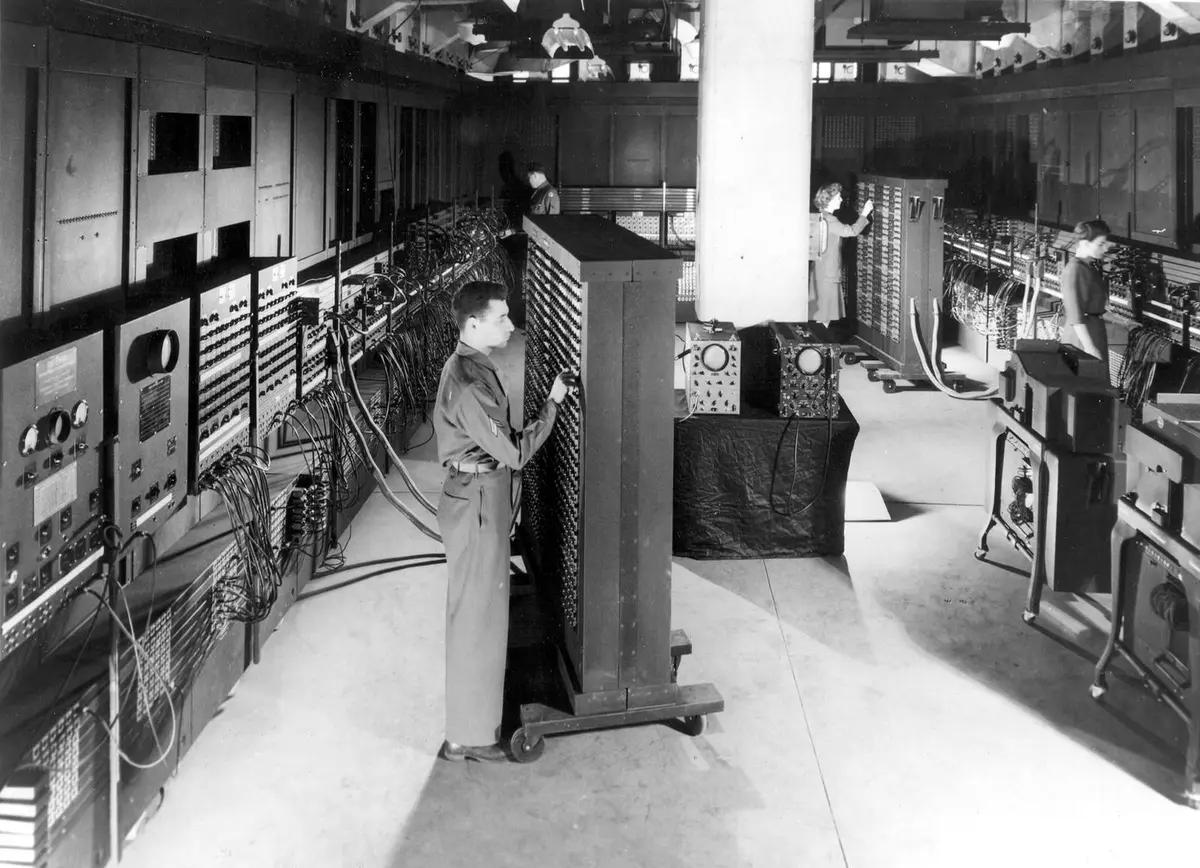
Cpl. Irwin Goldstein sets the switches on one of ENIAC’s portable function tables at the Moore School, 1946. U.S. Army photo / Ballistic Research Laboratory (ARL Technical Library). The six
The Army picks six of its best human computers to run the new machine: Kay McNulty, Betty Jennings, Betty Snyder, Marlyn Wescoff, Fran Bilas and Ruth Lichterman. Most are college graduates. There are no manuals and no programming languages. They learn ENIAC from its wiring diagrams and block diagrams, then plan each problem as a pattern of switch settings and cables. They become the world’s first programmers of an electronic general-purpose computer.
Problem A
ENIAC’s first real job comes from Los Alamos. Physicists Nicholas Metropolis and Stanley Frankel bring a classified calculation for the weapons laboratory. Herman and Adele Goldstine teach them how to set up the machine, and the six women set the switches and feed the punched cards. The Army holds off moving ENIAC to Aberdeen until the job is done.
The wink of an eye
Reporters get a preview, held under embargo until the War Department releases the story. Arthur Burks, one of ENIAC’s designers, presses a button and the machine adds 5,000 numbers in one second. Then it solves a problem that would take a trained person weeks. On 15 February the story is on the front page of The New York Times.
The shell lands
The War Department and Penn introduce ENIAC to the world, and the next day it is formally dedicated. The showpiece is a full trajectory, programmed by Betty Jennings and Betty Snyder. Days before, the program ran but the shell would not stop at the ground. Snyder worked it out in the night and fixed it with one switch on the master programmer. On the day, the shell lands, and ENIAC computes its path faster than the shell flies.
Nine years of service
ENIAC is taken apart, trucked to Aberdeen and running again by August 1947. In 1948 it is rewired, on John von Neumann’s suggestion, to run stored instructions without replugging cables. For years it is the nation’s main machine for big scientific problems: the Army and Air Force ballistic tables, atomic energy, the first computer weather forecasts. At 11:45 p.m. on 2 October 1955 the Army switches it off after 80,223 hours of operation.
The builders

Philadelphia-born electrical engineer from Penn’s Moore School. Chief engineer of ENIAC at 24, he kept its 18,000 tubes working by running every part below its rating. Co-founded the company that built UNIVAC. National Medal of Science, 1968.

Cincinnati-born physicist with a Johns Hopkins doctorate who ran the physics department at Ursinus College. In 1942 he wrote the memo that proposed an electronic computer. Designed ENIAC with Eckert, then co-founded the company that built BINAC and UNIVAC.

University of Chicago mathematician commissioned in the Army in 1942. He saw what Eckert and Mauchly’s idea could do, sold it to the Army and supervised it to the finish. Later led Princeton’s IAS computer project. National Medal of Science.

Philadelphia native who computed trajectories for the Army. Co-led the program that ran the unveiling’s trajectory and fixed its last bug just before the unveiling. Later wrote the Sort-Merge Generator for UNIVAC, an early program that wrote programs. IEEE Computer Pioneer Award, 1997.
By the numbers
In pictures


Watch, listen, see
Films, photographs and first-hand accounts from across the web. Each opens in a new tab.

Jean Jennings Bartik remembers breaking into a brand-new field and programming ENIAC in the 1940s.
Computer History Museum
One of ENIAC’s six original programmers tells her story, from Missouri to Eckert, Mauchly and von Neumann.
Computer History Museum
Arthur Burks, who designed ENIAC’s multiplier and ran its press demonstration, lectures on ENIAC and the machines that followed.
Computer History Museum
Penn tells how Eckert and Mauchly built ENIAC at the Moore School for the Army.
University of Pennsylvania
The ENIAC programmers are honored at the 1997 Women in Technology International Hall of Fame.
Women in Technology International
Photographs, artifacts and the story of ENIAC from the museum’s Birth of the Computer gallery.
Computer History Museum
The 1987 engineering milestone honoring ENIAC, with the plaque text and the machine’s history.
IEEE History Center
Eckert and Mauchly’s patent for the Electronic Numerical Integrator and Computer, filed in 1947.
Google Patents“This advance, however, is not adequate for many problems encountered in modern scientific work and the present invention is intended to reduce to seconds such lengthy computations.”
J. Presper Eckert and John Mauchly, ENIAC patent application, filed 26 June 1947
After
Eckert and Mauchly left Penn in March 1946 and started their own company. Their UNIVAC I went to work for the Census Bureau in 1951. On election night 1952 a UNIVAC on CBS called Eisenhower’s landslide from early returns. The computer industry grew from the Army’s bet at the Moore School.
Pieces of ENIAC survive at the Smithsonian, at Penn, at the Fort Sill Field Artillery Museum in Oklahoma, at the Computer History Museum and at the University of Michigan. In 1987 the IEEE named ENIAC an engineering milestone.
In 1997 all six original programmers were inducted into the Women in Technology International Hall of Fame. Betty Holberton received the IEEE Computer Pioneer Award that year, and Jean Jennings Bartik received it in 2008. Eckert received the National Medal of Science in 1968.
Primary sources
- Martin H. Weik, “The ENIAC Story.” Ordnance, January–February 1961. Ballistic Research Laboratories, Aberdeen Proving Ground.
- William T. Moye, “ENIAC: The Army-Sponsored Revolution.” U.S. Army Research Laboratory, January 1996.
- Milestones: Electronic Numerical Integrator and Computer, 1946. IEEE History Center, Engineering and Technology History Wiki.
Keep exploring
- The TransistorBell Labs, December 1947. The switch inside every chip, phone and computer on earth.3inventors
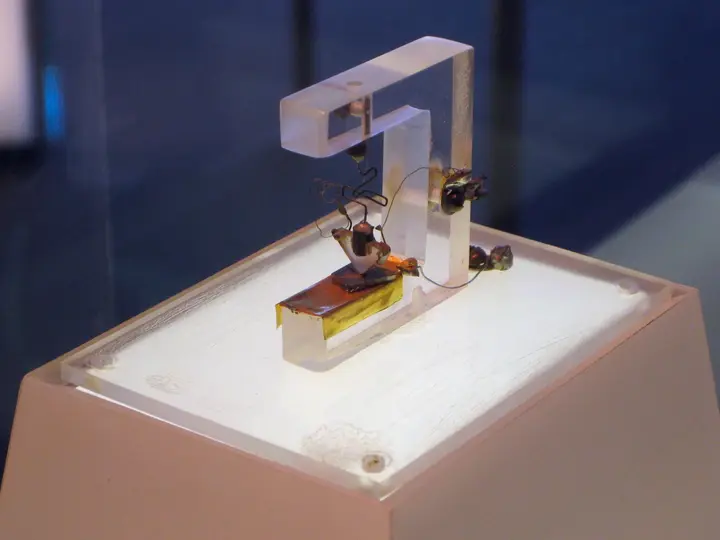
- The Integrated CircuitJack Kilby put a whole circuit on one sliver of germanium, and Robert Noyce made it in silicon. Every computer since runs on it.208Btransistors in one GPU
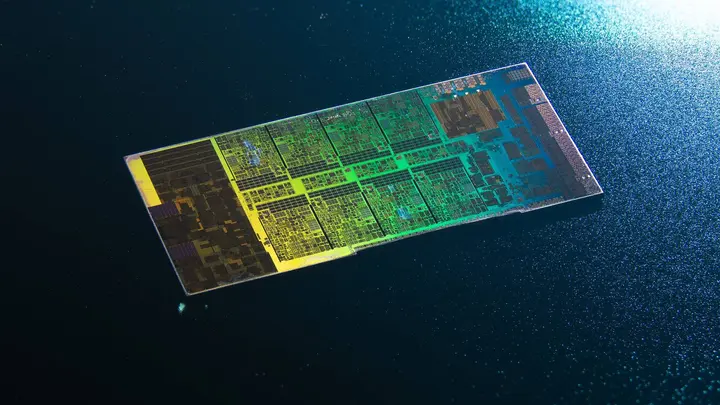
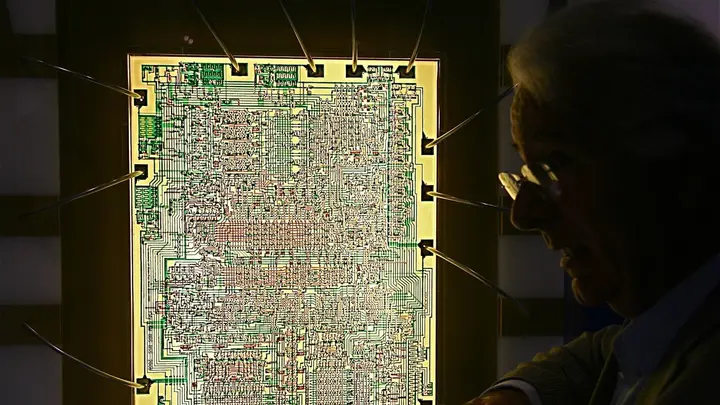
- The MicroprocessorIntel put a whole computer’s processor on one fingernail-sized chip. Every phone and computer since runs on a microprocessor.2,300transistors on one chip
- ARPANETUCLA tried to send “LOGIN” to SRI in Menlo Park. Two letters got through. That was the start of the internet.“LO”first message


Free, with no ads. Support the museum →