Belleau Wood, France · 6 June 1918 · 4th Marine Brigade, 2nd Division
Retreat? Hell, We Just Got Here
The French were falling back and the Germans were on the road to Paris. The Marines refused to budge, then spent 26 days taking a French hunting wood away from the German Army.

The moment · 17:00 · 6 June 1918
Two Marine battalions step off into open wheat in long, straight lines. Halfway across, the German machine guns open up. Major Berry is hit. The Marines keep coming. Sibley’s men reach the trees and fight hand to hand.
Come on, you sons-o’-bitches! Do you want to live forever?Attributed to First Sgt. Dan Daly
In the spring of 1918 Germany threw everything it had at the Western Front, racing to win the war before the Americans arrived in strength. By June its armies were on the Marne, about 50 miles from Paris, and the French line was giving way. Into the gap marched the 4th Marine Brigade of the Army’s 2nd Division.
The road to Paris
Nearly 4,000 German guns open fire along the Chemin des Dames. By 10:00 the German vanguard stands on the Aisne, and by the end of the day it has driven twelve miles. On the last day of May the Germans are on the Marne at Château-Thierry, headed for Paris. Hundreds of thousands of Parisians pack up and leave, and the French government makes plans to follow them.
Into the gap
The 2nd Division is in reserve northwest of Paris when the call comes. Its 4th Marine Brigade, under Army Brig. Gen. James Harbord, is the 5th Marines, the 6th Marines and the 6th Machine Gun Battalion. The Marines ride trucks through the night, some of them 36 hours without food, then march into line across the Paris–Metz road near Lucy-le-Bocage. The orders: no retirement on any pretext whatsoever.
We just got here
French troops fall back through the Marine line. A French major tells Capt. Corbin of the 51st Company that the Americans should withdraw too. Corbin passes it to his company commander, Capt. Lloyd Williams. Williams answers, “Retreat? Hell, we just got here!” German infantry comes on through the wheat. Marine riflemen, trained to aim at single targets, start hitting them at 800 yards. The drive on Paris stalls and never gets going again.
Hill 142
Ordered to seize better ground, the 1st Battalion, 5th Marines attacks Hill 142 without an artillery barrage, counting on surprise. By 07:00 the hill is theirs, at a cost of about 400 men. On the north slope, Gunnery Sgt. Ernest Janson sees twelve Germans with five light machine guns crawling toward his position. He shouts a warning, charges, bayonets the two leaders and sends the rest running. They leave their guns behind.
The wheat field
Harbord sends two battalions at the wood itself: Maj. Benjamin Berry’s 3rd Battalion, 5th Marines and Maj. Berton Sibley’s 3rd Battalion, 6th Marines. Berry’s men cross the open wheat in long, straight lines, and halfway over the German machine guns open up. Berry is hit. Sibley’s Marines reach the trees and fight hand to hand. By nightfall the brigade has 1,087 casualties, the costliest day in the Corps’ history to that point. It also has a foothold in the wood.
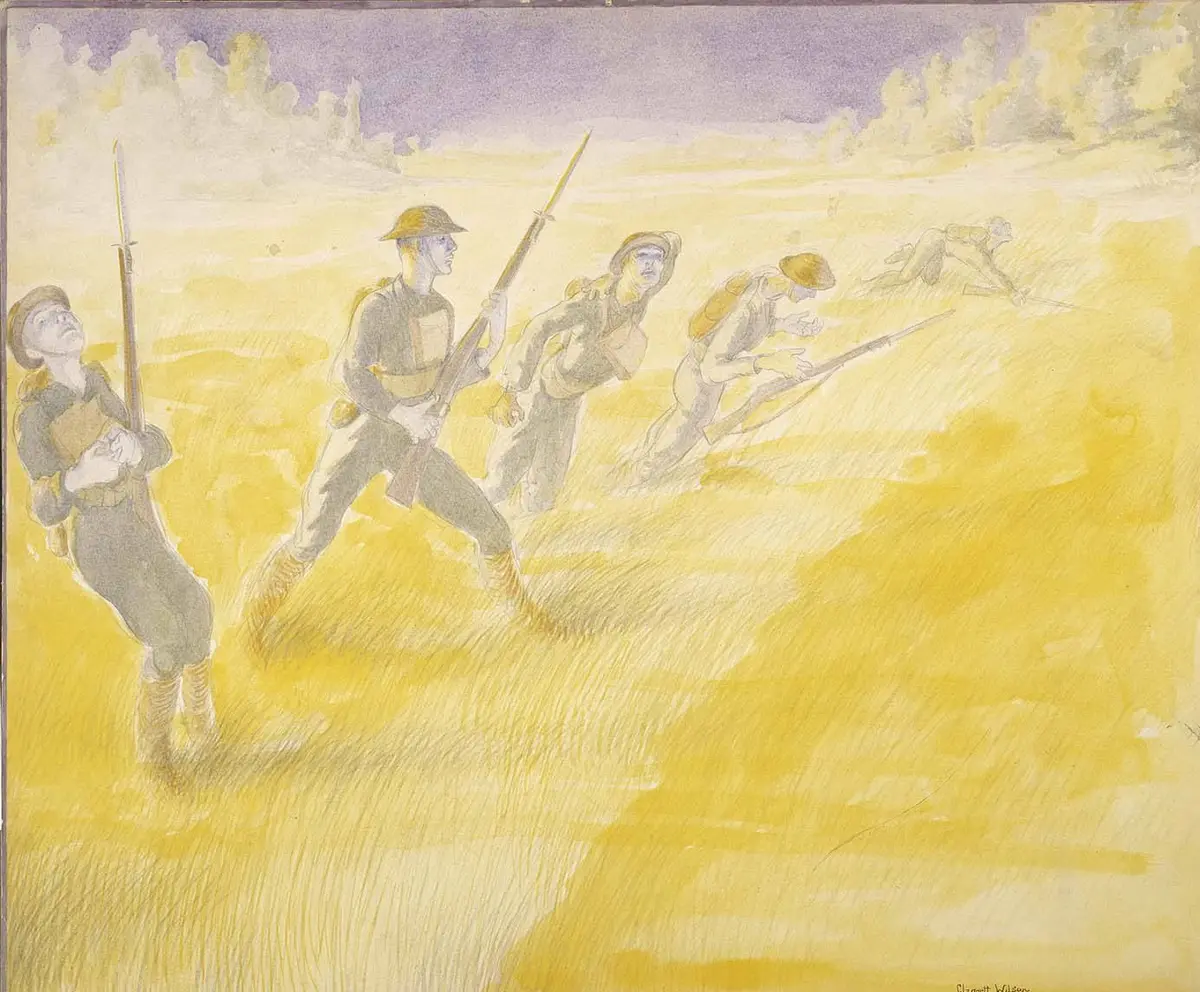
First Attack on the Bois de Belleau, June 6, 1918, at Five O'Clock: 3rd Battalion, 5th Marines advancing. Watercolor by Claggett Wilson, a Marine lieutenant who fought in the wood. Claggett Wilson / Smithsonian American Art Museum (1981.163.10). Reported by correspondent Floyd Gibbons; Marine tradition credits First Sgt. Dan DalyCome on, you sons-o’-bitches! Do you want to live forever?
Bouresches
On the right, the 96th Company of the 2nd Battalion, 6th Marines crosses the wheat toward the village of Bouresches. A machine-gun bullet strikes Lt. Clifton Cates’s helmet and knocks him out cold. He comes to, gets up and leads what is left of the company into town. They clear it, and 21 Marines remain to hold it. Lt. Moore and Sgt. Maj. John Quick drive an ammunition truck down a shell-swept road to keep them firing.
They fight like devils
Since the morning of 9 June, American guns have poured 34,000 shells into the wood. At 04:30 on 10 June the Marines go in behind a rolling barrage. First Sgt. Dan Daly charges a German machine-gun nest alone and takes it with grenades and his pistol. On 11 June Capt. Williams falls wounded, and Navy Lt. Orlando Petty carries him through the shellfire. A German lieutenant writes in his journal: “They fight like devils.”
The grind
On 13 June German gunners drench the wood with mustard gas, and two Marine companies evacuate 160 gas casualties. Gunnery Sgt. Fred Stockham pulls off his own mask and gives it to a wounded Marine. The gas kills him a week later, and he is awarded the Medal of Honor. The Army’s 7th Infantry relieves the worn-out battalions and attacks the north end. The Germans hold, and Maj. Maurice Shearer’s 3rd Battalion, 5th Marines takes the line back.
Entirely
From 03:00 to 17:00 on 25 June the guns pound the northern end of the wood. Then Shearer’s battalion goes in, loaded down with grenades. The barrage has wrecked the German machine-gun nests, and the defenders begin to give way. At 23:00 Shearer reports the wood practically taken. By 07:00 on 26 June the last corner is clear, and his battalion has taken about 300 prisoners. Shearer sends Harbord one line.
Maj. Maurice Shearer to Brig. Gen. James Harbord, 26 June 1918Woods now U.S. Marine Corps entirely.
The Marines

Virginia Tech class of 1907, commissioned a Marine in 1909. Told by the French to fall back, he refused. Wounded leading his men in the wood on 11 June, he died the next day and was promoted to major.

Earned the Medal of Honor at Peking in 1900 and again in Haiti in 1915. At Belleau Wood he put out a burning ammunition dump, took a German machine gun alone and carried in wounded under fire.

Served nearly ten years in the Army before joining the Marines in 1910, and fought in France as Charles F. Hoffman. Charged twelve Germans on Hill 142 and drove them off. Awarded both the Army and Navy Medals of Honor.

Enlisted as an Army private in 1889 and rose to be Pershing’s chief of staff. In May 1918 he took command of the Marine Brigade. In July he led the whole 2nd Division into the attack at Soissons.
By the numbers
In pictures


Watch, listen, see
Films, photographs and first-hand accounts from across the web. Each opens in a new tab.

The museum’s short film of the 6 June 1918 assault, made for its World War I gallery.
National Museum of the Marine Corps · LionHeart FilmWorks
The Corps’ own short history of the battle, released on its 100th anniversary.
U.S. Marine Corps · DVIDS
Nearly 200 photos and 19 videos from the centennial: ceremonies, battlefield walks and the men honored.
DVIDS
ABMC’s trail map of the wood: the wheat field, German gun pits, foxholes and the Marine Monument.
American Battle Monuments Commission
The Chicago Tribune correspondent’s eyewitness account of the wheat field, where he was hit three times.
Floyd Gibbons, 1918 · Project GutenbergThe brigade commander’s own diary of June 1918, kept at his farmhouse headquarters behind the line.
Internet Archive
Headquarters Marine Corps’ history of the war, with Shearer’s message and the French order renaming the wood.
U.S. Marine Corps · Internet Archive
Letters from Joel T. Boone, a Navy surgeon who treated Marines through the whole battle.
Library of Congress“I cannot write of their splendid gallantry without tears coming to my eyes. There has never been anything better in the world.”
Brig. Gen. James G. Harbord, commanding the 4th Marine Brigade, war diary, 17 June 1918
After
On 30 June 1918 Gen. Jean Degoutte, commanding the French Sixth Army, ordered that in all official papers the Bois de Belleau would be called the Bois de la Brigade de Marine. France cited the brigade, both regiments and the 6th Machine Gun Battalion in army orders. More citations followed at Soissons and Blanc Mont, and Marines of the 5th and 6th Regiments still wear the French fourragère on their left shoulder.
Belleau Wood made the Marines famous at home. The nickname Devil Dogs, said to be what the Germans called them, is a legend. No German record uses it, and an American newspaper printed the story in April 1918, before the battle. The Marines kept the name anyway. The 2nd Battalion, 5th Marines took Williams’s words for its motto: Retreat Hell.
Four officers who fought in the wood went on to be Commandant: Wendell Neville, Thomas Holcomb, Clifton Cates and Lemuel Shepherd. Today 2,289 Americans rest in Aisne-Marne American Cemetery at the foot of the wood. Above them, Felix de Weldon’s bronze Marine charges forward with fixed bayonet, dedicated in 1955.
Primary sources
- The United States Marine Corps in the World War. Maj. Edwin N. McClellan, Historical Section, Headquarters U.S. Marine Corps, 1920.
- Keystone Battle Brief: The Battle of Belleau Wood, 1–26 June 1918. Mark R. Folse, Marine Corps History Division (archived copy).
- Leaves from a War Diary. Maj. Gen. James G. Harbord, U.S. Army, 1925.