Midway Atoll, Central Pacific · 4 June 1942 · Task Forces 16 and 17
A Glorious Page in Our History
Six months after Pearl Harbor, Navy codebreakers named the target, and American dive bombers sank the four carriers that had attacked Hawaii.

The moment · About 10:20 · 4 June 1942
Three squadrons of Dauntlesses come out of the clouds together. The Zeros are down low, chasing torpedo planes. Dick Best pulls out of a crowded dive and takes Akagi. Max Leslie’s squadron takes Soryu. Bombs burst among fueled planes in the hangars. In five minutes, three carriers are burning.
For six months Japan’s carrier striking force ran wild, from Pearl Harbor to the Indian Ocean. In June 1942 Admiral Yamamoto aimed it at Midway, an atoll 1,100 miles from Pearl Harbor, to draw out and destroy what was left of the Pacific Fleet. Admiral Nimitz had three carriers against four. He also had codebreakers who knew the plan.
AF is short of water
In a basement at Pearl Harbor, Cmdr. Joseph Rochefort’s codebreakers are reading pieces of the Japanese navy’s main code. The messages point to a target called AF. Rochefort is sure it is Midway. To prove it, Midway sends a fake message in the clear saying its water plant has broken down. Soon an intercepted Japanese message reports that AF is short of water. Hypo then predicts the attack will come on 4 June.
Three days
Yorktown limps into Pearl Harbor from the Coral Sea with a bomb hole through her decks and a leaking hull. The experts say she needs three months in a yard. Nimitz tells them he must have her back in three days. Some 1,400 yard workers swarm aboard and work around the clock. On 30 May she sails for a patch of ocean northeast of Midway the planners call Point Luck.
Contact
A PBY Catalina from Midway flown by Lt. Howard Ady sights Japanese ships northwest of the atoll. Minutes later Lt. William Chase spots the inbound strike, 108 planes. Marine fighters climb to meet them and are badly outclassed, but they and Midway’s gunners hit nearly half the raid. At 07:00 Rear Adm. Raymond Spruance begins launching full strikes from Enterprise and Hornet at near-maximum range.
Lt. William Chase’s PBY to MidwayMany planes heading Midway from 320 degrees distant 150 miles!
Torpedo Eight
Lt. Cmdr. John Waldron leads the fifteen Devastators of Hornet’s Torpedo Squadron 8 straight to the enemy, with no fighter cover. About 30 Zeros fall on them. Not one pilot turns away. All fifteen planes go down. Ens. George Gay drops his torpedo at Soryu, flies over her deck and is shot into the sea, the squadron’s only survivor. Torpedo Six and Torpedo Three attack next, with the same courage and the same result.
Waldron’s attack plan for Torpedo EightIf there is only one plane left to make a final run-in, I want that man to go in and get a hit.
The lone destroyer
Lt. Cmdr. Wade McClusky has led Enterprise’s 33 dive bombers to the spot where the Japanese should be, and found empty ocean. Fuel is running low. He keeps searching. Below him he spots a single Japanese destroyer, Arashi, racing northeast at high speed after hunting an American submarine. McClusky guesses she is rejoining the fleet and follows her wake.
Five minutes
McClusky’s bombers arrive over Kaga and Akagi just as Yorktown’s Bombing Three, under Lt. Cmdr. Max Leslie, arrives over Soryu. The torpedo attacks have pulled the Zeros down to the wave tops. Kaga takes at least four bombs. Lt. Dick Best sees both squadrons diving on her, pulls out with two wingmen and puts his bomb into Akagi’s hangar. Soryu takes three hits. In five minutes, three carriers are wrecks.
Yorktown hit
The fourth carrier, Hiryu, strikes back. Her dive bombers put three bombs into Yorktown around noon. Her damage control crews put out the fires, relight the boilers and get her back up to 20 knots. Hiryu’s torpedo planes come next and put two torpedoes into her port side. Listing hard and without power, Yorktown is abandoned. Her planes fly on from Enterprise.
The fourth carrier
A Yorktown scout has found Hiryu. Enterprise launches about two dozen dive bombers, her own and Yorktown’s survivors, led by Lt. Earl Gallaher. They find Hiryu preparing one last strike. Zeros chase them into their dives. Four bombs smash her forward flight deck, and one of them is Dick Best’s. It is his second carrier of the day. Hiryu burns through the night and sinks the next morning.
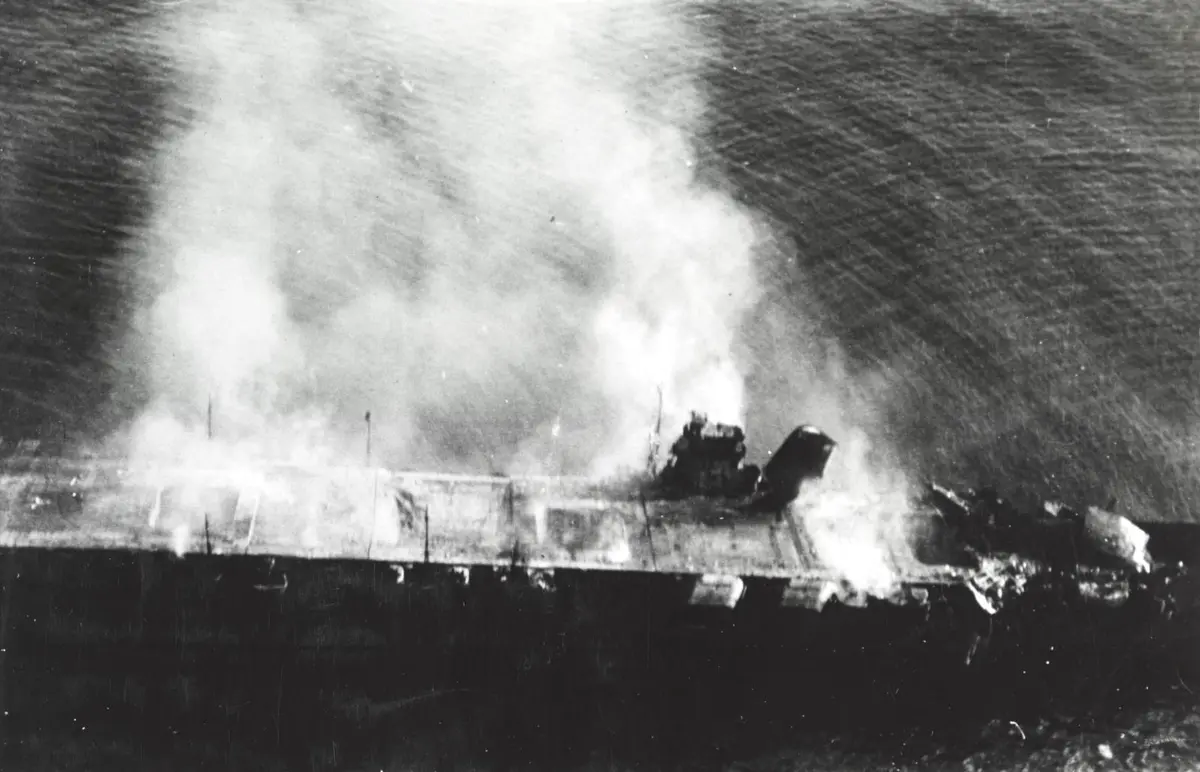
The Japanese carrier Hiryu burning at sunrise on 5 June 1942, her forward elevator thrown upright by the explosions in her hangar (NH 73064).. Ens. Kiyoshi Oniwa, Imperial Japanese Navy / Naval History and Heritage Command. Her battle flags flying
Spruance pursues west. On 6 June dive bombers from Enterprise and Hornet sink the heavy cruiser Mikuma. A salvage crew has Yorktown under tow when the submarine I-168 slips through the screen and torpedoes her and the destroyer Hammann, which sinks in minutes. Yorktown stays afloat through one more night. At dawn on 7 June she rolls over and goes down with her battle flags flying.

The men

Enlisted in 1917 and earned his commission without Annapolis. Studied Japanese for three years in Japan. His codebreakers read enough of the Japanese navy’s code to tell Nimitz where the enemy would strike and when.

Texan and career submariner who took command of a shattered fleet on 31 December 1941. He trusted his codebreakers, rushed Yorktown back to sea, and sent three carriers to ambush four under the principle of calculated risk.

Naval Academy 1926 and a fighter pilot for most of his career. With fuel low and no enemy in sight, he followed a lone destroyer to the Japanese carriers. Wounded by a Zero on the way out, he landed back aboard Enterprise.

Naval Academy 1932 and the commander of Bombing Six. He hit Akagi in the morning and Hiryu in the evening, two carriers in one day. Fumes from a faulty oxygen system wrecked his lungs and ended his flying.
By the numbers
In pictures


Watch, listen, see
Films, photographs and first-hand accounts from across the web. Each opens in a new tab.

An hour-long documentary in which Midway veterans tell the story of the battle in their own words.
U.S. Department of Defense
Ford’s 1942 color memorial film of Waldron’s squadron aboard Hornet, made for the families of the fallen.
USS Hornet Museum
Navy historians walk through the decisions and attacks that turned the battle, with wartime footage.
Naval History and Heritage Command
An Enterprise dive bomber pilot recounts finding the Japanese carriers and his hits on Kaga and Hiryu.
The National WWII Museum
How John Ford filmed the battle under fire and made a memorial to the airmen of VT-8.
U.S. National Archives
The Navy’s history director on Station Hypo, the torpedo squadrons and the dive bombers that won.
Naval History and Heritage Command
The Office of Naval Intelligence’s confidential account of the battle, written for the fleet’s officers.
Naval History and Heritage Command
The Navy’s official photo collection of the battle, from Midway’s defenders to Yorktown’s last hours.
Naval History and Heritage Command“Pearl Harbor has now been partially avenged. Vengeance will not be complete until Japanese sea power has been reduced to impotence.”
Admiral Chester W. Nimitz, Pacific Fleet communiqué, June 1942
After
Midway cost 307 American lives, most of them airmen. Marine Capt. Richard Fleming, who pressed his attack on Mikuma until his plane went into the sea, received the Medal of Honor. About 170 Navy Crosses followed, many of them posthumous, and Torpedo Squadron Eight received the Presidential Unit Citation.
Japan lost four fleet carriers, a heavy cruiser, 248 carrier planes and more than 3,000 men. All four carriers had attacked Pearl Harbor. Two months later, on 7 August 1942, U.S. Marines landed on Guadalcanal, and America went on the offensive in the Pacific for good.
Joe Rochefort received no medal during the war. On 30 May 1986, President Reagan presented his posthumous Distinguished Service Medal to his son and daughter at the White House.
Primary sources
- H-Gram 006 and attachments H-006-1 to H-006-4: The Battle of Midway. Naval History and Heritage Command.
- Battle of Midway: 3–6 June 1942 Combat Narrative. Office of Naval Intelligence; reprinted by the Naval History and Heritage Command, 2017.
- Yorktown III (CV-5). Dictionary of American Naval Fighting Ships, Naval History and Heritage Command.