Chosin Reservoir, North Korea · 27 November 1950 · 1st Marine Division
Attacking in a New Direction
Twelve Chinese divisions surrounded them in the frozen mountains of North Korea. The 1st Marine Division turned and fought its way 78 miles to the sea, and brought its wounded out with it.

The moment · Hagaru-ri · December 1950
Twelve Chinese divisions hold the mountains around Hagaru-ri. The only way to the sea is one frozen road, and the nights fall to 25 below. The division will fight down it with its wounded. A British correspondent calls that a retreat. Smith corrects him.
Retreat, hell! We’re just attacking in a new direction.Maj. Gen. O.P. Smith, as the newspapers printed it
In November 1950 the 1st Marine Division pushed north into the mountains of North Korea on one narrow road, under orders to reach the Chinese border. Its commander, Maj. Gen. O.P. Smith, did not trust the quiet and prepared for the worst. On the night of 27 November, about 120,000 Chinese troops sprang a trap around the Chosin Reservoir. Smith’s answer was to attack, toward the sea.
The careful general
The division is ordered north toward the Yalu on a single mountain road. Smith slows down. He writes the Commandant that he does not like stringing out a Marine division along one road for 120 air miles. He stocks ammunition and rations at Hagaru-ri and puts his engineers to work around the clock, under floodlights, carving an airstrip out of the frozen ground.
The trap springs
The 5th and 7th Marines are at Yudam-ni, 14 miles past Hagaru-ri, and the temperature is falling to 20 below. At about 22:00 the Chinese 89th and 79th Divisions hit the ridges around the village with submachine guns, grenades and mortars. A third division, the 59th, swings south to cut the road behind them. Rifle companies lose hilltops and win some back hand to hand. At dawn the Marines still hold Yudam-ni.
Fox Hill
On Toktong Pass, between Yudam-ni and Hagaru-ri, Capt. William Barber’s Fox Company, 7th Marines, about 240 men, holds a hill. At 02:30 a Chinese regiment hits it. Pvt. Hector Cafferata, his fire team down around him and his boots lost in the dark, fights on alone, kills fifteen of the enemy and throws a live grenade out of a trench full of wounded Marines. Fox Company has 20 dead and 54 wounded by daylight. It does not move.
Task Force Faith
Across the reservoir, about 2,500 soldiers of the Army’s 31st Regimental Combat Team hold out against Chinese attacks for four days and nights. On 1 December Lt. Col. Don Faith leads them south with hundreds of wounded on the trucks, pistol in hand at the roadblocks, until a grenade kills him. He earns the Medal of Honor. Survivors walk across the ice to Hagaru-ri, and Marine Lt. Col. Olin Beall drives out onto the ice and brings in 319 more.
The airstrip
After twelve days of work, the Hagaru-ri strip is 2,900 feet long and only 40 percent finished, well short of what the manuals demand at 4,000 feet of altitude. Smith uses it anyway. At 14:30 the first Air Force C-47 touches down on the frozen snow and lifts off half an hour later with 24 wounded. In five days, transports fly out 4,312 Marines, soldiers and Royal Marines, and fly in 537 replacements.
The Ridgerunners
The two regiments come out of Yudam-ni with their wounded on the trucks. Only drivers and the badly hurt ride. Lt. Col. Ray Davis takes his 1st Battalion, 7th Marines, off the road and over the mountains at night, through knee-deep snow. Just before noon on 2 December they reach Fox Hill, held for five days and six nights. On the evening of 3 December, Davis’s battalion marches into Hagaru-ri singing the Marines’ Hymn.
A new direction
When a British correspondent at Hagaru-ri calls the move a retreat, Smith corrects him. A surrounded division has no rear, so it cannot retreat. It can only attack in a new direction. At 06:30 on 6 December the 7th Marines lead out for Koto-ri, 11 miles south. The Chinese hit the column all night. Artillerymen fire their howitzers point-blank and the division band mans machine guns. By 17:00 on 7 December the 7th Marines are in Koto-ri.
Smith’s answer, as the newspapers printed itRetreat, hell! We’re just attacking in a new direction.
Sixteen feet
Col. Chesty Puller’s 1st Marines have held Koto-ri since the trap closed. Three and a half miles south, the Chinese have blown the bridge over the power-plant penstocks, leaving a 16-foot gap between a cliff and a sheer drop. On 7 December Air Force C-119s parachute eight 2,500-pound Treadway bridge sections into Koto-ri. On 9 December engineers lay the span in about three hours, with two inches to spare for the tanks. Puller’s regiment comes down last.
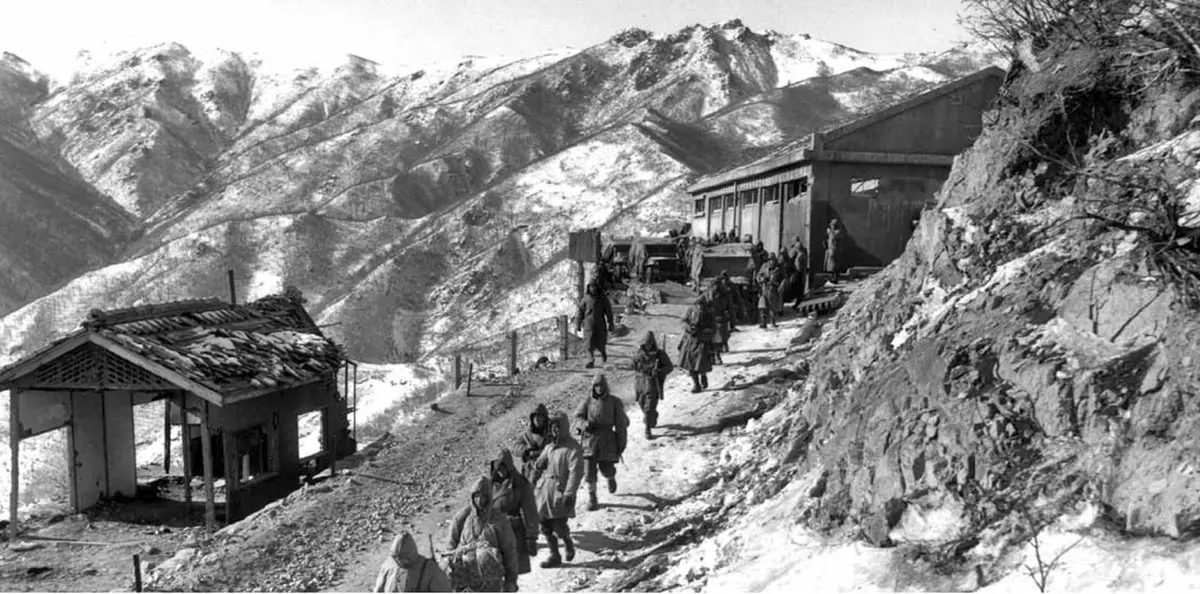
Marines march down Funchilin Pass past the gatehouse after the airdropped Treadway bridge went in, 9 December 1950 (A5408). Sgt. William R. Keating, USMC / Department of Defense. Col. Lewis B. “Chesty” Puller to his 1st Marines, December 1950Don’t you forget that you’re Marines — First Marines! Not all the communists in hell can overrun you!
To the sea
At 13:00 on 11 December the last units pass through Chinhung-ni. By 21:00 most of the division is in its assembly areas around Hamhung and Hungnam, where a tent camp and hot chow are waiting. On 13 December Smith joins his Marines at the division cemetery for a memorial service, with volleys and taps, then moves his command post aboard the transport Bayfield. She sails on 15 December.

The Marines

Texas-born, Berkeley-educated, known in the Corps as “the Professor.” He slowed the drive north, stockpiled supplies and built the Hagaru-ri airstrip despite pressure from above. He refused to fly out a single able-bodied man and brought his division out as a fighting unit.

Enlisted in 1918 and came to Korea already holding four Navy Crosses. His 1st Marines held Koto-ri, the last base on the plateau, while the division fought down to him, then came down Funchilin Pass last. Chosin earned him a fifth Navy Cross.

Kentucky-born, enlisted in 1940, trained as a paramarine and won the Silver Star on Iwo Jima. He took Fox Company three weeks before Toktong Pass. Shot in the leg on the second night, he held the pass for five days and six nights.

Georgia Tech chemical engineer who earned the Navy Cross at Peleliu. He led his battalion over the mountains at night to relieve Fox Company and open the road to Hagaru-ri. He later commanded the 3d Marine Division in Vietnam and retired a four-star general.
By the numbers
In pictures


Watch, listen, see
Films, photographs and first-hand accounts from across the web. Each opens in a new tab.

The Fox Company rifleman tells how he held his stretch of Toktong Pass and earned the Medal of Honor.
Congressional Medal of Honor SocietyThe commander of the Ridgerunners, interviewed for the Society’s living history archive.
Congressional Medal of Honor Society
A short film on the 17 days the Chosin Few fought through, told by men who were there.
U.S. Navy · DVIDS
Audio from the Rose Garden, 24 November 1952: Davis, Kennemore and Cafferata receive the Medal of Honor.
Harry S. Truman Library
The illustrated official history by Brig. Gen. Edwin Simmons, who fought at Hagaru-ri as a major.
Marine Corps History Division · Internet Archive
Photographs and history of the carrier air support over the reservoir and the sealift out of Hungnam.
Naval History and Heritage Command
The Army’s 31st Regimental Combat Team and its four-day stand on the east side of the reservoir.
Army Historical Foundation
Navy pilots over Chosin, Thomas Hudner’s Medal of Honor and the sealift that ended it.
Naval History and Heritage Command“The First Marine Division, Reinforced, emerged from its ordeal as a fighting unit with its wounded, with its guns and equipment and with its prisoners.”
Presidential Unit Citation, First Marine Division, Reinforced, Chosin Reservoir and Koto-ri, 27 November to 11 December 1950
After
On 20 August 1952, President Truman presented the Medal of Honor to William Barber at the White House. On 24 November he read the citations aloud in the Rose Garden and decorated Ray Davis, Hector Cafferata and Robert Kennemore. Seventeen men earned the medal in the campaign. One was Navy pilot Thomas Hudner, who crash-landed his Corsair in the snow to try to save his section leader, Ensign Jesse Brown, the Navy’s first Black aviator.
By Christmas Eve 1950 the Navy had lifted 105,000 troops, 17,500 vehicles and 91,000 Korean refugees out of Hungnam. The division received the Presidential Unit Citation. Decades later, the Navy added the Army’s Task Force Faith to it.
The men who fought there call themselves the Chosin Few. In 1991 the Navy commissioned a guided-missile cruiser in their honor, USS Chosin. Ray Davis rose to Assistant Commandant of the Marine Corps.
Primary sources
- Frozen Chosin: U.S. Marines at the Changjin Reservoir. Brig. Gen. Edwin H. Simmons, USMC (Ret.), Marine Corps Historical Center, 2002.
- U.S. Marine Operations in Korea 1950–1953, Vol. III: The Chosin Reservoir Campaign. Lynn Montross and Capt. Nicholas A. Canzona, USMC, Historical Branch, HQMC, 1957.
- Chosin Reservoir: Battle, Fighting Retreat, Evacuation, 27 November–24 December 1950. Naval History and Heritage Command.