East River, New York · 24 May 1883 · John, Washington and Emily Roebling
Courage Said, “It Shall Be!”
For fourteen years the Roeblings and their crews dug under the East River and spun steel wire over it. Then they opened the longest bridge on earth.

The moment · 25 August 1876
A single wire rope hangs between the towers, high over the East River. Master mechanic E. F. Farrington climbs into a boatswain’s chair hooked to it and rides out over open water. Thousands watch from both shores. He waves. He makes it across.
Before 1883 the only way between New York and Brooklyn, the first and third largest cities in America, was by boat. John A. Roebling drew a bridge high enough for sailing ships to pass under and long enough to cross the river in a single span. He died before work began. His son built it anyway. It took fourteen years.
The designer falls
John A. Roebling is standing on the Fulton Ferry slip, fixing the spot for the Brooklyn tower, when a docking ferry crushes his foot against the pilings. He is 63. Tetanus sets in, and he dies on 22 July. The trustees turn to his son. Washington Roebling is 32, a Civil War officer who helped his father build the record-setting span at Cincinnati.
The Brooklyn caisson
The foundation goes in first. It is a giant timber box, 168 feet long and 102 feet wide, open at the bottom. Tugs tow it down the river to the Brooklyn shore and sink it onto the riverbed. Inside, compressed air holds the river out while men called sandhogs dig away the mud and boulders. Masons stack stone on the roof, and the whole mass sinks as they dig.
Fire under the river
A worker’s candle sets the caisson’s timber roof smoldering. Washington Roebling goes down and fights the fire for hours, until he collapses and has to be carried out. Then he floods the caisson. Fireboats pump it full of river water and it stays drowned for days. The damage is repaired, and in March 1871 the Brooklyn caisson is filled with concrete at 44½ feet.
Stop at 78½ feet
The New York caisson goes deeper, and the air pressure grows with it. In the first five months of 1872 about 110 men come down with caisson disease, the bends, and three die. Bedrock is still far below. Roebling judges the packed sand and gravel at 78½ feet strong enough and stops digging. The tower still stands on it. The bends have wrecked his own health too.
Orders from the sickroom
Washington Roebling can no longer go to the river. He runs the job from his bed by letter and memo. His wife, Emily Warren Roebling, learns the mathematics, the strength of materials and the cable work. She carries his orders to the engineers and brings back their questions. In 1882 some trustees move to replace the crippled chief engineer. The vote fails, and Roebling stays.
The first rope
Both towers now stand. A scow pays a wire rope across the bottom of the river from tower to tower. The crews wait more than half an hour for a gap in the boat traffic. Then the signal comes, the steam engine hauls, and in four minutes the rope swings clear of the water to cheers from the wharves and the ferry boats.
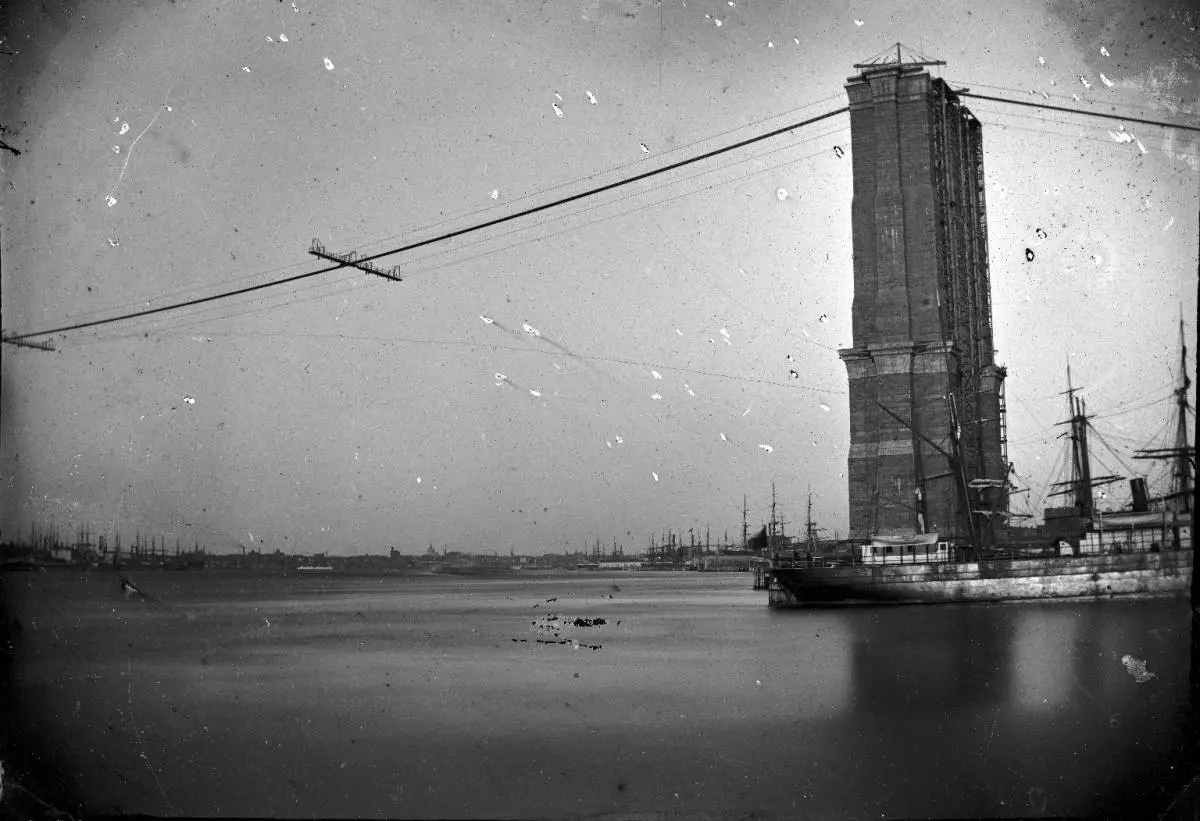
A finished tower and the first wire ropes strung over the East River, about 1876.. Unidentified photographer / Brooklyn Museum. Assistant engineer C. C. Martin, from the New York towerGo ahead!
Across on a wire
E. F. Farrington, the master mechanic who will build the cables, climbs into a boatswain’s chair hung from the new rope and is hauled across the East River, tower to tower, while thousands watch from both shores. He waves to them on the way. He goes first on purpose. He wants the riggers who will follow him to see his “entire confidence in the strength and security of the work.”
Spinning the cables
Wheels run back and forth over the river on the traveler ropes, each one laying a loop of steel wire. Riggers on a swaying footbridge set every wire in place. When contractor J. Lloyd Haigh is caught slipping rejected wire into the cables, Roebling orders 150 extra wires added to each one. The last wire crosses on 5 October 1878. Each cable holds 5,434 wires and 3,515 miles of steel.
Opening day
Business stops in both cities. President Chester A. Arthur and Governor Grover Cleveland walk across from the New York tower as warships in the river fire salutes and steam whistles roar on both shores. After the speeches they go to Washington Roebling’s house on Columbia Heights to honor the man who built it. That night fireworks burst over the river. At midnight the bridge opens to everyone.
Mayor Seth Low of Brooklyn, accepting the bridgeScience said, “It is possible,” and Courage said, “It shall be!”
The Roeblings

Prussian-born engineer who came to America in 1831, made wire rope in Pennsylvania and built the great suspension bridges at Niagara and Cincinnati. He designed the Brooklyn Bridge in 1867 and gave his life surveying its site.

Rensselaer-trained engineer who was among the first Union officers on Little Round Top at Gettysburg. Took charge at 32, fought the caisson fire himself, and finished the bridge from his sickroom after the bends crippled him.

Learned higher mathematics and bridge engineering so she could carry her husband’s orders to the job. For the rest of the build she was the link between the chief engineer and his men. Abram Hewitt honored her by name on opening day.
By the numbers
In pictures


Watch, listen, see
Films, photographs and first-hand accounts from across the web. Each opens in a new tab.

Ken Burns’s first film tells how the Roeblings and their crews built the bridge, from caisson to cable.
PBS
Thomas Edison’s camera rides a train from Brooklyn to New York between the great towers.
Library of Congress
John A. Roebling’s 1867 drawing of one tower, Gothic arches and all, for a 1,600-foot span.
National Archives
Washington Roebling’s report on the towers, with Farrington’s own account of hauling the first ropes across.
Internet Archive
The official 1883 record of opening day: the procession, the salutes and every speech.
Project Gutenberg
Dozens of large-format photographs of the towers, cables and anchorages, with the bridge’s vital statistics.
Library of CongressOriginal Roebling drawings and family portraits, including the Brooklyn caisson, at Washington Roebling’s alma mater.
Rensselaer Archives
The American Society of Civil Engineers on the bridge’s steel cables, granite towers and record span.
ASCE“The completed work, when constructed in accordance with my designs, will not only be the greatest bridge in existence, but it will be the greatest engineering work of the continent, and of the age.”
John A. Roebling, report to the New York Bridge Company, 1 September 1867
After
Washington Roebling missed the ceremonies, but the President came to his door. On 17 May 1884 P. T. Barnum marched 21 elephants across the bridge, led by Jumbo, to show everyone how solid it was.
The Roebling system of air-spun parallel steel wire became the standard for suspension bridges around the world, from the George Washington Bridge to the Golden Gate. A bronze plaque on the bridge honors all three Roeblings.
The bridge became a National Historic Landmark in 1964. More than 140 years after it opened, it still carries over 100,000 vehicles a day, and tens of thousands of people still walk Roebling’s promenade.
Primary sources