Fifth Avenue at 34th Street, New York · 1 May 1931 · Starrett Brothers & Eken
Four and a Half Stories a Week
In the first year of the Depression, New York tore down its grandest hotel and put the tallest building on earth in its place. It took 410 days.

The moment · 19 September 1930
Twenty-three weeks ago the first steel column went up. The steel has climbed four and a half stories a week ever since, once fourteen floors in ten working days. Now the frame tops out at 1,048 feet, twelve days early. The men run a flag up over the 86th floor.
In 1929 New York was racing to build the tallest building in the world, and Walter Chrysler was winning. Then Wall Street crashed. John J. Raskob and Al Smith kept going. They raised their target to 1,250 feet, put 3,400 men on the job, and built straight through the worst economy the country had ever seen. They finished early and under budget.
Biggest in the world
A new company, Empire State, Inc., buys the old Waldorf-Astoria on Fifth Avenue at 34th Street. The money comes from John J. Raskob, who ran the finances of General Motors and DuPont, and from Pierre and Coleman du Pont. The president is Al Smith, four times Governor of New York and the Democratic nominee for president the year before. Smith announces an 80-story tower, taller than anything standing.
Raskob to Smith, as a friend recalled itDon't worry, Al, I'm going to build a new skyscraper, biggest in the world, and you're going to be president of the company.
Down comes the Waldorf
Wreckers go to work on the Waldorf-Astoria, which opened in the 1890s as the largest hotel in the world, with 1,300 bedrooms. It was built to last, and it fights back. Much of its granite and bronze goes out on barges and is dumped in the Atlantic past Sandy Hook. On 24 October the stock market crashes. Raskob refuses to stop. In December Metropolitan Life lends $27.5 million, and the job goes on.
The race for the sky
Downtown, 40 Wall Street is rising to 927 feet. In October, Walter Chrysler's builders hoisted a 185-foot steel spire out of his tower and took it to 1,046 feet. The Empire State plans now stand at 1,050 feet. Raskob will not risk winning by four. Architect William F. Lamb crowns the tower with a mooring mast for airships, and the roof goes to 1,250 feet, the tallest building in the world by more than 200 feet.
Into the rock
Excavation starts before the last of the Waldorf is gone. Two shifts of 300 men each work twelve hours apiece, around the clock, digging the foundation 55 feet down. The steel was ordered while the upper floors were still being drawn: 57,480 tons, the largest single steel order ever placed. On 17 March, St. Patrick's Day, construction of the building itself begins, and the clock on 410 days starts. On 7 April the first steel column goes up.
Four and a half stories a week
Starrett Brothers & Eken run the site like a railroad, and on every floor there is one. Carts on narrow track carry eight times a wheelbarrow's load. Trucks drive into the building to unload, more than 200 a day, so Fifth Avenue stays clear. Lunch stands on five floors keep the men from riding down to eat. The frame climbs four and a half stories a week, and once rises fourteen floors in ten working days.
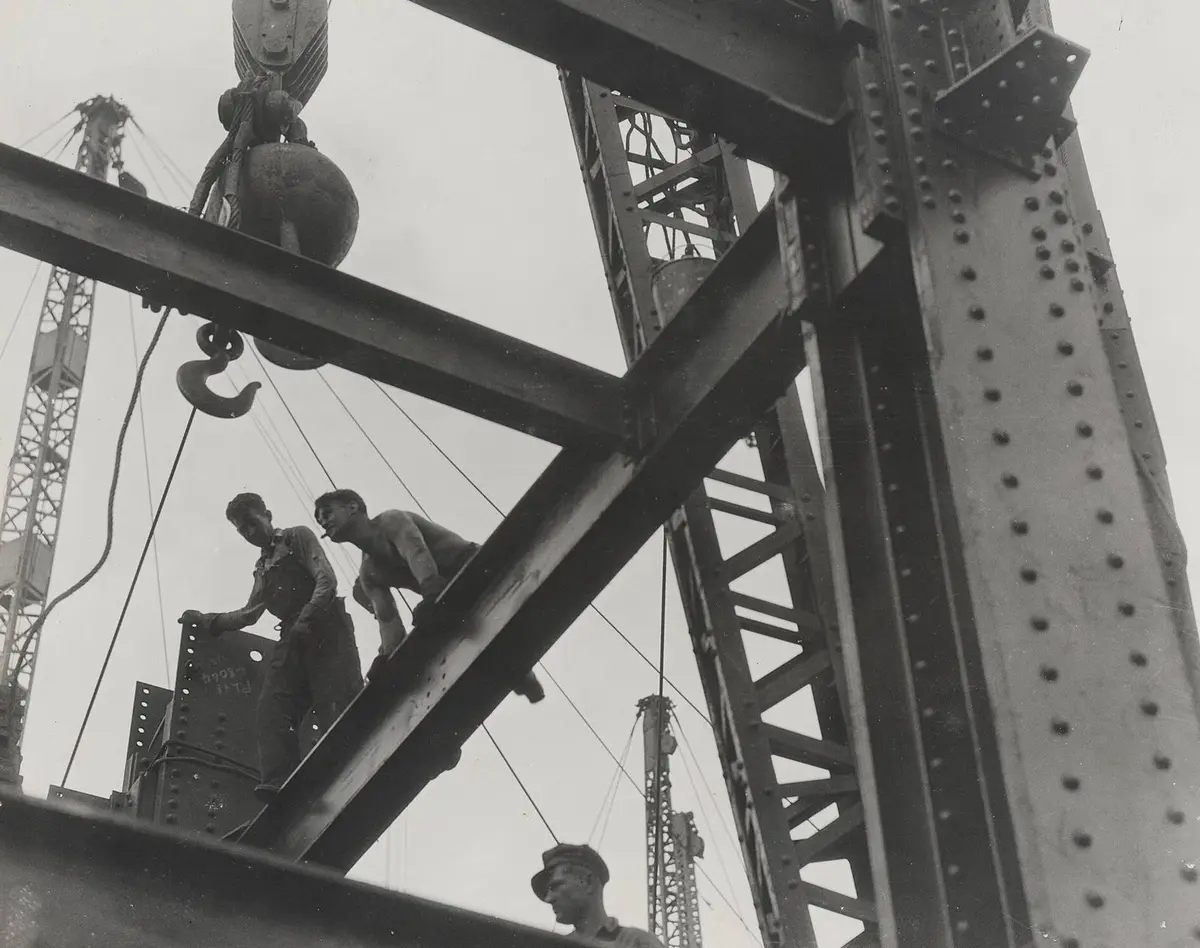
Ironworkers climb the steel frame of the Empire State Building beneath a derrick hook, 1930.. Lewis Hine / Preus Museum, Norway. The sky boys
3,439 men are on the job, the most on any single day. Many are Irish and Italian immigrants. Mohawk ironworkers from Kahnawake, near Montreal, walk the high steel. Lewis Hine, the building's official photographer, calls them sky boys. He climbs out on the beams beside them, and the company builds him a special cage so he can be swung out into the air over Fifth Avenue to get the shot.
Topped out
Twenty-three weeks after the first column, the steel frame tops out at 1,048 feet, twelve days ahead of schedule. The men raise a flag over the 86th floor. Indiana limestone, aluminum and 6,514 windows follow them up almost as fast. On 21 November the mooring mast is topped out. At 1,250 feet, the Empire State Building is now the tallest building in the world.
Lights on
On Fifth Avenue, Al Smith's two grandchildren cut the ribbon. In Washington, President Hoover presses a gold telegraph key in the White House, and the lights come on in New York. Governor Franklin Roosevelt and Mayor Jimmy Walker join more than 350 guests for lunch on the 86th floor. The building opens 410 days after the first steel went up, and ahead of schedule.
President Hoover to Al SmithI most cordially congratulate you and your associates upon the completion of the Empire State Building and the opening of its doors to the service of the public.
The builders

Born in 1873 on the Lower East Side, he watched the Brooklyn Bridge go up from his boyhood home. Never went to high school. Worked the Fulton Fish Market for $12 a week, then won four terms as Governor of New York. He was the building's face.

Cigar maker's son from Lockport, New York. Started as Pierre du Pont's secretary and rose to run the money at DuPont and General Motors. He sold his GM stock to pay for the building and pushed its height to 1,250 feet.

Kansas-born builder. In 1917 he chaired the Emergency Construction Committee that built the Army's training camps for more than a million soldiers. His firm took the Empire State from the Waldorf's demolition to opening day. He called skyscraper building “the nearest peacetime equivalent of war.”

Born in Oshkosh, Wisconsin, in 1874. His photographs of children in mills and mines helped win America's first child labor laws. In his mid-fifties he climbed the steel with the ironworkers and swung out over Fifth Avenue to show the country who built its tallest building.
By the numbers
In pictures


Watch, listen, see
Films, photographs and first-hand accounts from across the web. Each opens in a new tab.

Historian Carol Willis and engineer Donald Friedman show how the builders' own notebook explains the record pace.
The Skyscraper Museum
Author Glenn Kurtz puts names to the craftsmen in Lewis Hine's famous photographs of the building.
The Skyscraper Museum
Historian John Tauranac on the race for the sky and the men who planned and built the tower.
C-SPANPresident Hoover's congratulations to Al Smith, read aloud at the opening ceremonies on 1 May 1931.
The American Presidency Project
The city's 1981 history of the building, from the Waldorf site to Hine's photographs and the mooring mast.
NYC Landmarks Preservation Commission
Lewis Hine's photograph of a structural worker high over Midtown, with the Chrysler Building behind.
National Archives
A Hine print of ironworkers on the rising frame, from Norway's national museum of photography.
Preus Museum
The official history, from Raskob and Smith's 1929 venture to the observatories millions visit today.
Empire State Building“This achievement justifies pride of accomplishment in everyone who has had any part in its conception and construction and it must long remain one of the outstanding glories of a great city.”
President Herbert Hoover, message to Alfred E. Smith on the opening of the Empire State Building, 1 May 1931
After
The observation decks were a sensation. In the first year, sightseers paid the building about as much as its tenants did. Smith and Raskob kept the lights burning on empty floors through the Depression, and by the 1940s the offices were full.
The mooring mast never docked an airship. The winds around the tower were too strong, though one blimp did lower a bundle of newspapers to it. In 1950 a television antenna went up on top, and the mast became a broadcast tower for New York television.
It stood as the tallest building in the world until 1970. The American Society of Civil Engineers named it one of the Seven Modern Civil Engineering Wonders in 1955, and it became a National Historic Landmark in 1986. It still rises over Fifth Avenue: 102 stories, built in 410 days.
Primary sources
- Empire State Building Designation Report. New York City Landmarks Preservation Commission, 19 May 1981.
- Message on the Completion of the Empire State Building, President Herbert Hoover, 1 May 1931. The American Presidency Project.
- Building the Empire State. Carol Willis, ed. The Skyscraper Museum and W. W. Norton, 1998.