Braddock, Pennsylvania · 22 August 1875 · Edgar Thomson Steel Works
The Steel Age
A Scottish bobbin boy built the mills that made steel cheap. America passed Britain as the world’s steelmaker, and then he gave the fortune away.

The moment · 22 August 1875 · Edgar Thomson Works
Braddock’s Field, where a British army fell in 1755. Captain Bill Jones is in command. Air roars up through six tons of molten iron, and flame and sparks pour from the converter’s mouth. The first heat of steel is done, bound for 2,000 Pennsylvania Railroad rails.
In 1872 Andrew Carnegie watched the Bessemer process turn molten iron into steel with a blast of air. On sharp curves near Pittsburgh, iron rails wore out in six weeks. He bet everything on steel, built a new kind of mill at Braddock, Pennsylvania, and cut its costs year after year for a quarter century. Steel got cheap, and America was built of it.
A dollar twenty a week
The Carnegies borrow £20, sail from Dunfermline, Scotland, and settle across the river from Pittsburgh. Andrew’s first job is bobbin boy in a cotton mill at $1.20 a week, dawn to dark. Then telegraph messenger at $2.50 a week, then operator. In 1853 Thomas Scott of the Pennsylvania Railroad hires him at $35 a month. He later wrote that none of his millions gave him the happiness of that first week’s pay.
Iron gives way to steel
Carnegie sees the Bessemer process at work in Britain and makes up his mind. “The Iron Age would pass away and the Steel Age take its place,” he wrote. On 1 January 1873 he and his partners organize a steel-rail company. He picks the site, Braddock’s Field on the Monongahela, served by two railroads and the river, and names the works for his friend J. Edgar Thomson, president of the Pennsylvania Railroad.
Building through the panic
Alexander Holley, the country’s leading Bessemer engineer, designs the mill around the railroad tracks so material flows straight through. Digging the foundations turns up bayonets and swords from Braddock’s defeat of 1755. In September 1873 the bank of Jay Cooke & Co. fails and a national panic follows. Carnegie keeps building. Bill Jones comes over from the Cambria works at Johnstown, and about 200 skilled men follow him.
The first blow
With Captain Jones in command, the first of Holley’s twin six-ton converters is charged with molten iron. Air is driven up through the bath, burning out the carbon in a roaring column of flame and sparks. The first heat of Bessemer steel pours into ingot molds. It is the start of an order for 2,000 steel rails for the Pennsylvania Railroad.
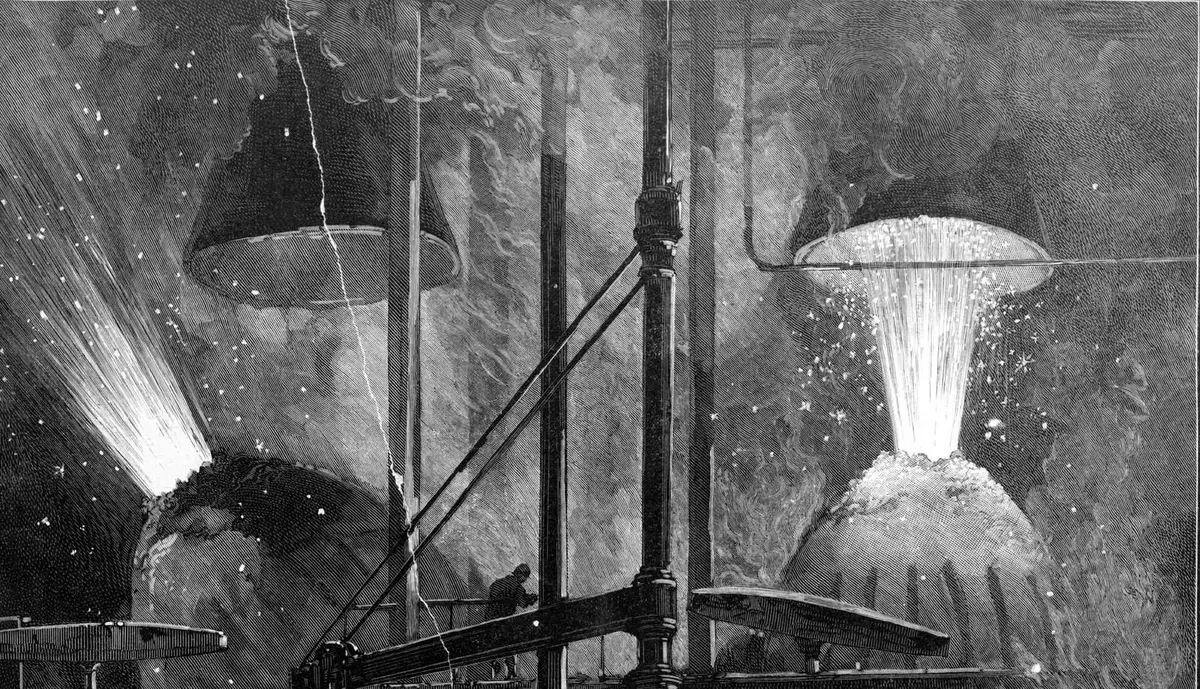
Bessemer converters blow at a Pittsburgh steel works, drawn by Charles Graham for Harper’s Weekly, 10 April 1886.. Charles Graham, Harper’s Weekly / Library of Congress. Profit from the first month
The first rail is rolled on 1 September. Steel rails sell for about $70 a ton, and Carnegie’s agents take orders across the country before rivals believe the mill is running. The works turns out just over 1,200 tons of rails that month and clears $11,000. By 1880 a single year’s profit, $1,625,000, is more than the entire mill had cost to build.
The Captain
Jones drives the works to records his rivals cannot match, and his patents pay for years. His mixer, a brick vessel holding 100 tons of molten iron, evens out the iron going to the converters and keeps them blowing without a stop. Carnegie offers him a partnership worth millions. Jones turns it down and asks for a salary instead.
Jones and Carnegie“Just give me a h--l of a salary if you think I’m worth it.” “All right, Captain, the salary of the President of the United States is yours.”
Coke, ore and boats
In 1882 Carnegie buys half of Henry Clay Frick’s coke company, the best fuel in the Connellsville field. In 1896 he leases Mesabi iron ore in Minnesota, and in 1897 his own railroad starts hauling it from Lake Erie at Conneaut to Pittsburgh. Ore is mined, railed, shipped and railed again, coal is turned to coke, and still the steel sells, in Carnegie’s words, at three pounds for two cents.
A library for the mill town
Carnegie gives Braddock a library, the first Carnegie library to open in the United States. That June he publishes the essay that becomes “The Gospel of Wealth.” A rich man should spend his life giving his money away, he argues, and “the man who dies thus rich dies disgraced.” By 1890 American mills are making more steel than Britain’s, and Carnegie owns a large share of it.
Morgan meets the price
At a dinner of 80 business leaders at the University Club, Charles Schwab speaks for 90 minutes without notes on what one great steel company could do. J. P. Morgan sits beside him and takes him aside afterward. In 1901 Carnegie writes down his price, $480 million, and Schwab carries it to Morgan, who accepts. Carnegie Steel becomes the core of U.S. Steel, capitalized at $1.4 billion.
Carnegie, testifying to Congress, 1912“I gave my memorandum and Morgan saw it was eminently fair.”

The steelmakers

Born in Dunfermline, Scotland, he came to America in 1848 and went to work as a bobbin boy. Telegraph operator, railroad man, then ironmaker. He bet his fortune on Bessemer steel, cut costs for a quarter century, and then gave it away.

A machinist’s apprentice at ten, he enlisted as a private in 1862, fought at Fredericksburg and Chancellorsville, and came home a captain. He ran Edgar Thomson from its first blow, invented the Jones mixer and led Braddock men to the Johnstown flood rescue.

A farm boy from West Overton, Pennsylvania, he started a coke business in 1871 at 21 and made it the leader of the Connellsville field. Carnegie bought in in 1882. As chairman from 1889 he ran the company while its pig iron output tripled.

He started at Edgar Thomson as a teenage stake driver at a dollar a day, and Bill Jones trained him. He ran the works at 27 and Carnegie Steel at 35. At 39 he became the first president of U.S. Steel.
By the numbers
In pictures


Watch, listen, see
Films, photographs and first-hand accounts from across the web. Each opens in a new tab.

The full Biography episode on the immigrant’s son who built an empire in steel.
HISTORY
Steelworker families mark 150 years of steelmaking at Carnegie’s first steel mill in Braddock.
U.S. Steel
A rare tour inside the plant that made its first steel in August 1875 and still runs.
KDKA CBS News Pittsburgh
Inside the Braddock library Carnegie gave his first mill town in 1889, still open today.
NEXTpittsburgh
The Historic American Engineering Record’s photographs and history of Carnegie’s first steel mill.
Library of Congress (HAER)The Autobiography of Andrew Carnegie, from bobbin boy to steelmaker to giver. Free to read.
Project Gutenberg
Carnegie’s 1889 essay arguing the rich should give their fortunes away while they live.
Andrew Carnegie Foundation
Carnegie’s biographer traces his rise from poverty to the top of American steel.
C-SPAN“The old nations of the earth creep on at a snail’s pace; the Republic thunders past with the rush of the express.”
Andrew Carnegie, Triumphant Democracy, 1886
After
Carnegie’s first act after the sale, on 12 March 1901, was a gift of $4 million in bonds for the men of his mills. Then he gave the rest away: 2,509 libraries, nearly 1,700 of them in American towns, Carnegie Hall, the Carnegie Technical Schools that became Carnegie Mellon University, and the Carnegie Corporation of New York. By his death in 1919 he had given away $350 million.
U.S. Steel began life as the largest company in the world. Charles Schwab went on to build Bethlehem Steel into America’s second-largest steelmaker. Henry Clay Frick left his New York mansion and its paintings to the public as the Frick Collection.
The Edgar Thomson Works still makes steel at Braddock. In 2025 it marked 150 years. The library Carnegie gave its town in 1889 is still open.
Primary sources