Promontory Summit, Utah · 10 May 1869 · Central Pacific and Union Pacific
Done
Chinese crews blasted through the Sierra. Union veterans raced across the plains. On a Utah summit in May 1869 the two lines met, and one telegraph word told the nation.

The moment · 12:47 p.m. · 10 May 1869
Two engines stand nose to nose across the last gap. The nation waits on the wire. Stanford swings at the final iron spike and misses. Durant swings and misses. The telegrapher doesn’t wait. He taps one word, and the celebrations begin.
DONE.W.N. Shilling, telegrapher
In 1862 the country was at war with itself, and the trip to California took months by wagon or by sea. President Lincoln signed a law to tie the coasts together by rail. One company would build east from Sacramento over the Sierra Nevada. Another would build west from Omaha across the plains and the Rockies. Six years after the first shovel, they met in the Utah desert.
Lincoln signs
The country is a year into the Civil War. Theodore Judah has spent the winter in Washington with his maps of the Sierra, working on the bill. President Lincoln signs the Pacific Railway Act. It charters the Union Pacific to build west from the Missouri River and lets the Central Pacific build east from Sacramento. For every mile of track, the government lends $16,000 to $48,000 in bonds, depending on the ground.
The first shovel
Leland Stanford, governor of California and president of the Central Pacific, turns the first shovel of earth in Sacramento. Every rail, spike and locomotive has to come from the East Coast by ship, around Cape Horn or across Panama. Judah does not live to see the climb he mapped. Sailing east by way of Panama that fall, he catches yellow fever and dies in New York on 2 November 1863. He is 37.
Four rails a minute
The Union Pacific lays its first rail at Omaha. With the war over, the Casement brothers fill their track gangs with Union Army veterans, most of them Irish immigrants. A horse-drawn car gallops rails to the front, and each gang drops one in under thirty seconds, four rails a minute. Ten spikes to a rail, three blows to a spike. In 1866 the Union Pacific builds 265 miles. In 1868 it builds 350.
Through the granite
The Central Pacific has to climb 7,000 feet in about 100 miles. Its crews, mostly Chinese by now, cut 15 tunnels through solid granite. At the 1,659-foot Summit Tunnel they work four faces at once, from both ends and outward from a shaft sunk in the middle, gaining under two feet a day. The winter of 1866–67 brings 44 storms and 40 feet of snow. On 3 April 1868 the first train steams into Truckee.
The race
Out of the mountains, the Central Pacific lays track flat out across Nevada. The Union Pacific crosses Sherman Summit at 8,247 feet, through a pass Grenville Dodge found in 1865, then drops down Echo and Weber Canyons. Both companies send graders hundreds of miles ahead of the track, and Mormon crews grade for both. On 10 April 1869 Congress settles it: the rails will meet at Promontory Summit, north of the Great Salt Lake.
Ten miles in a day
The Union Pacific once laid eight miles in a day. Charles Crocker means to beat it. At his signal, a line of about 1,000 men moves east toward Promontory: eight Irish rail handlers out front, backed by Chinese crews. By 1:30 p.m. they have six miles. By 7 p.m. they have laid 10 miles 56 feet of track, with Union Pacific men watching. Each of the eight handlers lifted about 125 tons of iron that day.
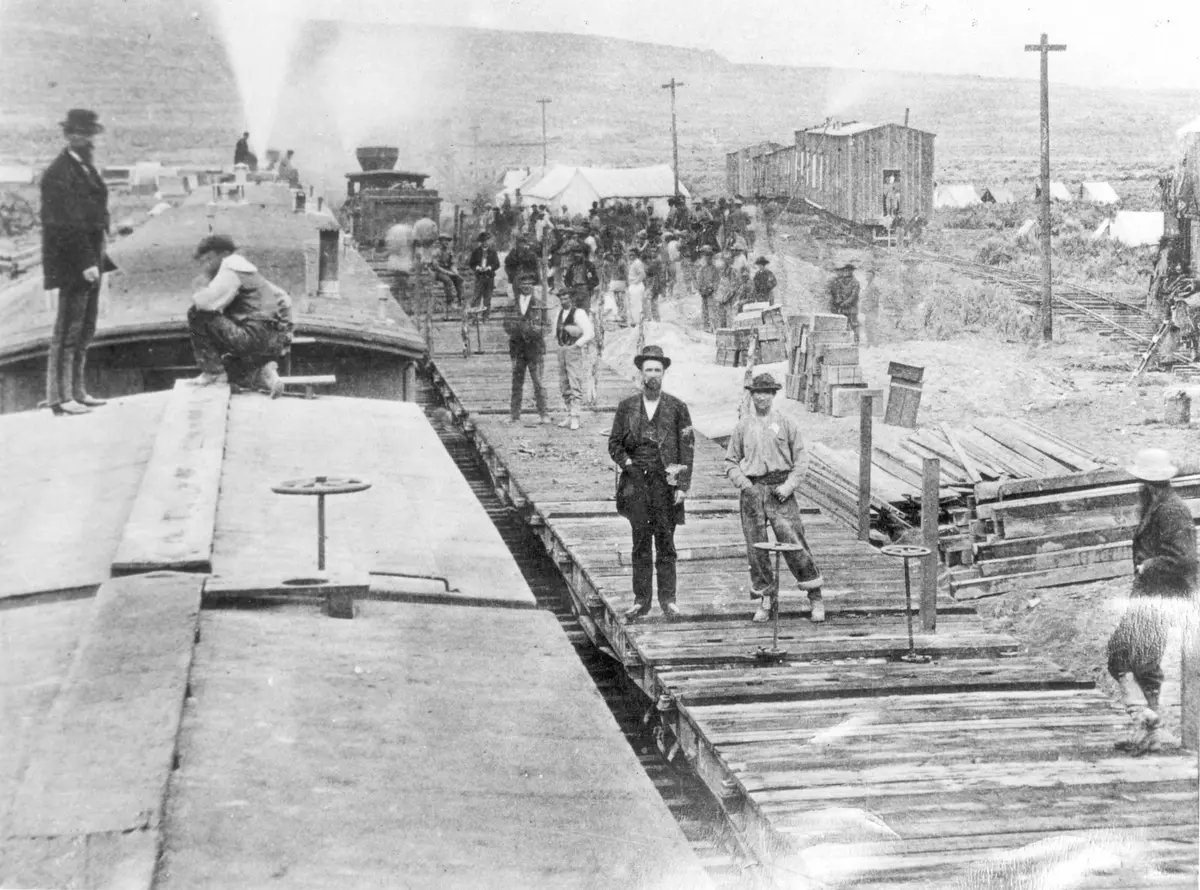
The Central Pacific camp near Victory, Utah, on 28 April 1869, the day its crews laid ten miles of track. Alfred A. Hart / University of Utah Marriott Library. Nose to nose
The sky is clear after two days of rain. Jupiter of the Central Pacific and No. 119 of the Union Pacific stand facing each other across the gap in the rails. A crowd of several hundred presses in, with soldiers of the 21st Infantry and two bands. Strobridge and the Union Pacific’s Samuel Reed set a polished laurel tie, bored to take the ceremonial spikes: two of gold, one of silver, one of iron, silver and gold.
One word
After a short prayer, telegrapher W.N. Shilling taps out to the waiting nation: “We have got done praying. The spike is about to be presented.” The precious spikes are set and tapped with a silver-plated sledge. Then comes an ordinary iron spike, wired to the telegraph like the sledge that will strike it. Stanford and the Union Pacific’s Thomas Durant both swing and miss. Shilling sends the signal anyway, and the celebrations begin.
Telegraph from Promontory SummitDONE.
Coast to coast
Strobridge and Reed drive the last spike home. Jupiter and No. 119 ease forward over the junction, men on the two engines reach across and shake hands, and a bottle of champagne breaks over the laurel tie. Jupiter backs away and No. 119 crosses the joint. Then No. 119 backs away and Jupiter crosses. The continent is open by rail. Shilling sends the report to the President.
Telegram to President GrantWe have the honor to report the last rail laid and the last spike driven. The Pacific Railroad is finished.

The builders

Connecticut-born engineer who built the first common carrier railroad west of the Mississippi. He found the route over Donner Pass, sold four Sacramento merchants on it and helped steer the Pacific Railway Act through Congress. Yellow fever killed him in 1863.

New York-born lawyer who came to California in the Gold Rush and became its governor in 1862. He turned the first shovel in Sacramento and swung at the last spike at Promontory. He and his wife Jane later founded Stanford University.

Norwich-trained engineer and Union major general, wounded at Pea Ridge and shot in the head at Atlanta. Escaping a war party in 1865, he found a pass over Wyoming’s Black Hills. From 1866 he located the Union Pacific’s line to Promontory.

Union colonel whose brigade held the center of the line at Franklin. Brevetted brigadier general in 1865. With his brother Dan he ran the Union Pacific’s track gangs from Nebraska to Promontory. His men called him General Jack.
By the numbers
In pictures


Watch, listen, see
Films, photographs and first-hand accounts from across the web. Each opens in a new tab.

Rangers and engineers at Golden Spike National Historical Park, where replicas of Jupiter and No. 119 run under steam.
PBS Utah
Margaret Yee, great-granddaughter of a railroad worker, on the Chinese crews who built the Central Pacific.
PBS Utah
Park ranger David Kilton at the spot where the Central Pacific and Union Pacific met in 1869.
C-SPAN American History TVUnion Pacific’s 2019 celebration at Ogden Union Station, the day before the 150th anniversary at Promontory.
Union Pacific
The law Lincoln signed on 1 July 1862, with images of the original and a full transcript.
National Archives
A guide to the digitized 1869 newspapers that covered the race to Promontory and the last spike.
Library of Congress
A digital exhibition with an interactive map and timeline, plus locomotives, tunnels, bridges and snow sheds.
Linda Hall Library
Andrew J. Russell’s album of 25 photographs along the Union Pacific line in Nebraska, Wyoming and Utah.
Yale University Library“May God continue the unity of our Country as this Railroad unites the two great Oceans of the world.”
Inscription on the Last Spike, presented by David Hewes, Promontory Summit, 10 May 1869
After
A trip from New York to San Francisco that had taken four months or more by wagon now took about a week by rail. San Francisco had started celebrating before the spike was driven and kept at it for three days. Across the country, cities held parades and set off fireworks.
David Hewes gave his gold spike to the Stanford Museum in 1892, and it belongs to Stanford’s Cantor Arts Center today. The laurel tie burned in the San Francisco earthquake and fire of 1906. Jupiter and No. 119 were scrapped in the early 1900s. Working replicas were finished in 1979, and they still meet nose to nose at Promontory.
Congress made the site Golden Spike National Historic Site in 1965 and a National Historical Park in 2019. On the 150th anniversary, 10 May 2019, thousands of people came to Promontory to honor the builders, and hundreds of Chinese Americans, many of them descendants of the Central Pacific crews, stood in a recreation of the famous champagne photograph.