Delaware River and Trenton · 25–26 December 1776 · Washington’s Continental Army
Victory or Death
Christmas night, 1776. The army was coming apart, the river was full of ice, and George Washington took 2,400 men across it anyway.

The moment · 03:00 · 26 December 1776
Ice has jammed the boats all night. Knox lands the last of 18 cannon three hours late. Trenton is nine miles off and the army will reach it in daylight. Turning back means being caught on the river. Washington gives the order to march.
I determined to push on at all Events.George Washington
By December 1776 the Continental Army had lost New York, retreated across New Jersey and shrunk to a few thousand worn-out men. Most of their enlistments ran out on New Year’s Eve. Across the Delaware, Hessian troops held Trenton for the winter. George Washington decided to strike first: at night, in a storm, across a river choked with ice.
The game is pretty near up
The army has been chased out of New York and across New Jersey. Washington has taken every boat for miles to the Pennsylvania shore, and the British have stopped at the river. He writes his brother that he has fewer than 3,000 men fit for duty against 10,000 or more. Most enlistments end on 31 December. Unless every nerve is strained to raise a new army, he writes, the game is pretty near up.
The times that try men’s souls
Thomas Paine marched with the troops on the retreat from Fort Lee as an aide to General Nathanael Greene. Now his essay The American Crisis appears in the Pennsylvania Journal. Its first line becomes the most famous sentence of the war. Tradition holds that Washington had it read aloud to the men in camp. The next day General John Sullivan marches in with 2,000 more troops.
The plan
The generals settle it. Three columns will cross on Christmas night. Washington’s main body will go over at McConkey’s Ferry, nine miles above Trenton, and hit the town at dawn. Two more columns are to cross downriver and block the roads south. The boats are brought down and hidden behind Taylor Island. Every man will carry 60 rounds and three days’ rations. Washington chooses the countersign.
Countersign for the crossingVictory or Death
Into the boats
The troops reach McConkey’s Ferry around 18:00, after dark. Drizzle turns to rain, then sleet and snow. Colonel John Glover’s Marblehead seamen man the high-sided Durham boats, built to haul iron ore, with Philadelphia watermen who know the river. Washington crosses early with the Virginians, who throw a guard line around the landing. Colonel Henry Knox runs the crossing, his huge voice carrying over the wind.
The last gun ashore
The plan called for everyone across by midnight. Floating ice jams the boats, and it is three in the morning before Knox lands the last of 18 cannon. Knox later writes that the ice “made the labor almost incredible.” Washington is three hours behind and knows he will reach Trenton in daylight. A retreat back across the river would be spotted and cut to pieces. He decides to go on.
Washington, report to CongressI determined to push on at all Events.
Nine miles in the storm
The army marches south in two columns: Greene’s, with Washington, on the Pennington Road and Sullivan’s on the River Road. Hail drives into their backs, and into the faces of the enemy ahead. Men without shoes wrap their feet in rags and leave blood on the snow. Two die of the cold. Sullivan sends word that his powder is wet. Washington answers: tell General Sullivan to use the bayonet. I am resolved to take Trenton.
Into Trenton
At eight o’clock exactly, Washington’s column hits the Hessian outpost on the Pennington Road. Three minutes later Sullivan’s guns open on the River Road. Knox sets his cannon at the head of King and Queen Streets and sweeps them clear. Captain William Washington and Lieutenant James Monroe, 18, lead a charge down King Street and are both wounded. Colonel Rall falls mortally wounded. Most of his men surrender in an orchard.
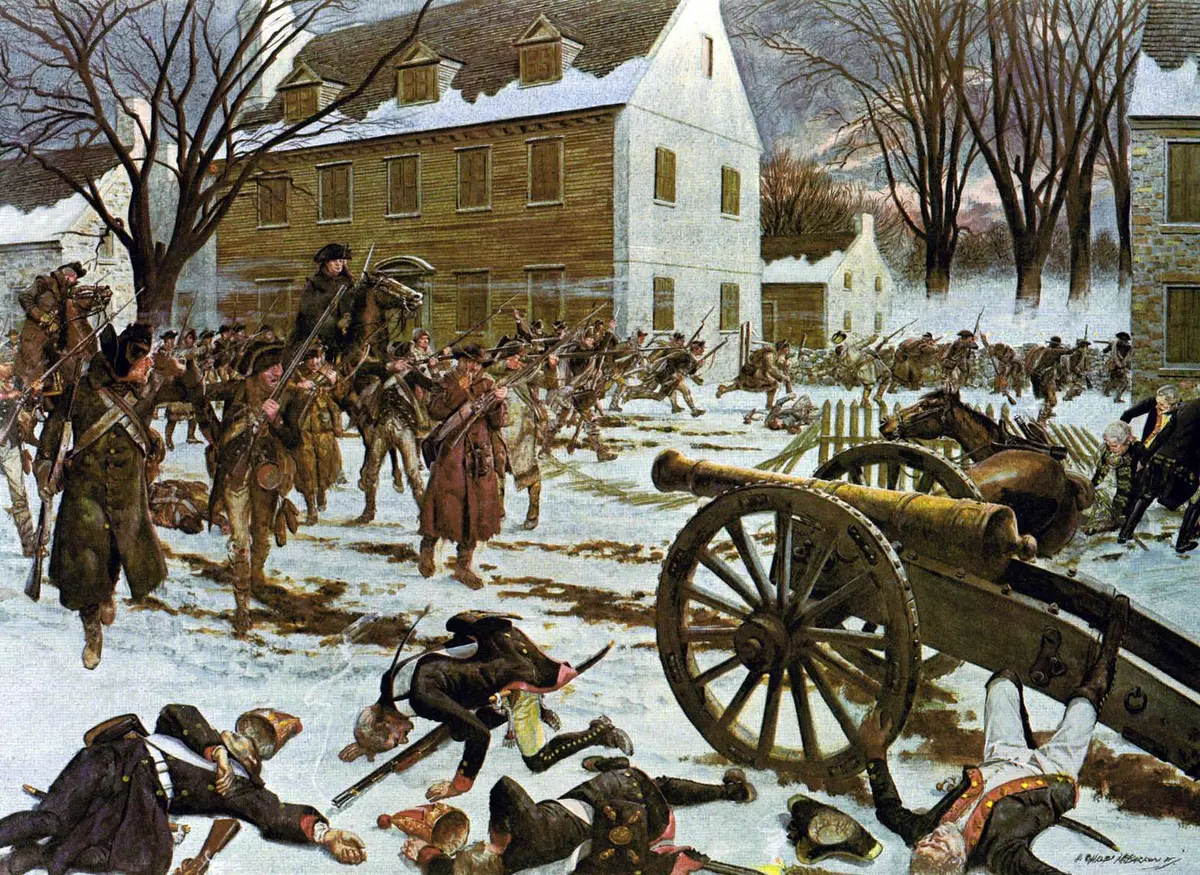
The Battle of Trenton, 26 December 1776: Continentals storm the town in the snow (H. Charles McBarron Jr.).. H. Charles McBarron Jr. / U.S. Army Center of Military History. The bridge at Assunpink Creek
On New Year’s Eve most of the army’s enlistments run out. Washington asks them to stay, and half or more of the New England men sign on for six more weeks and a ten-dollar bounty. On 2 January Cornwallis marches down from Princeton with the main British army. Around 17:00 his troops charge the bridge over the Assunpink Creek at Trenton three times. American guns throw them back each time.
Princeton
In the night the army slips away, leaving 500 men to keep the campfires burning, and takes back roads to Princeton. On the Clarke farm British regulars break General Hugh Mercer’s brigade and bayonet Mercer. Washington rides in, rallies the militia and leads them to within 30 yards of the British line. The line breaks. About 200 redcoats who barricade themselves in Nassau Hall surrender.

The men

Virginia planter and veteran of the French and Indian War, named commander in chief by Congress in June 1775. At 44 he staked the Revolution on one night. He crossed with the first boats and led the charge at Princeton himself.

Boston bookseller who taught himself gunnery. In the winter of 1775–76 he hauled 60 tons of cannon about 300 miles from Fort Ticonderoga to Boston. At 26 he ran the crossing. Promoted to general two days after Trenton; later President Washington’s Secretary of War.

Marblehead fisherman, merchant and shipowner who led a regiment of seamen. In August 1776 his men rowed the trapped army off Brooklyn in a single night. On Christmas night they rowed it across the Delaware. Brigadier general in the Saratoga campaign.

A King’s College student who took command of a New York artillery company in 1776. His guns crossed with Knox and fought at Trenton and Princeton. Washington made him an aide-de-camp in 1777. First Secretary of the Treasury.
By the numbers
In pictures


Watch, listen, see
Films, photographs and first-hand accounts from across the web. Each opens in a new tab.

Mount Vernon’s film on the darkest weeks of the war, the crossing, Trenton and Princeton.
George Washington’s Mount Vernon · YouTube
How Washington got 2,400 men, horses and cannon over the icy Delaware on Christmas night.
American Battlefield Trust · YouTube
How a whole army crossed an ice-choked river at night without losing a man.
Smithsonian Channel · YouTube
The third and final battle of the Ten Crucial Days, fought on 3 January 1777.
American Battlefield Trust · YouTube
Knox’s handwritten order of march for Christmas night, and his letter to his wife describing the battle.
Gilder Lehrman Institute
Washington’s general orders the day after Trenton, praising the men who crossed the river.
George Washington’s Mount Vernon
The columns, the guns at the head of the streets and the Hessian surrender, mapped.
American Battlefield Trust
Washington Crossing the Delaware, painted in 1851 and more than 21 feet wide, on view at the Met.
The Metropolitan Museum of Art“These are the times that try men’s souls: The summer soldier and the sunshine patriot will, in this crisis, shrink from the service of his country; but he that stands it now, deserves the love and thanks of man and woman.”
Thomas Paine, The American Crisis, 19 December 1776
After
The day after Trenton, Washington thanked the army in general orders. He wrote that he had not seen a single instance of bad behavior in officers or privates, and he had the value of everything captured divided among the men who crossed the river. Congress made Knox a brigadier general.
The British pulled back from most of New Jersey. Washington took the army into winter quarters at Morristown, and recruits came in through the spring. A cause that looked finished in mid-December went into 1777 with three victories in ten days.
Both banks of the crossing are preserved as Washington Crossing Historic Park in Pennsylvania and Washington Crossing State Park in New Jersey. Every Christmas Day, weather permitting, reenactors in Durham boats cross the river again. Hamilton’s artillery company still serves in the U.S. Army as the 1st Battalion, 5th Field Artillery.
Primary sources
- George Washington to John Hancock, President of Congress, 27 December 1776. George Washington Papers, Library of Congress.
- Henry Knox to Lucy Knox, 28 December 1776. Gilder Lehrman Collection.
- General Orders, 27 December 1776. George Washington’s Mount Vernon.