Philadelphia · 4 July 1776 · The Continental Congress
We Hold These Truths
Thirteen colonies told the most powerful empire on earth they were done with it. Fifty-six men signed their names to the letter.

The moment · 2 July 1776 · Philadelphia
Delaware is split and the voting has begun. Caesar Rodney walks into the State House in boots and spurs, nearly 80 miles of night storm behind him. He casts Delaware for independence. Twelve colonies vote yes. None vote no.
That these United Colonies are, and of right ought to be, free and independent States.Richard Henry Lee
By June 1776 the colonies had been at war with Britain for more than a year, and Congress still had not said what it was fighting for. In eight weeks of a Philadelphia summer it voted for independence, adopted Jefferson’s Declaration, printed it overnight, read it to the people and the army, and signed it on parchment. Every man who signed knew it was treason.
Free and independent States
In the Pennsylvania State House, Richard Henry Lee of Virginia rises and offers a resolution: “That these United Colonies are, and of right ought to be, free and independent States.” The colonies have been fighting Britain since Lexington and Concord. Congress puts off the vote until 1 July so the middle colonies can come around, and on 11 June it names five men to draft a declaration.
The Committee of Five
John Adams, Benjamin Franklin, Roger Sherman, Robert Livingston and Thomas Jefferson get the job. The committee hands the pen to Jefferson, 33, of Virginia. He writes in two rented rooms at Seventh and Market Streets, two blocks from the State House. Adams and Franklin mark up his draft. The committee makes 47 changes, adds three paragraphs, and lays it before Congress on 28 June.
Rodney’s ride
Delaware’s two delegates in Philadelphia are split, one for independence and one against. The third, Caesar Rodney, is down in Delaware. Word reaches him that his vote decides it. He mounts up and rides nearly 80 miles through darkness, rain and a violent storm. He walks into the State House on 2 July, still in his boots and spurs, as the voting begins.
Independence
Rodney casts Delaware for independence. South Carolina and Pennsylvania come over. Twelve colonies vote yes, none vote no, and New York abstains until its convention can give the word. The Lee Resolution passes and the United Colonies are independent States. The next day John Adams writes to his wife Abigail that the date will be celebrated by generations to come.
John Adams to Abigail Adams, 3 July 1776It ought to be solemnized with Pomp and Parade, with Shews, Games, Sports, Guns, Bells, Bonfires and Illuminations from one End of this Continent to the other.
Adopted
Through 3 July and into the morning of the Fourth, Congress goes over Jefferson’s draft line by line and makes 39 more revisions. Late that morning the work is done and the Declaration is adopted. Congress orders it printed and sent to every state assembly and to the commanders of the Continental Army. It goes out over two names: John Hancock, President, and Charles Thomson, Secretary.
The Dunlap broadside
That evening John Dunlap, printer to the Congress, sets the text in type and runs off broadsides, big single sheets made for posting on walls and reading aloud. On the morning of 5 July, members of Congress send them by express rider to assemblies, conventions, committees of safety and army commanders up and down the coast. Twenty-six of that first printing survive today.
The State House Yard
The bells of the city call Philadelphia to the yard behind the State House. Colonel John Nixon of the city militia climbs a platform and reads the Declaration aloud to the crowd. “Three cheers rended the Welkin,” Adams writes. The militia battalions parade on the Common and fire a feu de joie, scarce powder or not. The bells ring all day and almost all night.
New York hears it
In New York, General Washington has his brigades drawn up on their parade grounds at six in the evening, and the Declaration is read aloud to the army. That night soldiers and townspeople march down Broadway to Bowling Green and pull down the gilded lead statue of King George III. The lead goes to Litchfield, Connecticut, and comes back as 42,088 musket balls.
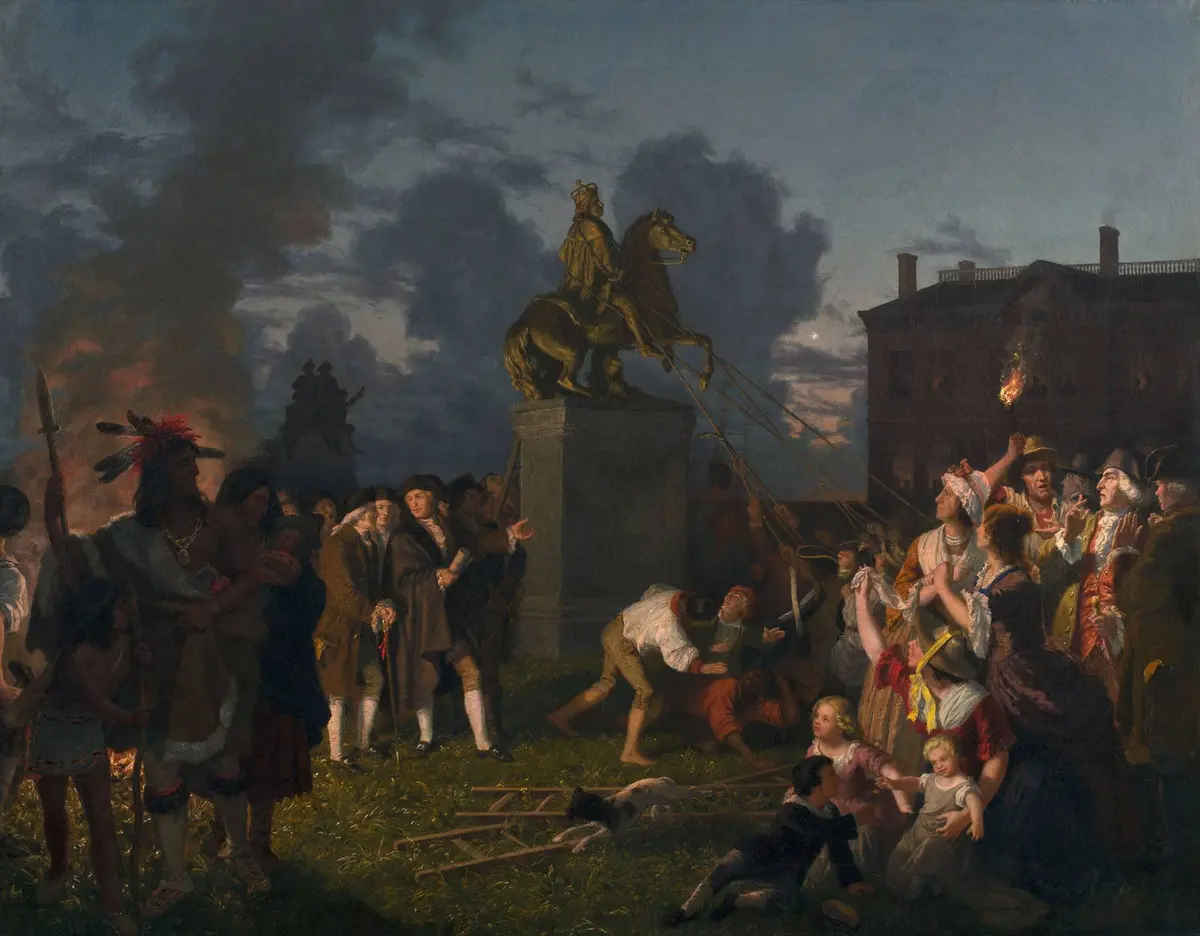
The Sons of Freedom pull down the gilded statue of King George III at Bowling Green, New York, after the Declaration is read on July 9, 1776 (Johannes Oertel, 1859).. Johannes A. S. Oertel / New-York Historical Society. Washington’s General Orders, 9 July 1776The General hopes this important Event will serve as a fresh incentive to every officer, and soldier, to act with Fidelity and Courage, as knowing that now the peace and safety of his Country depends (under God) solely on the success of our arms.
The signing
With New York now on board, Congress orders the text engrossed on parchment as “The unanimous Declaration of the thirteen united States of America.” Timothy Matlack, a clerk with a fine hand, most likely writes it out. On 2 August the journal records it “engrossed and compared at the table” and signed. Hancock signs first, large and bold. Others add their names later. In the end, 56 men sign.

The signers

A 33-year-old Virginia lawyer and planter who wrote the draft in rented rooms in Philadelphia. He went on to serve as the third President, doubled the nation with the Louisiana Purchase, and founded the University of Virginia.

Braintree lawyer who proposed Washington to command the army and led the floor fight for independence on 1 July. Sat on the Committee of Five and edited Jefferson’s draft. Later the first Vice President and the second President.

Printer, scientist and inventor of the lightning rod. At 70 the oldest signer, he edited Jefferson’s draft on the Committee of Five. That fall he sailed for France and won the 1778 alliance that helped win the war.

Boston merchant and President of the Continental Congress. A year earlier the British governor had offered pardons to every rebel but him and Samuel Adams. The first printing went out over his name, and he signed the parchment first.
By the numbers
In pictures


Watch, listen, see
Films, photographs and first-hand accounts from across the web. Each opens in a new tab.

A Thomas Jefferson interpreter reads the full Declaration of Independence, every grievance and every pledge.
Colonial Williamsburg
Interpreters as Jefferson, Abigail Adams and others read the Declaration at the National Archives, 4 July 2026.
C-SPAN
Library curators show John Dunlap’s first printing of the Declaration, set in type the night of 4 July.
Library of Congress
A guided tour of the building where the Declaration and the Constitution were debated and signed.
National Park Service
High-resolution scans of the engrossed Declaration, front and back, plus a full transcript.
National Archives
Jefferson’s own draft in high resolution, with edits by Adams, Franklin and Congress.
Library of Congress
Adams’s 3 July 1776 letter to Abigail calling for “Pomp and Parade” from this time forward forever more.
Massachusetts Historical Society
Spin and explore a 3D scan of the portable desk Jefferson used to write the Declaration.
Smithsonian“We hold these truths to be self-evident, that all men are created equal, that they are endowed by their Creator with certain unalienable Rights, that among these are Life, Liberty and the pursuit of Happiness.”
The Declaration of Independence, adopted by the Continental Congress, 4 July 1776
After
The signed parchment traveled with Congress through the war. In December 1941, days after Pearl Harbor, it went under guard to the Bullion Depository at Fort Knox and stayed nearly three years. Since December 1952 it has been on display at the National Archives in Washington.
Adams and Jefferson, partners in 1776, both died on 4 July 1826, fifty years to the day after the Declaration was adopted. Charles Carroll of Carrollton, the last surviving signer, died in 1832 at 95.
Adams missed the date by two days and got everything else right. Congress made the Fourth of July a federal holiday in 1870, and in 2026 the country turned 250.