Saratoga, New York · 17 October 1777 · Gates’s Northern Army
Burgoyne and His Whole Army
A British army came down from Canada to split the states in two. Riflemen, farmers and Continentals stopped it in the woods above the Hudson and made the whole army lay down its arms.

The moment · About 15:00 · 17 October 1777
The regiments that marched out of Canada in June file down to the meadow by the Hudson and ground their muskets. Then they march south between silent American lines while fifes and drums play Yankee Doodle. On the hill, Burgoyne hands Gates his sword. Gates hands it back.
The fate of war has put me into your hands.Gen. John Burgoyne to Gen. Horatio Gates, as a Continental chaplain wrote it down that day
In June 1777 Gen. John Burgoyne sailed south from Canada with about 9,400 British, German, Loyalist, Canadian and Indian troops and 138 cannon. His orders were to take the Hudson to Albany and cut New England off from the other states. Four months later he was surrounded at Saratoga, and his whole army laid down its arms.
A mile a day
On 5 July British cannon appear on Sugar Hill, high above Fort Ticonderoga. That night Gen. Arthur St. Clair slips his 3,000 men out of a fort built for 10,000. Then Gen. Philip Schuyler sends hundreds of axmen ahead of the British. They fell trees across the roads, break down the bridges and drive off the cattle. Burgoyne needs 23 days to reach Fort Edward on the Hudson. His army makes about a mile a day.
Stark’s farmers
Burgoyne sends about 800 men under Lt. Col. Friedrich Baum to seize the American supply depot at Bennington. Gen. John Stark meets them with about 2,000 volunteers from New Hampshire, Vermont and Massachusetts. At 15:00 his men close in from all sides. By 17:00 Baum is mortally wounded and his force is broken. A German relief column under Heinrich Breymann arrives, and Seth Warner’s Green Mountain Boys drive it off. Burgoyne loses about 800 men and four bronze cannon.
Stark to his men, as tradition tells itThere are your enemies, the Red Coats and the Tories. They are ours, or this night Molly Stark sleeps a widow!
The ground Kościuszko chose
On 19 August Gen. Horatio Gates takes command of the Northern Army, and militia pour in. Col. Thaddeus Kościuszko, a 31-year-old Polish volunteer engineer, picks Bemis Heights, where the bluffs crowd the Albany road against the river. His line runs from batteries on the bluff to the Neilson farm on the crest, then three-quarters of a mile southwest. Twenty-two cannon cover it. On 13 September Burgoyne crosses the Hudson and cuts his own road back to Canada.
Freeman’s Farm
Burgoyne advances in three columns through thick woods. Morgan’s riflemen hit the pickets of the center column at John Freeman’s farm, and their first volley nearly wipes them out. Morgan rallies his men with a turkey call. Gen. Benedict Arnold feeds in regiment after regiment, and for more than three hours the fight sways back and forth across the clearing. German reinforcements at dusk let Burgoyne hold the field. It costs him about 590 men to the Americans’ 320.
Begin the game
Outnumbered and short of food, Burgoyne sends about 1,500 picked men to probe the American left. They halt in a wheat field. Gates gives his order. Gen. Enoch Poor’s brigade breaks the British grenadiers while Morgan’s riflemen swing around the other flank. Gen. Simon Fraser rides along his line to rally it and falls, mortally wounded by one of Morgan’s riflemen. Tradition names Timothy Murphy. Within an hour Burgoyne has lost 8 cannon and more than 400 men.
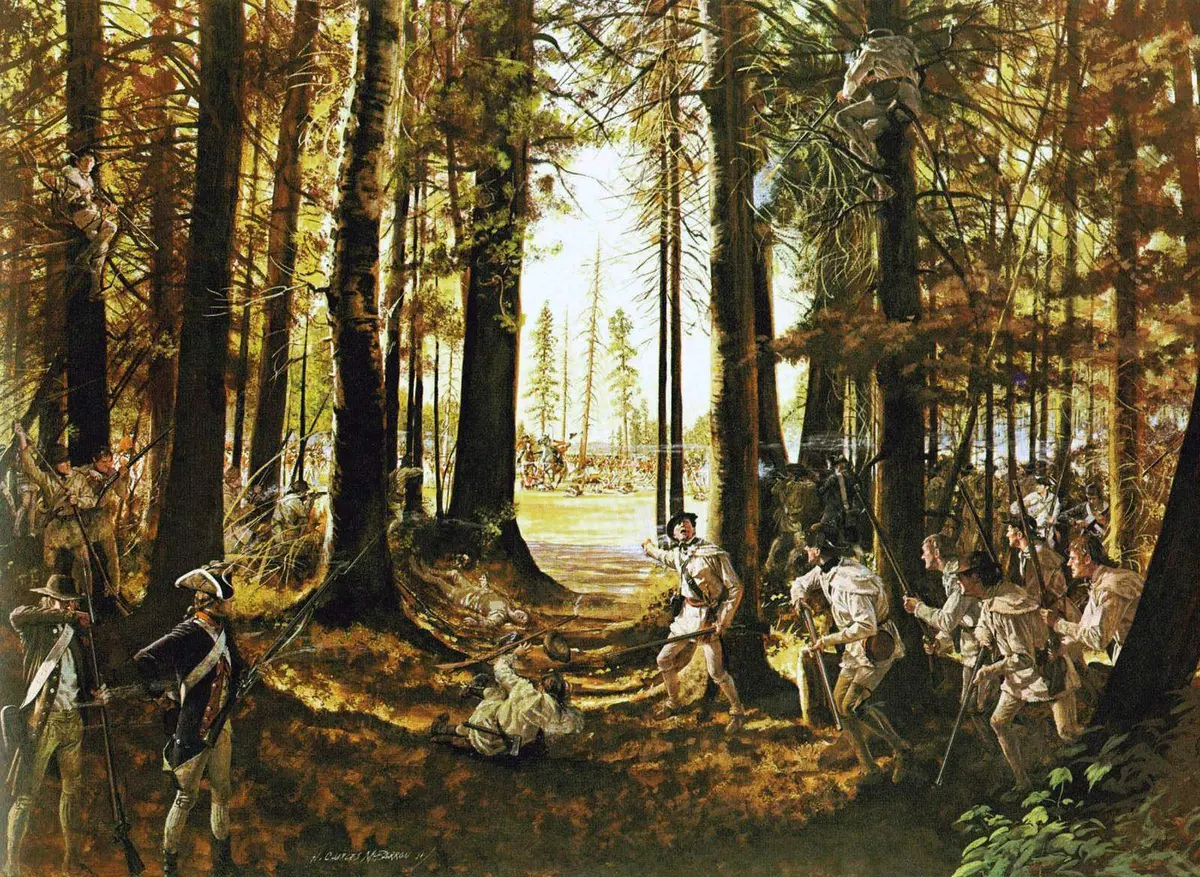
Morgan’s riflemen at Saratoga, 7 October 1777 (H. Charles McBarron Jr.).. H. Charles McBarron Jr. / U.S. Army Center of Military History. Gates to his adjutant, James WilkinsonOrder on Morgan to begin the game.
Breymann’s redoubt
Arnold leads the pursuit. An attack on the British redoubt at Freeman’s farm fails, so he rides north through the crossfire to the fort held by Breymann’s Germans. A dozen riflemen are already working around its open flank. Arnold goes in with them as the front wall is stormed. The Germans break. Breymann is killed, and Arnold is shot in the left leg. Darkness ends the battle. British losses are about 630, American about 150.
Surrounded
On the night of 8 October Burgoyne retreats north through a pouring storm. His army reaches Saratoga the next day, cold and half-starved. Gates follows. Americans hold the far bank of the Hudson, and Stark’s men block the road north. Burgoyne is outnumbered nearly three to one, and his food is almost gone. On 13 October he asks for terms. After days of talks, he agrees to march out and lay down his arms.
Yankee Doodle
Late in the morning Burgoyne rides out to meet Gates and takes off his hat. His regiments march down to the meadow by the Hudson and ground their muskets. Then nearly 7,000 soldiers, women and children march south between the American lines. A German officer marvels that not one American shows mockery or pride. The fifes and drums play Yankee Doodle, which one soldier calls very suitable for the times. Burgoyne hands Gates his sword. Gates gives it back.
Greater news than that
Jonathan Loring Austin rides into the courtyard of Benjamin Franklin’s house outside Paris with dispatches from Boston. Franklin asks if Philadelphia has fallen. It has, Austin says. But he has greater news: General Burgoyne and his whole army are prisoners of war. The French foreign minister, the Comte de Vergennes, decides for an alliance. On 6 February 1778 Franklin, Silas Deane and Arthur Lee sign the treaties that bring France into the war.

The men

Frontier wagoner who carried the scars of a British flogging. Captured at Quebec in 1775, he came back to lead Washington’s picked riflemen. They opened both battles at Saratoga and broke the British flank on 7 October. Later he won at Cowpens.

English-born British Army veteran, wounded at Braddock’s defeat in 1755, who settled in Virginia and joined the Continental Army in 1775. He took the Northern Army on 19 August 1777, dug in on Bemis Heights and took Burgoyne’s surrender. Congress voted him a gold medal.

New Hampshire woodsman, veteran of Rogers’ Rangers, Bunker Hill, Trenton and Princeton. Passed over for promotion, he resigned, then raised the militia that crushed Burgoyne’s raid at Bennington. Congress made him a Continental brigadier. He wrote the words Live Free or Die.

Polish-born engineer, trained in Warsaw and Paris, who volunteered in 1776 and was made a colonel by Congress. He chose Bemis Heights and built the lines Burgoyne could not get past. Next he fortified West Point and chained the Hudson.
By the numbers
In pictures


Watch, listen, see
Films, photographs and first-hand accounts from across the web. Each opens in a new tab.

Animated map of Burgoyne’s invasion, from Ticonderoga and Bennington to the two battles and the surrender.
American Battlefield Trust · YouTube
Park ranger Eric Schnitzer explains how the Americans won at Saratoga and why it mattered so much.
C-SPAN American History TV
Stop-by-stop audio for the park’s 10-stop battlefield tour road, with full transcripts.
National Park Service
The park’s interactive story map of the campaign, before, during and after the battles.
National Park ServiceAudio and transcript built from soldiers’ journals: the generals’ meeting, the grounded arms, and Yankee Doodle.
National Park Service
Trumbull’s 1821 surrender painting in the Capitol Rotunda. Daniel Morgan stands in white at the head of the officers.
Architect of the Capitol
The treaty Saratoga won: France and the United States allied, signed in Paris on 6 February 1778.
National Archives
Congress’s proclamation of 1 November 1777 setting aside 18 December for thanksgiving and praise.
Library of Congress“Let every face brighten, and every heart expand with grateful Joy and praise to the supreme disposer of all events, who has granted us this signal success.”
General George Washington, General Orders, 18 October 1777
After
On 4 November 1777 Congress thanked Gates and his army and voted him a gold medal. It set aside Thursday, 18 December, as a day of thanksgiving and praise for the victory. Daniel Morgan named his Virginia home Saratoga, and at Cowpens in January 1781 he beat a British army again.
France recognized the United States and came into the war in 1778. Spain followed in 1779. Four years to the day after Saratoga, Lord Cornwallis asked for terms at Yorktown, and the war for independence was won.
The battlefield, the surrender site and the 155-foot Saratoga Monument are preserved in Saratoga National Historical Park. Statues of Gates, Schuyler and Morgan stand in three of the monument’s niches. The fourth is empty. It belongs to Benedict Arnold, who was shot leading the charge into Breymann’s redoubt and turned traitor three years later. The Boot Monument on the battlefield honors his wounded leg and leaves out his name.
Primary sources
- Saratoga. National Park Service Historical Handbook No. 4.
- Saratoga Surrender Site Audio Tour, drawn from eyewitness journals and letters. Saratoga National Historical Park, National Park Service.
- George Washington, General Orders, 18 October 1777. The Papers of George Washington, Revolutionary War Series, vol. 11.