Stagg Field, University of Chicago · 2 December 1942 · Enrico Fermi and the Metallurgical Laboratory
The Italian Navigator Has Landed
In a squash court under the stands of a Chicago football field, Enrico Fermi’s team stacked 57 layers of graphite and uranium into a pile and started the first man-made nuclear chain reaction.

The moment · 15:36 · 2 December 1942
George Weil stands on the floor of the squash court with his hands on the last control rod. At 15:25 Fermi calls for one more foot. Weil pulls it. The counters click faster and faster and do not level off. Fermi works his slide rule. Then his face breaks into a smile.
The reaction is self-sustaining. The curve is exponential.Enrico Fermi
By 1942 everyone in physics knew uranium could split and throw off neutrons. Nobody had ever made those neutrons keep the reaction going on its own. Germany had the same science. At the University of Chicago, Arthur Compton’s Metallurgical Laboratory gave the job to Enrico Fermi: build a pile big enough to sustain a chain reaction, prove it can be controlled, and do it fast.
Everyone to Chicago
After Pearl Harbor the chain reaction work is put under Arthur Compton and pulled together at the University of Chicago. The Columbia and Princeton groups move west, and the Metallurgical Laboratory is born. Fermi and Leo Szilard settle on a lattice of uranium lumps set in blocks of pure graphite. Under the west stands of Stagg Field the team builds about 30 smaller test piles to measure every number before the real one.
A pile on campus
The pile is meant for a new site in the Argonne Forest outside the city, but a construction strike stalls the buildings. Fermi tells Compton he can run it safely on campus, in a 30-by-60-foot squash court under the stands. Compton agrees and does not ask the university’s president. Goodyear sews a square balloon-cloth envelope to hang around the pile, and is never told what it is for.
Around the clock
Two crews, one under Walter Zinn and one under Herbert Anderson, work almost around the clock. Zinn’s men machine the graphite into bricks in a shop under the stands. Westinghouse, Metal Hydrides and Frank Spedding’s team at Ames deliver several tons of pure uranium metal, set near the center. Layer by layer the pile rises. Albert Wattenberg remembers the graphite dust: “We found out how coal miners feel.”
The last layer
Anderson’s crew relieves Zinn’s and soon sets the 57th and final layer in place. Fermi had predicted almost to the brick where the pile would go critical. Zinn and Anderson take measurements and are sure it will run once the rods come out. They agree not to start it without Fermi and the rest of the team. They lock the control rods for the night. Word goes out: the test is tomorrow morning.
Places, everyone
Fermi, Zinn, Anderson and Compton gather at the instruments on a balcony ten feet above the floor. George Weil stands below at the last control rod. Norman Hilberry holds an axe, ready to cut a rope and drop the emergency rod. Three men of the liquid-control squad, the “suicide squad,” stand on a platform above the pile with cadmium solution to drown it if all else fails. At 09:45 Fermi orders the first rods out.
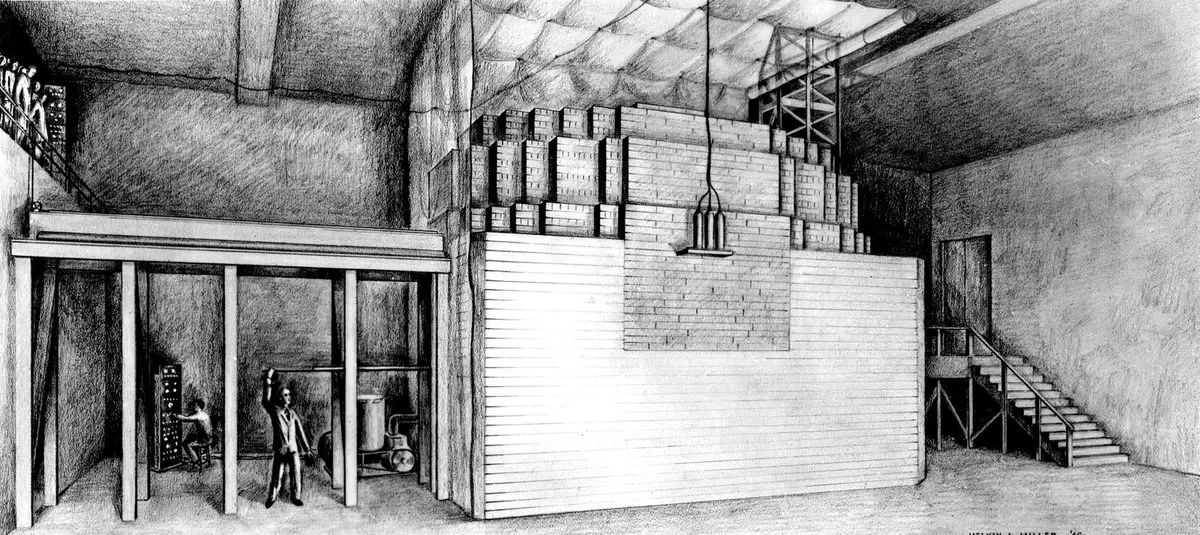
Sketch of Chicago Pile-1 in the squash court under the west stands of Stagg Field, with the balcony where Fermi and the observers stood.. U.S. Department of Energy. Let’s go to lunch
Fermi takes it one step at a time. “Pull it to 13 feet, George.” Each time the counters climb, then level off exactly where he says they will. Then the automatic safety rod slams home with a crash. It was set to trip too low. Nothing is wrong. “I’m hungry,” he says. “Let’s go to lunch.” The team is back on the court at 14:00.
It will not level off
At 15:25 Fermi calls for another foot. Weil pulls the rod. “This is going to do it,” Fermi tells Compton. “The trace will climb and continue to climb. It will not level off.” He times the rise on his slide rule, again and again. Leona Woods, 23, the only woman in the room, records the readings. The clicking becomes a steady buzz. At 15:36 Fermi closes his slide rule and smiles. The pile is critical.
Enrico Fermi, on the balconyThe reaction is self-sustaining. The curve is exponential.
Zip in
The pile runs on its own, at about half a watt, while the pen draws a straight line up the chart. At 15:53, 28 minutes after Weil’s last pull, Fermi calls “O.K., Zip in” and Zinn drops the emergency rod. Eugene Wigner hands Fermi a bottle of Chianti. They drink from paper cups without a toast. Most of them sign the bottle. Compton picks up the telephone and calls James Conant at Harvard.
Arthur Compton to James Conant, by telephoneThe Italian navigator has landed in the New World.
From a squash court to Hanford
The Army had already bet on Fermi. Before the test, the Manhattan District was negotiating with DuPont to build a $350 million plutonium plant at Hanford, Washington, on the principles of the still-unproven pile. Early in 1943 Chicago Pile-1 is taken apart and rebuilt in the Argonne Forest as Chicago Pile-2, with a radiation shield. On 26 September 1944 Hanford’s B Reactor goes critical with Fermi in charge of loading it.

The builders

Rome-born Nobel laureate who left Fascist Italy in 1938 and became an American citizen in 1944. Designed the pile, predicted almost to the brick where it would go critical, and ran the experiment from the balcony with a slide rule.

Ohio-born physicist who shared the 1927 Nobel Prize in Physics. Ran the Chicago laboratory that built the pile. When a strike stalled the Argonne site, he let Fermi build it on campus, then phoned the news to Harvard in code.

Hungarian-born physicist who conceived the nuclear chain reaction in 1933 and drafted Albert Einstein’s 1939 letter to President Roosevelt. Worked out the uranium-graphite lattice with Fermi, and shares the patent for the reactor with him. American citizen from 1943.

Ontario-born physicist and American citizen since 1938. Designed the dies for the uranium oxide lumps and led the crew that machined the graphite and stacked the pile. On the day he pulled the emergency rod by hand. Became Argonne’s first director in 1946.
By the numbers
In pictures


Watch, listen, see
Films, photographs and first-hand accounts from across the web. Each opens in a new tab.

Harold Agnew and Warren Nyer, two of the last surviving pioneers, recall the day the pile went critical.
Argonne National Laboratory
The laboratory Fermi’s team founded retells the building of the first reactor in toy bricks.
Argonne National Laboratory
Argonne’s classic documentary on building Chicago Pile-1, from the first fission work to the squash court.
Nuclear Engineering at Argonne
A museum curator shows a small block of graphite from the first reactor and tells its story.
Griffin Museum of Science and Industry
A member of Fermi’s group, 19 when he started, recalls building the test piles and the first reactor.
Atomic Heritage Foundation · Voices of the Manhattan ProjectThe 1946 government account of 2 December 1942, minute by minute, from interviews with the team.
U.S. Atomic Energy Commission
DOE’s 40th-anniversary history, with Fermi’s own account, the drawings and the list of those present.
U.S. Department of Energy · OSTIU.S. Patent 2,708,656, “Neutronic Reactor,” filed by Fermi and Szilard in 1944 and issued in 1955.
Google Patents“On December 2, 1942 man achieved here the first self-sustaining chain reaction and thereby initiated the controlled release of nuclear energy.”
Bronze plaque at the site of Chicago Pile-1, University of Chicago
After
The Metallurgical Laboratory grew into Argonne National Laboratory, chartered on 1 July 1946 with Walter Zinn as its first director. Under Zinn, Argonne built the breeder reactor in Idaho that made the first usable electricity from atomic power, in 1951. The Fermi and Szilard patent for the nuclear reactor was issued on 17 May 1955.
On the fifth anniversary, Fermi and Zinn watched a plaque unveiled on the west stands. The stands came down in 1957. In 1965 the site became a National Historic Landmark.
At 15:36 on 2 December 1967, twenty-five years to the day, the university unveiled Henry Moore’s twelve-foot bronze Nuclear Energy where the pile once stood. The reactors that drive American submarines and carriers and light American cities all trace back to the pile Fermi’s team stacked by hand.
Primary sources
- Corbin Allardice and Edward R. Trapnell, “The First Pile.” U.S. Atomic Energy Commission, 1946.
- The First Reactor, 40th Anniversary edition (DOE/NE-0046). U.S. Department of Energy, 1982.
- 10 Intriguing Facts About the World’s First Nuclear Chain Reaction. U.S. Department of Energy, Office of Nuclear Energy.
Keep exploring
- Trinity130,000 Americans built secret cities, the first reactor and the weapon that ended the Second World War.3years, start to finish
- Nautilus 90 NorthThe world’s first nuclear-powered ship sailed 1,830 miles beneath the Arctic ice and became the first ship ever to reach the North Pole.90°Nunder the ice
- Franklin and the Lightning RodFranklin proposed the test, a kite repeated it in a Philadelphia storm, and a few feet of iron rod gave every house a way to survive lightning.6–8 ftof iron rod to save a house
- The PentagonThe largest office building in the world went up on a Virginia flood plain called Hell’s Bottom in sixteen months, in the middle of a world war.16months to build


Free, with no ads. Support the museum →