Mazar-i-Sharif, Afghanistan · 10 November 2001 · 5th Special Forces Group, ODA 595
The Horse Soldiers
Five weeks after 9/11, twelve Green Berets climbed onto Afghan horses, rode into the mountains with a warlord’s cavalry and called down B-52s on the Taliban. Twenty-two days later, Mazar-i-Sharif was free.

The moment · Afternoon · 5 November 2001
Taliban trenches line the Darya Suf, twenty to thirty men to a bunker, with tanks and machine guns behind them. The Green Berets call in the bombs. Dostum’s horsemen charge at a gallop. The bombs land fifteen meters from the horsemen. The lead riders are already past the bunkers.
On 11 September 2001, al Qaeda, sheltered by the Taliban in Afghanistan, killed 2,977 people. America struck back within weeks, and not with a mass invasion. It sent small teams of Green Berets to fight beside Afghans who already hated the Taliban. The first team went in on 19 October. Its orders: help General Dostum take the north.
Task Force Dagger
Col. John Mulholland’s 5th Special Forces Group at Fort Campbell, Kentucky, gets the mission. He builds Task Force Dagger at Karshi-Khanabad, an old Soviet air base in southern Uzbekistan. Bombing starts on 7 October. The plan is cautious: train the Northern Alliance through the winter and take a city or two before the snow. The CIA’s Team Alpha links up with General Dostum on 17 October. ODA 595 is next.
Into the Darya Suf
An MH-47E of the 160th Special Operations Aviation Regiment flies through a night sandstorm so thick its two Black Hawk gunship escorts turn back. The Night Stalkers refuel at 110 knots, 300 feet off the ground, then thread mountains higher than the Rockies on radar. At 02:00, right on schedule, they land in a plowed field in the Darya Suf valley. Twelve Green Berets step off the ramp. In Washington it is still the evening of 19 October.
Fifteen minutes to saddle up
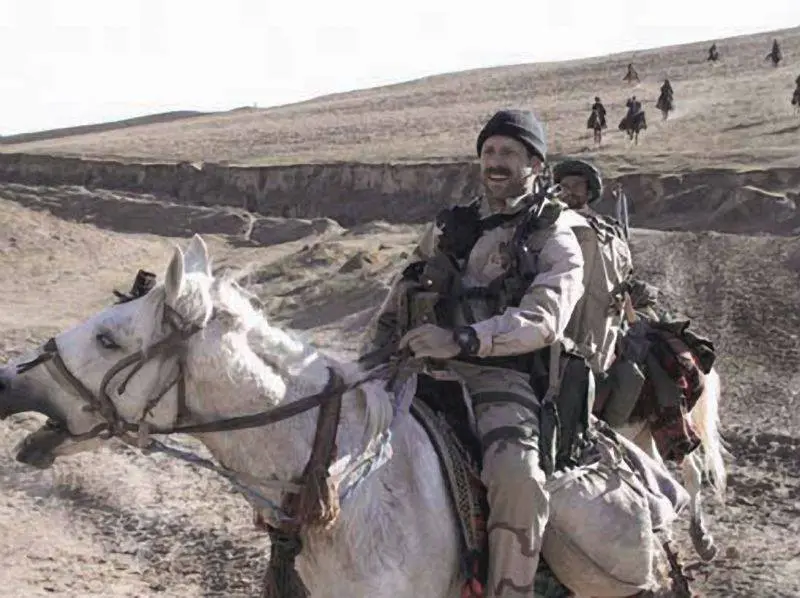
Thirty armed horsemen gallop into camp, then Dostum himself with twenty more. Over tea he spreads out his map. Then he stands and says the Americans will ride with him to his command post. They have fifteen minutes. Capt. Mark Nutsch, a Kansas cowboy, takes five sergeants. Most have barely ridden before. His first rule: if a man is thrown and dragged, the nearest man shoots the horse.
The first bombs
Dostum keeps the Americans eight kilometers back from the Taliban line. Nutsch plots a bunker with a GPS and compass and radios the grid to a lone B-52 circling at 20,000 feet. The first bombs miss wide. Nutsch is frustrated. Dostum is thrilled. He picks up a radio tuned to the enemy’s frequency and speaks to the Taliban commander across the gorge.
General Dostum, on the Taliban’s own radio netThis is General Dostum speaking. I am here, and I have brought the Americans with me.
Spur to spur
Nutsch splits his team into cells of three and four so bombs can fall around the clock. Some cells are a day’s ride from the next. Dostum tells him five hundred Afghans can die but not one American, and keeps them back. Nutsch keeps pushing until Dostum lets them close. Air Force Combat Talons drop supplies at night onto drop zones no bigger than a tennis court. The team’s first requests: boots, ammunition and horse feed.
A Green Beret’s situation report, read aloud by Secretary RumsfeldWe’ve witnessed the horse cavalry bounding from spur to spur to attack Taliban’s strong points, the last several kilometers under mortar, artillery and sniper fire.
Out of the smoke
Near Baluch, the Taliban have learned the bombers’ rhythm. They duck each strike, then pop up to meet the charge. So the Green Berets and their combat controllers tie each strike to the charge, and the horsemen ride in on the bombs. One commander is already past the bunkers when the bombs land fifteen meters from his men. The line breaks. A Taliban commander had told Dostum by radio that whoever took this ground took the whole north.
Air Force combat controller Staff Sgt. Bart Decker on horseback with Northern Alliance fighters, October 2001. He called in the B-52s and Navy jets for ODA 595. U.S. Army. The Tiangi gap
One pass is left, the Tiangi, the gateway to Mazar-i-Sharif. About a thousand foreign fighters hold it with mines, rocket launchers and antiaircraft guns fired flat at the horsemen. The first assault is thrown back. A Green Beret cell climbs the mountain above the pass and works the airstrikes from there. Commander Kamal leads 240 riders through. Nutsch rides into the pass behind them. The road to Mazar is open.
Mazar is free
Dostum and his allies sweep into Mazar-i-Sharif, the first major city taken from the Taliban. Several hundred foreign fighters barricade themselves in a school and gun down the mullahs sent to arrange their surrender. ODA 595 guides smart bombs into the building. About 3,000 Taliban soldiers surrender soon after. The Green Berets ride in on begged, borrowed and confiscated transportation, through streets of cheering people.
Situation report from Mazar-i-Sharif, read aloud by Secretary RumsfeldWhile they looked like a ragtag procession, the morale in Mazar-e-Sharif was like a triumphal procession.
Qala-i-Jangi
Hundreds of al Qaeda and Taliban prisoners are held in the old Qala-i-Jangi fortress outside Mazar. CIA officer Mike Spann is questioning them when they rise up. His last act is to warn a colleague and get him clear. Spann is killed, the first American to die in combat in Afghanistan. Green Berets, British troops and AC-130 gunships fight for three more days to recover him.

The men

Raised on his family’s cattle ranch near Washington, Kansas, he rode college rodeo at Kansas State. He was the best horseman in the 5th Special Forces Group. He led ODA 595 from the Darya Suf to Mazar-i-Sharif and brought all twelve men home.

Born in Clovis, New Mexico, commissioned from Furman University in 1978, and a Green Beret since 1983. He took command of the 5th Group two months before 9/11, built Task Force Dagger in Uzbekistan and sent the first A-teams into Afghanistan.

Grew up in Winfield, Alabama, graduated from Auburn and served eight years in the Marines, rising to captain. He went in with Team Alpha two days ahead of the Green Berets. Killed at Qala-i-Jangi, the first American to fall in combat in Afghanistan.
By the numbers
In pictures


Watch, listen, see
Films, photographs and first-hand accounts from across the web. Each opens in a new tab.

A Green Beret of ODA 595 tells how the team rode with the Northern Alliance and drove out the Taliban.
American Veterans Center
A South Dakota horseman on the twelve-man team recalls riding into battle weeks after 9/11.
American Veterans Center
An ODA 595 Green Beret walks through the deployment, the horseback campaign and the drive on Mazar.
American Veterans Center
Team members describe the horseback campaign and the galloping charges that broke the Taliban lines.
PBS Frontline
Thirty-eight photographs from Task Force Dagger’s teams in Afghanistan in 2001, released by the Army.
U.S. Army Special Operations CommandThe CIA’s tribute to the first American killed in combat in Afghanistan, the 79th star on its wall.
Central Intelligence Agency
Green Berets, Night Stalkers and a combat controller remember the first teams into Afghanistan.
U.S. Army
The 5th Group’s account of the Veterans Day 2011 dedication near Ground Zero.
5th Special Forces Group“That day on the plains of Afghanistan, the 19th century met the 21st century, and they defeated a dangerous and determined adversary, a remarkable achievement.”
Secretary of Defense Donald H. Rumsfeld, National Defense University, 31 January 2002
After
The planners had expected a winter of training and a spring offensive. Instead, Mazar fell on 10 November and Kabul on 13 November. Kandahar, the Taliban’s home city, fell on 7 December, 49 days after ODA 595 landed. About 130 Army Special Forces, civil affairs and psychological operations soldiers, with a handful of Air Force controllers and American air power overhead, had led the way. Secretary Rumsfeld called the charge on Mazar the first cavalry attack of the 21st century.
Mike Spann came home to Arlington National Cemetery in December 2001. His star was the 79th carved on the CIA’s Memorial Wall, and he received the Intelligence Star. Mark Nutsch retired as a major. In 2022 his hometown of Washington, Kansas, dedicated a monument to him and his team.
On Veterans Day 2011, Vice President Joe Biden and Lt. Gen. John Mulholland unveiled De Oppresso Liber, a 13-foot bronze Green Beret on an Afghan horse, commissioned by Manhattan businessmen who lost friends on 9/11. Since 2016 it has stood in Liberty Park, looking over the ground where the towers fell.
Primary sources
- Charles H. Briscoe et al., Weapon of Choice: ARSOF in Afghanistan. Combat Studies Institute Press, U.S. Army, 2003 (CMH Pub 70-100-1).
- William M. Knarr Jr., Mazar-e Sharif Battle Site Survey Support Documents (Revised). Institute for Defense Analyses, June 2011.
- Remarks on Transformation, Secretary of Defense Donald H. Rumsfeld, National Defense University, Fort McNair, 31 January 2002.