Kuwait and Iraq · 24–28 February 1991 · U.S. Central Command
Kuwait Is Liberated
Thirty-eight days of air war, then 100 hours on the ground. The army that seized Kuwait was broken, and Kuwait was free.

The moment · 16:18 · 26 February 1991
A sandstorm hides everything. Capt. H.R. McMaster’s tank crests a low rise, and there they are: eight T-72s dug in 1,420 meters ahead. The first one explodes. Three seconds later, a second. Eight more Abrams pour over the ridge. Twenty-three minutes later the position is burning.
Tanks direct front.Staff Sgt. Craig Koch, McMaster’s gunner
On 2 August 1990 Saddam Hussein’s army overran Kuwait in days. President George H.W. Bush said it would not stand and built a coalition of more than 30 nations. Gen. Norman Schwarzkopf drew the plan: blind Iraq’s army from the air, then swing the armor wide through the empty desert and hit the Republican Guard from the flank.
Party in ten
Eight Army AH-64 Apaches of Task Force Normandy, led by four Air Force MH-53J Pave Lows, fly low into Iraq in the dark. Their targets are two early-warning radar sites. 1st Lt. Tom Drew breaks radio silence. Ten seconds later the Hellfires fly. In about four minutes both sites are wreckage, and a 20-mile gap opens in Iraq’s air defenses. Twenty-two minutes to H-Hour.
1st Lt. Tom Drew, Task Force NormandyParty in ten.
Over Baghdad
Black F-117 Nighthawks of the 37th Tactical Fighter Wing slip over Baghdad unseen by Iraqi radar. They put laser-guided bombs on command bunkers, communications centers and air defense headquarters. From the gulf, the battleship USS Missouri launches Tomahawk cruise missiles. The F-117 is the only coalition aircraft that will strike downtown Baghdad. By the end of the war it has flown about 1,300 sorties.
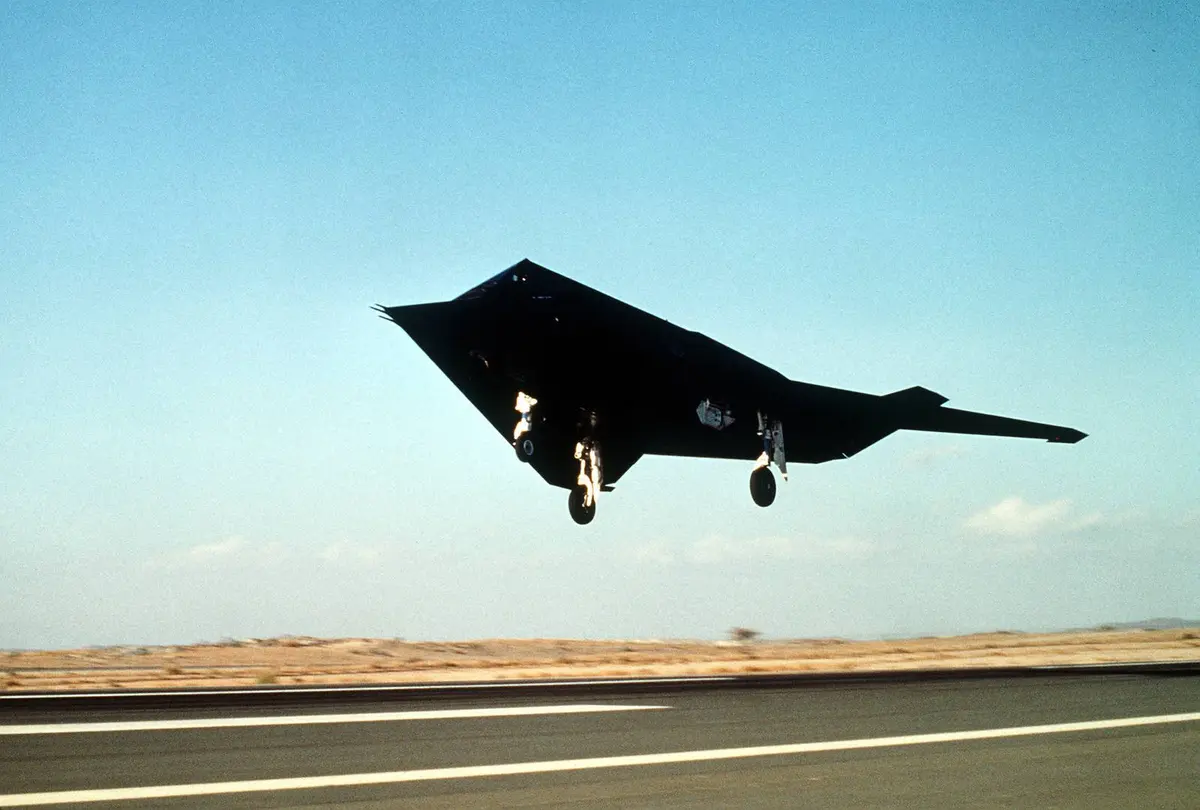
A 37th Tactical Fighter Wing F-117 stealth fighter takes off on a mission during Operation Desert Storm, 10 February 1991.. Tech. Sgt. Rose Reynolds, U.S. Air Force / Department of Defense, via National Archives. Thirty-eight days
Lt. Gen. Chuck Horner runs one air war for every service and every ally. Coalition aircraft fly more than 100,000 sorties. They take the sky, cut Iraq’s command and supply lines, and pound the army dug in along the border. Iraq cannot fly a single reconnaissance mission. Behind that curtain, two whole American corps shift far to the west, beyond the end of the Iraqi line. Schwarzkopf later calls it a Hail Mary play.
Through the Saddam Line
The 1st and 2nd Marine Divisions hit the border first. Engineers fire mine-clearing line charges and push plow tanks through berms, two belts of mines, wire and fire trenches. The Army’s Tiger Brigade rolls through with the 2nd Marine Division. By nightfall the Marines are 20 miles into Kuwait with nearly 10,000 prisoners. Schwarzkopf calls it an “absolutely classic military breaching.”
The Left Hook swings
Far to the west, 300 helicopters carry the 101st Airborne 110 miles into Iraq to build Forward Operating Base Cobra. By evening the division has cut Highway 8. The XVIII Airborne Corps is moving so fast that Schwarzkopf moves the VII Corps attack up 14 hours. The 1st Infantry Division plows through the Iraqi trench line, buries ten miles of it, and loses not one soldier.
73 Easting
The 2nd Armored Cavalry Regiment leads VII Corps into a raging sandstorm. Eagle Troop, nine Abrams and twelve Bradleys, crests a rise into the Republican Guard’s Tawakalna Division, dug in on a reverse slope. Thermal sights cut through the dust. The troop attacks through four kilometers of tanks, bunkers and mines and keeps going past its limit of advance. In 23 minutes the position is destroyed. Eagle Troop loses no one.
McMaster, told he was past the 70 EastingI can’t stop. We’re still in contact. Tell them I’m sorry.
Kuwait City
Arab coalition forces pass through the 2nd Marine Division and drive into Kuwait City. The 1st Marine Division holds Kuwait International Airport. On Mutla Ridge the Tiger Brigade has slammed the highway north shut. In the west, the 24th Infantry Division stands on the Euphrates, 190 miles into Iraq. VII Corps is grinding the Republican Guard apart: an estimated 1,300 tanks destroyed, against 7 Abrams lost.
One hundred hours
At 21:02 Eastern time on 27 February, President Bush tells the nation that all coalition forces will stop offensive operations at midnight, exactly 100 hours after the ground war began. In the desert that is 08:00 on 28 February. American armored divisions stand deep inside Kuwait and astride the roads north. The guns go quiet on schedule.
The commanders

West Point, Class of 1956. Two combat tours in Vietnam with three Silver Stars and two Purple Hearts. Led all coalition forces in the Gulf and planned both the 38-day air war and the Left Hook that ended it in 100 hours.

Son of Jamaican immigrants, raised in the South Bronx, commissioned through ROTC at City College of New York. Two tours in Vietnam. The youngest Chairman ever at 52. His plan for Iraq’s army was simple: cut it off, then kill it.

Iowa-born fighter pilot who flew F-105s over North Vietnam, including Wild Weasel missions hunting missile sites, and won the Silver Star. In the Gulf he commanded every coalition aircraft under a single plan and won the sky in days.

West Point, Class of 1984. At 73 Easting he led nine Abrams and twelve Bradleys through a sandstorm into the Republican Guard and won in 23 minutes without a casualty. Silver Star. Later a lieutenant general and National Security Advisor.
By the numbers
In pictures


Watch, listen, see
Films, photographs and first-hand accounts from across the web. Each opens in a new tab.

Schwarzkopf walks reporters through the whole campaign in Riyadh on the last day of the ground war.
C-SPAN
President Bush’s address from the Oval Office announcing the ceasefire after 100 hours of ground war.
C-SPANThe commander on building the coalition, the plan and the four-phase campaign that freed Kuwait.
PBS Frontline
The coalition air commander explains how the first night seized control of the sky.
PBS FrontlineEagle Troop’s commander tells the battle in his own words, written right after the ceasefire.
2d Cavalry Association
The October 1991 account of Task Force Normandy’s raid that fired the first shots of Desert Storm.
Air & Space Forces Magazine
Leatherneck’s April 1991 report on the Marines’ breach of the Iraqi line and the drive to Kuwait City.
Leatherneck
Paintings and drawings of Desert Shield and Desert Storm from the Navy Art Collection.
Naval History and Heritage Command“Kuwait is liberated. Iraq’s army is defeated. Our military objectives are met.”
President George H.W. Bush, Address to the Nation, 27 February 1991
After
The victory cost 148 Americans killed in action. The Army’s own history calls Desert Storm arguably the fastest and most complete victory in American military history.
The troops came home to parades. On 8 June 1991 Schwarzkopf led the National Victory Celebration in Washington, with President Bush on hand to salute them. Two days later New York welcomed them home under a blizzard of ticker tape.
The Army that had rebuilt itself after Vietnam had done everything asked of it. Its historians wrote that American forces had never been better prepared for a war. In 2022 construction began on a national memorial to the veterans of Desert Shield and Desert Storm on the National Mall.
Primary sources
- War in the Persian Gulf: Operations Desert Shield and Desert Storm, August 1990–March 1991. U.S. Army Center of Military History, CMH Pub 70-117-1, 2010.
- Address to the Nation on the Suspension of Allied Offensive Combat Operations in the Persian Gulf, President George H.W. Bush, 27 February 1991. Public Papers of the Presidents.
- Battle of 73 Easting. Capt. H.R. McMaster, Eagle Troop, 2nd Squadron, 2nd Armored Cavalry Regiment, 1991.