Takur Ghar, Afghanistan · 4 March 2002 · Navy SEALs, Army Rangers, Air Force Special Tactics
Never Leave a Fallen Comrade
A SEAL fell onto a mountaintop held by al Qaeda. His teammates went back for him, and the Rangers came for them. Seven Americans died. Not one was left behind.

The moment · About 05:00 · 4 March 2002
Razor 04 settles onto the peak under fire, and six men jump into the snow: five SEALs and John Chapman. Chapman runs uphill first, straight at a bunker under a tree, and kills the two fighters inside. A machine gun opens up from a second bunker 20 meters away.
On 4 March 2002, the third day of Operation Anaconda, a Navy SEAL team flew to the top of Takur Ghar to watch the valley below. Al Qaeda was already there. When Petty Officer Neil Roberts fell from the helicopter into their positions, his teammates went straight back for him. Then the Rangers came for them. Nobody stayed on that mountain.
Man overboard
Razor 03, an MH-47E Chinook of the 160th Special Operations Aviation Regiment, flares to land in a saddle on the summit. The crew sees fresh tracks in the snow. An RPG slams into the side and machine-gun fire cuts the hydraulic and oil lines. As the pilot hauls the Chinook off the peak, Petty Officer 1st Class Neil Roberts slips on the oil-soaked ramp and falls 5 to 10 feet into the snow. The crippled helicopter crash-lands 7 kilometers north.
We go back
Roberts survives the fall and fights alone with his machine gun until he is mortally wounded. At the crash site, Tech. Sgt. John Chapman, the team's Air Force combat controller, calls an AC-130 gunship overhead for cover. Razor 04 picks up the stranded men and flies them to Gardez. Senior Chief Britt Slabinski rallies his five remaining men. A climb from below would take two to three hours. They decide to land on the same peak.
Into the fire
Razor 04 takes hits on the way in but puts all six men on the peak. Chapman charges uphill through thigh-deep snow, clears the first bunker and kills both fighters in it, then moves from cover to attack a second machine gun. He is hit and falls. Two SEALs are wounded. Caught in fire from three directions, Slabinski pulls his team off the summit while the AC-130 Grim 32 covers them.
Shot down at dawn
The Ranger quick reaction force, 23 men in two Chinooks, never gets the order to land at a safer spot. Razor 01 flies straight to the summit as the sun comes up. An RPG explodes against its right side and door gunner Sgt. Phil Svitak is killed. The helicopter drops into the snow. Sgt. Brad Crose and Cpl. Matt Commons are killed at the ramp, Spc. Marc Anderson inside. Up the slope, Chapman is still fighting.
Air Force account of Chapman's last hourFor over an hour he sustained a violent engagement with multiple enemy fighters through the arrival of the quick reaction force.
Hold the hill
Capt. Nate Self, wounded in the thigh, gathers his Rangers behind rock outcrops. They kill an RPG gunner. Pararescueman Senior Airman Jason Cunningham and an Army medic stay inside the burning helicopter, treating the wounded. Self tries one assault uphill and sees he needs more men. His combat controller calls in air power instead. Jets strafe the bunkers and drop 500-pound bombs within 50 meters of the Rangers. By 07:00 the Rangers are no longer in danger of being overrun.
Down the mountain
Below the summit, Slabinski's SEALs are driven farther down the mountainside by mortar fire, calling in strikes on the ridges around them. Slabinski carries a wounded teammate through deep snow. At one ledge the team rigs a harness from their rifle slings and lowers Stephen Toboz down a 13-foot cliff. For 14 hours Slabinski keeps his wounded alive and keeps fighting until the hill is taken and his team is lifted out.
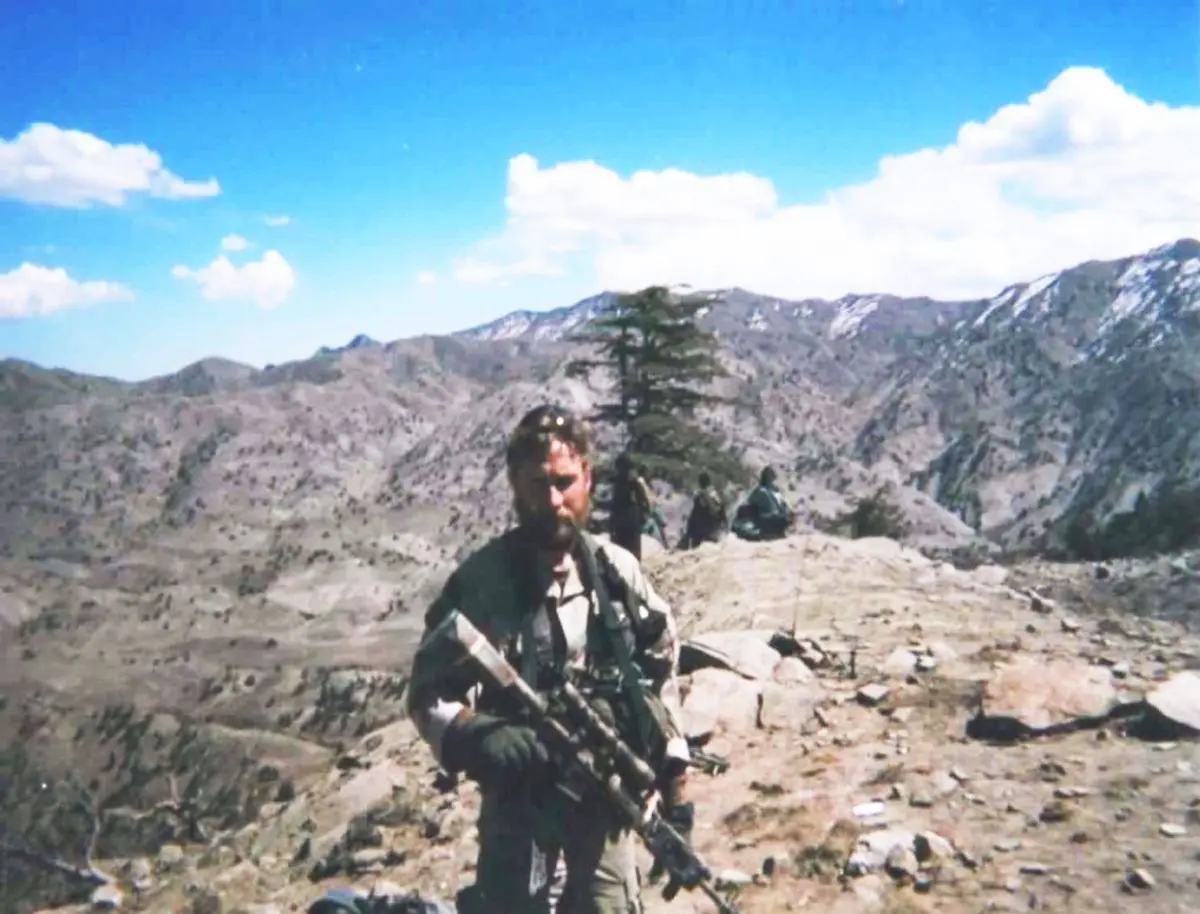
Senior Chief Britt Slabinski on Roberts Ridge, March 2002.. U.S. Navy. The Rangers take the peak
The second half of the force, ten Rangers from Razor 02, has climbed for two hours from a landing zone 2,000 feet below, up slopes of 45 to 70 degrees in three feet of snow, under mortar fire. Exhausted, they reach their platoon. Combat controller Staff Sgt. Gabe Brown calls in one last air strike. Two machine guns open up, and seven Rangers storm the bunkers through knee-deep snow, shooting and throwing grenades. Within minutes the summit is theirs.
The Ranger CreedI will never leave a fallen comrade to fall into the hands of the enemy.
That others may live
Fighters on a ridge 400 meters behind the helicopter open fire on the wounded. Cunningham and the Army medic are hit as they work. Cunningham has already crossed open ground under fire seven times to move his patients. Mortally wounded, he keeps directing their care and hands them to the medic. It takes four to six men to carry each casualty up the steep slope. Cunningham dies before help can land.
Everyone comes home
Helicopters cannot land in daylight, so the Rangers hold the peak all afternoon while Australian and American teams on nearby hilltops call in strikes on fighters trying to reinforce. After dark, four helicopters of the 160th lift out the Rangers on the summit and the SEALs on the mountainside. Two hours later the survivors are back at base, and the seven fallen come with them. Surgeons at Bagram are waiting for the wounded.

The men

Eagle Scout at 14, enlisted in 1988 and earned his SEAL Trident in 1990. Led his team back onto the peak to rescue Neil Roberts, fought the bunkers beside Chapman, then carried a wounded teammate down the mountain under fire. Medal of Honor, 2018.
Medal of Honor citation
For conspicuous gallantry and intrepidity at the risk of his life above and beyond the call of duty while assigned to a Joint Task Force in support of Operation ENDURING FREEDOM. In the early morning of 4 March 2002, Senior Chief Special Warfare Operator Slabinski led a reconnaissance team to its assigned area atop a 10,000-foot snow-covered mountain. Their insertion helicopter was suddenly riddled with rocket-propelled grenades and small arms fire from previously undetected enemy positions. The crippled helicopter lurched violently and ejected one teammate onto the mountain before the pilots were forced to crash land in the valley far below. Senior Chief Slabinski boldly rallied his five remaining team members and marshalled supporting assets for an assault to rescue their stranded teammate. During reinsertion the team came under fire from three directions, and one teammate started moving uphill toward an enemy strongpoint. Without regard for his own safety, Senior Chief Slabinski charged directly toward enemy fire to join his teammate. Together, they fearlessly assaulted and cleared the first bunker they encountered. The enemy then unleashed a hail of machine gun fire from a second hardened position only twenty meters away. Senior Chief Slabinski repeatedly exposed himself to deadly fire to personally engage the second enemy bunker and orient his team’s fires in the furious, close-quarters firefight. Proximity made air support impossible, and after several teammates became casualties, the situation became untenable. Senior Chief Slabinski maneuvered his team to a more defensible position, directed air strikes in very close proximity to his team’s position, and requested reinforcements. As daylight approached, accurate enemy mortar fire forced the team further down the sheer mountainside. Senior Chief Slabinski carried a seriously wounded teammate through deep snow and led a difficult trek across precipitous terrain while calling in fire on the enemy, which was engaging the team from the surrounding ridges. Throughout the next 14 hours, Senior Chief Slabinski stabilized the casualties and continued the fight against the enemy until the hill was secured and his team was extracted. By his undaunted courage, bold initiative, leadership, and devotion to duty, Senior Chief Slabinski reflected great credit upon himself and upheld the highest traditions of the United States Naval Service.

From Windsor Locks, Connecticut. Enlisted in 1985, cross-trained into combat control and volunteered for Afghanistan after 9/11. First up the slope, he cleared a bunker and, mortally wounded, fought on alone for over an hour. Medal of Honor, 2018.
Medal of Honor citation
Technical Sergeant John A. Chapman distinguished himself by extraordinary heroism as an Air Force Special Tactics Combat Controller, attached to a Navy Sea, Air, and Land (SEAL) Team conducting reconnaissance operations in Takur Ghar, Afghanistan, on March 4, 2002. During insertion, the team’s helicopter was ambushed causing a teammate to fall into an entrenched group of enemy combatants below. Sergeant Chapman and the team voluntarily reinserted onto the snow-capped mountain, into the heart of a known enemy stronghold to rescue one of their own. Without regard for his own safety, Sergeant Chapman immediately engaged, moving in the direction of the closest enemy position despite coming under heavy fire from multiple directions. He fearlessly charged an enemy bunker, up a steep incline in thigh-deep snow and into hostile fire, directly engaging the enemy. Upon reaching the bunker, Sergeant Chapman assaulted and cleared the position, killing all enemy occupants. With complete disregard for his own life, Sergeant Chapman deliberately moved from cover only 12 meters from the enemy, and exposed himself once again to attack a second bunker, from which an emplaced machine gun was firing on his team. During this assault from an exposed position directly in the line of intense fire, Sergeant Chapman was struck and injured by enemy fire. Despite severe, mortal wounds, he continued to fight relentlessly, sustaining a violent engagement with multiple enemy personnel before making the ultimate sacrifice. By his heroic actions and extraordinary valor, sacrificing his life for the lives of his teammates, Technical Sergeant Chapman upheld the highest traditions of military service and reflected great credit upon himself and the United States Air Force.

West Point class of 1998, platoon leader in the 1st Ranger Battalion. Wounded leaving the crippled Razor 01, he rallied his Rangers, called in air strikes and led the fight that took and held the peak. Silver Star.

Served four years in the Navy, then became an Air Force pararescueman in 2001. Stayed in the burning helicopter to treat the wounded and kept directing their care after he was mortally hit. Ten gravely wounded Americans reached surgeons. Air Force Cross.
By the numbers
In pictures


Watch, listen, see
Films, photographs and first-hand accounts from across the web. Each opens in a new tab.

Air Force surveillance video of John Chapman charging the bunkers, the first Medal of Honor action caught on video.
Congressional Medal of Honor Society
The SEAL team leader recounts the night his team went back up the mountain for Neil Roberts.
U.S. Navy
The Executive Summary of the Battle of Takur Ghar, released 24 May 2002, hour by hour.
Department of Defense
President Trump's remarks presenting John Chapman's Medal of Honor to his family, 22 August 2018.
Daily Compilation of Presidential Documents
The President's remarks honoring Britt Slabinski and every man who fought on Roberts Ridge, 24 May 2018.
Daily Compilation of Presidential Documents
The Pentagon's 2002 news account of the battle and the men who fought it.
DVIDS / American Forces Press Service
The airmen of Takur Ghar: Chapman, Cunningham and the combat controllers who called in the air power.
Air & Space Forces MagazineHow Army aviators brought a shot-down MH-47E out of the mountains by air a month later, with photos.
ARSOF History“Through your actions, you demonstrated that there is no love more pure and no courage more great than the love and courage that burns in the hearts of American patriots.”
President Donald J. Trump, to the men of Roberts Ridge, 24 May 2018
After
All seven of the fallen came off the mountain with the living. Tech. Sgt. Keary Miller, a pararescueman with the quick reaction force, treated 10 gravely wounded men and recovered the bodies of all seven. On 5 March an Air Force honor guard at Ramstein, Germany, carried them on toward home. The peak has carried Neil Roberts's name ever since.
Chapman, Cunningham and Miller earned the Air Force Cross. In 2018 President Trump awarded the Medal of Honor to Britt Slabinski on 24 May and to John Chapman on 22 August, the first airman so honored since Vietnam. Chapman's widow, Valerie, accepted it on what would have been their 26th wedding anniversary.
A Navy cargo ship now sails as MV TSgt John A. Chapman. The Air Force compound at Bagram was named Camp Cunningham. Every March, special operators run, ruck and remember the men of Roberts Ridge, who went up a frozen mountain for one of their own.
Primary sources
- Executive Summary of the Battle of Takur Ghar. Department of Defense, 24 May 2002.
- Remarks on Presenting Posthumously the Medal of Honor to Technical Sergeant John A. Chapman, 22 August 2018. Daily Compilation of Presidential Documents.
- Medal of Honor citations of Britt K. Slabinski and John A. Chapman, and Air Force Cross citation of Jason D. Cunningham, 2002–2018.
Keep exploring
- We Were SoldiersDropped by helicopter into a valley held by thousands of North Vietnamese, Hal Moore’s cavalrymen held on for three days.450troopers held the landing zone
- The Horse SoldiersWeeks after 9/11, twelve Green Berets rode with Afghan cavalry, called in B-52s and helped topple the Taliban.12Green Berets
- The Boys of Pointe du Hoc225 Rangers climbed a sheer cliff under fire and destroyed the guns aimed at the D-Day beaches.100ft of cliff
- The Bin Laden RaidNearly ten years after 9/11, Navy SEALs flew into Pakistan in the dark and got him.3,520days after 9/11


Free, with no ads. Support the museum →