Stockholm, Sweden · 15 July 1912 · Jim Thorpe and the Carlisle Indian School
The Greatest Athlete in the World
A Sac and Fox man from Oklahoma went to Stockholm, won both of the Olympics’ new all-around events, and heard a king call him the greatest athlete in the world.

The moment · Closing ceremony · 15 July 1912
The last decathlon race is run. Thorpe steps forward in Stockholm Olympic Stadium. King Gustaf V sets a laurel wreath on his head. Thorpe receives two gold medals, a bronze bust and a jeweled Viking ship. Then the King speaks to him.
You, sir, are the greatest athlete in the world.King Gustaf V of Sweden, as reported by Carlisle’s magazine The Red Man, September 1912
In 1912 the Olympic Games added two all-around events, the pentathlon and the decathlon, to find the most complete athlete on earth. The United States sent a 25-year-old Sac and Fox man from Oklahoma who had learned his sports at the Carlisle Indian School in Pennsylvania. In nine days in Stockholm, Jim Thorpe won both events, and won them by wide margins.
Bright Path
James Francis Thorpe is born in 1887 in Indian Territory, in what is now Oklahoma. He is Sac and Fox, and his Sauk name, Wa-Tho-Huk, means Bright Path. In 1904 he enrolls at the Carlisle Indian Industrial School in Pennsylvania. In 1907, still in his street clothes, he walks up to the high jump and clears 5 feet 9 inches, a school record. Coach Glenn “Pop” Warner takes notice.
Four field goals
Harvard is one of the great powers of college football. Carlisle comes to Cambridge and beats it, 18–15. Thorpe kicks four field goals, and Alex Arcasa runs in the touchdown. Carlisle finishes the season 11–1. Walter Camp names Thorpe a first-team All-American, and he will make the team again in 1912. Football is his favorite sport. Track will make him famous.
Picked for Stockholm
That spring Thorpe adds the pole vault, the javelin and the discus to his jumps, hurdles and shot put. At the U.S. Olympic trials at Celtic Park in Queens, he wins the pentathlon trial and three of its events. The decathlon trial is called off, and Thorpe is named to the team for both. Warner goes with him to Sweden, along with Carlisle distance runner Louis Tewanima.
Four of five
The pentathlon is new to the Olympics. Twenty-six men from 11 nations enter. Thorpe wins the long jump at 7.07 metres, the 200 metres in 22.9 seconds, the discus at 35.57 metres and the 1,500 metres in 4:44.8. His one miss is third place in the javelin, an event he had never competed in before 1912. The same day he qualifies for the high jump final.
Tewanima’s silver
Louis Tewanima, a Hopi runner from Shungopavi on Arizona’s Second Mesa, lines up for the Olympic 10,000 metres final. Finland’s Hannes Kolehmainen wins in an Olympic record 31:20.8. Tewanima takes the silver in 32:06.6. No American will do better in the event until Billy Mills wins gold in 1964. Two Carlisle men have now won Olympic medals on back-to-back days.
Ten events
Twenty-nine men from 12 nations enter the first Olympic decathlon. As the story is commonly told, someone has stolen Thorpe’s shoes, and he competes in a mismatched pair. It does not slow him down. He wins the shot put at 12.89 metres, the high jump at 1.87 metres and the 110 metre hurdles in 15.6 seconds. He finishes in the top four in all ten events.
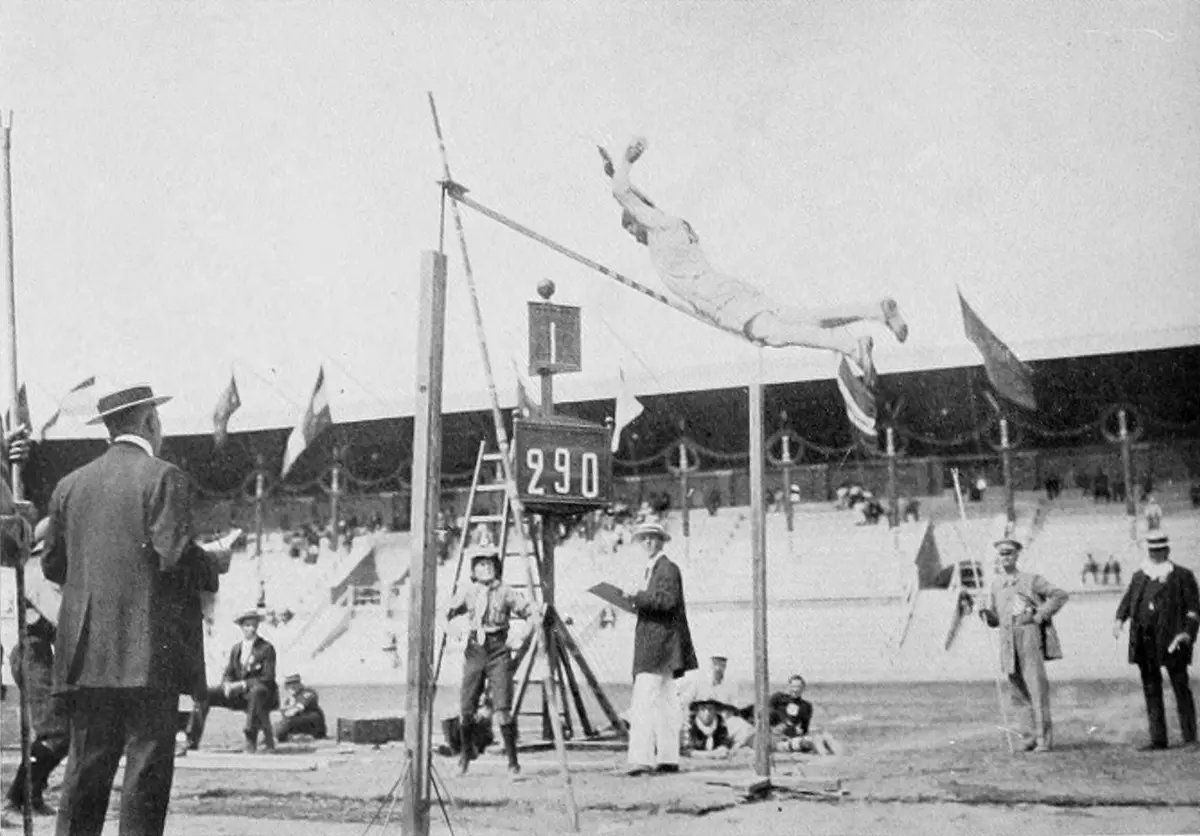
Thorpe clears the bar in the decathlon pole vault at Stockholm Olympic Stadium, July 1912. Official Report of the Stockholm 1912 Olympic Games. The last race
One event is left, the 1,500 metres. Thorpe already leads by more than 650 points. He wins the race anyway, in 4:40.1, the fastest time in the field. His total is 8,412 points, a world record, and 688 points ahead of Sweden’s Hugo Wieslander. Between his two golds he has also placed fourth in the Olympic high jump and seventh in the long jump.
Thanks, King
King Gustaf V crowns each champion with a laurel wreath. Thorpe receives his two gold medals and two challenge prizes: a bronze bust from the King for the decathlon and a jeweled Viking ship from Czar Nicholas II of Russia for the pentathlon. Carlisle’s own magazine reports what the King told him. Tradition gives Thorpe’s answer in two words: “Thanks, King.”
King Gustaf V to ThorpeYou, sir, are the greatest athlete in the world.
Ticker tape on Broadway
The Olympic team comes home to a ticker-tape parade on Broadway, and Thorpe is the star of it. Mayor William Gaynor welcomes the athletes at City Hall. The Red Man counts 25,000 marchers in New York and 10,000 more at a parade in Philadelphia. Carlisle throws its own celebration for Thorpe and Tewanima. Thorpe said later he could not understand how one fellow could have so many friends.
The Carlisle men

Sac and Fox, born in Indian Territory and schooled at Haskell and Carlisle. First-team All-American running back in 1911 and 1912. At Stockholm he won the pentathlon and the decathlon. Later starred in major league baseball and pro football.

Cornell guard turned coach who led Carlisle from 1899 to 1903 and 1907 to 1914. He built the school into a national football power, coached Thorpe in football and track, and went with him to Stockholm. He retired with 319 wins.
By the numbers
In pictures


Watch, listen, see
Films, photographs and first-hand accounts from across the web. Each opens in a new tab.
Biographer David Maraniss on Thorpe’s two Stockholm golds and their full restoration in 2022.
History in Five
NFL Films profiles Thorpe, number 37 on its list of the NFL’s 100 greatest players.
NFL Films
Biographer David Maraniss and granddaughter Anita Thorpe on his life, from Carlisle to Stockholm and beyond.
U.S. National Archives
Mayor Gaynor greets Thorpe and the Olympic team at New York City Hall, 24 August 1912.
Library of Congress
His school records, 1904 to 1913: cards, letters, photographs and news clippings, from the National Archives.
Carlisle Indian School Digital Resource Center
The Red Man’s September 1912 account of Thorpe and Tewanima, with the King’s words.
ExplorePAhistory.com
Full results of the first Olympic decathlon: 29 athletes, ten events, Thorpe first with 8,412 points.
Olympedia
His Hall of Fame biography: Canton Bulldogs star, first league president, charter member in 1963.
Pro Football Hall of Fame“The history of college and professional football, world decathlon and pentathlon competition, and major league baseball is permanently enriched by the contributions of this noble American.”
President Richard Nixon, Proclamation 4209, Jim Thorpe Day, 16 April 1973
After
In January 1913 newspapers reported that Thorpe had been paid to play minor league baseball in North Carolina in 1909 and 1910. The Olympic rules of the day barred paid athletes, and the IOC took back his medals. Thorpe turned professional and signed with the New York Giants, the National League champions.
He starred in pro football for the Canton Bulldogs, who paid him $250 a game. In 1920 the founders of the American Professional Football Association, soon renamed the NFL, made him its first president. In 1950 the Associated Press named him the greatest athlete of the half-century, and in 1963 he entered the Pro Football Hall of Fame in its first class.
In 1982 the IOC restored his medals, and in January 1983 it presented commemorative golds to two of his children. On 15 July 2022, 110 years to the day after his decathlon win, the IOC announced it would recognize Jim Thorpe as the sole champion of both events. In 2024 he was awarded the Presidential Medal of Freedom.
Primary sources