Olympic Stadium, Berlin · 4 August 1936 · Jesse Owens and the U.S. track team
The Fastest Man on Earth
A sharecropper’s son from Alabama walked into Hitler’s Olympic stadium and won four gold medals in seven days.

The moment · Long jump qualifying · 4 August 1936
Owens holds the world record, and he has fouled twice. One jump is left. Foul again and he is out of the long jump. He sprints down the runway and takes off. 7.64 metres, nearly half a metre past the mark. He is through.
In 1936 Nazi Germany hosted the Olympic Games and staged them as a showcase for its regime and its idea of a master race. The United States sent 312 athletes. One was a 22-year-old from Ohio State, the son of Alabama sharecroppers. In one week in Berlin, Jesse Owens beat the fastest men in the world and the best the host nation had.
The sharecropper’s son
James Cleveland Owens is born on 12 September 1913 in Oakville, Alabama, the ninth of ten children of sharecroppers Henry and Emma Owens. After World War I the family moves north to Cleveland. A teacher hears his name, J.C., as Jesse, and it sticks. His junior high coach, Charles Riley, lets him train before school because he works after it. By 1933, still in high school, he has tied the world record for 100 yards: 9.4 seconds.
A bad back at Ann Arbor
Five days before the Big Ten championships, Owens tumbles down a flight of stairs. His back is so stiff he has to be helped into the rumble seat of coach Larry Snyder’s car, and at Ferry Field he cannot even jog. Snyder asks if he wants to scratch. Owens says he will try the 100-yard dash and see. He runs it in 9.4 seconds and ties the world record.
Owens, recalling the start of the 100When I got down on my marks and the starter said, ‘set,’ there was suddenly no more pain.
Forty-five minutes
Ten minutes later Owens takes one long jump and lands 26 feet 8¼ inches out. It is a world record, the first jump ever past eight metres, and it stands for 25 years. He wins the 220-yard dash in 20.3 seconds and the 220-yard low hurdles in 22.6, both world records that also count at the metric distances. By 4:00 p.m. he has five world records and a tie. A Michigan student named Gerald Ford is in the stands.
Ten point three
Owens ties the Olympic record of 10.3 seconds in his first heat and runs a wind-aided 10.2 in the quarterfinal. In the final he is clear of the field within 30 metres. Ralph Metcalfe, the silver medalist in 1932, closes hard from behind but cannot catch him. Owens wins in 10.3. Metcalfe takes silver in 10.4, and Frank Wykoff is fourth. Germany’s best sprinter, Erich Borchmeyer, finishes fifth.
One jump left
It is the busiest day of his week: two rounds of the 200 metres, at 10:30 and 15:30, and the whole long jump competition. The qualifying mark is 7.15 metres, and Owens holds the world record at 8.13. He fouls his first jump. He fouls his second. On his third and last try he lands 7.64 metres out and goes through to the final. He wins both 200 metre heats too.
The duel with Luz Long
Germany’s Luz Long, the European record holder, pushes Owens round after round with Hitler in the stadium. In the fifth round Long ties Owens’s best at 7.87 metres. Owens goes 7.94 in the same round. On his last jump he flies 8.06 metres, an Olympic record. Long is the first to congratulate him. The two pose for photographs together and walk off arm in arm.
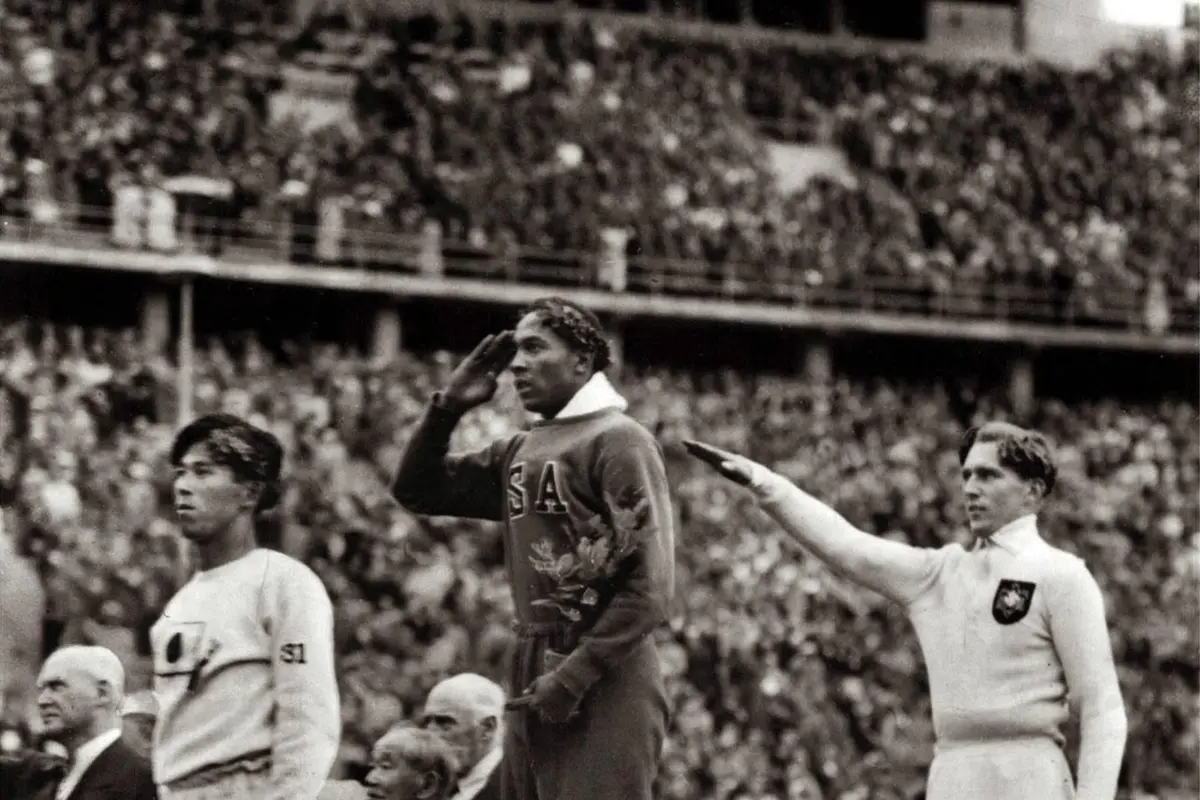
The long jump medal ceremony, Berlin, 4 August 1936: Owens salutes the flag between Naoto Tajima of Japan, third, and Luz Long of Germany, second. Associated Press. Around the turn
Owens wins all four rounds of the 200 metres. In the final he runs 20.7 seconds around the turn, an Olympic record and easily the fastest 200 metres anyone has run. He finishes four metres ahead of Mack Robinson, the brother of Jackie Robinson, with Tinus Osendarp of the Netherlands third. It is Owens’s third gold medal in three days, and he has not lost a race in Berlin.
Thirty-nine point eight
Head coach Lawson Robertson puts Owens and Metcalfe on the 4×100 relay with Foy Draper and Frank Wykoff. Owens leads off. Metcalfe runs second, Draper third, and Wykoff, winning his third straight Olympic relay gold, brings it home in 39.8 seconds. It is a world record, and it stands for 20 years. Italy finishes 1.3 seconds back and Germany is third. Owens has his fourth gold medal.
The men

Born in Oakville, Alabama, to sharecroppers and raised in Cleveland. Won a record eight individual NCAA titles in two seasons for Ohio State. In Berlin he ran ten races, won all ten, and took four gold medals in seven days.

Canton, Ohio, native and World War I flight instructor who hurdled for Ohio State, then coached there from 1932 to 1965. He refined Owens’s technique and got him to the line at Ann Arbor. His athletes set 14 world records.

Atlanta-born, Chicago-raised sprinter who won silver in the 100 metres and bronze in the 200 at the 1932 Olympics. In Berlin he took silver behind Owens and ran the relay’s second leg to a world record. Later an Army officer and congressman.
By the numbers
In pictures


Watch, listen, see
Films, photographs and first-hand accounts from across the web. Each opens in a new tab.

Olympic film of Owens winning the 100, the 200, the long jump and the relay in 1936.
Olympic Games
Owens, at Berlin’s Olympic Stadium, explains what goes through a sprinter’s mind.
Olympic Games
Period newsreel of Owens in the relay, the sprints and the long jump, and on the podium.
British MovietoneArchival film of Owens winning the Olympic 100 metres in Berlin in 10.3 seconds.
U.S. Holocaust Memorial MuseumHow eighteen Black Americans went to the 1936 Games and brought home 14 medals.
U.S. Holocaust Memorial MuseumA virtual exhibit that walks through each of Owens’s four gold medal events in Berlin.
U.S. Olympic & Paralympic Museum
Ohio State’s online exhibit of Owens’s life, with photographs from the university archives.
Ohio State University LibrariesPresident Ford’s 1976 tribute to Owens, whom he had watched set records at Ann Arbor in 1935.
The American Presidency Project“One American athlete in particular proved that excellence knows no racial or political limits. That man is Jesse Owens.”
President Gerald R. Ford, presenting the Presidential Medal of Freedom, 5 August 1976
After
On 3 September 1936, New York gave Owens and the Olympic team a ticker-tape parade up Broadway. In 1950 an Associated Press poll named him the greatest track and field athlete of the half-century.
He spent the rest of his life as a speaker, youth leader and goodwill ambassador, sent abroad on tours under President Eisenhower. In 1951 he went back to the Olympic Stadium in Berlin, and the crowd stood and cheered when he urged it to stand fast with us for freedom and democracy.
President Ford awarded him the Presidential Medal of Freedom in 1976. He died in 1980. Ten years later President George H. W. Bush presented his widow, Ruth, with the Congressional Gold Medal and called it Jesse Owens’ fifth gold medal.
Primary sources
- The Nazi Olympics: Berlin 1936. U.S. Holocaust Memorial Museum, Holocaust Encyclopedia.
- Athletics at the 1936 Summer Olympics: Long Jump, Men. Olympedia.
- Remarks to Members of the U.S. Olympic Team and Presentation of the Presidential Medal of Freedom to Jesse Owens, President Gerald R. Ford, 5 August 1976. The American Presidency Project.