Nenana to Nome, Alaska · 27 January – 2 February 1925 · Twenty mushers and their dogs
The Great Race of Mercy
Diphtheria in Nome. No good serum, no airplane that could fly, and 674 miles of frozen trail. Twenty mushers and about 150 dogs ran it in 127½ hours.

The moment · 05:30 · 2 February 1925
Gunnar Kaasen drives his thirteen dogs down Front Street in the dark. Seven and a half hours out of Bluff, through a blizzard that flipped his sled and buried the trail, Balto has kept them on course. The serum is in Nome.
I gave Balto, my lead dog, his head and trusted to him. He never once faltered.Gunnar Kaasen, to United Press, February 1925
In January 1925 diphtheria broke out in Nome, a gold-rush town of 1,429 on the Bering Sea. Its one doctor had only expired antitoxin. The sea was frozen and Alaska’s few airplanes were open-cockpit biplanes, taken apart for the winter. The nearest serum was 674 miles of trail away, at the railhead in Nenana. Alaska sent its dog teams.
The strangling angel
Dr. Curtis Welch, Nome’s only physician, diagnoses diphtheria in a three-year-old boy. The disease closes a child’s throat with a leathery membrane, and it spreads fast. Welch’s 24-bed hospital holds just 8,000 units of antitoxin, dated 1918. The last ship of the season sailed months ago. The nearest railroad ends at Nenana, 674 trail miles away. The next evening the town council orders a quarantine.
Wire for help
Welch telegraphs the territory’s towns, Governor Scott Bone in Juneau and the U.S. Public Health Service in Washington. In Anchorage, Dr. John Beeson of the Alaska Railroad hospital finds 300,000 units and packs them: glass vials in quilts, in a metal cylinder, about 20 pounds. Flying it is ruled out in the cold and dark. Governor Bone gives the job to the mail drivers and their dogs.
Dr. Welch to Washington, 22 January 1925An epidemic of diphtheria is almost inevitable here STOP I am in urgent need of one million units of diphtheria antitoxin STOP Mail is only form of transportation STOP
Wild Bill Shannon
The train from Anchorage pulls into Nenana and the conductor hands the package to Wild Bill Shannon. He sets off with nine dogs down the frozen Tanana River, running beside the sled to stay warm as the cold falls past 50 below. He reaches Minto at 3 a.m. with his face blackened by frostbite, rests four hours, and finishes his 52 miles at Tolovana.
The mail carriers
Edgar Kalland runs the next 31 miles to Manley Hot Springs, where the roadhouse keeper pours hot water over his hands to free them from the handlebar. Then Dan Green, Johnny Folger, Sam Joseph, Titus Nikolai, Dave Corning, Harry Pitka, Bill McCarty and Edgar and George Nollner carry it on, day and night, about 30 miles each. Many are Athabaskan mail carriers who run these trails all winter.
Sixty-four below
Charlie Evans leaves Bishop Mountain at 5 a.m. into ice fog off the Koyukuk River at 64 below. Two of his dogs freeze. He leads the team into Nulato himself. Tommy Patsy runs 36 miles to Kaltag in three and a half hours, the fastest leg of the run. Jackscrew crosses the portage, Victor Anagick reaches Unalakleet at 3:30 a.m., and Myles Gonangnan drives 40 miles through a whiteout to Shaktoolik.
Seppala turns around
Leonhard Seppala has mushed some 170 miles out from Nome to meet the serum. Just outside Shaktoolik, Henry Ivanoff flags him down and hands it over. Seppala turns his twenty huskies into a gale and takes the short cut: about 20 miles of sea ice across Norton Bay, in the dark, with 12-year-old Togo in lead. They reach Isaac’s Point at 8 p.m., 84 miles in one day.
Over the ice and the mountain
At 2 a.m. Seppala heads back out into winds near 65 miles an hour. He runs the pack ice along the shore as it starts to break up, then climbs over Little McKinley and drops into Golovin that afternoon. His 91 miles with the serum are the longest leg of the relay. Charlie Olson takes it 25 miles to Bluff, blown off the trail and frostbitten on the way.
Balto
Gunnar Kaasen leaves Bluff with thirteen of Seppala’s dogs and Balto in lead. Snow drives so hard he cannot always see the dogs nearest the sled. Balto keeps the trail over Topkok and right past Solomon, where a message is waiting for Kaasen to stop. A gust flips the sled and throws the serum into a drift. Kaasen digs for it with bare hands, finds it and drives on.
Front Street
At Point Safety the relief driver is asleep, expecting Kaasen to wait out the storm. Kaasen drives on. At 5:30 a.m. his team pulls up on Front Street. The serum is frozen solid. Dr. Welch thaws it, and that night he uses nearly 40,000 units on his patients. Nenana to Nome, 674 miles, has taken 127½ hours.
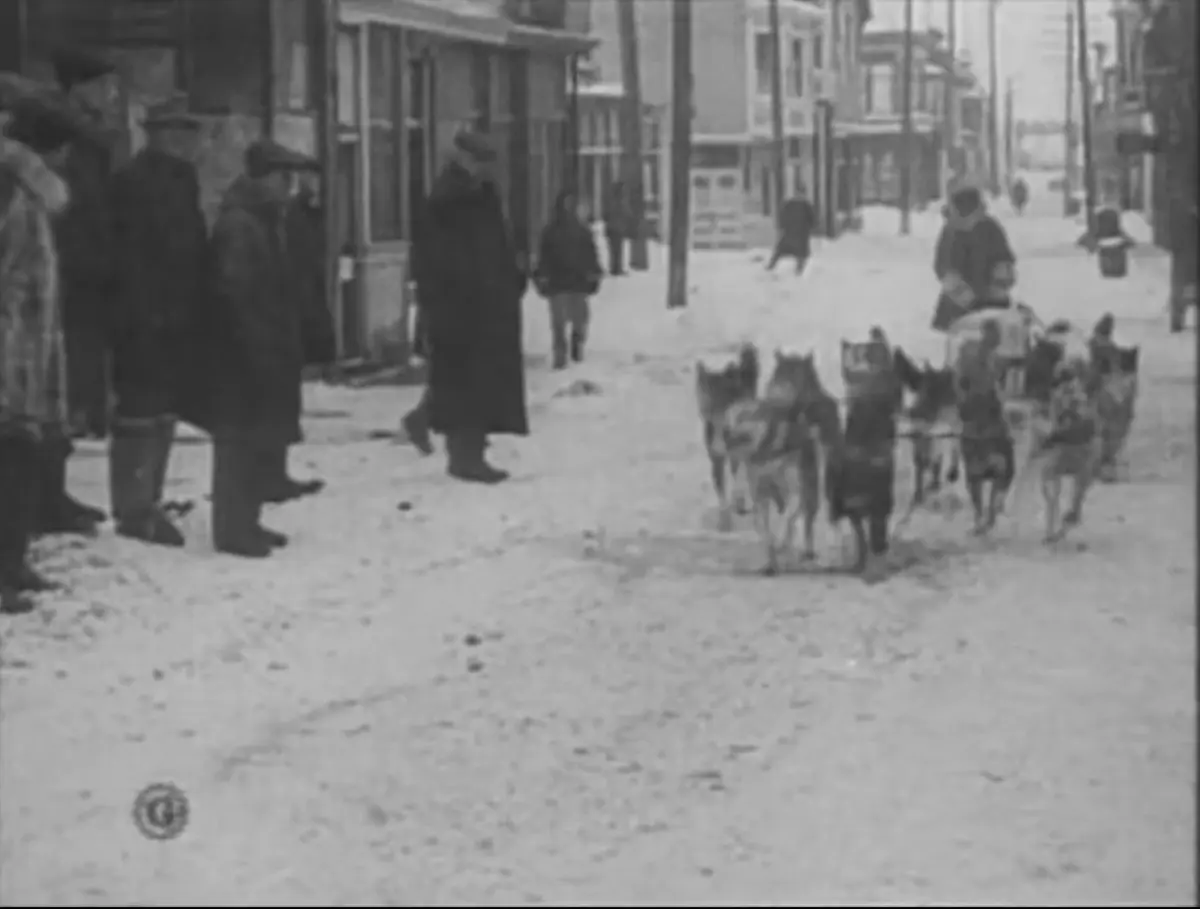
Kaasen’s team on Front Street, Nome, filmed for a Gaumont newsreel later on the day the serum arrived, 2 February 1925.. Gaumont newsreel / Cleveland Museum of Natural History collection. Seward Daily Gateway, 3 February 1925The distance from Nenana to Nome was made in 127 and a half hours.

The mushers and the doctor

Norwegian-born Alaskan who came to Nome in the 1900 gold rush and won the All Alaska Sweepstakes three years running. With 12-year-old Togo in lead, he carried the serum 91 miles across Norton Bay’s ice and ran about 260 miles that week.

Norwegian-born Alaskan who came to Nome in 1903 for the gold. Behind lead dog Balto he drove 53 miles through a blizzard, dug the spilled serum out of a drift bare-handed, and brought it into Nome at 5:30 a.m.

Nome’s only doctor, with four nurses and a 24-bed hospital. He diagnosed diphtheria, quarantined the town and wired for help. When the frozen serum arrived he thawed it and began treating patients that day.

Athabaskan musher, 21 years old. He ran 30 miles through ice fog off the Koyukuk River at 64 below, the coldest reading of the relay. When two of his dogs froze, he led the team into Nulato on foot.
By the numbers
In pictures


Watch, listen, see
Films, photographs and first-hand accounts from across the web. Each opens in a new tab.

Newsreel shot in Nome the day the serum arrived: Kaasen’s team on Front Street and Dr. Welch receiving it.
Gaumont / Cleveland Museum of Natural History
A 1970s Alaskan film retelling the 1925 relay, from the University of Alaska Fairbanks film archive.
Alaska Film Archives, UAF
The Seward Daily Gateway front page of 3 February 1925: Kaasen’s arrival, 127½ hours from Nenana.
Library of Congress
Governor Scott Bone’s correspondence on the relay, January and February 1925, digitized in full.
Alaska State Archives
The museum that has kept Balto since 1927 tells his story, with photos of Kaasen and the team.
Cleveland Museum of Natural History
Frederick Roth’s bronze, unveiled on 17 December 1925 with Kaasen and Balto there to see it.
Central Park Conservancy
The winter trail system that carried the serum’s last miles to Nome, a National Historic Trail since 1978.
Bureau of Land ManagementThe Alaska Science Forum on the relay, the cold, and the dogs that went where airplanes could not.
UAF Geophysical Institute“Dedicated to the indomitable spirit of the sled dogs that relayed antitoxin six hundred miles over rough ice, across treacherous waters, through Arctic blizzards from Nenana to the relief of stricken Nome in the winter of 1925. Endurance · Fidelity · Intelligence.”
Inscription on the statue of Balto, Central Park, New York, 1925
After
The serum held the epidemic. A second shipment of 1.1 million units followed by train and dog team and reached Nome on 15 February. Six days later Nome lifted its quarantine. Newspapers across the country had followed the relay leg by leg, and its mushers came home heroes.
On 17 December 1925 New York unveiled a bronze of Balto in Central Park, with Kaasen and Balto there for the ceremony. Balto lived out his life in Cleveland, where schoolchildren and workers raised the money to bring him and his teammates home in 1927. He stands today in the Cleveland Museum of Natural History. Togo is preserved at Iditarod headquarters in Wasilla.
In 1978 Congress made the Iditarod a National Historic Trail. Every March since 1973, the Iditarod Trail Sled Dog Race has run nearly 1,000 miles to Nome, and it honors the twenty mushers of 1925 who showed what men and dogs can do.
Primary sources
- Iditarod National Historic Trail: Historic Overview. U.S. Bureau of Land Management.
- “Antitoxin Reaches Nome; Fierce Storm.” Seward Daily Gateway, 3 February 1925. Library of Congress, Chronicling America.
- Governor Scott C. Bone’s correspondence files on the 1925 Serum Run to Nome, January to February 1925. Alaska State Archives.