Barnett Shale to the Permian Basin · 12 September 2018 · Mitchell, Steinsberger, Nichols, Hamm
This Is Huge
A Galveston wildcatter spent seventeen years on rock the experts called worthless. One engineer’s cheap water recipe cracked it, and the United States became the largest oil producer the world has ever seen.

The moment · 1998 · S.H. Griffin Estate No. 4, near Justin, Texas
Ten frac pumps crowd a three-acre pad north of Fort Worth. Nick Steinsberger has one more chance. This time he starts the sand thin and feeds in more as the water runs, a mile and a half down into the Barnett. Then the pressure climbs.
We saw the pressure was going up and up and up and up, and we were excited.Nick Steinsberger, recalling the Griffin well frac
For decades American oil output fell. By 2008 it was down to 5 million barrels a day, the lowest since 1946, and the country had been importing more than 12 million barrels a day as recently as 2005. Deep under North Texas lay the Barnett Shale, full of gas the experts said could never be produced at a profit. A Galveston wildcatter spent seventeen years proving them wrong.
Washington studies the shale
The federal Energy Research and Development Administration launches the Eastern Gas Shales Program in 1976, and the new Department of Energy carries it on from 1978. Labs, universities and gas companies core, log and fracture the shales of Appalachia to learn how much gas they hold. Sandia National Laboratories builds receivers that listen to rock cracking far underground, early work on the microseismic fracture mapping shale drillers use today.
The C.W. Slay No. 1
Mitchell Energy’s big North Texas gas field, Boonsville Bend, will not last forever, and George Mitchell needs new gas to fill a long-term pipeline contract. Below the field lies a thick, tight layer called the Barnett Shale. In 1981 his crew drills the C.W. Slay No. 1 into it and fractures the rock that September. Mitchell tells his shale team that if they don’t think they’re capable, he will find people who are.
A quarter of a billion dollars
Mitchell deepens 41 wells into the Barnett between 1981 and 1986 and makes Barnett producers of 20. Through 1997 the company puts about a quarter of a billion dollars into the play, and the Barnett runs in the red the whole time. The thick gel fracs often cost more than the drilling. In 1995 a young engineer named Nick Steinsberger takes charge of the wells and is told to expect thirty or forty more, then the end.
A tip at the ballgame
At a Texas Rangers game, Steinsberger falls in with engineers from Union Pacific Resources. In the Cotton Valley formation of East Texas they are fracturing wells with water instead of gel, a slick-water frack, at about half the cost. Late in 1996 he takes the idea to Mitchell’s executives in The Woodlands. If it fails, he argues, they can frac again with gel. All they lose is time and some water. He gets three wells.
Three failures
The first slickwater frac in the Barnett is pumped in May 1997. All three test wells screen out. The thin water drops its sand near the hole, the pressure spikes, and Steinsberger shuts the jobs down early to save the casing. Months later the wells produce no better than gel wells. “They were all failures,” he says. That winter, with prices falling, he goes back to The Woodlands and asks for three more wells. He gets them.
Start thin, then build
On a three-acre pad north of Fort Worth, about ten frac pumps line up beside a well a mile and a half deep. This time Steinsberger changes the recipe. He starts with a little sand and raises the concentration as the water goes down. The job places 229,000 pounds of sand. The well costs $600,000 to $700,000 and averages a million cubic feet of gas a day, the best well Mitchell has ever completed.
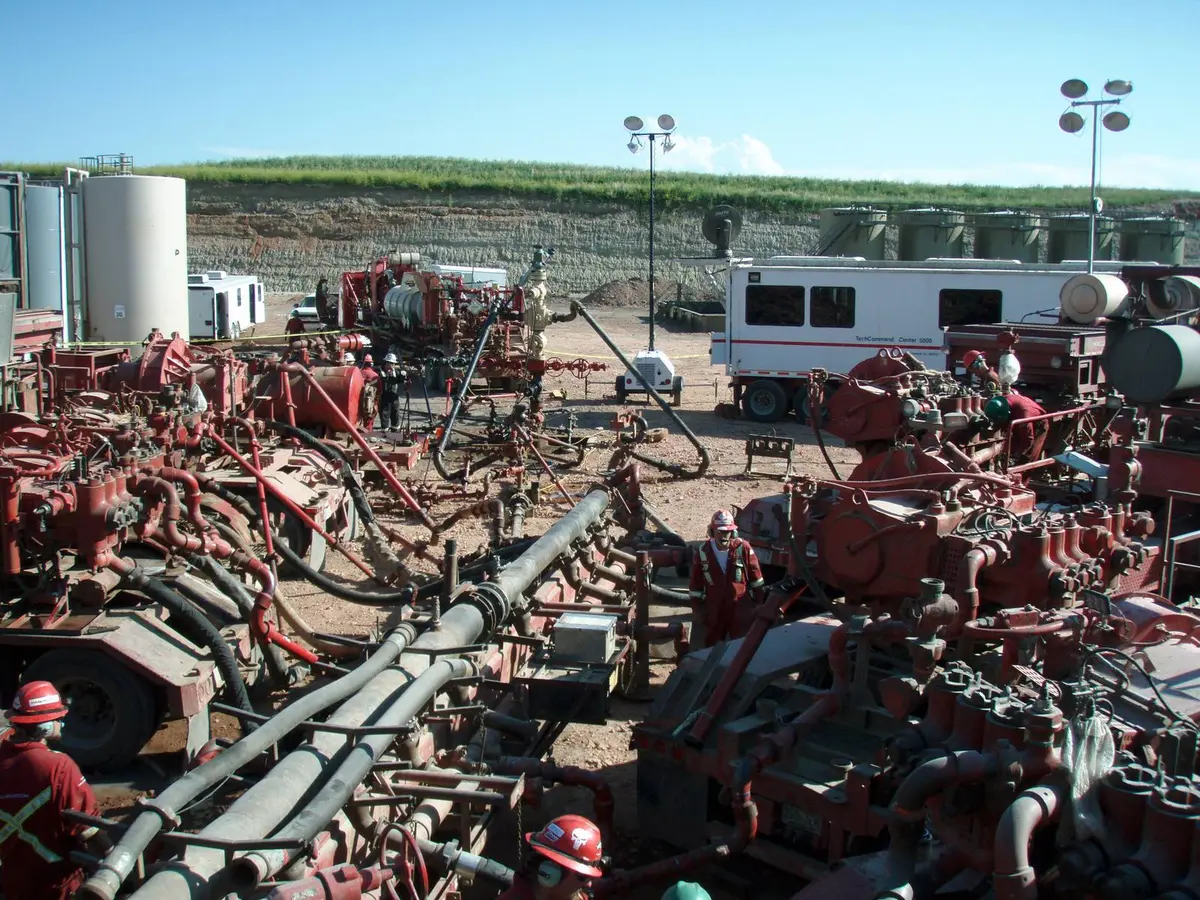
A frac crew at work on a fracture job on a Bakken well in North Dakota, August 2011. Joshua Doubek / Wikimedia Commons. George Mitchell, reading the Griffin well’s numbersThis is huge.
Turn the drill sideways
Mitchell makes slickwater fracs the standard across the Barnett in September 1998. In January 2002 Devon Energy, led by Larry Nichols, closes its $3.5 billion purchase of the company and pairs the new frac with horizontal wells. Its first five horizontals, spudded in 2002, outperform anything yet seen in the Barnett. Three start at more than three and a half times the rate of Mitchell’s vertical wells. In 2003 another 25 operators file for more than 100 horizontal permits.
The Robert Heuer 1-17R
Harold Hamm’s Continental Resources has already proved horizontal drilling at Cedar Hills, discovered in 1995, the first field developed entirely with horizontal wells. Now it takes the method into the Bakken shale. The Robert Heuer 1-17R becomes the first commercially successful North Dakota Bakken well both drilled horizontally and fractured. North Dakota produces 98,000 barrels of oil a day in 2005. By 2014 it produces more than a million.
Number one
The U.S. Energy Information Administration reports that the United States has likely passed Russia and Saudi Arabia as the world’s largest crude oil producer. American output topped Saudi Arabia’s in February for the first time in more than two decades, and Russia’s in June and August for the first time since 1999. For the year, U.S. production averages 11 million barrels a day, breaking the record set in 1970.
EIA, Today in EnergyThe United States is now the largest global crude oil producer.
The wildcatters

Galveston-born son of a Greek immigrant who had tended goats before coming to America. First in his Texas A&M petroleum engineering class, he co-founded his oil company in 1947 and spent seventeen years and a fortune proving the Barnett would pay.

University of Texas petroleum engineer, class of 1987, hired by Mitchell during an oil bust. Took charge of the Barnett wells in 1995 and was told the play would likely be dropped. His slickwater frac on the S.H. Griffin made shale gas pay.

Princeton geologist and Michigan lawyer who clerked for Chief Justice Earl Warren, then built Devon Energy with his father. He bought Mitchell Energy for $3.5 billion in 2002, and Devon paired slickwater fracs with horizontal wells.

Youngest of thirteen children of Oklahoma cotton sharecroppers. Pumped gas at 16 and founded his own oil company at 21. Proved horizontal drilling at Cedar Hills in 1995, then made the North Dakota Bakken pay in 2004.
By the numbers
In pictures


Watch, listen, see
Films, photographs and first-hand accounts from across the web. Each opens in a new tab.
Nick Steinsberger returns to the S.H. Griffin No. 4 and tells how his slick-water frac worked.
NPR Planet Money
The September 2018 report that U.S. crude output had passed Russia and Saudi Arabia.
U.S. Energy Information Administration
Record 2025 output of 13.6 million barrels a day, America’s eighth straight year on top.
U.S. Energy Information Administration
From the first Sabine Pass cargo in 2016 to 15 billion cubic feet a day in 2025.
U.S. Energy Information Administration
A 2012 satellite view of North Dakota’s oil patch, lit up by drilling rigs and crew camps.
NASA Earth ObservatoryThe life of the Galveston-born engineer whose company made shale gas pay.
Texas State Historical Association
Dan Steward, on the Barnett team from 1981 to 2001, recounts how Mitchell Energy cracked the shale.
Journal of Petroleum Technology
From Civil War-era well torpedoes to George Mitchell’s Barnett Shale, the story of fracturing rock.
American Oil & Gas Historical Society“U.S. crude oil production powered by shale development has turned the United States into not just the world’s largest producer, but the largest producer of crude oil ever.”
U.S. Energy Information Administration, 9 July 2026
After
On 24 February 2016 the tanker Asia Vision sailed from Sabine Pass, Louisiana, with 3.3 billion cubic feet of liquefied natural gas bound for Brazil, the first export cargo of the shale era. In 2019 America exported more energy than it imported for the first time in 67 years. In 2020 it became a net exporter of petroleum for the first time since at least 1949.
In 2025 the United States produced a record 13.6 million barrels of crude a day, its eighth straight year as the world’s top producer and about 40% more than either Russia or Saudi Arabia. It shipped 15 billion cubic feet of gas a day as LNG, more than any other nation. In 2023 about 64% of American crude came straight from shale and other tight rock.
George Mitchell died in Galveston on 26 July 2013, at 94. Nick Steinsberger kept fracturing wells, and twenty years after his slickwater frac the Griffin well was still producing gas. Harold Hamm’s Continental Resources became one of the largest leaseholders and producers in North Dakota.
Primary sources
- The United States is now the largest global crude oil producer. U.S. Energy Information Administration, Today in Energy, 12 September 2018.
- Dan B. Steward, “George P. Mitchell and the Barnett Shale.” Journal of Petroleum Technology, 2013.
- Loren C. Steffy, George P. Mitchell: Fracking, Sustainability, and an Unorthodox Quest to Save the Planet. Texas A&M University Press.