Black Hills, South Dakota · 1927–1941 · Gutzon Borglum and 400 workers
The Shrine of Democracy
Four presidents, sixty feet high, blasted and drilled out of a granite mountain by local men in the depths of the Depression. Fourteen years. Not one death.

The moment · About 14:30 · 30 August 1936
The president’s car pulls up below the mountain. Thomas Jefferson’s face looks out of the granite, sixty feet high, finished. Franklin Roosevelt has not planned to speak. Gutzon Borglum asks him to dedicate the memorial. Roosevelt speaks from his car.
I had had no conception until about ten minutes ago not only of its magnitude but of its permanent beauty and of its permanent importance.President Franklin D. Roosevelt
In 1923 South Dakota’s state historian wanted something that would draw Americans to the Black Hills. The sculptor he wrote to had a bigger idea: the four presidents who stood for the founding, expansion, preservation and development of the nation, carved into a mountain. It took fourteen years, most of a million dollars from Congress, and a crew of local men trained on the job.
An idea for the Black Hills
Doane Robinson, South Dakota’s state historian, proposes carving giant figures in the Black Hills. In 1924 he writes to Gutzon Borglum, then carving a mountain in Georgia, and invites him west. Borglum comes that September with his 12-year-old son, Lincoln. The rock of the Needles is not fit for carving. On a second trip in August 1925, Borglum picks a broad wall of granite on 5,725-foot Mount Rushmore, facing the sun.
A cornerstone laid by the Almighty
President Calvin Coolidge is spending the summer in the Black Hills. Borglum flies over his lodge and drops a wreath to invite him to the mountain. Coolidge rides up on horseback, saluted by 21 dynamite blasts that clear stumps for the new road. He calls it a “distinctly national monument” and hands Borglum a set of drill bits. The ceremonial drilling begins.
President Coolidge, at the mountainWe have come here to dedicate a cornerstone that was laid by the hand of the Almighty.
An inch to a foot
Real drilling starts. Borglum builds his models at one inch to the foot. On top of each head the crew sets a giant protractor with a 30-foot arm and a plumb bob. Pointers measure the model, multiply by twelve, and paint the marks on the stone, one every six inches. That is how local men with no training in sculpture put every feature exactly where Borglum wanted it. In 1929 Congress puts up $250,000 to keep going.
Washington
Borglum runs double shifts and sixteen-hour days to have the first face ready by Independence Day. An American flag hangs over Washington’s head. Doane Robinson’s grandson presses a button that buzzes the winch house on top, and the cables reel the flag in while four men in sling chairs, Red Anderson, Merle Peterson, Walt Wilkerson and Jack Payne, walk it smoothly up the face.
The men in the chairs
Every morning the crew climbs 700 stairs to punch the clock on top. Steel cables three-eighths of an inch thick lower them over a 500-foot face in bosun chairs, cranked by hand from the winch houses. Call boys at the edge shout every move. Powdermen cut charges to take off exact amounts of rock, to within three to six inches of the finished surface. Then drillers honeycomb the granite, and carvers smooth it with bumper tools.
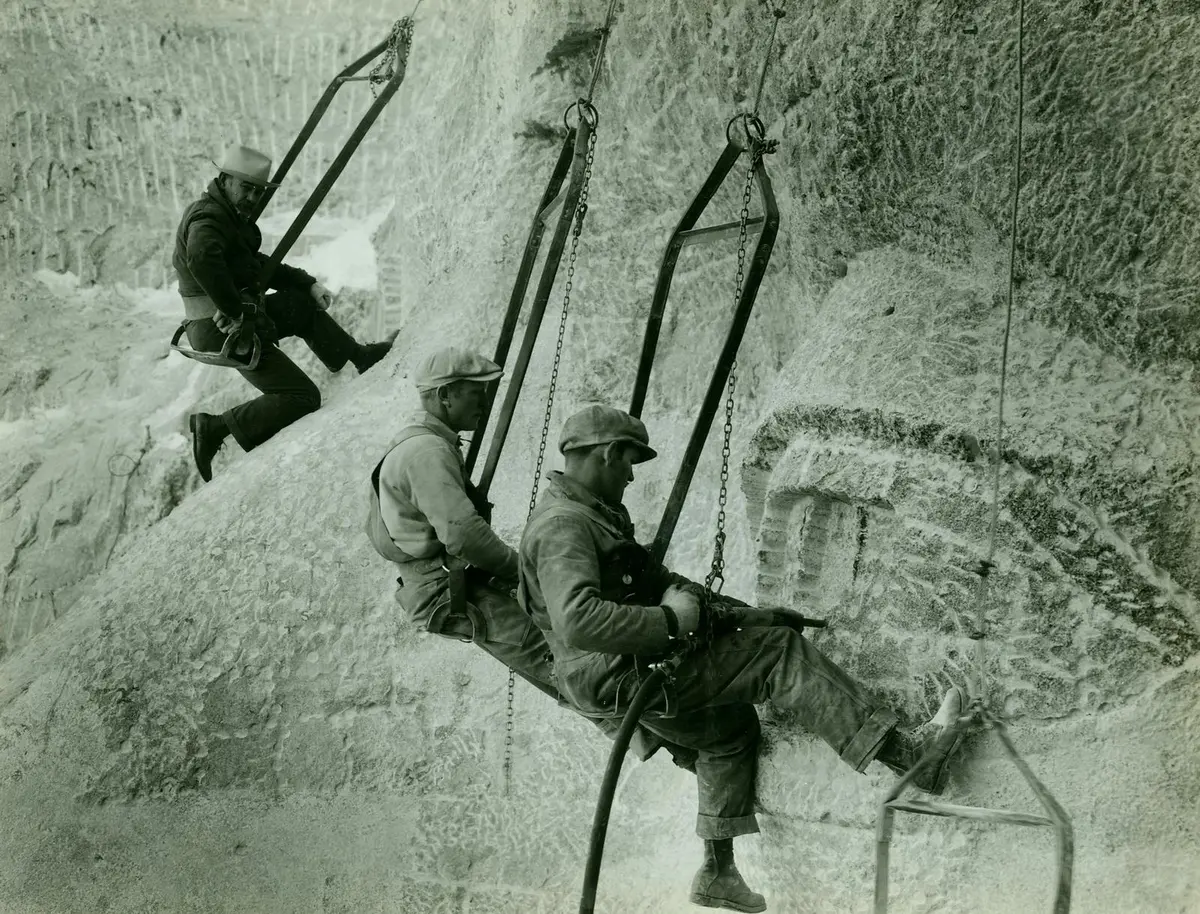
Drillers in bosun chairs work the granite, each man hung on a steel cable from a hand-cranked winch at the top of the mountain, photographed by Charles D'Emery.. Charles D'Emery / National Park Service, Mount Rushmore National Memorial. Jefferson starts over
Jefferson was begun on Washington’s right. The granite there is cracked. Borglum makes the hard call: he blasts the first Jefferson off the mountain and starts a new one on Washington’s left. Theodore Roosevelt now has to fit between Jefferson and Lincoln, and to find sound rock for him the crew cuts about 120 feet back into the mountain.
A Shrine to Democracy
The Jefferson head is done, and President Franklin Roosevelt is in the Black Hills. He arrives at 2:30 and does not plan to speak. Borglum, at the podium, asks him to dedicate the memorial as a Shrine to Democracy. Roosevelt speaks from his car. In the front row sits Senator Peter Norbeck, the carving’s great champion in Congress, ill with cancer, on his last visit to the mountain.
President Roosevelt, from his carI had had no conception until about ten minutes ago not only of its magnitude but of its permanent beauty and of its permanent importance.
Lincoln and Roosevelt
Lincoln is unveiled on 17 September 1937, the 150th anniversary of the Constitution. A bugler on Washington’s head plays taps, the flag lifts off Lincoln’s face, and the Fourth Cavalry Band, standing on top of his head, plays the national anthem. On 2 July 1939, before 12,000 people, floodlights reveal Theodore Roosevelt, his spectacles a single ridge of stone across his nose.
The last drilling
Gutzon Borglum dies in Chicago on 6 March 1941, days before his 74th birthday, with the faces nearly done. His son Lincoln takes over. Lincoln Borglum and the crew refine the four faces until the money runs out. On 31 October the last drilling is done. Thirty-seven days later comes Pearl Harbor. The faces look today exactly as they did that afternoon.
The builders

Idaho-born son of a Danish immigrant, trained in Paris, he carved the marble head of Lincoln in the Capitol. He chose the mountain and the four presidents, sculpted the models, adapted the pointing machine and designed the bosun chairs.

First saw the Black Hills at 12. Worked years on the mountain without pay, rose to chief pointer and in 1938 superintendent of all work. He finished the faces after his father died and became the memorial’s first Park Service superintendent.

The “Father of Mount Rushmore.” In December 1923 he proposed a colossal carving in the Black Hills, then wrote to Borglum and invited him west. He spent years raising money and support, and spoke at the Jefferson dedication in 1936.

Two-term governor and the state’s first native-born senator. With Congressman William Williamson he wrote and pushed the bills that paid for most of the carving, and he found New Deal relief money to keep the drills running.
By the numbers
In pictures


Watch, listen, see
Films, photographs and first-hand accounts from across the web. Each opens in a new tab.

Rare travelogue footage of the carving: blasts off the cliff, scaffolding, and men at work on the faces.
Smithsonian Human Studies Film Archives
Rushmore’s drillers and carvers, fifty years on, explain the tools and techniques they used on the mountain.
South Dakota Public Broadcasting
The park tells how the sculptor’s son, a favorite of the crew, got the carving finished.
Mount Rushmore National Memorial
How unstable stone forced the sculptor to dynamite Jefferson’s first face and carve him again.
Smithsonian Channel
Spin and zoom a laser-scanned model of the four faces from CyArk’s survey with the Park Service.
CyArk
Twenty-two photographs of the carving by the photographer who rode the cables with the crews.
National Park Service
Borglum’s call for a Shrine to Democracy and the President’s unscripted remarks, 30 August 1936.
National Park Service
The park’s roll of the men and women who carved the mountain, from call boys to carvers.
National Park ServiceRead it
Dedication Address at Mount Rushmore1,041 words · Read the full text
We have come here to dedicate a cornerstone that was laid by the hand of the Almighty. On this towering wall of Rushmore, in the heart of the Black Hills, is to be inscribed a memorial which will represent some of the outstanding features of four of our Presidents, laid on by the hand of a great artist in sculpture. This memorial will crown the height of land between the Rocky Mountains and the Atlantic seaboard, where coming generations may view it for all time.
It is but natural that such a design should begin with George Washington, for with him begins that which is truly characteristic of America. He represents our independence, our Constitution, our liberty. He formed the highest aspirations that were entertained by any people into the permanent institutions of our Government. He stands as the foremost disciple of ordered liberty, a statesman with an inspired vision who is not outranked by any mortal greatness.
Next to him will come Thomas Jefferson, whose wisdom insured that the Government which Washington had formed should be entrusted to the administration of the people. He emphasized the element of self-government which had been enshrined in American institutions in such a way as to demonstrate that it was practical and would be permanent. In him was likewise embodied the spirit of expansion. Recognizing the destiny of this Country, he added to its territory. By removing the possibility of any powerful opposition from a neighboring state, he gave new guaranties to the rule of the people.
After our country had been established, enlarged from sea to sea, and was dedicated to popular government, the next great task was to demonstrate the permanency of our Union and to extend the principle of freedom to all inhabitants of our land. The master of this supreme accomplishment was Abraham Lincoln. Above all other national figures, he holds the love of his fellow countrymen. The work which Washington and Jefferson began, he extended to its logical conclusions.
That the principles for which these three men stood might be still more firmly established destiny raised up Theodore Roosevelt. To political freedom he strove to add economic freedom. By building the Panama Canal he brought into closer relationship the east and the west and realized the vision that inspired Columbus in his search for a new passage to the Orient.
The union of these four Presidents carved on the face of the everlasting hills of South Dakota will constitute a distinctly national monument. It will be decidedly American in conception, in its magnitude, in its meaning and altogether worthy of our Country. No one can look upon it understandingly without realizing that it is a picture of hope fulfilled. Its location will be significant. Here in the heart of the continent, on the side of a mountain which probably no white man had ever beheld in the days of Washington, in territory which was acquired by the action of Jefferson, which remained an unbroken wilderness beyond the days of Lincoln, which was especially beloved by Roosevelt, the people of the future will see history and art combined to portray the spirit of patriotism. They will know that the figure of these Presidents has been placed here because by following the truth they built for eternity. The fundamental principles which they represented have been wrought into the very being of our Country. They are steadfast as these ancient hills.
Other people have marveled at the growth and strength of America. They have wondered how a few weak and discordant colonies were able to win their independence from one of the greatest powers of the world. They have been amazed at our genius for self-government. They have been unable to comprehend how the shock of a great Civil War did not destroy our Union. They do not understand the economic progress of our people. It is true that we have had the advantage of great natural resources, but those have not been exclusively ours. Others have been equally fortunate in that direction. The progress of America has been due to the spirit of the people. It is in no small degree due to that spirit that we have been able to produce such great leaders. If coming generations are to maintain a like spirit, it will be because they continue to support the principles which these men represented. It is for that purpose that we erect memorials. We can not hold our admiration for the historic figures which we shall see here without growing stronger in our determination to perpetuate the institutions which their lives revealed and established.
The fact that this enterprise is being begun in one of our new states not yet great in population, not largely developed in its resources, discloses that the old American spirit still goes where our people go, still dominates their lives, still inspires them to deeds of devotion and sacrifice. It is but another illustration of the determination of our people to use their material resources to minister to their spiritual life. This memorial will be another national shrine to which future generations will repair to declare their continuing allegiance to independence, to self-government, to freedom and to economic justice. It is an inspiring phase of American life that men are willing to devote their energies to the erection of a memorial of this nature. Money spent for such a purpose is certain of adequate returns in the nature of increased public welfare.
The people of South Dakota are taking the lead in the preparation of this memorial out of their meager resources, because the American spirit is strong among them. Their effort and courage entitles them to the sympathy and support of private beneficence and the national government. They realize fully that they have no means of succeeding in the development of their state except a strong reliance upon American institutions. They do not fail to appreciate their value. There is no power that can stay the progress of such a people. They are predestined to success. Our Country is fortunate in having the advantage of their citizenship. They have been pioneers in the development of their State. They will continue to be pioneers in the defense and development of American institutions.
President Calvin Coolidge, Mount Rushmore, 10 August 1927 · Source
“It will be decidedly American in conception, in its magnitude, in its meaning and altogether worthy of our Country.”
President Calvin Coolidge, opening of work on Mount Rushmore, 10 August 1927
After
With Borglum gone and war coming, the work ended, and on 31 October 1941 Mount Rushmore was declared complete. Lincoln Borglum stayed on as its first National Park Service superintendent until 1943. The visitor center at the memorial bears his name.
The 450,000 tons of granite blasted off the mountain still lie below the faces where they fell. Park Service rope teams still go over the side, as the carvers did, to inspect the sculpture and seal its cracks. In 2010 they laser-scanned it in sub-centimeter detail, a record good enough to rebuild any face that is ever damaged.
About two million people a year come to the Black Hills to see them. Coolidge promised that the people of the future would see history and art combined to portray the spirit of patriotism. They do.
Primary sources
- Carving History, Timeline and People. Mount Rushmore National Memorial, National Park Service.
- Shrine of Democracy and Sacred Stone: Historic Resource Study, Mount Rushmore National Memorial. Paula S. Reed and Edith B. Wallace for the National Park Service, 2016.
- Address at the Dedication of Mount Rushmore, President Calvin Coolidge, 10 August 1927. Senate Report No. 1176, 70th Congress.
Keep exploring
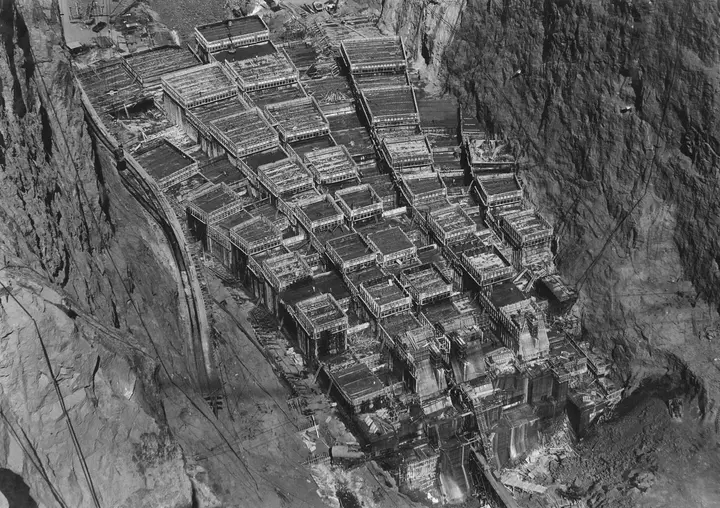
- Hoover DamPoured in the Nevada desert in the middle of the Depression and finished two years ahead of schedule.726feet high
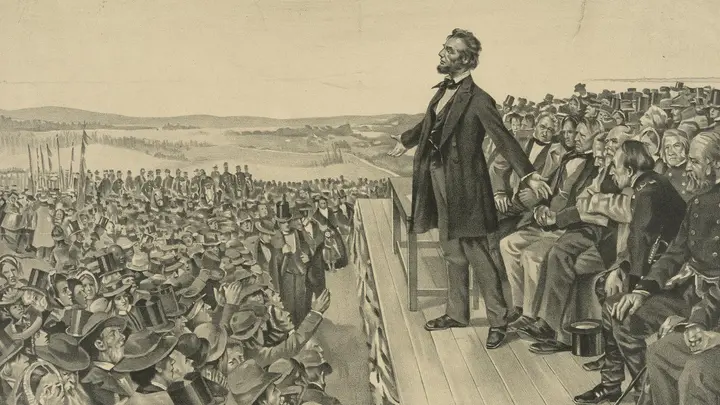
- A New Birth of FreedomLincoln spoke for about two minutes at Gettysburg and defined what the nation was for.272words
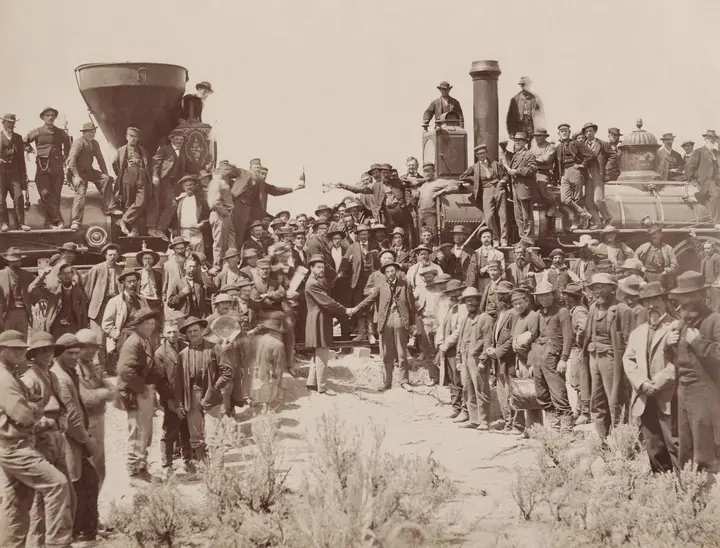
- The Golden SpikePromontory Summit, Utah. A trip that took months by wagon now took about a week.7days coast to coast
- Americans on EverestFive Americans and Sherpa Nawang Gombu reached the top of the world, and two of the Americans made the first traverse of Everest.29,032feet


Free, with no ads. Support the museum →