Peoria, Brooklyn and Normandy · 6 June 1944 · USDA scientists and 21 American drug makers
Industry Would Do It
Britain discovered penicillin but could make it only by the spoonful. A Peoria lab, a Brooklyn ice plant and 21 American companies had 2.3 million doses ready for D-Day.

The moment · 14 March 1942 · New Haven, Connecticut
New Haven Hospital. Anne Miller, 33, is dying of blood poisoning, her fever raging for weeks. A state trooper delivers a small package: 5.5 grams of penicillin, half the supply in America. She gets her first dose that day. By the next morning, the fever is gone.
In 1941 penicillin was the most promising drug on earth, and there was almost none of it. Oxford’s team grew the mold in bedpans and milk churns, and their first patient died when the supply ran out. Britain, fighting for its life, had no factories to spare. So Howard Florey brought the mold to America. Three years later it was pouring out of tanks the size of rooms.
Two scientists and a mold
Howard Florey and Norman Heatley of Oxford arrive at the USDA’s new Northern Regional Research Laboratory with a culture of Fleming’s penicillin mold. A telegram asking for the lab’s help reached director Orville May five days earlier. Work starts the next day. Robert Coghill, chief of the Fermentation Division, suggests growing the mold in big fermentation vats, and Heatley stays on to work beside microbiologist Andrew Moyer.
Corn steep liquor
Within weeks, Moyer swaps the sugar in Oxford’s recipe for lactose, and the yield climbs. Then he adds corn steep liquor, a leftover from the corn mills that the Peoria lab tries in all its fermentation work. Penicillin output jumps tenfold. Later the lab adds phenylacetic acid to push it higher still. Moyer’s lactose and steep liquor brew becomes the medium most American producers use for the rest of the war.
Industry would do it
Ten days after Pearl Harbor, A. N. Richards of the federal Committee on Medical Research calls the heads of Merck, Squibb, Pfizer and Lederle together. Coghill reports Peoria’s corn steep liquor results. George W. Merck has doubted that enough penicillin could ever be made. Now he speaks up. If the results hold in their own labs, the kilo of penicillin Florey wants can be made, and industry will do it.
Half the penicillin in America
Anne Miller, 33, is dying of blood poisoning after a miscarriage. Her doctors, John Bumstead and Orvan Hess, have tried everything. Through Yale’s John Fulton, word reaches Washington, and A. N. Richards releases 5.5 grams of penicillin, half the nation’s supply. It is flown in, and a state trooper carries it to New Haven Hospital. She gets her first dose that day. By the next morning her fever is gone. She lives to 90.
The Peoria cantaloupe
Florey’s mold makes little penicillin in deep tanks, so mycologist Kenneth Raper hunts for a better one. The Army Transport Command brings him soil from around the world, and technicians like Mary Hunt, known as Moldy Mary, comb local markets for moldy produce. The winner comes off a cantaloupe from a Peoria fruit market. X-rays at the Carnegie Institution and ultraviolet light at the University of Wisconsin breed it into far stronger strains.
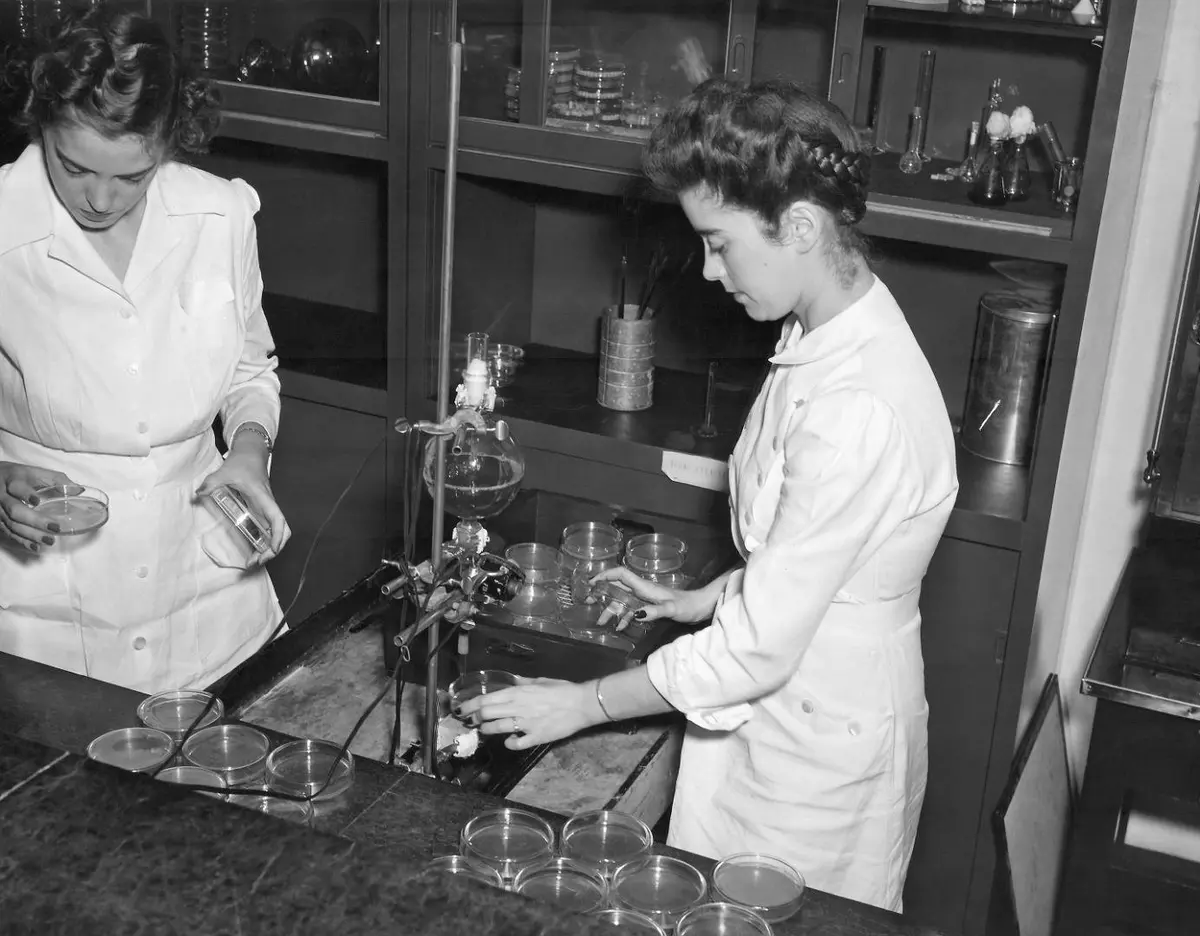
Technicians at the USDA Northern Regional Research Laboratory in Peoria test mold samples in the worldwide strain search, about 1943. Mary Hunt is believed to be on the left.. U.S. Department of Agriculture. The War Production Board takes charge
An allocation order puts every dose of penicillin under the War Production Board. The board studies more than 175 companies and picks 21. Under Albert Elder, its penicillin coordinator, they get top priority for construction materials, Elder orders filters, instruments and air-conditioning equipment ahead of need, and rival firms are pushed to share what they learn. The goal is fixed: enough penicillin for the invasion of Europe.
Albert Elder to penicillin manufacturers, 1943You are urged to impress upon every worker in your plant that penicillin produced today will be saving the life of someone in a few days or curing the disease of someone now incapacitated.
The ice plant
In 1942 Pfizer biochemist Jasper Kane proposed growing penicillin in the deep tanks Pfizer already used for other chemicals. It meant setting aside more profitable products, and vice president John L. Smith knew the odds. Pfizer took the gamble. In September 1943 it bought the old Rubel Ice Plant on Marcy Avenue, refrigeration already in place, and filled it with fourteen 7,500-gallon tanks. The world’s first large-scale penicillin plant opens and runs around the clock.
John L. Smith, PfizerThe mold is as temperamental as an opera singer, the yields are low, the isolation murder, the purification invites disaster. Think of the risks!
Ready for D-Day
When the Allies land in Normandy, 2.3 million doses of American penicillin are ready for them. Most of the penicillin that goes ashore with the invasion comes from the Marcy Avenue plant in Brooklyn. By that fall, a single day of Pfizer’s output often beats all the penicillin made in 1943. Bacterial pneumonia, which killed 18 percent of its victims in the First World War, kills fewer than 1 percent in this one.
A miracle for everyone
The government lifts its controls, and penicillin goes on sale at the corner pharmacy. By June, American plants are turning out 647 billion units a month, 1,610 times the output of June 1943 and enough to treat about 647,000 serious cases. A dose that cost $20 in July 1943 costs 55 cents by 1946. After the war, British firms switch to the American deep-tank method.
The makers

Indiana-born microbiologist with a doctorate from the University of Maryland. In Peoria he replaced sugar with lactose and added corn steep liquor, and penicillin yields jumped tenfold. Most wartime plants used his recipe. National Inventors Hall of Fame, 1987.

Seventh of eight children from a North Carolina farm, with a Harvard doctorate. He ran the Peoria lab’s mold collection and led the worldwide hunt for a better strain. The winner, NRRL 1951 from a Peoria cantaloupe, fathered the strains industry used.

Started at Pfizer as a 16-year-old lab assistant and grew up on its fermentation lines. In 1942 he proposed making penicillin in deep tanks. The Marcy Avenue plant that followed made most of the penicillin that went ashore on D-Day. Lived to 101.

University of Illinois chemist and the War Production Board’s “penicillin czar.” His program picked 21 firms out of 175, gave them top priority for materials and pushed rivals to share know-how so the D-Day supply would be there. Later president of the American Chemical Society.
By the numbers
In pictures


Watch, listen, see
Films, photographs and first-hand accounts from across the web. Each opens in a new tab.
A tour of the USDA lab in Peoria where scientists learned to mass-produce penicillin in the 1940s.
C-SPAN American History TV
USDA’s short history of how its Peoria lab launched the age of antibiotics.
USDA
A WW2 Special on penicillin’s race from laboratory curiosity to battlefield medicine.
World War Two (TimeGhost)An online exhibition on wartime penicillin, with posters, ads and the American drug makers who scaled it up.
National Library of Medicine
The landmark history of penicillin, from Fleming’s dish to Peoria, Pfizer and the War Production Board.
American Chemical SocietyLandmark booklet on how Pfizer turned a Brooklyn ice plant into the first big penicillin factory.
American Chemical Society
The story of the Peoria cantaloupe strain, NRRL 1951, and the question of who found it.
USDA Agricultural Research ServicePeoria fermentation chief Robert Coghill’s own account of the production miracle, with the numbers.
USDA Northern Regional Research Laboratory“Too high a tribute cannot be paid to the enterprise and energy with which the American manufacturing firms tackled the large-scale production of the drug. Had it not been for their efforts there would certainly not have been sufficient penicillin by D-Day in Normandy in 1944 to treat all severe casualties, both British and American.”
Sir Howard Florey, 1949
After
In 1945 Alexander Fleming, Howard Florey and Ernst Chain shared the Nobel Prize for the discovery of penicillin. Andrew Moyer entered the National Inventors Hall of Fame in 1987. When the American Chemical Society named the development of penicillin a chemical landmark in 1999, it honored the Peoria lab and five American drug makers alongside Fleming’s London laboratory. In 2008 it honored Pfizer’s Brooklyn plant on its own.
The numbers kept climbing. By 1949 American plants made 133,229 billion units a year, and the price of 100,000 units fell from $20 to less than ten cents. Pfizer turned its deep-tank know-how into Terramycin, the first antibiotic found by its own scientists, and the antibiotic age was under way.
In 2021 Illinois named the cantaloupe strain, NRRL 1951, its official State Microbe. The USDA counts it as the parent of the penicillin strains industry went on to use. Anne Miller lived to 90.
Primary sources
- Discovery and Development of Penicillin. International Historic Chemical Landmark, American Chemical Society and Royal Society of Chemistry, 1999.
- Robert D. Coghill and Roy S. Koch, “Penicillin, A Wartime Accomplishment.” USDA Northern Regional Research Laboratory (AIC-110), reprinted from Chemical and Engineering News, vol. 23.
- Penicillin: Opening the Era of Antibiotics. USDA Agricultural Research Service, National Center for Agricultural Utilization Research.