Tripoli, Barbary Coast · 16 February 1804 · Lt. Stephen Decatur and the men of Intrepid
To the Shores of Tripoli
A captured American frigate lay under the guns of Tripoli. Stephen Decatur sailed in by night with a ketch full of volunteers and burned her where she lay.

The moment · 21:30 · 16 February 1804
Intrepid drifts up to the captured frigate in the dark, her crew hidden. The pilot calls up that they have lost their anchors in the storm. Lines go across. A guard shouts that they are Americans. Too late. Decatur and sixty men swarm aboard with swords and pikes.
In 1801 the Pasha of Tripoli declared war on the United States because President Jefferson refused to pay the tribute he demanded. Jefferson sent the Navy. In October 1803 the frigate Philadelphia ran onto a reef off Tripoli and was captured with about 300 Americans aboard. Now she lay in the harbor under the Pasha’s guns, ready to be turned against her own navy.
The frigate on the reef
Philadelphia is chasing a Tripolitan ship close inshore when she runs hard onto an uncharted reef. Captain William Bainbridge throws guns overboard and cuts away the foremast, but she will not come off. Gunboats take station where her guns cannot reach them, and he surrenders. About 300 Americans go into the Pasha’s prisons. The Tripolitans float the frigate free and tow her into the harbor.
A ketch called Mastico
Decatur’s schooner Enterprise captures the ketch Mastico, one of the vessels that took Philadelphia. Salvadore Catalano, a Sicilian pilot who knows Tripoli harbor and speaks Arabic, saw her do it, and his testimony lets Commodore Edward Preble keep her as a prize. Preble renames her Intrepid. She is the one ship in the squadron that can pass for a local trader in Tripoli.
Burn her
Aboard Constitution, Preble writes Decatur’s orders. Take the ketch, seventy volunteers from Enterprise and five midshipmen from Constitution. Go in at night while the brig Syren waits outside to cover the retreat. Board quietly and carry all by the sword so no alarm is raised. Then burn the ship. He closes: “May God prosper and succeed you in this enterprise.”
Preble’s orders to DecaturEnter that harbor in the night, board the Philadelphia, burn her, and make good your retreat.
Into the harbor
Intrepid and Syren left Syracuse on 3 February and reached Tripoli on the 7th. Gales held them off for more than a week. Now the wind is light. At seven, Intrepid stands into the harbor alone, disguised as a Maltese trader under British colors, most of her crew hidden from sight. Philadelphia lies moored within range of the Pasha’s castle, with two cruisers and a line of gunboats close by. Crossing the harbor takes two and a half hours.
Alongside
Catalano hails the frigate and asks to tie up until morning. They lost their anchors in the storm, he says. The guards agree and lines go across. As the hulls touch, a guard shouts that they are Americans. Decatur leads sixty men up the side with swords and boarding pikes. No one fires a gun. About twenty of the enemy are killed. The rest flee in a boat or leap into the sea. The frigate is his.
Fire
Parties carry combustibles to the storerooms, gunroom, cockpit and berth deck. Within fifteen minutes the frigate is ablaze and the fire chases the raiders out. Decatur is the last man off. Midshipman Ralph Izard later wrote that it was a miracle the ketch escaped the flames, lying two feet from them. The shore batteries open up and put one shot through Intrepid’s topgallant sail. Not a man is killed.
Preble’s summer
Preble brings Constitution and the squadron in close for the first of five bombardments of Tripoli. Decatur leads gunboats into the Tripolitan flotilla and fights hand to hand on their decks. His brother James is killed in the same fight. On 4 September Intrepid goes in one last time as a fire ship loaded with powder under Lt. Richard Somers. She blows up short of her target. All thirteen volunteers die.
Across the desert
Navy Agent William Eaton backs Hamet Karamanli, the Pasha’s exiled brother. From Egypt he marches an army of Greeks, Arabs and a few Americans, with Marine Lt. Presley O’Bannon’s detachment at its core, nearly 500 miles across the Libyan desert. Mutinies flare. By the time they reach the Navy’s supply ships at Bomba on 15 April, they have gone 25 days without meat and 15 without bread, living on rice.
The shores of Tripoli
Hornet anchors 100 yards off Derna’s eight-gun battery, and Nautilus and Argus open fire. On shore, a shot carries away the rammer of Eaton’s only field gun. Eaton orders a charge and takes a musket ball through the left wrist. O’Bannon, Midshipman George Mann, six Marines and the Greeks run through the musket fire, take the battery about 15:30 and raise the American flag. By a little after four, Derna is theirs.
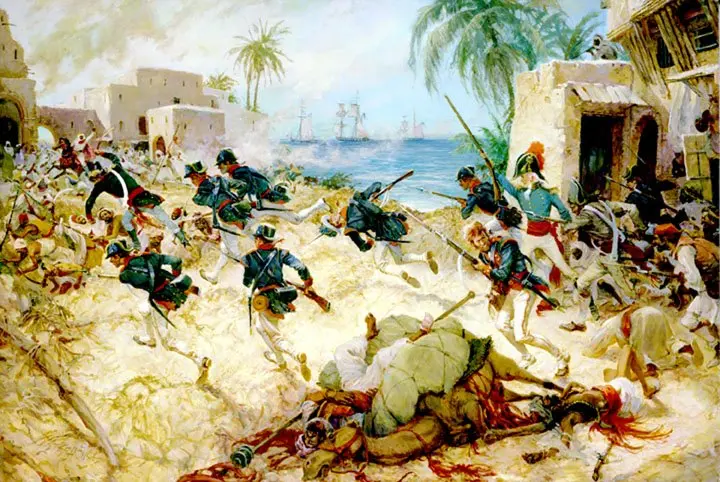
Lt. Presley O'Bannon leads Marines and Greek gunners in the charge at Derna, 27 April 1805. Painting by Col. Charles H. Waterhouse, USMCR.. Col. Charles H. Waterhouse, USMCR / Marine Corps Art Collection. The Governor of Derna’s reply to EatonMy head or yours!
The men

Midshipman at 19 in the Quasi-War with France. Volunteered to destroy Philadelphia, led sixty men aboard her and was the last to leave. Promoted captain for it. Took HMS Macedonian in 1812 and in 1815 secured the final peace with the Barbary powers.
Congressional sword citation
Resolved by the Senate and House of Representatives of the United States of America in Congress assembled, That the President of the United States be requested to present, in the name of Congress, to Captain Stephen Decatur, a sword, and to each of the officers and crew of the United States ketch Intrepid, two months pay, as a testimony of the high sense entertained by Congress of the gallantry, good conduct and services of Captain Decatur, the officers and crew of the said ketch, in attacking, in the harbor of Tripoli, and destroying a Tripolitan frigate of forty-four guns.

Revolutionary War sailor who survived a British prison ship. Took the Mediterranean command in 1803 with Constitution as his flagship, blockaded Tripoli and sent Decatur in. The young officers he trained won some of the Navy’s greatest victories of the War of 1812.
Congressional Gold Medal citation
Resolved by the Senate and House of Representatives of the United States of America in Congress assembled, That the thanks of Congress be, and the same are hereby presented to Commodore Edward Preble, and through him to the officers, petty officers, seamen and marines attached to the squadron under his command, for their gallantry and good conduct, displayed in the several attacks on the town, batteries and naval force of Tripoli, in the year one thousand eight hundred and four. Resolved, That the President of the United States be requested to cause a gold medal to be struck, emblematical of the attacks on the town, batteries and naval force of Tripoli, by the squadron under Commodore Preble’s command, and to present it to Commodore Preble, in such manner as in his opinion will be most honourable to him.

Ran off at 16 to join the Continental Army and rose to sergeant. Army captain, then U.S. consul at Tunis. Marched an army nearly 500 miles across the Libyan desert and took a musket ball through the wrist leading the charge at Derna.

Virginian commissioned in the Marines in 1801. Led six Marines and the Greek gunners through a shower of musket fire to take Derna’s harbor battery, then raised the American flag over it. His charge is the shores of Tripoli in the Marines’ Hymn.
By the numbers
In pictures


Watch, listen, see
Films, photographs and first-hand accounts from across the web. Each opens in a new tab.

The Navy’s short film on Decatur’s night raid into Tripoli harbor to burn the captured frigate.
U.S. Navy
The Marine Corps on the 1805 march and assault that put Tripoli into the Marines’ Hymn.
U.S. Marine Corps
A short history of Derna and the line every Marine knows by heart.
U.S. Marine Corps
Paintings, engravings and a harbor chart of the 16 February 1804 raid from the Navy’s collection.
Naval History and Heritage Command
The Navy Museum’s page on the 27 April 1805 assault, with art and portraits of O’Bannon.
Naval History and Heritage CommandPreble’s orders, Decatur’s after-action report and the official papers of the raid, published in 1850.
Naval History and Heritage Command
How Salvadore Catalano talked Intrepid alongside the Philadelphia, then served the U.S. Navy for 40 years.
USS Constitution Museum
The full text of the 4 June 1805 treaty that ended the war and freed 300 Americans.
Avalon Project, Yale Law School“Their conduct in the performance of the dangerous service assigned them, cannot be sufficiently estimated. It is beyond all praise.”
Commodore Edward Preble to the Secretary of the Navy, 19 February 1804
After
Preble wrote that in any navy in Europe the raid would win Decatur instant promotion. It did. At 25 he became the youngest captain in the history of the U.S. Navy. Congress voted him a sword and every man of Intrepid two months’ pay. Britain’s Lord Nelson, then blockading Toulon, is said to have called it “the most bold and daring act of the age.”
On 4 June 1805, with Eaton’s army holding Derna and the squadron off his harbor, the Pasha signed a treaty of peace. The 300 Americans of the Philadelphia walked free. O’Bannon’s flag at Derna was the first American flag raised over a fortress on the far side of the Atlantic, and the Marines have sung about the shores of Tripoli ever since.
Preble’s young officers became the Navy’s great captains. Isaac Hull, who brought Argus to Derna, took HMS Guerriere in Constitution. Decatur took HMS Macedonian. Thomas Macdonough, who sailed in Intrepid with Decatur, won the Battle of Lake Champlain. The Tripoli Monument, carved in Italy in 1806 for the officers who fell, is the oldest military monument in the United States. It stands today at the Naval Academy.
Primary sources
- Documents, Official and Unofficial, Relating to the Capture and Destruction of the Frigate Philadelphia at Tripoli (1850), including Preble’s orders of 31 January 1804 and Decatur’s report of 17 February 1804. Naval History and Heritage Command.
- Naval Documents Related to the United States Wars with the Barbary Powers, Vol. V, Part 3 (1944): reports of William Eaton and Isaac Hull on the capture of Derne, April 1805.
- Intrepid I (Ketch) and Philadelphia II (Frigate). Dictionary of American Naval Fighting Ships, Naval History and Heritage Command.
Keep exploring
- Old IronsidesUSS Constitution left HMS Guerriere without a mast standing in under 30 minutes. British cannonballs bounced off her oak sides.30minutes
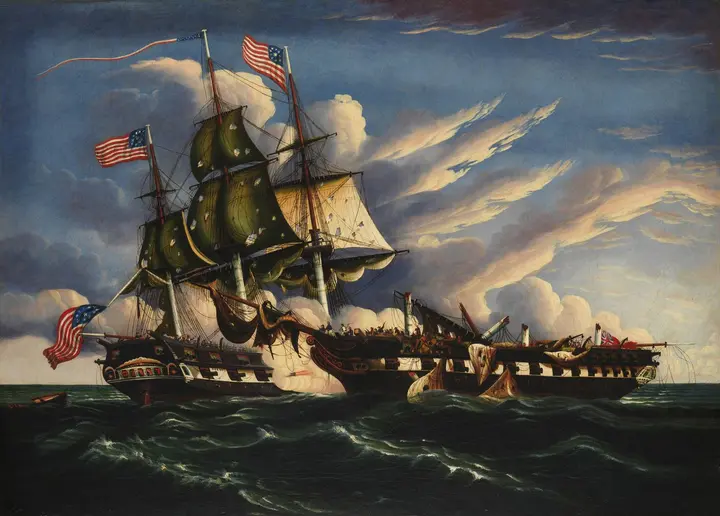
- I Have Not Yet Begun to FightHis ship sinking under him, John Paul Jones lashed it to a British frigate and took her.3½hours
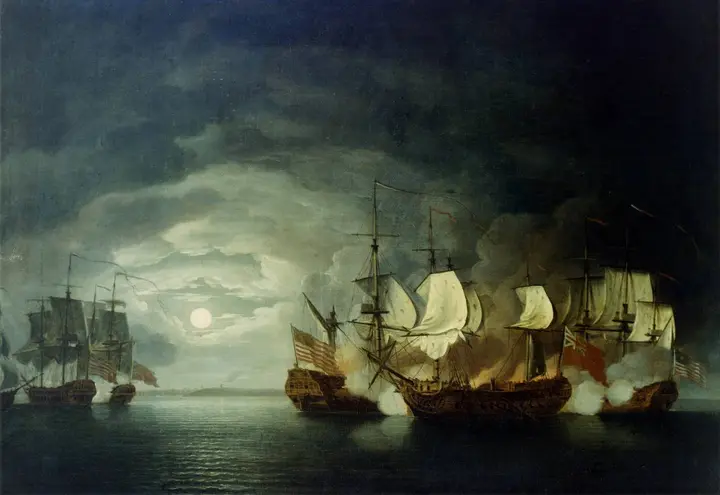
- The Gibraltar of the New World FallsAbout 4,000 New England militia under a Maine merchant, backed by the Royal Navy, dragged their guns through the bog and took France’s greatest fortress in North America.47days to take Louisbourg
- To the Halls of MontezumaWinfield Scott landed at Veracruz, cut loose from his supply line and marched on an enemy capital, winning every battle.6months


Free, with no ads. Support the museum →