Veracruz to Mexico City · 13 September 1847 · Scott’s army and the Marines
To the Halls of Montezuma
Winfield Scott landed an army on an enemy beach, cut loose from the sea and marched 260 miles inland against a larger foe. He won every battle and took the capital.

The moment · 08:00 · 13 September 1847
The guns fall silent. Three columns charge up Chapultepec’s rocky slopes under fire from the walls above. At the moat they halt and wait for the scaling ladders. The ladders come up. Men swarm up them and over the walls. By 09:30 the castle belongs to the Americans.
By early 1847 American armies held northern Mexico, and Mexico still refused to make peace. President Polk turned to the commanding general of the Army, Winfield Scott, to end the war at its heart. Scott’s plan was bold: land an army from the open sea at Veracruz, then march inland over the mountains and take Mexico City.
Ashore without a shot
Off the beach three miles south of Veracruz, soldiers climb down into 65 surfboats built for the job. Navy officers steer and sailors pull the oars while steamers and gunboats close in to cover them. General William Worth leads the first wave, more than 4,500 men landing almost at once just before sunset. By 10 p.m. more than 10,000 are ashore, without a single accident.
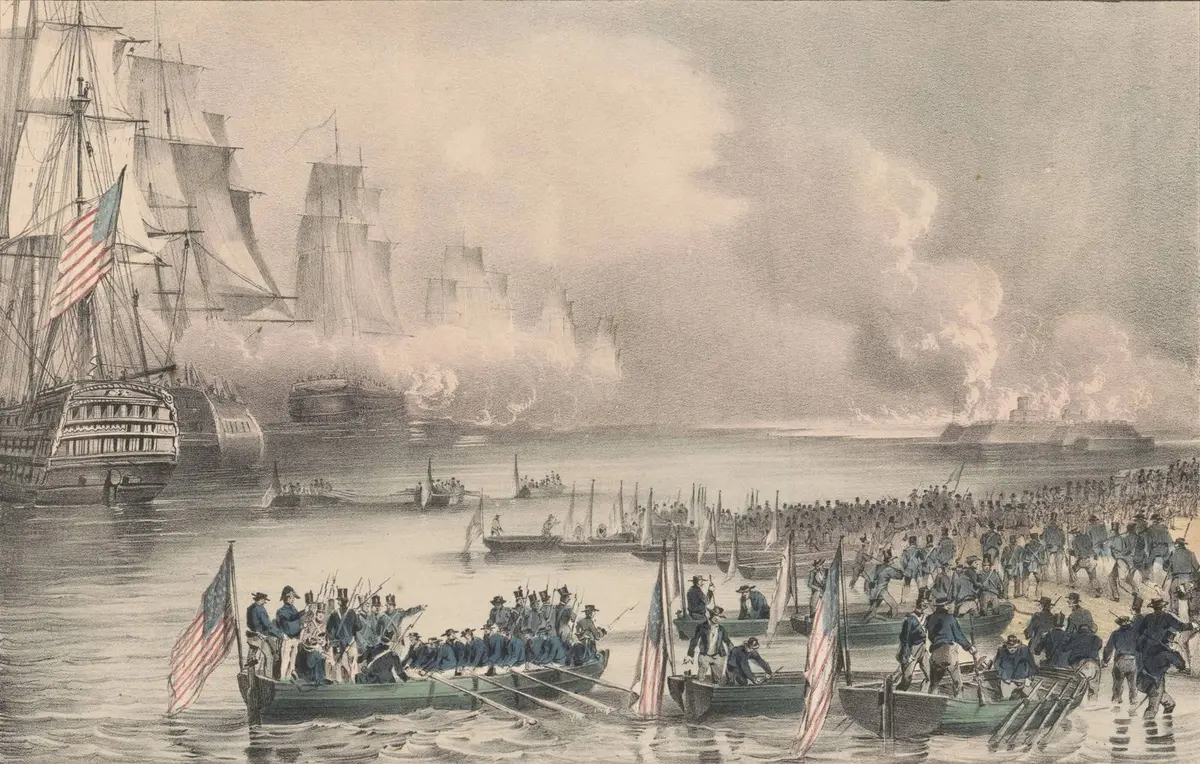
Surfboats under American colors carry Scott’s army onto the beach near Veracruz, 9 March 1847 (N. Currier, 1847).. N. Currier / Library of Congress. Veracruz falls
Scott rings the walled city with a seven-mile siege line. His mortars open fire on 22 March, but the walls hold. Commodore Matthew Perry lends six heavy naval guns and the sailors to work them, and Army engineer Capt. Robert E. Lee sites the battery 700 yards from the walls. The big guns breach them. Veracruz capitulates on 27 March, and on 29 March the Stars and Stripes fly over its island fortress.
Around the cliffs at Cerro Gordo
Santa Anna holds a mountain pass with about 12,000 men and guns on the hill of El Telégrafo, sure the highway is the only way through. Army engineers scout a path through ravines he thinks impassable. Soldiers cut a road and lower cannon down the cliffs on ropes. At dawn they strike front and rear. By noon the Mexican army is broken and about 3,000 men are prisoners.
Throwing away the scabbard
Puebla, the second city of Mexico, surrendered without a fight on 15 May. Scott waits there for reinforcements, then makes the boldest call of the campaign. He leaves a garrison behind, gives up the road to Veracruz and every link with home, and marches on the capital with about 10,000 men. Ahead waits an army more than twice his size.
Scott, on leaving PueblaWe had to throw away the scabbard and to advance with the naked blade in hand.
Seventeen minutes at Contreras
Scott swings south around the lakes and the Pedregal, a lava field thought impassable. His engineers find a gully through it. Troops march all night in pouring rain and hit Valencia’s camp from front and rear at once. Contreras falls in seventeen minutes, and 800 Mexicans are captured, four generals among them. That afternoon the army storms the fortified convent at Churubusco, the hardest fight in the valley.
Molino del Rey
A two-week armistice fails. Worth’s division attacks the Molino del Rey, a long range of stone mills at the foot of Chapultepec, and fights its way in through every door. Lt. Ulysses S. Grant props a cart’s shafts against the wall, climbs to the roof and takes the swords of a major and five or six officers. The mills fall, at a heavy cost in officers and men.
Storming Chapultepec
After a day of bombardment, the infantry goes in. Two volunteer storming parties of about 250 men each lead the way, 40 Marines among them, with pioneers carrying ladders and pickaxes. On the Tacubaya causeway, Marine Maj. Levi Twiggs rises to lead his men forward and is killed by rifle fire from the castle. On the western slope the ladders arrive, men swarm the walls, and by 09:30 the castle is taken.
At the gates
Quitman’s division, the Marine battalion in the van, fights up the Belén causeway and carries the gate shortly after one o’clock. On the San Cosme road, Grant’s men carry a mountain howitzer in pieces into a church belfry and drop shells among the defenders. Marines under Capt. George Terrett join Grant’s party, and together they are the first Americans inside the city. By 6 p.m. Worth breaks through the San Cosme gate.
The Halls of the Montezumas
Santa Anna’s army slips away in the night. At daylight Quitman marches to the Grand Plaza and hoists the Stars and Stripes over the National Palace, the building the army calls the Halls of the Montezumas. Marines clear looters out of the palace and stand guard. Scott rides in at the head of the cavalry as the bands play Hail Columbia and Yankee Doodle.
Scott, on the taking of the capitalThe capital, however, was not taken by any one or two corps, but by the talent, the science, the gallantry, the vigor of this entire army.

The soldiers

Virginia lawyer turned soldier, badly wounded at Lundy’s Lane in 1814 and commanding general of the Army since 1841. He planned the Veracruz landing, cut loose from his supply line at Puebla and took Mexico City without losing a battle.

Scott’s aide in the War of 1812, badly wounded at Lundy’s Lane, later Commandant of Cadets at West Point. His division led the first wave onto the Veracruz beach, took Puebla, stormed Molino del Rey and broke through the San Cosme gate.

Ohio-born West Pointer, class of 1843, serving as regimental quartermaster. He climbed to the roof at Molino del Rey and put a howitzer in a church belfry at San Cosme. Brevetted twice for gallantry. Later commanded the Union armies and served two terms as president.

Georgia-born Marine commissioned in 1813, captured at sea aboard the frigate President in the War of 1812 and a veteran of the Seminole wars. Second in command of the Marine battalion, he led a storming party at Chapultepec and fell leading it forward.
By the numbers
In pictures


Watch, listen, see
Films, photographs and first-hand accounts from across the web. Each opens in a new tab.

Marine Time Machine tells how the storming of Chapultepec gave the Marines’ Hymn its opening line.
U.S. Marine Corps · DVIDSGrant’s own account of Veracruz, Cerro Gordo, Molino del Rey and the howitzer in the belfry.
Project GutenbergVolume two of Scott’s 1864 memoirs: the landing, the march and the entry into the capital.
Internet ArchiveThe Corps’ official history of its Mexican War battalion, from Veracruz to the National Palace.
USMC History and Museums Division
Chapter 8 of American Military History follows every battle from the landing to the capital.
U.S. Army Center of Military History
Carl Nebel’s 1851 lithograph of Scott riding into the Grand Plaza, the flag over the palace.
Library of Congress
A clear account of the campaign, from the Veracruz landing to the fall of Mexico City.
American Battlefield Trust
The treaty that ended the war, with a scan of the original and a full transcript.
National Archives“He invaded a populous country, penetrating two hundred and sixty miles into the interior, with a force at no time equal to one-half of that opposed to him; he was without a base; the enemy was always intrenched, always on the defensive; yet he won every battle, he captured the capital, and conquered the government.”
Ulysses S. Grant on Winfield Scott, Personal Memoirs, 1885
After
Mexico signed the Treaty of Guadalupe Hidalgo on 2 February 1848. It fixed the Rio Grande as the border of Texas and ceded present-day California, Nevada and Utah, with most of Arizona, New Mexico and Colorado and parts of three more states. The United States paid $15 million. The Senate ratified the treaty on 10 March 1848.
Congress voted Scott its thanks and a gold medal on 9 March 1848, the reverse struck with his battles from Vera Cruz to the City of Mexico. In 1855 he was made a brevet lieutenant general, the first Army officer to hold that rank since George Washington.
The Marines came home with a line of their own. “From the Halls of Montezuma” opens the Marines’ Hymn, the Corps’ official song since 1929. By tradition, the red stripe on the dress blue trousers of Marine officers and NCOs honors those who fell at Chapultepec.
Primary sources
- American Military History, Volume I, chapter 8, “The Mexican War and After.” U.S. Army Center of Military History, CMH Pub 30-21, 2009.
- Gabrielle M. Neufeld Santelli and Charles R. Smith, Marines in the Mexican War. History and Museums Division, Headquarters, U.S. Marine Corps, 1991.
- Personal Memoirs of U. S. Grant, Volume I, chapters 9–12. Charles L. Webster & Company, 1885.