West Berlin · 26 June 1948 · Operation Vittles
We Are Going to Stay, Period
Stalin cut West Berlin off by land to starve it into line. American and British crews fed and heated two million people from the sky until he gave up.

The moment · 13 August 1948 · Tempelhof
A cloudburst hides Tempelhof’s runway from the tower. One C-54 overruns the field and burns. Another blows its tires. Dozens of loaded transports stack up overhead, from 3,000 to 12,000 feet. General Tunner is circling in the stack. He keys his radio.
Tunner talking, and you listen. Send every plane in the stack back to its base.Maj. Gen. William H. Tunner
On 24 June 1948 the Soviets closed every road, rail line and canal into West Berlin, 110 miles inside their zone. Two million people had 36 days of food and 45 days of coal. The West had three air corridors and about a hundred small transports. General Lucius Clay decided to supply an entire city by air. For fifteen months, American and British crews did exactly that.
The blockade
The Soviets halt all rail, road and barge traffic into the American, British and French sectors of Berlin and cut off electricity from the plants they control. They mean to squeeze the West out of the city. West Berlin has 36 days of food and 45 days of coal. The only way in left open is three air corridors, each 20 miles wide.
Operation Vittles
General Clay gives the order on 25 June without waiting for Washington. The next day 32 Air Force C-47s fly 80 tons of milk, flour and medicine into Tempelhof. Brig. Gen. Joseph Smith, running the first task force, names it Operation Vittles because, he says, they are hauling grub. The city needs at least 4,500 tons a day.
The President decides
At the White House, some of the President’s advisers argue that Berlin cannot be held and that the only course is to pull out. Truman cuts the discussion short. The United States will stay. The same day the Royal Air Force flies its first loads in, and the airlift becomes an Allied effort.
President Truman, the White HouseWe are going to stay, period.
Two sticks of gum
C-54 pilot Gail Halvorsen meets about 30 children at the Tempelhof fence. He has only two sticks of gum. They split them into slivers and pass the wrapper around to smell. He promises to drop more and says they will know his plane because he will wiggle his wings. The next day he drops candy bars on handkerchief parachutes.
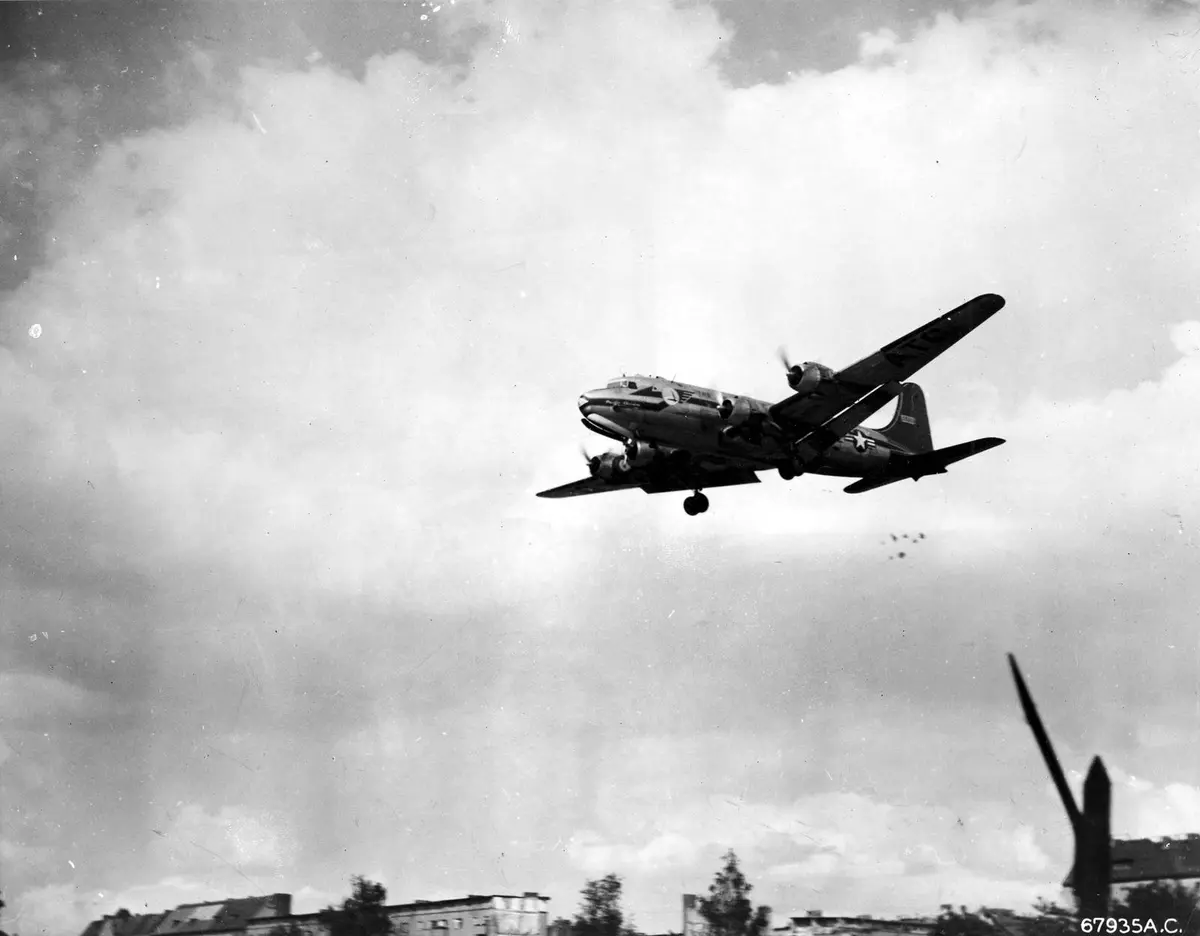
A C-54 Skymaster makes a Little Vittles candy drop on approach to Berlin. The tiny parachutes are visible below its tail.. U.S. Air Force / National Museum of the U.S. Air Force. Black Friday
Two weeks after Maj. Gen. William Tunner takes command, a cloudburst blinds Tempelhof. A C-54 overruns the runway and burns, its crew unhurt. Another blows its tires. Planes stack up to 12,000 feet. Tunner sends them all home and rewrites the rules: instruments in all weather, three minutes apart at fixed altitudes, one try to land. Miss it and fly your load home.
Tunner, from the stack over TempelhofTunner talking, and you listen. Send every plane in the stack back to its base.
Look upon this city
About 300,000 Berliners fill the rubble field in front of the burned-out Reichstag. Ernst Reuter, the city’s elected mayor, asks the free world not to abandon them. Over their heads the transports keep coming. Under Tunner, crews no longer leave their planes in Berlin. Jeeps bring food and flight clearances to the cockpit while the cargo comes off, and turnaround falls to about thirty minutes.
Ernst Reuter, at the ReichstagPeople of the world, look upon this city.
A new airport by hand
Berlin needs more runways, so a third airfield goes up at Tegel in the French sector. Thousands of Berliners, many of them women, build it in about ninety days, mostly by hand with shovels and carts. Heavy machinery is taken apart, flown in aboard C-82 Packets and put back together. The first C-54 lands at Tegel on 5 November.
The Easter Parade
Tunner wants a record to shake off routine. Coal is stockpiled and maintenance is rescheduled so as many airplanes as possible can fly. For 24 hours over Easter weekend, crews fly 1,398 flights into Berlin, nearly one a minute, and deliver 12,941 tons of coal without a single accident. That is close to three times the 4,500-ton daily minimum.
The blockade is lifted
At one minute past midnight the Soviets reopen the roads and rails. A British convoy drives straight through, and the first train from the West reaches Berlin at 5:32 a.m. Later that day an enormous crowd celebrates. The airlift keeps flying until 30 September 1949 to stock the city in case Stalin changes his mind.
The men who held Berlin

Artillery captain in France in 1918, then senator, then president when Roosevelt died. In June 1948 some advisers wanted out of Berlin. He refused to leave, backed the airlift and kept it flying for fifteen months.

Georgia-born Army engineer, West Point class of 1918. One day into the blockade he ordered the airlift on his own authority, before Washington approved it. Berlin later made him an honorary citizen and named a boulevard for him.

West Point class of 1928. In World War II he ran the airlift over the Himalayas to China and more than doubled its tonnage. In Berlin he turned the airlift into an assembly line: fixed altitudes, three-minute spacing, one try to land.

Utah farm boy who learned to fly in 1941 and flew wartime transports over the South Atlantic. Dropped candy to Berlin’s children on his own until Tunner made it official. Came back in 1970 to command Tempelhof. Lived to 101.
By the numbers
In pictures


Watch, listen, see
Films, photographs and first-hand accounts from across the web. Each opens in a new tab.

The Air Force’s own Oscar-nominated film of the airlift: loading, flying and delivering supplies to blockaded Berlin.
U.S. Air Force / Internet Archive
Signal Corps film shot in July 1948 at Rhein-Main air base and at Tempelhof, one month into the airlift.
U.S. Army Signal Corps / National Archives
The U.S. Mission to Germany salutes Gail Halvorsen on his 100th birthday in October 2020.
U.S. Embassy BerlinThe President’s first great Cold War test, and why he refused to leave Berlin.
HISTORYOctober 1948 newsreel of General Lucius Clay speaking on the airlift he ordered.
Universal Newsreel / Internet Archive
Declassified reports, Cabinet minutes, letters, oral histories and photographs from the White House side of the airlift.
Harry S. Truman Library
The Air Force’s own 1949 history of the airlift, in full, with charts, maps and photographs.
U.S. Air Forces in Europe / Internet Archive
A month-by-month timeline of the airlift, with pilots’ stories, from four national museums.
National Museum of the USAF and partners“We are going to stay, period.”
President Harry S. Truman, the White House, 28 June 1948
After
In all, the airlift delivered 2,326,406 tons of food, coal and supplies on 278,228 flights. U.S. Air Force crews carried more than three-quarters of it. General Clay came home in May 1949 to a ticker-tape parade in New York.
The square in front of Tempelhof is now Platz der Luftbrücke, Airlift Square. Its memorial, dedicated in 1951, carries the names of the American and British airmen who died flying the airlift, under the words: “They gave their lives for the freedom of Berlin.”
Three years after the war, Berlin’s children were waving at American planes. They called them Rosinenbomber, raisin bombers. West Germany joined NATO in 1955, and West Berlin stayed free until the Wall came down.
Primary sources
- Berlin Airlift: A USAFE Summary. Headquarters, U.S. Air Forces in Europe, 1949.
- The Berlin Airlift. Harry S. Truman Library and Museum, online collection.
- William H. Tunner, Over the Hump. Duell, Sloan and Pearce, 1964.