Inglewood, California, to Berlin · 1940–1944 · North American Aviation
All the Way to Berlin
The British asked North American Aviation to build another company’s fighter. Dutch Kindelberger’s team drew a better one, and four years later it was flying over Berlin.

The moment · 11 January 1944 · Oschersleben
The B-17s are under heavy attack deep in Germany and no other American fighter is in sight. Maj. James Howard, alone in his Mustang, dives into more than 30 German planes. For about half an hour he breaks up their passes, down to one working gun and low on fuel.
In 1943, American bombers over Germany flew the deepest part of their missions alone, because no American fighter could follow them that far. The answer came from a Los Angeles plant that had started from a blank sheet in 1940. Fitted with a Rolls-Royce Merlin built in Detroit, North American’s Mustang could fly from England to Berlin and fight when it got there.
A better fighter
Britain is fighting for its life and needs fighters fast. The British Purchasing Commission asks North American Aviation to build Curtiss P-40s under license. Company president James “Dutch” Kindelberger offers something else: an all-new fighter, designed around the same Allison engine, in a matter of months. Edgar Schmued and Raymond Rice lead the design team. The British place their order on 29 May 1940.
102 days
The prototype, the NA-73X, rolls out of North American’s plant beside Mines Field, Los Angeles, 102 days after the order. It has no engine yet, and its landing gear is borrowed from an AT-6 trainer. Everything else is new: a slim fuselage, a radiator tucked under the belly, and a laminar-flow wing shaped for low drag at high speed.
The Mustang
Test pilot Vance Breese takes the NA-73X up for the first time. Production begins the next year, and the Royal Air Force names the fighter the Mustang. The U.S. Army Air Forces is slower. After Gen. Hap Arnold steps in, it keeps 55 Mustangs from a British order. Down low, the Allison engine is excellent. Up high, where the bombers fly, it runs out of breath.
British engine, Detroit-built
In the spring of 1942, Rolls-Royce test pilot Ronald Harker flies an RAF Mustang and urges fitting it with the Merlin engine. That fall, Mustangs in Britain and the United States get Merlins. One in the United States reaches 441 mph at 29,800 feet, about 100 mph faster than the Allison model at that height. Packard builds the Merlin in Detroit. North American builds the new P-51B in Inglewood and the P-51C in Dallas.
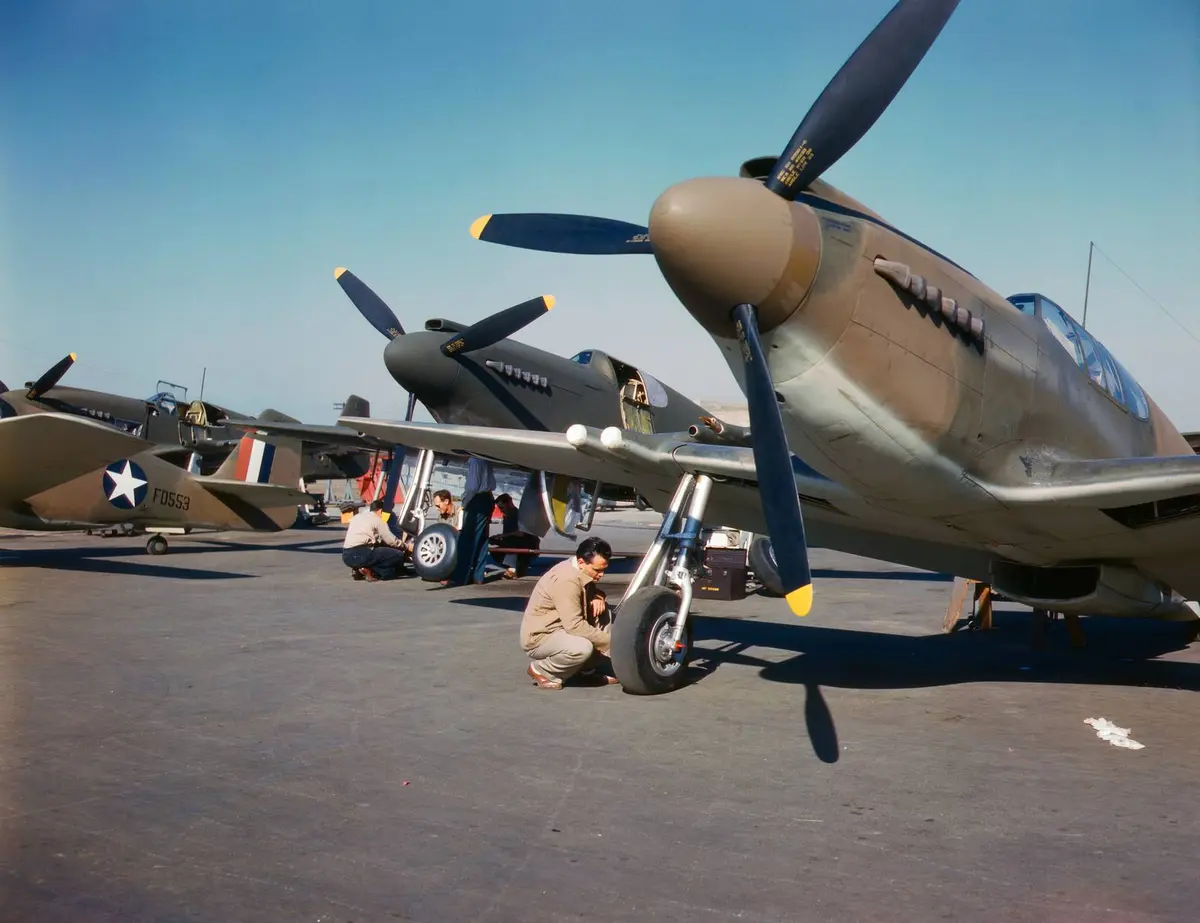
Mustangs on the flight line at North American Aviation, Inglewood, California, being readied for test flights in October 1942.. Alfred T. Palmer / Office of War Information, Library of Congress (fsac.1a35322). Black Thursday
The Eighth Air Force sends 291 bombers against the ball-bearing plants at Schweinfurt. Their escorts have to turn back at the German border, and the bombers fight the rest of the way alone. Sixty are shot down and some 600 airmen are lost over enemy territory. After this raid and two months of heavy losses, Army Air Forces leaders suspend strikes beyond the range of fighter escort.
The Mustangs arrive
The 354th Fighter Group, the Pioneer Mustang Group, takes the first Merlin-powered P-51Bs into combat. Overnight the escort radius jumps from 320 miles to 650. With two 108-gallon drop tanks it will stretch to 750 or even 850 miles. For the first time, American fighters can stay with the bombers over the targets deep inside Germany, and daylight raids there can begin again.
One against thirty
Maj. James Howard leads the 354th’s Mustangs to meet B-17s over the aircraft works at Oschersleben. In the first clash he shoots down a Messerschmitt Bf 110 and loses contact with his group. Back at the bombers, he finds them under heavy attack with no friendly fighters in sight. For about thirty minutes he fights more than 30 German planes alone and destroys three of them.
Medal of Honor citation, 5 June 1944He chose instead to attack singlehanded a formation of more than 30 German airplanes.
Hunting the Luftwaffe
Under Maj. Gen. Jimmy Doolittle, the Eighth Air Force changes the escorts’ job. They no longer stay tied to the bombers. They are told to invite the German fighters up and engage them at every opportunity. In Big Week, American crews fly nearly 4,000 heavy bomber sorties against German aircraft plants. The Luftwaffe loses a third of its available fighters and a fifth of its veteran fighter pilots.
Over Berlin
On 4 March, Mustangs of the 4th and 354th Fighter Groups escort American bombers over Berlin for the first time, a round trip of about 1,100 miles. Two days later comes the first major raid: 672 heavy bombers strike the city and 69 are shot down. Don Blakeslee’s 4th Fighter Group is overhead. On 8 March, 462 bombers go back to Berlin with 174 P-51s flying escort.

The builders and the pilots

Army Air Service flight instructor in World War I, then engineering chief at Douglas on the DC-1 and DC-2. Asked to build another company’s fighter in 1940, he told the British his team would design a better one. It flew in under five months.

Born in Germany, he taught himself engineering, worked for General Motors’ aviation business in Brazil and came to America in the early 1930s. He led the design of the Mustang, then went on to design the F-86 Sabre.

Born in China to American parents. Navy fighter pilot aboard USS Enterprise, then a Flying Tiger with six victories. Over Oschersleben he took on more than 30 German fighters alone to protect the bombers. The Medal of Honor followed.
Medal of Honor citation
For conspicuous gallantry and intrepidity above and beyond the call of duty in action with the enemy near Oschersleben, Germany, on 11 January 1944. On that day Col. Howard was the leader of a group of P-51 aircraft providing support for a heavy bomber formation on a long-range mission deep in enemy territory. As Col. Howard’s group met the bombers in the target area the bomber force was attacked by numerous enemy fighters. Col. Howard, with his group, and at once engaged the enemy and himself destroyed a German ME. 110. As a result of this attack Col. Howard lost contact with his group, and at once returned to the level of the bomber formation. He then saw that the bombers were being heavily attacked by enemy planes and that no other friendly fighters were at hand. While Col. Howard could have waited to attempt to assemble his group before engaging the enemy, he chose instead to attack singlehanded a formation of more than 30 German airplanes. With utter disregard for his own safety he immediately pressed home determined attacks for some thirty minutes, during which time he destroyed 3 enemy airplanes and probably destroyed and damaged others. Toward the end of this engagement 3 of his guns went out of action and his fuel supply was becoming dangerously low. Despite these handicaps and the almost insuperable odds against him, Col. Howard continued his aggressive action in an attempt to protect the bombers from the numerous fighters. His skill, courage, and intrepidity on this occasion set an example of heroism which will be an inspiration to the U.S. Armed Forces.

Ohio native who joined the Royal Canadian Air Force and was flying Spitfires over Europe by 1941, later commanding an RAF Eagle Squadron. He pushed the 4th into Mustangs and led it to Berlin. Nearly 500 missions and about 1,000 combat hours.
By the numbers
In pictures


Watch, listen, see
Films, photographs and first-hand accounts from across the web. Each opens in a new tab.

From IWM Duxford: how North American’s new fighter became the long-range escort that changed the air war.
Imperial War Museums
Designed for the Royal Air Force, the Mustang became America’s long-range escort against Nazi Germany.
Smithsonian National Air and Space Museum
The Air Force Museum on the P-51D, the long-range escort that served from Europe to Korea.
National Museum of the U.S. Air Force
Clayton Kelly Gross of the 354th Fighter Group describes his first two aerial victories.
The National WWII Museum
357th Fighter Group ace Clarence “Bud” Anderson recalls the first of his victories over Europe.
The National WWII MuseumThe record and citation of the Mustang pilot who defended the bombers alone over Oschersleben.
National Medal of Honor Museum
The Fifteenth Air Force’s longest mission, 24 March 1945, with Mustang escorts all the way to Berlin.
Air Force Historical Research Agency
The 102-day prototype, the Merlin and the fighter that took the skies over Germany.
The National WWII Museum“With this plane, in some respects the most important addition to Allied air power during the European war, … daylight operations in depth were again launched.”
United States Strategic Bombing Survey, Summary Report (European War), 30 September 1945
After
By the spring of 1944, the Strategic Bombing Survey found, the Luftwaffe’s opposition “had ceased to be effective.” German air generals later said they had only 80 operational planes to throw against the D-Day landings. That June, Lt. Gen. Carl Spaatz presented James Howard the Medal of Honor.
On 24 March 1945 the Fifteenth Air Force flew its longest mission of the war, from Italy to a tank plant in Berlin, escorted by four groups of Mustangs and one of P-38s. Eight Mustang pilots shot down German jets that day. Three were Tuskegee Airmen of the 332nd Fighter Group, which earned a Distinguished Unit Citation.
More than 15,000 Mustangs were built. They fought again in Korea and flew with the Air National Guard until 1957. Edgar Schmued went on to design the F-86 Sabre, and North American went on to build the X-15 and the Apollo spacecraft.
Primary sources
- United States Strategic Bombing Survey, Summary Report (European War), 30 September 1945.
- North American P-51D Mustang; Black Thursday; Big Week; and Target Berlin fact sheets. National Museum of the U.S. Air Force.
- Medal of Honor citation, Lt. Col. James H. Howard. War Department General Orders No. 45, 5 June 1944.
Keep exploring
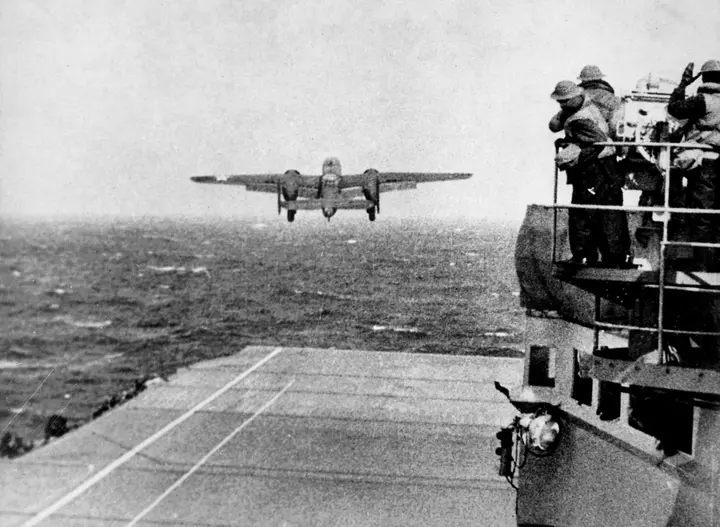
- Thirty Seconds Over TokyoFour months after Pearl Harbor, 80 volunteers flew Army bombers off a Navy carrier and struck Japan.16B-25 bombers
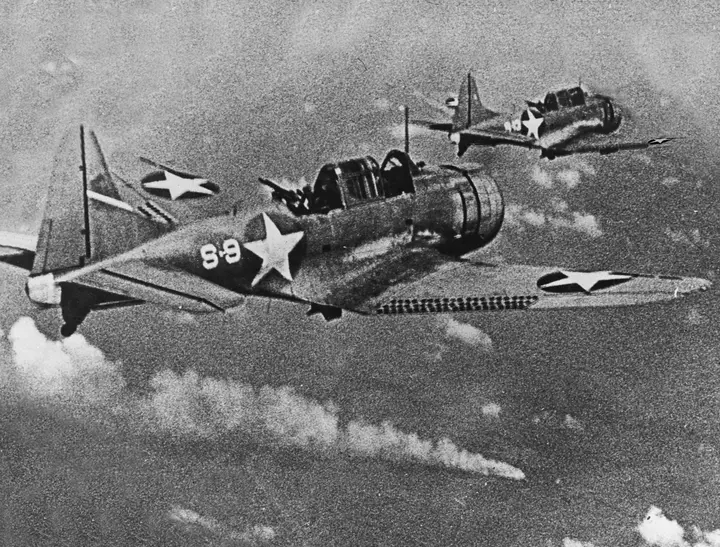
- MidwaySix months after Pearl Harbor, American dive bombers set three Japanese carriers burning in a few minutes. Before dark they got the fourth.4carriers sunk
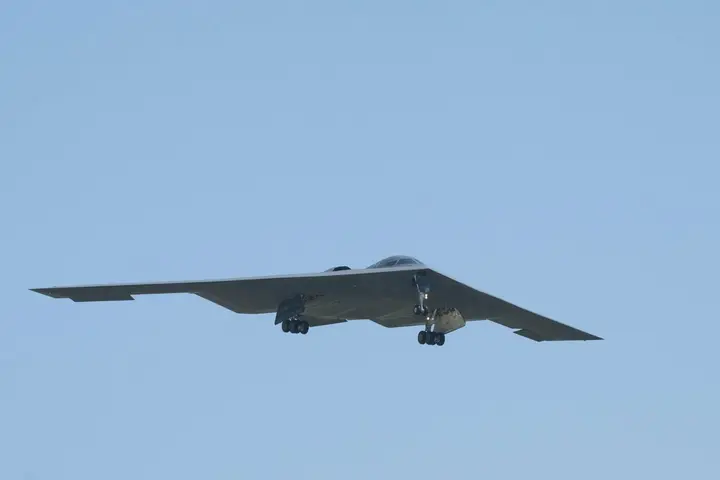
- Midnight HammerB-2 bombers flew 18 hours from Missouri and struck Iran’s buried nuclear sites with the heaviest bombs in the arsenal.14bunker busters
- The Berlin AirliftStalin cut off West Berlin by land. American and British crews flew in its food and coal for almost eleven months until he gave up.2.3Mtons flown in


Free, with no ads. Support the museum →