Arlington, Virginia · 15 January 1943 · Army engineers and 15,000 builders
Nothing Like It Has Ever Been Done
Plans drawn over a weekend. Ground broken eight weeks later. Sixteen months after that, the largest office building in the world stood finished beside the Potomac, in the middle of a world war.

The moment · 09:00 · 21 July 1941
Four days ago Somervell asked for one building to hold 40,000 people. Bergstrom's team has drawn from Friday night to Sunday night. At nine on Monday morning the plan is on his desk: five sides, twice the capacity of the Empire State Building.
In the summer of 1941 the War Department had 24,000 people crammed into 17 buildings around Washington, and the Army was growing by the day. Brig. Gen. Brehon Somervell wanted them all under one roof. He asked for plans over a weekend and broke ground eight weeks later. Sixteen months after that, America had the largest office building on earth.
Plans by Monday
The Army is growing by the day, and its headquarters staff is scattered across 17 buildings. On Thursday evening Brig. Gen. Brehon Somervell, chief of Army construction, calls in his engineers, Col. Leslie Groves among them, and his chief architect, George Bergstrom. He wants plans on his desk by nine o’clock Monday morning for one fireproof, air-conditioned office building to hold 40,000 people. No elevators.
Five sides
Bergstrom’s team works from Friday night to Sunday night. Their site at Arlington Farms is boxed in by roads that form a rough pentagon, so the building gets five sides. The plan calls for 5.1 million square feet, twice the capacity of the Empire State Building. Gen. George Marshall approves it that afternoon. The next day Somervell tells a House subcommittee it will cost $35 million.
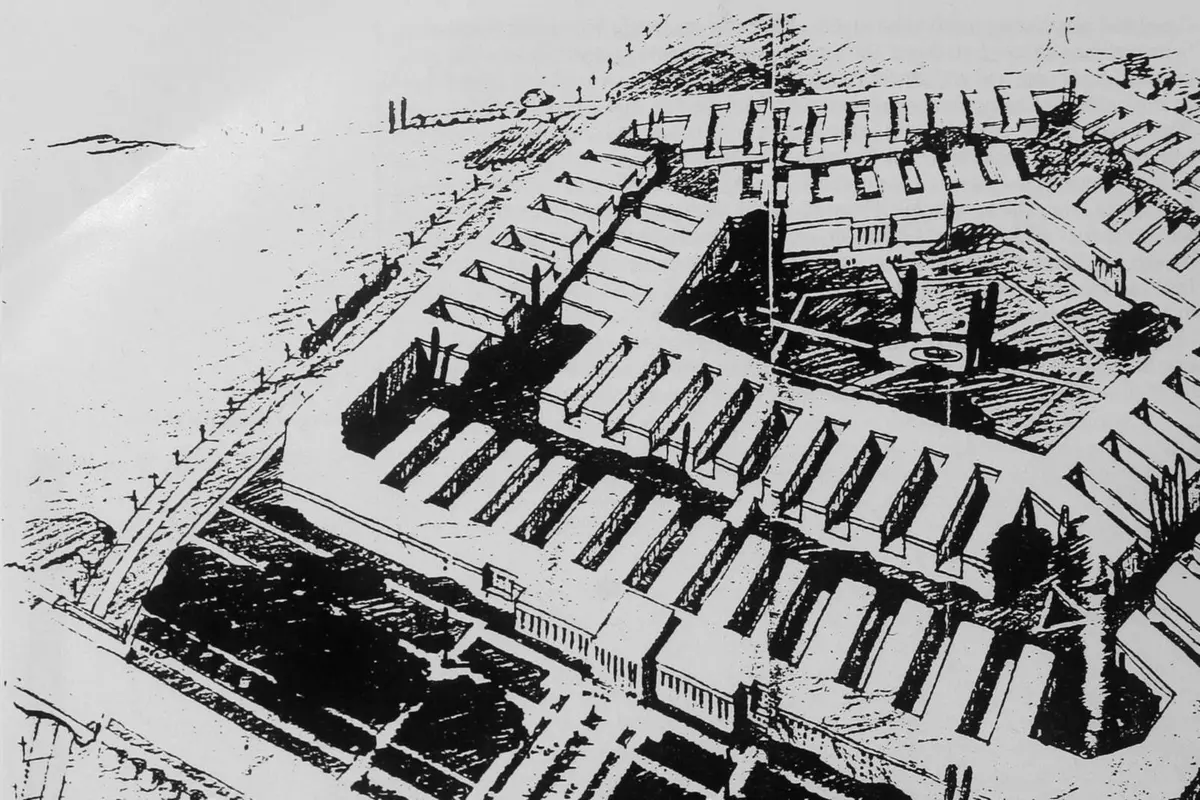
The first design, July 1941: an aerial perspective of the “Arlington Office Building for War Department” from the Construction Division's design section, its office wings set like the teeth of a comb.. Office of the Quartermaster General, Construction Division; reproduced in Alfred Goldberg, The Pentagon: The First Fifty Years (Historical Office, Office of the Secretary of Defense, 1992). Somervell to a House Appropriations subcommittee, 22 July 1941Of course we always have to build the biggest.
Hell’s Bottom
Critics say the building will spoil the view from Arlington National Cemetery, and President Roosevelt agrees. He moves it three-quarters of a mile down the river to an Army depot site called Hell’s Bottom, low ground of shacks, dumps, brickyards and rail yards beside the Potomac. Somervell argues for the first site until Roosevelt cuts him off. The new site has no roads forcing five sides. The planners keep the pentagon anyway.
Roosevelt to Somervell at the site, as Gilmore Clarke recalled itMy dear General, I’m still Commander-in-Chief of the Army!
Ground broken
The Army signs a $31 million contract with John McShain of Philadelphia and two Richmond firms, Doyle and Russell and Wise Contracting. In 34 days the draftsmen have already turned out 2,500 drawings. That day Bergstrom shows Somervell a regular pentagon of concentric rings tied together by corridors, and Somervell picks it. Capt. Clarence Renshaw runs the job for Groves. A month later 1,000 men are at work.
Pearl Harbor
Four thousand men are on the site, working three shifts under floodlights, but progress runs about 1 percent a month. At that rate the job would take eight more years. Then Japan strikes Pearl Harbor, and the building becomes a war project. More than 10,000 more workers join in the next six or seven months. Somervell orders the first section ready for occupants by 1 May.
Concrete from the river
Steel is going to the war, so the Pentagon is built of concrete. Barges dredge 680,000 tons of sand and gravel from the Potomac beside the site, and a batching plant turns out up to 3,000 cubic yards of concrete a day. Crews pour 435,000 cubic yards in every kind of weather, over 41,492 concrete piles. Wide ramps take the place of elevators. The savings come to enough steel to build a battleship.
Moving in
Less than eight months after groundbreaking, 300 Ordnance Department workers move into the first finished section while the rest of the building goes up around them. In May the War Department names it the Pentagon. By the end of the month a million square feet are in use. New occupants arrive around the clock, close to 1,000 a week. By 22 December, 22,000 people are at work inside.
A fifth floor
The War Department needs still more room. Somervell orders a fifth floor across the three inner rings, adding 350,000 square feet, though the roofing there is already on. In August, with the building 80 percent done, Budget Bureau inspectors report no loafing to speak of and call its builders able and fearless. In September Groves takes over the Manhattan Project and keeps watch on the Pentagon from there.
Finished
Sixteen months after groundbreaking, the Army declares the Pentagon complete. There is no dedication ceremony. There is a war on. The building holds more than 6 million square feet, three times the floor space of the Empire State Building, with 17.5 miles of corridors. Thanks to its rings and spokes, a brisk walker can get between its two farthest points in seven or eight minutes.
The builders

Arkansas native, sixth in West Point’s class of 1914. Won the Distinguished Service Cross scouting bridges beyond the lines in 1918 and built LaGuardia Airport during the Depression. He conceived the Pentagon, picked its builders and drove the job.

Army chaplain’s son, fourth in West Point’s class of 1918. As Somervell’s hard-driving deputy, he had the architects and the builders reporting to him. In September 1942 he took command of the Manhattan Project and still kept watch on the Pentagon.

Born in Neenah, Wisconsin, schooled at Yale and MIT. He designed many of downtown Los Angeles’s office buildings and the Pasadena Civic Auditorium, and led the American Institute of Architects. His team drew the first five-sided plan in one weekend.

Son of Irish immigrants, he took over his late father’s Philadelphia firm and built National Airport and the Jefferson Memorial. On the Pentagon he led the three prime contractors. Federal inspectors credited his “supreme command” of men and materials.
By the numbers
In pictures


Watch, listen, see
Films, photographs and first-hand accounts from across the web. Each opens in a new tab.

Washington Post reporter Steve Vogel tells the story of the wartime race to build the Pentagon, with slides.
C-SPAN Book TV
The building by the numbers: 17.5 miles of corridors and more than six million square feet.
HISTORY
Newly acquired negatives of the Pentagon going up in 1941 and 1942: crews, pile drivers and concrete plants.
Library of Congress
The Defense Department’s official history of how the building was conceived, designed and built, richly illustrated.
OSD Historical Office
Defense Department photographs of the building from its first section to its finished facade.
DVIDS
Civil engineers on how 41,492 piles and 435,000 cubic yards of concrete became the Pentagon in sixteen months.
ASCE Civil Engineering
An Army Signal Corps photograph of the River Entrance under construction, mirrored in the lagoon.
U.S. Army Corps of Engineers
Bureau of Public Roads photographs of the overpasses and highways built to carry the Pentagon’s workers.
National Archives“It certainly should not. It should not ever come to pieces.”
Brig. Gen. Brehon B. Somervell, asked by Congress whether the building would come to pieces early, 22 July 1941
After
There was no dedication. From offices in the new building, Secretary of War Henry Stimson and Gen. George Marshall ran an Army that grew past 8 million men, on a switchboard billed as the largest private telephone exchange in the world.
Somervell commanded the Army Service Forces and supplied the whole American war effort. Groves built the atomic bomb. McShain went on to rebuild the inside of the White House for President Truman.
The Pentagon stood as the largest office building in the world for 80 years and became a National Historic Landmark in 1992. On 11 September 2001, sixty years to the day after its groundbreaking, terrorists flew a hijacked airliner into its west side, and the damaged section was rebuilt within a year.
Primary sources
- Alfred Goldberg, The Pentagon: The First Fifty Years. Historical Office, Office of the Secretary of Defense, 1992.
- Lenore Fine and Jesse A. Remington, The Corps of Engineers: Construction in the United States. U.S. Army Center of Military History, 1972.
- Steve Vogel, The Pentagon: A History. Random House, 2007.
Keep exploring
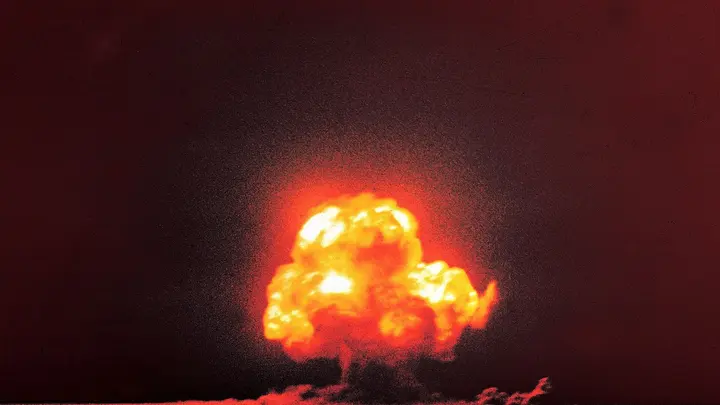
- Trinity130,000 Americans built secret cities, the first reactor and the weapon that ended the Second World War.3years, start to finish
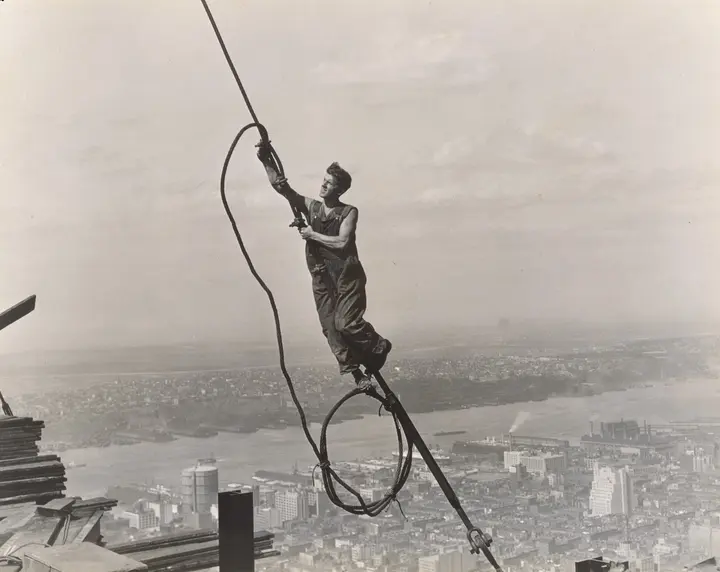
- Empire State Building102 stories in 410 days. The tallest building on earth for nearly forty years.410days
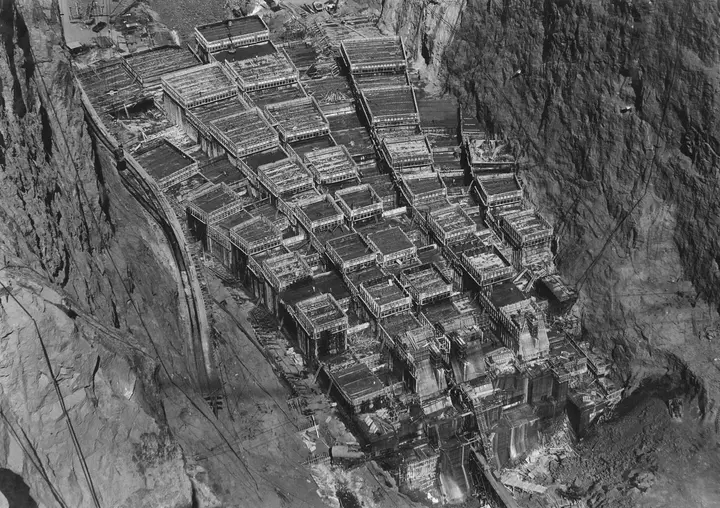
- Hoover DamPoured in the Nevada desert in the middle of the Depression and finished two years ahead of schedule.726feet high
- The Interstate HighwaysEisenhower’s 41,000 miles of four-lane freeway tied the continent together and now carry a quarter of all American driving.41,000miles


Free, with no ads. Support the museum →