Alamogordo, New Mexico · 16 July 1945 · The Manhattan Project
The Greatest Scientific Gamble in History
In under three years, 130,000 Americans built secret cities, started the first nuclear reactor and set off the first atomic bomb. Four weeks later, the war was over.

The moment · 05:29:45 MWT · 16 July 1945
The rain has stopped. In the control bunker 10,000 yards south of the tower, Sam Allison counts down over the loudspeakers. At minus 45 seconds Joe McKibben throws the switch to the automatic timer. Oppenheimer grips a post to steady himself. Ten. Nine. Then the desert turns brighter than noon.
Now!Samuel Allison, calling zero in the control bunker
By 1942 the United States knew Germany was racing to build an atomic bomb. Nobody had ever run a nuclear chain reaction. On 17 September the Army handed the job to Col. Leslie Groves, the engineer who had just built the Pentagon. He had to invent the science, build the factories and raise the cities to house them, all at once and all in secret.
The Army takes over
Groves expects orders overseas. Instead he gets the bomb. The next day he buys 1,250 tons of Belgian Congo uranium ore sitting in a warehouse on Staten Island. The day after that he approves the site in Tennessee that becomes Oak Ridge. He wins the highest emergency priority in the war economy and moves headquarters to Washington. Six days in, he is a brigadier general. On 15 October he picks J. Robert Oppenheimer to run the bomb laboratory.
A laboratory on a mesa
In mid-November Groves and Oppenheimer tour a boys’ ranch school on a remote mesa in northern New Mexico. On 25 November the War Department approves buying it for $440,000. Los Alamos becomes Project Y, the laboratory that will design the bomb itself. Its scientists arrive under a single mailing address, P.O. Box 1663, Santa Fe, and spend the war turning theory into hardware.
The first chain reaction
Under the west stands of Stagg Field at the University of Chicago, Enrico Fermi’s team has stacked almost 400 tons of graphite bricks around six tons of uranium metal and 34 tons of uranium oxide. At 15:25 George Weil eases out the last control rod and Fermi announces the reaction is self-sustaining. It runs 28 minutes at about half a watt. Eugene Wigner opens a bottle of Chianti, and the team signs the label.
Arthur Compton to James Conant, by telephoneThe Italian navigator has landed in the New World.
The secret city
On the farmland of East Tennessee the Army builds a city of more than 75,000 people that appears on no map. At Y-12, 22,000 workers run the calutrons that separate uranium-235, many of them young women just out of high school. Copper is short, so the magnets are wound with more than 13,000 tons of silver borrowed from the Treasury. At K-25 the Army puts 44 acres under one roof, the largest building in the world.
The plutonium works
Groves endorses a stretch of desert on the Columbia River on 16 January 1943. By mid-1944 some 45,000 construction workers are on the payroll. In September 1944 Fermi personally takes charge of loading the B Reactor, the first full-scale plutonium production reactor in the world. On 26 September it goes critical. Chicago Pile-1 made half a watt. B Reactor is designed for 250 million.
Up the tower
On 12 July the two plutonium hemispheres ride to the McDonald ranch house, two miles from ground zero on the Jornada del Muerto. Assembly begins on the afternoon of the 13th. On the morning of 14 July the Gadget goes up to the shed atop a 100-foot steel tower. Around it, more than 50 cameras and three observation bunkers at 10,000 yards wait for Monday. About 250 people are at base camp.
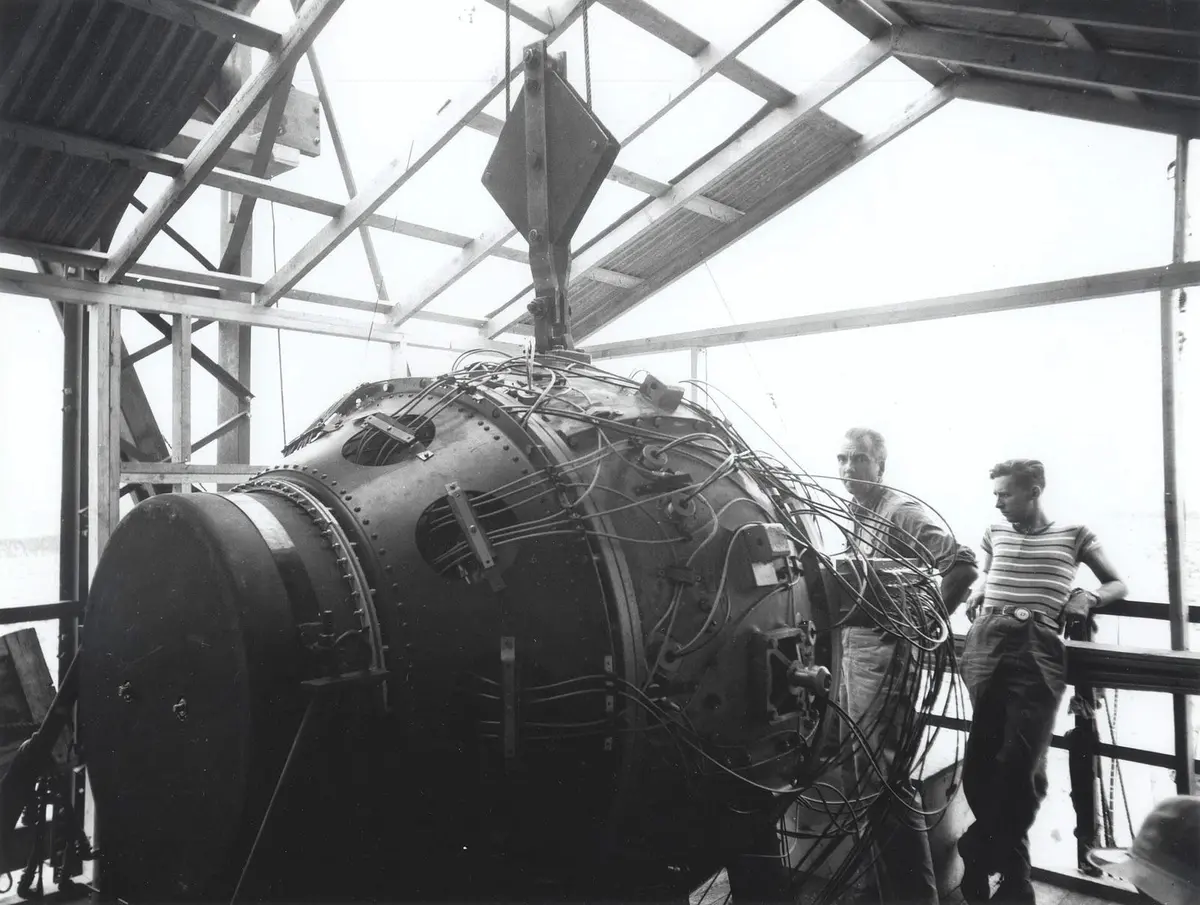
The Gadget in the shed atop the 100-foot Trinity tower, with Norris Bradbury (left) and Boyce McDaniel, July 1945.. Los Alamos National Laboratory / U.S. Department of Energy. Brighter than the midday sun
A thunderstorm pushes the shot from 04:00 to 05:30. At 05:29:45 the Gadget fires. The light is seen as far as Albuquerque, Santa Fe and El Paso. The tower vanishes and the cloud climbs to 38,000 feet. Fermi drops scraps of paper into the blast wave and calls it 10,000 tons of TNT. The final figure is about 21,000. Gen. Thomas Farrell turns to Groves: “The war is over.” Groves answers: “Yes, after we drop two bombs on Japan.”
Brig. Gen. Thomas Farrell, report to the Secretary of WarThe effects could well be called unprecedented, magnificent, beautiful, stupendous and terrifying.
Hiroshima
At 02:45 Col. Paul Tibbets lifts the B-29 Enola Gay off Tinian with Little Boy, the uranium bomb, in its bay. Navy Capt. William Parsons arms it in flight. At 08:15 Hiroshima time bombardier Thomas Ferebee releases it from 31,060 feet over the city. Sixteen hours later President Truman tells the world what it was: an atomic bomb, with more power than 20,000 tons of TNT.
The surrender
On 9 August Maj. Charles Sweeney’s B-29 Bockscar drops Fat Man, a plutonium bomb of the Trinity design, on Nagasaki. It explodes at 11:02. The same day the Soviet Union declares war on Japan. At 19:00 on 14 August, Washington time, Truman announces that Japan has accepted the Allied terms. On 15 August, Emperor Hirohito tells his people by radio. The invasion of Japan, set to begin on 1 November, never has to come.

The builders

Graduated fourth in his West Point class of 1918. Army engineer who finished the Pentagon in under a year and a half. Took the bomb project on 17 September 1942 and drove every site, contract and dollar of it to victory.

New Yorker who finished Harvard in three years and earned his doctorate at Göttingen at 23. Groves picked him in October 1942 to lead the bomb laboratory. He built Los Alamos from a ranch school into the place that designed both bombs.

Nobel laureate who left Fascist Italy in 1938 and became an American citizen in 1944. Led the team that ran the first nuclear reactor, took personal charge of starting Hanford’s B Reactor, and at Trinity measured the blast with scraps of paper.

Flew the lead bomber on the first American heavy-bomber raid on occupied Europe in August 1942, then logged more B-29 time than any other pilot. Built and trained the 509th to deliver the bomb, and flew it to Hiroshima himself.
By the numbers
In pictures


Watch, listen, see
Films, photographs and first-hand accounts from across the web. Each opens in a new tab.

Raw film of the Trinity shot, from The National WWII Museum’s series on the Manhattan Project.
The National WWII Museum
Enola Gay navigator Theodore “Dutch” Van Kirk and a Hiroshima eyewitness recall 6 August 1945 in their own words.
The National WWII Museum
The young women at Oak Ridge who ran the machines that enriched the uranium for Little Boy.
National Park ServiceThe Enola Gay’s pilot, in 1989, on building the 509th and flying the mission that ended the war.
Atomic Heritage Foundation · Voices of the Manhattan Project
DOE’s interactive history: every event, person, place and process from the first reactor to victory.
U.S. Department of Energy
Groves’ 18 July 1945 report to the Secretary of War, with Farrell’s eyewitness account of Trinity.
Office of the Historian, U.S. State Department
The President’s 6 August 1945 statement revealing the atomic bomb and the project that built it.
Harry S. Truman Library
The laboratory’s own account of the test, with photographs of the tower, the Gadget and the fireball.
Los Alamos National Laboratory“What has been done is the greatest achievement of organized science in history. It was done under high pressure and without failure.”
President Harry S. Truman, statement announcing the atomic bomb, 6 August 1945
After
Japan signed the instrument of surrender aboard USS Missouri in Tokyo Bay on 2 September 1945. Gen. Carl Spaatz pinned the Distinguished Service Cross on Tibbets minutes after the Enola Gay landed on Tinian.
On 1 January 1947 the civilian Atomic Energy Commission took over the project’s plants and laboratories. Los Alamos, Oak Ridge and the Chicago work that became Argonne grew into national laboratories that still lead American science. B Reactor made plutonium until it was retired in 1968. In 1963 Oppenheimer received the Enrico Fermi Award, named for his old colleague.
In 2015 Congress made Oak Ridge, Hanford and Los Alamos the Manhattan Project National Historical Park. A stone obelisk now marks ground zero at Trinity, where the Atomic Age began.
Primary sources
- Memorandum, Maj. Gen. Leslie R. Groves to the Secretary of War, “The Test,” 18 July 1945. Foreign Relations of the United States, The Conference of Berlin, Vol. II.
- The Manhattan Project: An Interactive History. U.S. Department of Energy, Office of History and Heritage Resources.
- Statement by the President Announcing the Use of the A-Bomb at Hiroshima, 6 August 1945.