Grünau, Berlin · 14 August 1936 · The University of Washington eight
And the United States Wins!
Nine Depression kids from Seattle drew the worst lane, missed the start and sat fifth at halfway. Then they ran down Italy and Germany with Hitler watching.

The moment · Final 200 metres · 14 August 1936
Lane six, into the wind. Twenty-five thousand people on the floating grandstand chant for their crew. Don Hume, sick for weeks, drives the rate past 40. Bobby Moch calls for twenty more, then twenty more again. The cedar bow edges past Italy.
20 meters to go, 10 meters to go, and the United States wins!Bill Henry, CBS radio, live from Grünau
In 1936 rowing was a rich man’s sport, ruled by the Ivy League and the crews of Europe. The University of Washington sent a boat of loggers’ sons, farm boys and shipyard kids who worked their way through school in the Depression. They beat the best of the East, then crossed the Atlantic to race the best of Hitler’s Germany and Mussolini’s Italy in Berlin.
Sweep on the Hudson
The national championship regatta on the Hudson River is the biggest day in American college rowing. Washington enters three boats and wins all three races: freshman, junior varsity and varsity. The varsity eight, with Don Hume at stroke and Bobby Moch at the tiller, comes from behind in the last mile of the four-mile race and catches California at the finish.
The Olympic trials
On Lake Carnegie the four-mile boat has to become a 2,000-metre sprint crew. It does. Washington wins its heat, then beats Pennsylvania, California and the New York Athletic Club in the final and sets a course record. One sportswriter wrote that the Huskies went past the Easterners like the Queen Mary going by a lighthouse.
Five thousand dollars
The day after the trials comes bad news. The Olympic Committee will not pay the crew’s way. Washington must find $5,000 within days or stay home. Seattle answers. The Seattle Times puts up $500, and nickels and dollars pour in from newspapers, Legion posts and chambers of commerce. On 15 July the crew sails for Europe on the SS Manhattan.
The heat
In their first race at Grünau the Americans draw Great Britain, the nation that invented the sport. Washington wins in 6:00.8, the fastest time of the whole Olympic regatta, with Britain 1.3 seconds back. The win puts them straight into the final and spares them the repechage. Britain has to row an extra race to get there.
A sick stroke and a bad lane
Don Hume has been fighting a chest cold since the trials. He has lost something like 12 to 15 pounds. Coach Al Ulbrickson weighs taking him out of the stroke seat and keeps him in. Then the lanes come out. Germany gets lane one and Italy lane two, sheltered from the crosswind. The United States gets lane six, on the outside, in the roughest water.
Late off the line
Cold, gray, a brisk wind out of the west. The starter drops the flag, but in lane six Bobby Moch cannot hear or see the start. Neither can the British coxswain next to him. The other four crews are gone. Washington gets away about a stroke and a half late. At 300 metres Switzerland leads, then Britain and Germany. The Americans are last.
Bill Henry, on CBS radioWe all know the Washington crew, which is representing the United States, is probably the slowest-starting crew in the world and gives everybody heart failure.
Fifth at halfway
Italy reaches halfway in 3:06.3 with Germany second. Washington is fifth in 3:11.0, almost five seconds down. Moch watches his stroke. Hume has looked half-conscious since the warm-up, eyes closed, breathing hard. Moch holds his nerve and waits. With about 800 metres left, Hume’s eyes open and he starts to row with authority.
Deutschland! Deutschland!
Hume takes the rate from 34 to 40. Washington passes Hungary, then Britain, then closes on Italy and Germany. Along the last 500 metres a floating grandstand holds 25,000 people, and they chant Deutschland in time with the German strokes. In the last 200 metres Italy and Germany sprint above 40. Hume answers at 44. Moch calls for twenty more, then twenty more again.
Bobby Moch to his crew, as Jim McMillin recalled itTwenty more, again!
Six tenths of a second
The Husky Clipper crosses first in 6:25.4. Italy is 0.6 seconds back in 6:26.0 and Germany third in 6:26.4. One second covers three boats after 2,000 metres. Washington rowed the second half in 3:14.4, almost four seconds faster than anyone else. In the boat nobody is sure who won. Then Moch, almost without a voice, says he thinks they did.
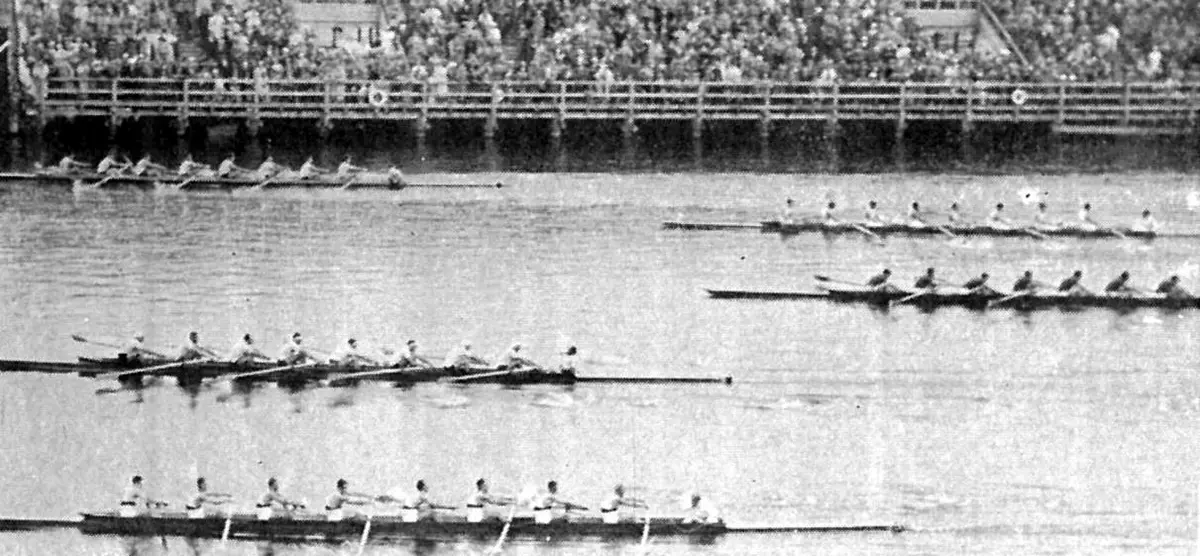
The Washington varsity sweeps across the finish line at Grünau to win the Olympic final, 14 August 1936. Italy is second and Germany, in the near lane, third.. Tyee yearbook, ASUW / University of Washington Libraries Special Collections.
The boat

Born in Spokane. His mother died when he was a small child, and as a boy his family left him to fend for himself. He cut timber and worked hay fields to get through high school and college. Rowed the seven seat in Berlin, then spent 35 years at Boeing.

Valedictorian at Montesano High, son of a Swiss immigrant watchmaker. He steered the Husky Clipper, read the race and called every move. Down five seconds at halfway, he held off until Hume came alive, then called the sprint. Later a Harvard-trained Seattle lawyer.

Grew up on Puget Sound in Anacortes. Set the rhythm for the whole boat. Sick for weeks and badly underweight in Berlin, he still took the rate to 44 in the final sprint. Served in the Merchant Marine in World War II, then worked in oil and gas.

Son of the Eton College boatbuilder on the Thames. Came to the Northwest in 1911, settled in Seattle and became an American citizen. Built the Husky Clipper from western red cedar and went to Berlin as the U.S. team’s boatman. His shells won Olympic gold again in 1948 and 1952.
By the numbers
In pictures


Watch, listen, see
Films, photographs and first-hand accounts from across the web. Each opens in a new tab.

Film of the 1936 final: the late start, the German crowd and Washington’s charge to the line.
American Experience, PBS
The full documentary on the nine working-class Huskies who took Olympic gold in Hitler’s Berlin.
American Experience, PBS
Bill Henry’s live 1936 broadcast of the final, cut with crew captain Jim McMillin’s memories.
Michael J. SocolowThe coxswain of the gold medal eight recalls the 1936 final, recorded in Seattle in 2000.
JAMCO Times
The Washington varsity crossing the finish at Grünau ahead of Italy and Germany, 14 August 1936.
University of Washington Libraries
A detailed history of the 1936 season, from Poughkeepsie and the trials to the Berlin final.
HistoryLink.org
Full results of the 1936 Olympic eights: every heat, lane and 1,000-metre split.
OlympediaThe shell house, the Husky Clipper and the rowing legacy the 1936 crew left at Washington.
University of Washington“Harmony, balance, rhythm. There you have it. That’s what life is all about.”
George Pocock, builder of the Husky Clipper
After
The crew came home to Seattle as national heroes. That crew never lost a race together. In 1937 Rantz and Hume won the national championship again, and Bobby Moch joined the Washington coaching staff.
Then they went to work. Joe Rantz spent 35 years at Boeing as a chemical engineer. Moch earned a law degree at Harvard. Don Hume sailed with the Merchant Marine in World War II. Others built warplanes at Boeing or served as Navy doctors and Seabees. For decades they met to row together again.
The Husky Clipper hangs today from the rafters of the Conibear Shellhouse at the University of Washington. George Pocock’s shells carried American crews to Olympic gold again in 1948 and 1952, and in 2013 Daniel James Brown’s book The Boys in the Boat brought the nine back to millions of readers.
Primary sources
- Eight, Men: 1936 Olympic Games results and splits. Olympedia.
- The Official Report of the Organising Committee for the XI Olympiad, Berlin 1936, vol. 2.
- John Caldbick, The 1936 Berlin Olympics and the Washington Huskies’ Road to Rowing Glory. HistoryLink.org, Essay 22823, 2023.
Keep exploring
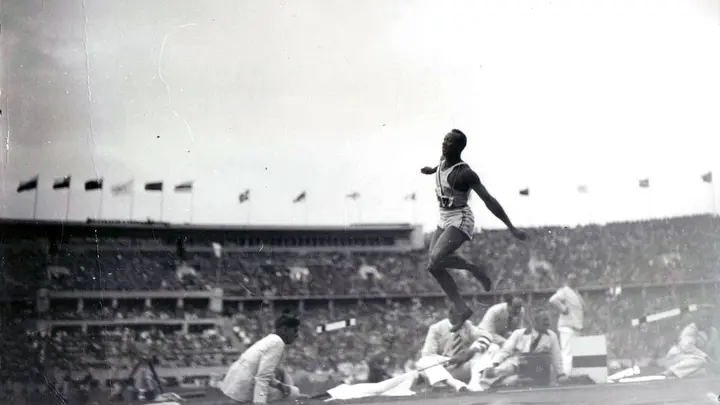
- Four Golds in BerlinIn Hitler’s Olympic stadium, a sharecropper’s son from Alabama won the 100, the 200, the long jump and the relay.4gold medals
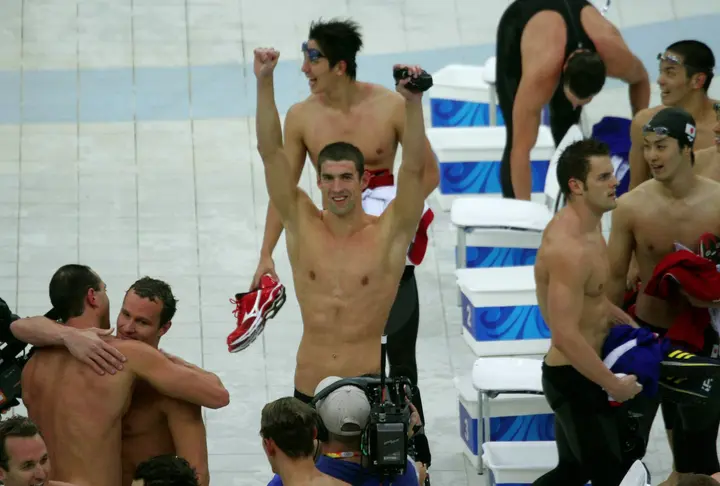
- Eight GoldsMichael Phelps won eight gold medals at one Olympics, the most ever, in Beijing.8gold medals
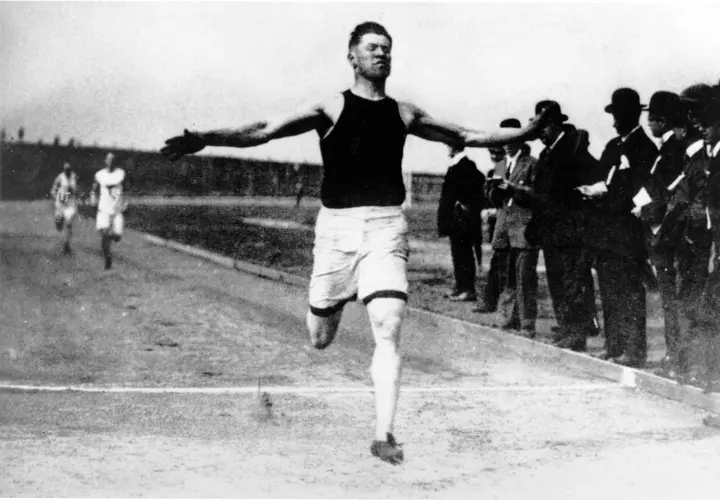
- The Greatest Athlete in the WorldAt Stockholm, Jim Thorpe won the pentathlon and the decathlon. The King of Sweden called him the greatest athlete in the world.2Olympic golds
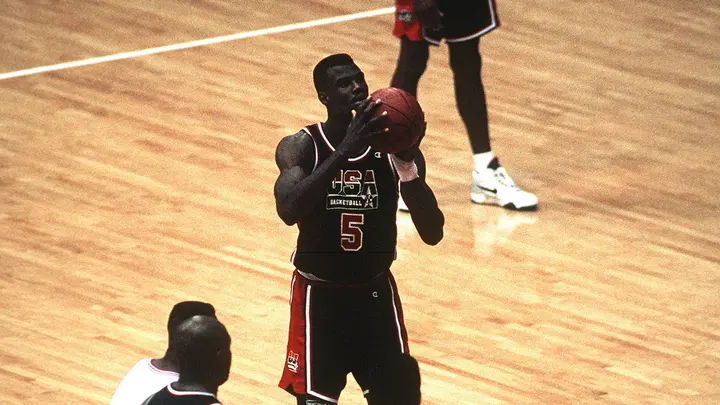
- The Dream TeamJordan, Magic, Bird and the best team ever assembled won Olympic gold in Barcelona without a close game.44point average margin


Free, with no ads. Support the museum →