Breed’s Hill, Charlestown, Massachusetts · 17 June 1775 · New England militia
We Gave Them Such a Hot Fire
A thousand farmers dug a fort in one night. The next afternoon they held their fire until the King’s regulars were thirty yards off, and threw them back down the hill twice.

The moment · About 15:00 · 17 June 1775
The regulars climb through waist-high grass in long scarlet lines. Behind the redoubt wall and the rail fence, nobody fires. The order is to wait. At fifty paces the whole American line fires at once, and the front ranks of the King’s best troops go down.
Two months after Concord, the militia of four colonies had the British army penned inside Boston. Word came that General Gage meant to seize the high ground around the town. The Americans moved first. They would build a fort on the Charlestown heights, in plain sight of the fleet, and dare the most professional army in the world to come and take it.
Across the Neck
After a prayer by Harvard’s president, Samuel Langdon, Col. William Prescott marches about a thousand men out of Cambridge: three Massachusetts regiments and 200 Connecticut men under Capt. Thomas Knowlton. They carry picks and shovels over Charlestown Neck in the dark. Gen. Israel Putnam and the engineer, Col. Richard Gridley, come too. They pick Breed’s Hill, 62 feet high and closer to Boston than Bunker Hill behind it.
A fort in one night
Gridley lays out the lines and the men start digging around midnight, quietly, with British warships anchored below. By first light they have thrown up a square redoubt about 130 feet on a side, its earth walls six feet high, with a firing step inside. Prescott later wrote that they plied the work “with all possible expedition” until just before sunrise.
The fleet opens fire
A lookout on HMS Lively sees the new fort and the ship opens fire. By morning every warship in the harbor is shooting at the hill, plus the battery on Copp’s Hill in Boston. The guns kill one man and smash the water supply. Prescott keeps the tired men digging and runs a breastwork about 20 rods north from the fort.
The regulars land
Gen. William Howe lands about 1,500 grenadiers and light infantry at Moulton’s Point and sends for more. Col. John Stark arrives with New Hampshire men and goes to the open left. Knowlton’s Connecticut men stuff a rail fence with new-mown grass. Stark sees the narrow beach along the Mystic River, has his men pile stones across it to the water, stands them three deep and drives a stake about 100 feet out.
Hold your fire
The light infantry come up the beach in column, the Royal Welch Fusiliers in front. The grenadiers march on the rail fence and Brig. Gen. Robert Pigot’s regiments on the redoubt. The militia wait until the regulars are within 50 paces. Then they fire. The light infantry break and run, some all the way back to their boats. Pigot pulls back. Behind him, a British fire shell and a landing party set Charlestown ablaze.
They come again
The regulars re-form and march back up over their own dead. The result is the same. “Some had only eight or nine men a company left,” one British witness wrote. In the redoubt Prescott has perhaps 150 men and the powder is running low, so he orders them to wait. They fire at 30 yards. Pigot’s men fall back nearly 150 yards before they can rally.
Col. William Prescott, to John AdamsI commanded a cessation till the enemy advanced within 30 yards, when we gave them such a hot fire that they were obliged to retire nearly 150 yards.
Out of powder
Gen. Henry Clinton sends about 400 more men across from Boston. Howe orders packs off and forms his men in columns with bayonets fixed, aimed straight at the redoubt. The defenders have a few rounds left, then none. The regulars come over the walls. With very few bayonets of their own, the Americans fight their way out the back. Prescott parries bayonet thrusts with his sword and is among the last out.
Warren falls
Dr. Joseph Warren, president of the Massachusetts Provincial Congress, had been made a major general three days earlier. He chose to fight on the hill as a private, with a musket. As the men pull out of the redoubt, he is shot in the head and killed. Out on the left, Stark and Knowlton hold the fence line long enough to keep the British from cutting off the retreat, and most of the wounded get away.
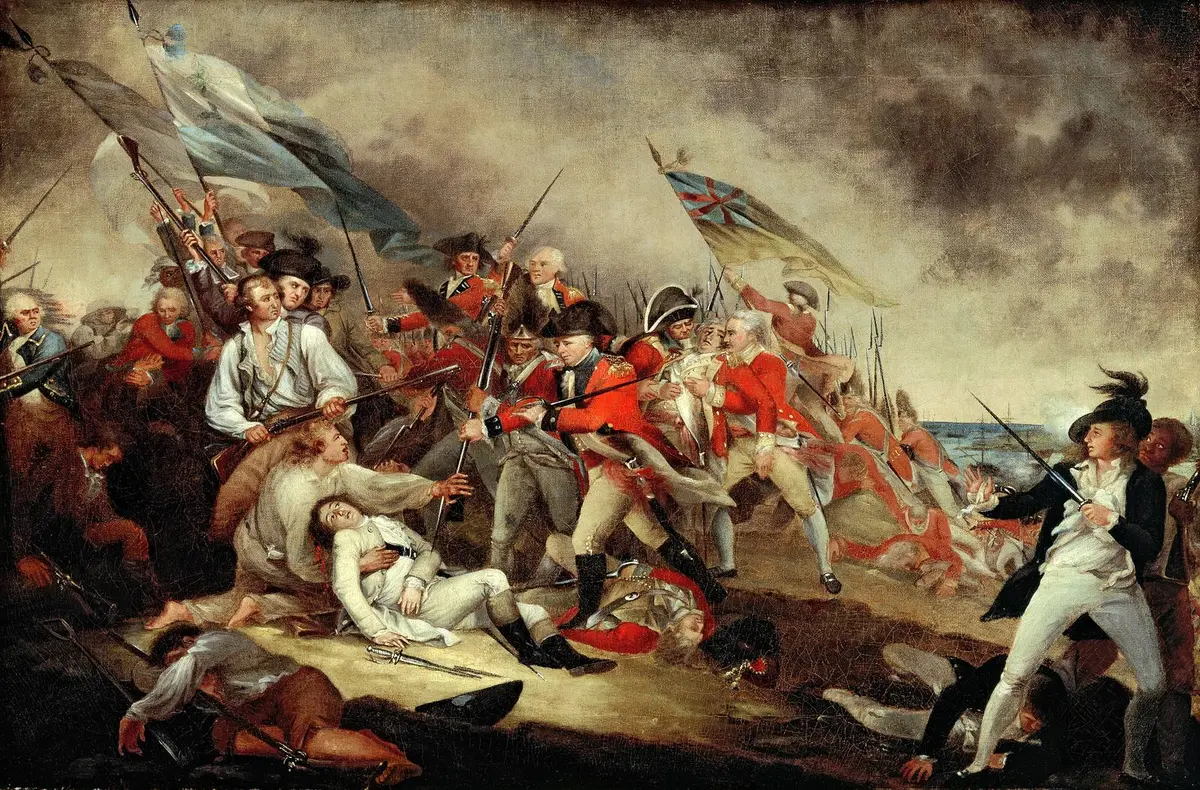
The Death of General Warren at the Battle of Bunker’s Hill: Warren falls in the redoubt as the regulars storm it (John Trumbull, 1786).. John Trumbull / Yale University Art Gallery. Gen. John Burgoyne, on the American retreatNo flight; it was even covered with bravery and military skill.
Over the Neck
The militia cross Charlestown Neck under fire from the warships. A cannonball kills Maj. Andrew McClary of New Hampshire, the last American to die that day. By evening the army is back behind its lines at Cambridge. The British hold the peninsula. It has cost them 226 killed and 828 wounded, more than in any other single battle of the war.

The men on the hill

Pepperell farmer and veteran of the 1745 siege of Louisbourg who turned down a British commission. He led the night march, built the redoubt, held his fire to 30 yards and was among the last men out, parrying bayonets with his sword.

Officer in Rogers’ Rangers in the French and Indian War. He saw the open beach on the Mystic, walled it with stones to the water, stood his men three deep and broke the light infantry. Then he held the fence while the army got away.

Boston physician and president of the Massachusetts Provincial Congress. Commissioned a major general three days before the battle, he chose to fight as a private, went into the redoubt with a musket and was killed in its last minutes.

Connecticut farmer and Rogers’ Rangers veteran who left his plow in the field when word of Lexington came. He helped plan the fortification, spent the battle pushing reinforcements toward Breed’s Hill and tried to rally the retreat on Bunker Hill.
By the numbers
In pictures


Watch, listen, see
Films, photographs and first-hand accounts from across the web. Each opens in a new tab.

Historian Jim Percoco tells the story of the battle that showed there was no turning back.
American Battlefield TrustThe colonel’s letter to John Adams: the night’s digging, the volley at 30 yards, the last stand.
Massachusetts Historical Society
Twelve stops of orders and letters from the men who fought on Breed’s Hill.
National Museum of the U.S. Army
Author Nathaniel Philbrick on Boston in 1775, the siege and the battle for the Charlestown heights.
C-SPANMore than 1,000 reenactors restage the battle for its 250th anniversary before 20,000 spectators.
C-SPAN
The free Black soldier his officers commended to the General Court for his conduct at Bunker Hill.
National Park Service
The 221-foot obelisk on Breed’s Hill and its 294 steps, part of Boston National Historical Park.
National Park Service
The presidential proclamation marking 250 years since the militia held Breed’s Hill.
The White House“The trials we have had show that the rebels are not the despicable rabble too many have supposed them to be.”
General Thomas Gage, British commander in chief, to the Earl of Dartmouth, 25 June 1775
After
The British had the hill and nothing else. “A few more such victories would have shortly put an end to British dominion in America,” General Clinton wrote. Washington took command of the army at Cambridge on 3 July. On 17 March 1776, nine months to the day after the battle, the British sailed out of Boston for good.
That April, Paul Revere and Warren’s brothers found his grave on Breed’s Hill. Revere knew him by the wire he had used to fasten Warren’s false tooth, the first known time a fallen American soldier was identified by his teeth. In December 1775, fourteen officers petitioned the General Court to honor Salem Poor, a free Black soldier they called brave and gallant. He served on through Valley Forge and Monmouth.
On 17 June 1825, fifty years after the battle, Lafayette laid the cornerstone of the Bunker Hill Monument and Daniel Webster gave the oration. The 221-foot granite obelisk was dedicated in 1843. A bronze Prescott stands at its foot, and every June Charlestown still marches for Bunker Hill Day.
Primary sources
- Col. William Prescott to John Adams, Camp at Cambridge, 25 August 1775. Massachusetts Historical Society.
- General Thomas Gage to the Earl of Dartmouth, 25 June 1775. The National Archives (UK).
- The Battle of Bunker Hill. National Park Service, Boston National Historical Park.
Keep exploring
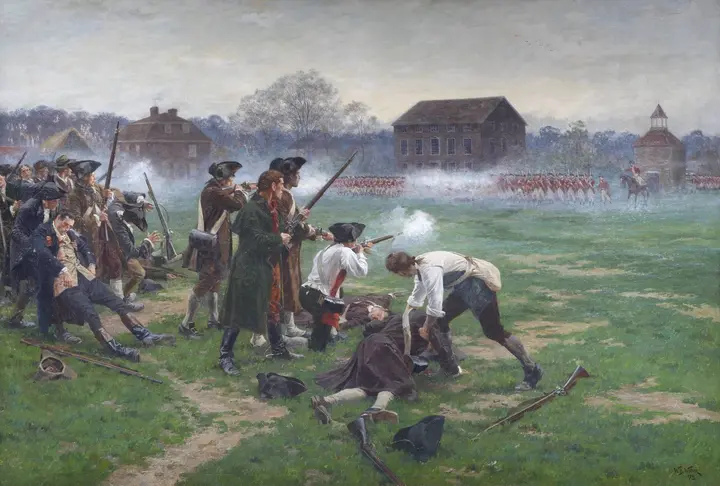
- The Shot Heard Round the WorldFarmers turned out in the night, fired back at the North Bridge, and chased the King’s regulars 18 miles back to Charlestown.~4,000militiamen
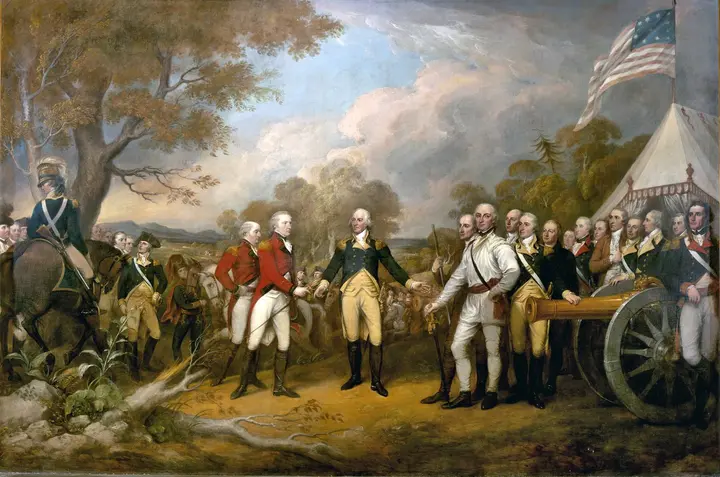
- SaratogaThe Park Service calls it the first surrender of a British army in history. France saw it and came into the war.~6,000troops surrendered
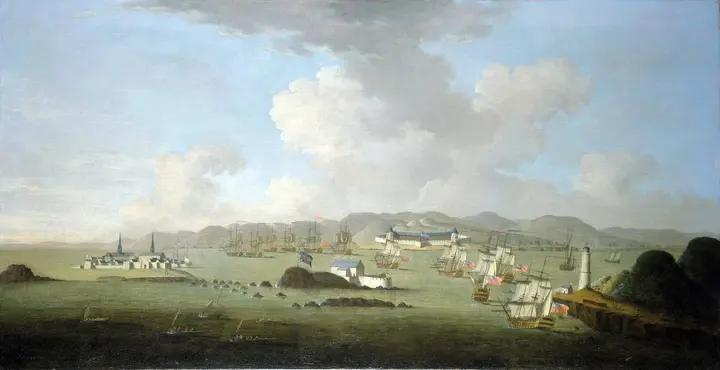
- The Gibraltar of the New World FallsAbout 4,000 New England militia under a Maine merchant, backed by the Royal Navy, dragged their guns through the bog and took France’s greatest fortress in North America.47days to take Louisbourg
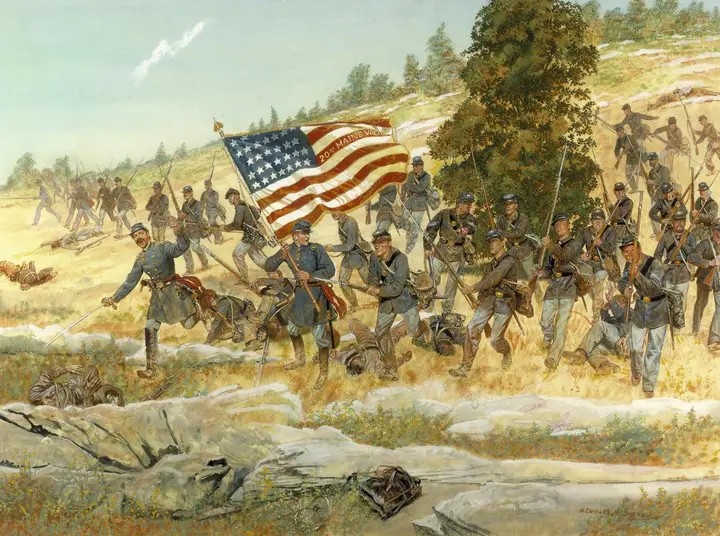
- Little Round TopAt the far end of the Union line at Gettysburg, out of ammunition, the 20th Maine fixed bayonets and charged downhill.386men of the 20th Maine


Free, with no ads. Support the museum →