Gettysburg, Pennsylvania · 2 July 1863 · 20th Maine and Vincent’s brigade
Hold That Ground at All Hazards
On the second day at Gettysburg, the end of the Union line hung on a rocky hill. A professor from Maine and 386 men held it, and when the cartridges ran out, they charged.

The moment · Early evening · 2 July 1863
More than an hour of close fighting. The men are firing their last cartridges and the Alabamians are forming for another rush, thirty yards off. Chamberlain steps to the colors and gives one word. The left wing swings down the hill like a gate.
Bayonet!Col. Joshua L. Chamberlain, as he recalled the order
By the afternoon of 2 July 1863, Robert E. Lee’s army had pushed the Union back onto a fishhook of ridges south of Gettysburg. The southern end of that line was Little Round Top, a rocky hill that looked straight down it. Confederate guns up there could rake the Army of the Potomac end to end. At 15:30, no troops held it.
Into line after a night march
The 20th Maine marches through the night with the Fifth Corps and reaches the heights east of Gettysburg about seven in the morning. It brings 358 rifles and 28 officers. Every pioneer and musician who can carry a musket is in the ranks. The colonel is Joshua Lawrence Chamberlain, a Bowdoin College professor who left the classroom in 1862 to go to war.
Nobody on the hill
Gen. Daniel Sickles has pushed his III Corps forward to the Peach Orchard and left Little Round Top bare. Brig. Gen. Gouverneur K. Warren, Meade’s chief engineer, reaches the summit and finds only a signal station. He has a battery fire a shot into the woods to the west. As the men in the trees turn toward the sound, Warren sees the glint of a Confederate battle line far outflanking the Union left.
Warren, recalling the momentThe discovery was intensely thrilling to my feelings and almost appalling.
Vincent doesn’t wait
Warren sends aides galloping for troops. One reaches the Fifth Corps, and Col. Strong Vincent hears the call. He waits for no one. He takes his brigade, four regiments and about 1,300 men, up the back of the hill at the double-quick and lines it along the southern spur, the 20th Maine on the far left. Within moments, Hood’s Texans and Alabamians come out of the woods.
Vincent to Chamberlain, his last words to himHold that ground at all hazards.
Company B goes out alone
Nobody is on Chamberlain’s left. He sends Capt. Walter Morrill and Company B, 44 men, out across the hollow toward Big Round Top to guard the flank. A dozen or more U.S. Sharpshooters join them behind a stone wall. Then Col. William Oates brings the 15th Alabama and the 47th Alabama up the slope, after a march of more than 20 miles that day.
Stretched to the breaking point
Oates swings wide to get around the regiment. Chamberlain stretches his line to nearly twice its length and bends the left half back at a right angle to meet him. For an hour the fighting is close and savage. Squads break through and are thrown out. At the center, Color Sgt. Andrew Tozier stands alone with the flag braced in his arm, firing a musket he picked up from the fallen.
Don’t give an inch
On Vincent’s right, the 4th and 5th Texas hit the 16th Michigan and it starts to give. Vincent jumps onto a boulder, shouts to his men, and goes down with a bullet in the groin. Warren pulls Col. Patrick O’Rorke’s 140th New York off the road and sends it straight over the crest. O’Rorke leads the charge and is shot dead. The line holds. Gunners haul Lt. Charles Hazlett’s cannon up the rocks by hand.
Vincent, from the boulderDon’t give an inch, boys, don’t give an inch!
Bayonet
The cartridge boxes are empty. Men are getting ready to club their muskets. With the Alabamians thirty yards off, Chamberlain orders the bayonet. The shout runs down the line and the regiment goes over the rocks. The left wing swings forward like a gate on a hinge. Morrill’s company and the sharpshooters open fire from behind their wall. A Confederate officer fires his pistol at Chamberlain’s head with one hand and surrenders his sword with the other.
Chamberlain’s report, 6 July 1863I ordered the bayonet. The word was enough.
Up the big hill in the dark
Col. James Rice, now commanding the brigade, wants Big Round Top before the enemy can use it at daylight. Chamberlain takes 200 men up the mountain in the dark, bayonets fixed, without waiting for ammunition. They take 25 prisoners, including a staff officer of Gen. Evander Law, and hold the crest through the night. The 83rd Pennsylvania and 44th New York come up beside them.
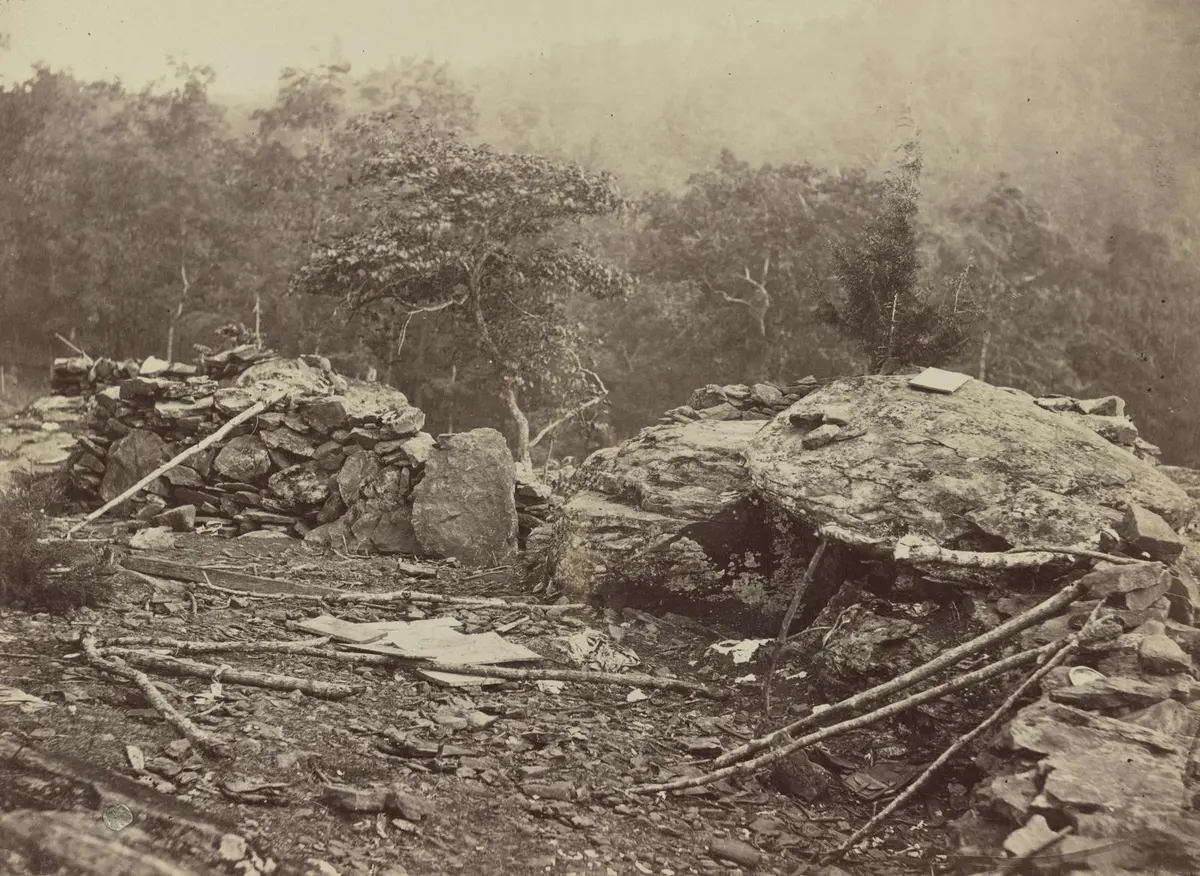
Stone breastworks Union troops threw up on Little Round Top, with Big Round Top behind, photographed by Timothy O'Sullivan in July 1863.. Timothy H. O'Sullivan / Library of Congress. The army is saved
At nine the next morning the 20th Maine is relieved and moved to the center of the line, the ground Pickett’s Charge strikes that afternoon. The great Confederate assault breaks against the Union line. On 4 July, Lee’s army starts its retreat to Virginia. The same day, Vicksburg surrenders to Ulysses S. Grant. The tide of the war has turned.
The men

Bowdoin College professor of languages who went to war in 1862 with no military training. He held the extreme left, then led the charge. Wounded six times, he commanded the troops at the surrender at Appomattox and served four terms as Maine’s governor.

Harvard-educated lawyer from Erie, Pennsylvania, who joined up in 1861. He took his brigade to Little Round Top on his own authority and placed every regiment himself. Mortally wounded rallying his right, he was promoted brigadier general and died on 7 July.

Graduated second in the West Point class of 1850. He spotted the empty hill, sent for troops, and pulled the 140th New York onto the crest himself, taking a wound in the neck. Promoted major general that summer, he later commanded the V Corps.

Born in Ireland and raised in Rochester, New York, he graduated first in the West Point class of June 1861. Warren sent his regiment over the crest as the Texans broke through. O’Rorke led the charge and was killed at its head.
By the numbers
In pictures


Watch, listen, see
Films, photographs and first-hand accounts from across the web. Each opens in a new tab.

Ranger Chuck Teague walks the rocky slopes where Vincent’s brigade and the 20th Maine held the line.
Gettysburg National Military Park
A Gettysburg park ranger leads a full program on the hill, the men who held it and the charge.
Gettysburg National Military Park
Eight stops across the hill, from Warren’s rock to the 20th Maine’s monument, with photos and maps.
National Park Service
Historians Garry Adelman and Kris White walk every part of the hill and the fight for it.
American Battlefield TrustChamberlain’s own report of 6 July 1863, from the night march to the bayonet charge, with a transcription.
Maine State Archives
A detailed battle map of the fight for the hill between 4:30 and 5:30 on 2 July.
American Battlefield Trust
Timothy O’Sullivan’s photograph of the stone walls the Union troops built on the hill, in full resolution.
Library of Congress
Lincoln’s two drafts of the address that dedicated the cemetery to the men who fought here.
Library of Congress“The brave men, living and dead, who struggled here, have consecrated it, far above our poor power to add or detract.”
President Abraham Lincoln, Gettysburg, 19 November 1863
After
In 1893 Chamberlain received the Medal of Honor for “daring heroism and great tenacity in holding his position on the Little Round Top against repeated assaults.” Five years later, at his urging, Color Sgt. Andrew Tozier received one too, for standing alone with the flag at the crisis of the fight.
The man who led the attack paid them the highest compliment. “There never were harder fighters than the Twentieth Maine men and their gallant Colonel,” William Oates wrote in 1905. “His skill and persistency and the great bravery of his men saved Little Round Top and the Army of the Potomac from defeat.”
On 3 October 1889 Chamberlain came back to dedicate the regiment’s monument on the spot where its colors stood. “In great deeds something abides,” he told his old soldiers. “On great fields something stays.”
Primary sources
- Report of Col. Joshua L. Chamberlain, Twentieth Maine Infantry, 6 July 1863. Official Records, Series I, Vol. 27, Part 1.
- Little Round Top Virtual Tour. Gettysburg National Military Park, National Park Service.
- William C. Oates, The War Between the Union and the Confederacy and Its Lost Opportunities. Neale Publishing, 1905.