Guadalcanal, Solomon Islands · 7 August 1942 · 1st Marine Division
Tokyo Express No Longer Has Terminus
The Marines took a half-built Japanese airfield in two days, named it Henderson Field and held it. Six months later, not one organized Japanese unit was left on the island.

The moment · Night of 13–14 September 1942
The Japanese are everywhere, fighting hand to hand in the foxholes. Edson pulls his Raiders and Paramarines back to the last knob, a mile from Henderson Field, and goes wherever the fighting is worst. Marine 105s fire at 1,600 yards. At dawn the ridge still belongs to the Marines.
They were just testing, just testing. They’ll be back.Merritt Edson to his company commanders, the morning before
In July 1942 the Japanese were building an airfield on Guadalcanal, in the Solomon Islands. Planes flying from it could threaten the lifeline from America to Australia and New Zealand. The Joint Chiefs ordered it taken. On 7 August the 1st Marine Division under Maj. Gen. Alexander Vandegrift went ashore in America’s first ground offensive of the war. The job was simple: take the airfield and hold it.
Red Beach
At 06:41 Rear Adm. Richmond Kelly Turner signals his ships to “land the landing force.” The first boats of the 5th Marines touch Red Beach at 09:09 and find no one there. The airfield’s builders, mostly laborers, have fled into the jungle. Twenty miles across the channel, Tulagi is a different fight. Edson’s Raiders clear it cave by cave against naval troops who will not surrender.
Left alone
The Marines take the airfield on the 8th. By nightfall 10,900 men are ashore on Guadalcanal and 6,075 on Tulagi. That night a Japanese cruiser force sinks four Allied heavy cruisers off Savo Island. On the 9th the transports sail away half unloaded. The Marines have 17 days of food, counting captured Japanese rice, and four days of ammunition. Vandegrift cuts rations to two meals a day.
The Cactus Air Force
Marines finish the runway with captured Japanese equipment and name it Henderson Field, for Maj. Lofton Henderson, a Marine pilot killed at Midway. On 20 August Capt. John L. Smith leads 19 Wildcat fighters of VMF-223 onto the strip, followed by Maj. Richard Mangrum’s 12 Dauntless dive bombers. The island’s radio code is Cactus, and its fliers become the Cactus Air Force. On 24 August its Wildcats shoot down 16 Japanese planes in one fight.
The Tenaru
Sgt. Maj. Jacob Vouza, a Solomon Islands scout, staggers into the Marine lines bayoneted and bleeding. The Japanese tortured him for hiding a small American flag, and he told them nothing. Now he warns that they are coming. At 01:30 Col. Kiyono Ichiki’s troops charge the sandbar at the river mouth. Lt. Col. Edwin Pollock’s 2d Battalion, 1st Marines cuts them down. By sunset nearly 800 attackers are dead.
Vandegrift to the Commandant of the Marine CorpsThese youngsters are the darndest people when they get started you ever saw.
Bloody Ridge
Kawaguchi’s brigade cuts through the jungle to hit the airfield from the south. On a grassy ridge a mile from the runway wait about 840 of Edson’s Raiders and Paramarines. They throw back the first night’s attacks. “They were just testing,” Edson tells his officers. “They’ll be back.” The second night is hand to hand. Edson pulls back to the last knob and holds, with Marine 105s firing at 1,600 yards. The Japanese leave more than 600 dead.
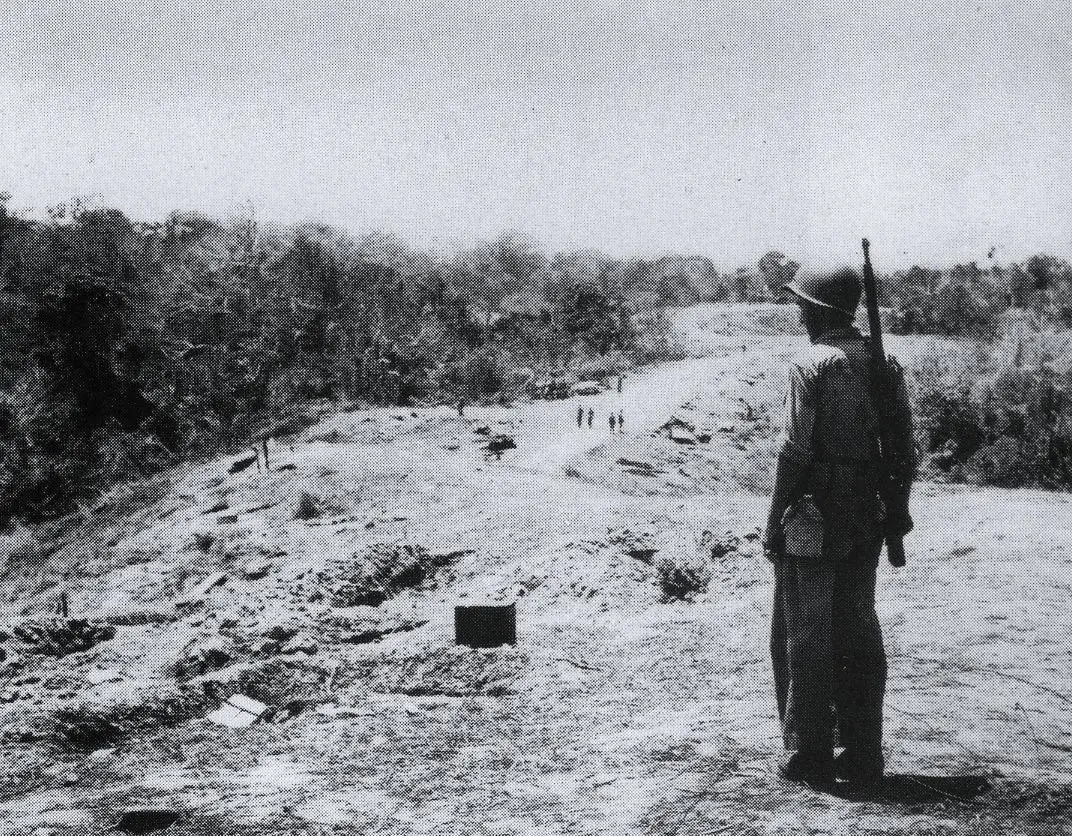
A Marine looks over the fighting positions on Edson’s Ridge, September 1942.. U.S. Marine Corps / National Archives. Did they get off?
Companies of Lt. Col. Lewis “Chesty” Puller’s 1st Battalion, 7th Marines are cut off west of the Matanikau River. Coast Guard Signalman Douglas Munro leads the landing craft in to bring them out. When Japanese guns open up on the beach, he puts his own boat between the guns and the loaded boats and holds it there. Nearly 500 Marines get off. A single bullet kills Munro. His last words are a question: “Did they get off?”
Manila John’s guns
The Sendai Division comes out of the rain near midnight against Puller’s battalion. Sgt. John Basilone runs two sections of heavy machine guns. When one is knocked out, he moves in an extra gun, repairs another and mans it himself, then fights through enemy lines to bring his gunners ammunition. Soldiers of the 164th Infantry are fed into the line in the dark. Over two nights, about 3,500 attackers die. The airfield holds.
Ironbottom Sound
Japan sends battleships to shell the airfield and land a fresh division. Rear Adm. Daniel Callaghan’s cruisers and destroyers charge into them in the dark at point-blank range. Callaghan and Rear Adm. Norman Scott are killed, but the battleship Hiei is crippled and later scuttled. Cactus and carrier fliers then sink seven troop transports in a day. On the night of the 14th, the 16-inch guns of USS Washington wreck the battleship Kirishima. Japan never again sends transports to Guadalcanal.
Total and complete
On 9 December Vandegrift hands command to Army Maj. Gen. Alexander Patch, and the worn-out 1st Marine Division sails for Australia. In January Patch’s XIV Corps of soldiers and Marines drives west. Japan pulls its survivors off the island by night. On 9 February, American troops advancing from east and west meet at Tenaro village near Cape Esperance. No organized Japanese unit is left on Guadalcanal.
Maj. Gen. Alexander Patch to Admiral HalseyTotal and complete defeat of Japanese forces on Guadalcanal effected 1625 today … Tokyo Express no longer has terminus on Guadalcanal.

The men

Born in Charlottesville, Virginia, and commissioned in 1909, he fought in Nicaragua, Veracruz and Haiti. He led America’s first offensive of the war and held Henderson Field for four months. Medal of Honor. Later the first active-duty Marine to wear four stars.
Medal of Honor citation
For outstanding and heroic accomplishment above and beyond the call of duty as commanding officer of the 1st Marine Division in operations against enemy Japanese forces in the Solomon Islands during the period 7 August to 9 December 1942. With the adverse factors of weather, terrain, and disease making his task a difficult and hazardous undertaking, and with his command eventually including sea, land, and air forces of Army, Navy, and Marine Corps, Maj. Gen. Vandegrift achieved marked success in commanding the initial landings of the U.S. forces in the Solomon Islands and in their subsequent occupation. His tenacity, courage, and resourcefulness prevailed against a strong, determined, and experienced enemy, and the gallant fighting spirit of the men under his inspiring leadership enabled them to withstand aerial, land, and sea bombardment, to surmount all obstacles, and leave a disorganized and ravaged enemy. This dangerous but vital mission, accomplished at the constant risk of his life, resulted in securing a valuable base for further operations of our forces against the enemy, and its successful completion reflects great credit upon Maj. Gen. Vandegrift, his command, and the U.S. Naval Service.

Called Red Mike for the beard he wore in Nicaragua, where he won the Navy Cross leading a patrol up the Coco River in 1928. He built the 1st Raider Battalion, took Tulagi, then held the ridge for two nights. Medal of Honor.
Medal of Honor citation
For extraordinary heroism and conspicuous intrepidity above and beyond the call of duty as commanding officer of the 1st Marine Raider Battalion, with Parachute Battalion attached, during action against enemy Japanese forces in the Solomon Islands on the night of 13-14 September 1942. After the airfield on Guadalcanal had been seized from the enemy on 8 August, Col. Edson, with a force of 800 men, was assigned to the occupation and defense of a ridge dominating the jungle on either side of the airport. Facing a formidable Japanese attack which, augmented by infiltration, had crashed through our front lines, he, by skillful handling of his troops, successfully withdrew his forward units to a reserve line with minimum casualties. When the enemy, in a subsequent series of violent assaults, engaged our force in desperate hand-to-hand combat with bayonets, rifles, pistols, grenades, and knives, Col. Edson, although continuously exposed to hostile fire throughout the night, personally directed defense of the reserve position against a fanatical foe of greatly superior numbers. By his astute leadership and gallant devotion to duty, he enabled his men, despite severe losses, to cling tenaciously to their position on the vital ridge, thereby retaining command not only of the Guadalcanal airfield, but also of the 1st Division's entire offensive installations in the surrounding area.

Manila John, from Raritan, New Jersey, earned his nickname as an Army boxer in the Philippines before joining the Marines in 1940. On 24–25 October his machine guns anchored Puller’s line. His Medal of Honor citation credits him with helping annihilate a Japanese regiment.
Medal of Honor citation
For extraordinary heroism and conspicuous gallantry in action against enemy Japanese forces, above and beyond the call of duty, while serving with the 1st Battalion, 7th Marines, 1st Marine Division in the Lunga area, Guadalcanal, Solomon Islands, on 24 and 25 October 1942. While the enemy was hammering at the Marines' defensive positions, Sgt. Basilone, in charge of two sections of heavy machine guns, fought valiantly to check the savage and determined assault. In a fierce frontal attack with the Japanese blasting his guns with grenades and mortar fire, one of Sgt. Basilone's sections, with its guncrews, was put out of action, leaving only two men able to carry on. Moving an extra gun into position, he placed it in action, then, under continual fire, repaired another and personally manned it, gallantly holding his line until replacements arrived. A little later, with ammunition critically low and the supply lines cut off, Sgt. Basilone, at great risk of his life and in the face of continued enemy attack, battled his way through hostile lines with urgently needed shells for his gunners, thereby contributing in large measure to the virtual annihilation of a Japanese regiment. His great personal valor and courageous initiative were in keeping with the highest traditions of the U.S. Naval Service.

From Cle Elum, Washington, he joined the Coast Guard in 1939. At Point Cruz he commanded 24 landing craft sent to rescue trapped Marines and shielded them with his own boat until he was killed. The only Coast Guardsman awarded the Medal of Honor.
Medal of Honor citation
For extraordinary heroism and conspicuous gallantry in action above and beyond the call of duty as petty officer in charge of a group of 24 Higgins boats, engaged in the evacuation of a battalion of marines trapped by enemy Japanese forces at Point Cruz, Guadalcanal on 27 September 1942. After making preliminary plans for the evacuation of nearly 500 beleaguered marines, Munro, under constant strafing by enemy machine guns on the island, and at great risk of his life, daringly led five of his small craft toward the shore. As he closed the beach, he signaled the others to land, and then in order to draw the enemy's fire and protect the heavily loaded boats, he valiantly placed his craft with its two small guns as a shield between the beachhead and the Japanese. When the perilous task of evacuation was nearly completed, Munro was instantly killed by enemy fire, but his crew, two of whom were wounded, carried on until the last boat had loaded and cleared the beach. By his outstanding leadership, expert planning, and dauntless devotion to duty, he and his courageous comrades undoubtedly saved the lives of many who otherwise would have perished. He gallantly gave his life for his country.
By the numbers
In pictures


Watch, listen, see
Films, photographs and first-hand accounts from across the web. Each opens in a new tab.

A Marine of Puller’s 1st Battalion, 7th Marines recalls the night attack on Henderson Field, 24–25 October 1942.
The National WWII Museum
Silent Navy film of Marines, Wildcats, B-17s and supply crews at work on Guadalcanal’s airfield.
Naval Photographic Center, via Internet Archive
Interview with the platoon sergeant whose machine guns held the line the night after Basilone’s.
Library of Congress Veterans History Project
Pharmacist’s Mate Louis Ortega recalls Samoa, Chesty Puller and landing on Guadalcanal with the 7th Marines.
Naval History and Heritage Command
Official Navy photographs of the August 1942 landings, Henderson Field and the first weeks ashore.
Naval History and Heritage Command
Veterans’ interviews, letters, diaries and photographs from the six-month fight for the island.
Library of CongressThe Coast Guard honors its only Medal of Honor recipient at his grave in Cle Elum, Washington.
U.S. Coast Guard (DVIDS)
The Navy’s history chief on the landings, the Battle of the Eastern Solomons and the sailors who rescued trapped Marines.
Naval History and Heritage Command“We train our men to go to a place, fight to win, and to live. I can assure you, it is a better theory.”
Gen. Alexander A. Vandegrift, Commandant of the Marine Corps
After
President Roosevelt presented Vandegrift the Medal of Honor at the White House. He awarded the Presidential Unit Citation to the 1st Marine Division and every unit that fought beside it, from the Army’s Americal Division to the Marine, Navy and Army squadrons of the Cactus Air Force. On 1 January 1944 Vandegrift became Commandant of the Marine Corps.
On the flight out, the division’s operations officer sketched a diamond with a numeral 1, the stars of the Southern Cross and the word Guadalcanal. Vandegrift initialed it. It became the first unit shoulder patch authorized in the war.
After Guadalcanal, Japan was no longer on the offensive. Some of its best infantry, pilots and sailors had been beaten in close combat by Americans. There were years of fighting ahead, but there was no longer any question how it would end.
Primary sources
- Henry I. Shaw Jr., First Offensive: The Marine Campaign for Guadalcanal. Marines in World War II Commemorative Series, History and Museums Division, Headquarters, U.S. Marine Corps.
- John Miller Jr., Guadalcanal: The First Offensive. United States Army in World War II, Center of Military History, 1949.
- Medal of Honor citations of Alexander A. Vandegrift, Merritt A. Edson, John Basilone and Douglas A. Munro.
Keep exploring
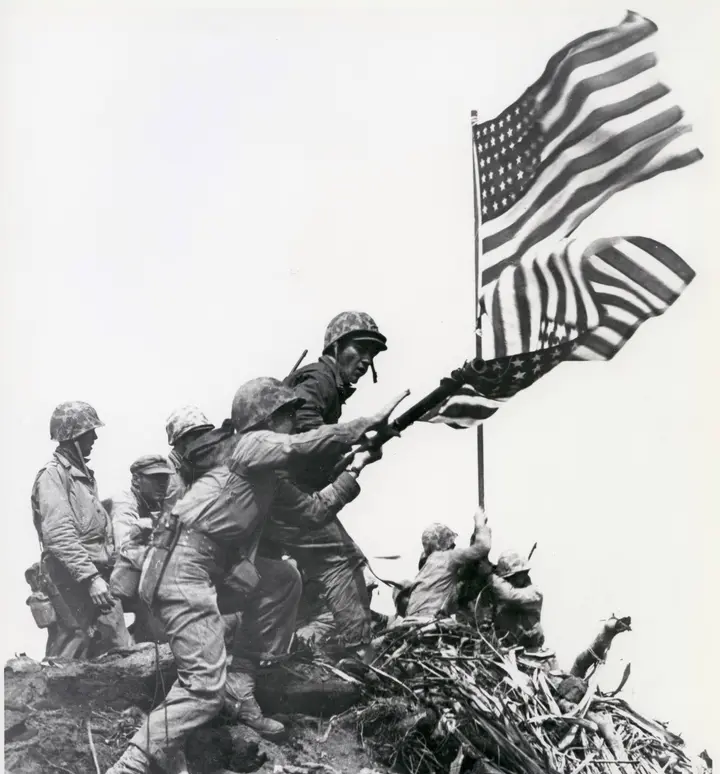
- Iwo JimaThirty-six days on eight square miles of volcanic rock. More Medals of Honor than any other battle of the war.27Medals of Honor
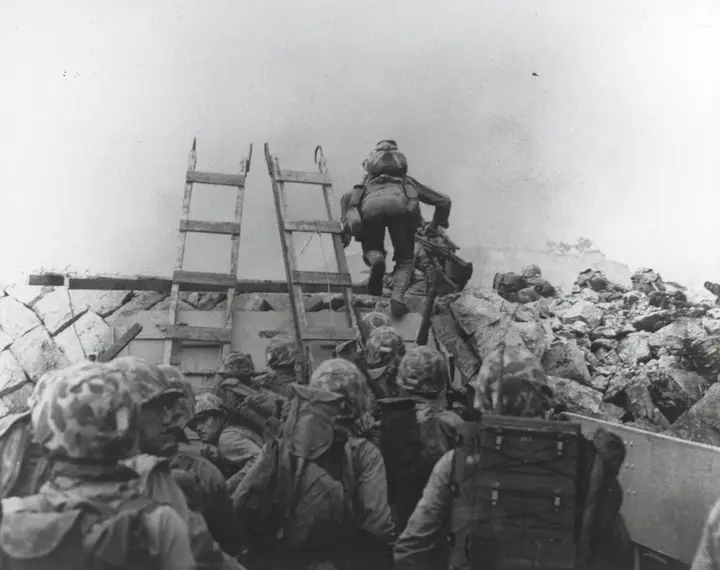
- InchonMacArthur landed behind enemy lines on a 31-foot tide, and Marines climbed the seawall on ladders to turn the Korean War.12days from the seawall to Seoul
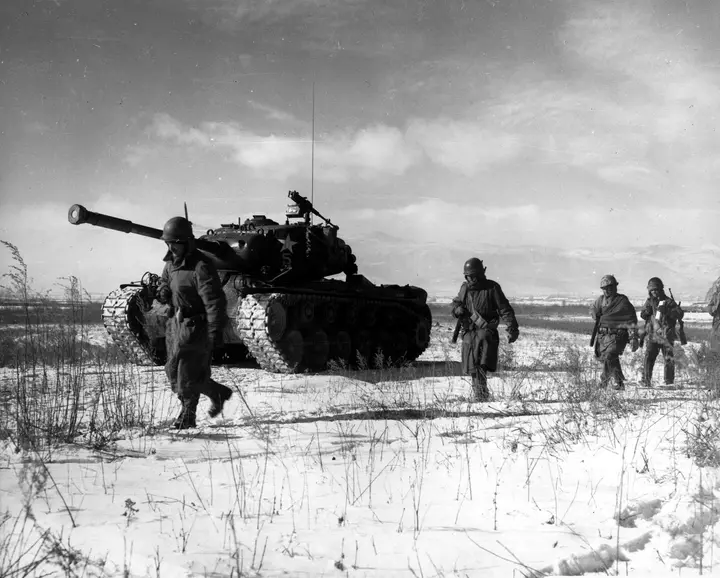
- Chosin ReservoirSurrounded by 120,000 Chinese troops at twenty-five below, the Marines attacked in a new direction: out, all the way to the sea.17days
- Belleau WoodTold to fall back, a Marine captain answered “Retreat? Hell, we just got here.” Then the Marines took the wood.26days


Free, with no ads. Support the museum →