Normandy, France · 6 June 1944 · Utah, Omaha and the 82nd and 101st Airborne
The Great Crusade
Thirteen thousand paratroopers jumped into the dark. At dawn the infantry hit Utah and Omaha. By midnight America was in France to stay.

The moment · About 08:00 · 6 June 1944
Men lie packed against the sea wall on Dog White. Brig. Gen. Norman Cota walks upright behind them under fire, telling officers to get their men moving. Bangalore torpedoes blow the wire. The 5th Rangers go through the gaps and up the smoking bluff.
Rangers, lead the way!Brig. Gen. Norman Cota to the 5th Ranger Battalion, Omaha Beach
For four years Germany had held France and fortified its coast. On 6 June 1944 the Allies came for it. The Americans had two beaches, Utah and Omaha, and two airborne divisions to drop behind them in the dark. General Dwight D. Eisenhower gave the order. By midnight the Atlantic Wall was broken and the liberation of Europe had begun.
The decision
The invasion is set for 5 June, but a storm sweeps the Channel and Eisenhower postpones it a day. Before dawn on 5 June, at Southwick House near Portsmouth, his weather officers forecast a short break in the storm. Eisenhower weighs it and orders the invasion to go on 6 June. That afternoon he writes out a statement to be released if the landings fail. In it he takes all the blame himself.
Eisenhower’s note, in case of failureIf any blame or fault attaches to the attempt it is mine alone.
With the paratroopers
Eisenhower drives out to see the 101st Airborne before they go. He walks among the men of the 502nd Parachute Infantry, faces blackened, and asks where they are from. At 22:15 the first of 432 C-47s lift off with 6,600 men of the 101st. In all, more than 13,000 paratroopers of the 82nd and 101st fly to Normandy. Cloud and flak scatter them across miles of hedgerows and flooded fields, and they fight in whatever groups they can form.
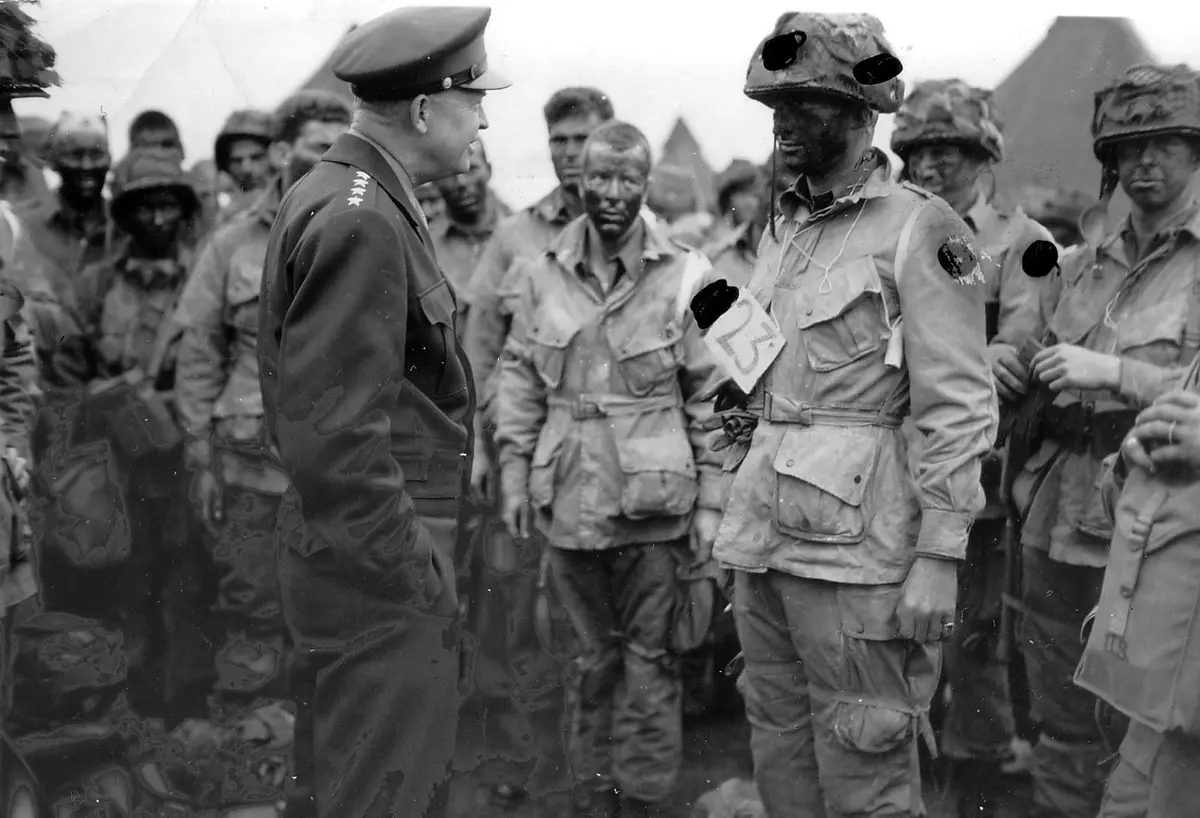
General Eisenhower talks with paratroopers of Company E, 502nd Parachute Infantry, 101st Airborne Division, in England on the evening of 5 June 1944.. U.S. Army Signal Corps / National Archives. The flag from Naples
Lt. Col. Edward Krause gathers about a quarter of his 3rd Battalion, 505th Parachute Infantry, and heads for Sainte-Mère-Église. In the dark his men use only knives, bayonets and grenades, so any rifle fire gives a German away. By 04:30 they hold the town and raise the same American flag the battalion raised over Naples. They cut the main cable to Cherbourg. The town sits on the main road to Cherbourg, and it is in American hands.
The wrong beach
Twenty landing craft of the 8th Infantry, 4th Division, land almost exactly at H-Hour. Current and smoke have set them about 2,000 yards south of the planned beach. Brig. Gen. Theodore Roosevelt Jr., 56 years old, lands with the first wave. He scouts the ground behind the dunes himself, finds the causeways, and sends the battalions inland from where they stand. The defenses here are weaker. The mistake becomes a gift.
The hard beach
The Germans have moved a whole field division, the 352nd, into the Omaha sector. Of 32 swimming tanks meant for the eastern half of the beach, only two swim in. Boat teams land scattered, many of them far from their targets, and pile up at the shingle under machine-gun fire. Company L, 16th Infantry, is the only first-wave rifle company of eight still able to fight as a unit. It reorganizes under the bluff and goes up near the F-1 draw.
Rangers, lead the way
Brig. Gen. Norman Cota, assistant commander of the 29th Division, lands with the command group of the 116th Infantry. The men are pinned at the sea wall. Cota and Col. Charles Canham walk behind them under fire, telling officers to get them moving. Canham is hit in the wrist and keeps going. At about 07:50 Company C blows the wire and starts up the bluff. The 5th Rangers follow. They lose only eight men getting to the top.
Off the beach
Col. George A. Taylor, commanding the 16th Infantry, lands to find men hugging the embankment under mortar fire. He groups them under the nearest sergeant and sends them through the wire and up the bluff. Farther east, 1st Lt. Jimmie Monteith of Company L leads two blind tanks on foot through a minefield and puts their guns on German positions. Between 10:00 and 11:00 two destroyers close to within a thousand yards of the beach and pound the strongpoints.
Col. George A. Taylor, 16th Infantry, Easy RedTwo kinds of people are staying on this beach, the dead and those who are going to die—now let’s get the hell out of here.
Down the draw
Before 11:00 men of the 116th and a company of Rangers are in Vierville, with Cota close behind the lead men. Between 12:00 and 13:00 naval guns, the battleship Texas among them, pound the strongpoint guarding the Vierville draw. After the destroyer McCook’s first four salvos, Germans leave their concrete to surrender. Cota then walks down the draw to the beach with four or five men. Five German prisoners lead them through the minefield.
Ashore to stay
Soon after noon at Pouppeville, paratroopers of the 101st meet the 4th Division coming off Utah, the first link between the beach and the airborne. By midnight more than 20,000 men and 1,700 vehicles are across Utah, at a cost of 197 casualties in the 4th Division. At Omaha most of five regiments are ashore, holding a strip up to a mile and a half deep. The Atlantic Wall is broken.
Hear it
The men

Raised in Abilene, Kansas, and a West Point graduate of 1915. He commanded the Allied landings in North Africa, Sicily and Italy before taking over the invasion of France. Before dawn on 5 June he made the call to go.

Eldest son of President Theodore Roosevelt. Wounded in France in 1918, he led troops ashore in North Africa and Sicily. He asked three times to land with the first wave at Utah, went in with a cane, and ran the beach all morning.
Medal of Honor citation
For gallantry and intrepidity at the risk of his life above and beyond the call of duty on 6 June 1944, in France. After 2 verbal requests to accompany the leading assault elements in the Normandy invasion had been denied, Brig. Gen. Roosevelt's written request for this mission was approved and he landed with the first wave of the forces assaulting the enemy-held beaches. He repeatedly led groups from the beach, over the seawall and established them inland. His valor, courage, and presence in the very front of the attack and his complete unconcern at being under heavy fire inspired the troops to heights of enthusiasm and self-sacrifice. Although the enemy had the beach under constant direct fire, Brig. Gen. Roosevelt moved from one locality to another, rallying men around him, directed and personally led them against the enemy. Under his seasoned, precise, calm, and unfaltering leadership, assault troops reduced beach strong points and rapidly moved inland with minimum casualties. He thus contributed substantially to the successful establishment of the beachhead in France.

West Point class of 1917 and chief of staff of the 1st Infantry Division in North Africa. On Omaha he walked the sea wall under fire, got the first men up the bluff at Dog White, then walked down the Vierville draw to open it.
Distinguished Service Cross citation
The President of the United States of America, authorized by Act of Congress, July 9, 1918, takes pleasure in presenting the Distinguished Service Cross to Brigadier General Norman Daniel Cota (ASN: 0-5284), United States Army, for extraordinary heroism in connection with military operations against an armed enemy while serving as Assistant Division Commander, 29th Infantry Division, in action against enemy forces on 6 June 1944, at Normandy, France. General Cota landed on the beach shortly after the first assault wave of troops had landed. At this time the beach was under heavy enemy rifle, machine gun, mortar and artillery fire. Numerous casualties had been suffered, the attack was arrested, and disorganization was in process. With complete disregard for his own safety, General Cota moved up and down the fire-swept beach reorganizing units and coordinating their action. Under his leadership, a vigorous attack was launched that successfully overran the enemy positions and cleared the beaches. Brigadier General Cota’s superb leadership, personal bravery and zealous devotion to duty exemplify the highest traditions of the military forces of the United States and reflect great credit upon himself, the 29th Infantry Division, and the United States Army.

Grew up in Richmond, Virginia, and studied at Virginia Tech. Drafted in 1941, he was commissioned in 1942 and fought in Sicily with the Big Red One. On Omaha he led tanks through a minefield on foot and held the high ground until he was killed.
Medal of Honor citation
For conspicuous gallantry and intrepidity above and beyond the call of duty on 6 June 1944, near Colleville-sur-Mer, France. 1st Lt. Monteith landed with the initial assault waves on the coast of France under heavy enemy fire. Without regard to his own personal safety he continually moved up and down the beach reorganizing men for further assault. He then led the assault over a narrow protective ledge and across the flat, exposed terrain to the comparative safety of a cliff. Retracing his steps across the field to the beach, he moved over to where 2 tanks were buttoned up and blind under violent enemy artillery and machinegun fire. Completely exposed to the intense fire, 1st Lt. Monteith led the tanks on foot through a minefield and into firing positions. Under his direction several enemy positions were destroyed. He then rejoined his company and under his leadership his men captured an advantageous position on the hill. Supervising the defense of his newly won position against repeated vicious counterattacks, he continued to ignore his own personal safety, repeatedly crossing the 200 or 300 yards of open terrain under heavy fire to strengthen links in his defensive chain. When the enemy succeeded in completely surrounding 1st Lt. Monteith and his unit and while leading the fight out of the situation, 1st Lt. Monteith was killed by enemy fire. The courage, gallantry, and intrepid leadership displayed by 1st Lt. Monteith is worthy of emulation.
By the numbers
In pictures


Watch, listen, see
Films, photographs and first-hand accounts from across the web. Each opens in a new tab.

Army Signal Corps film of the landings and the first three days ashore in Normandy.
U.S. National Archives
Eisenhower reads his Order of the Day to the men of the invasion.
U.S. Army
A 116th Infantry rifleman from the first waves at Omaha, wounded five times in 32 hours.
The National WWII Museum
The bluff above Omaha Beach where more than 9,300 Americans rest.
American Battle Monuments Commission
Robert Sargent’s photograph of 1st Division troops wading into Omaha Beach on D-Day.
National Archives
Eisenhower’s signed message to the soldiers, sailors and airmen of the invasion.
National Archives
The prayer President Roosevelt read to the nation by radio on the night of 6 June 1944.
FDR Presidential Library
The Army’s own 1945 history of the Omaha landing, hour by hour and company by company.
War DepartmentRead it
Order of the Day236 words · Full text
Soldiers, Sailors, and Airmen of the Allied Expeditionary Force!
You are about to embark upon the Great Crusade, toward which we have striven these many months. The eyes of the world are upon you. The hope and prayers of liberty-loving people everywhere march with you. In company with our brave Allies and brothers-in-arms on other Fronts, you will bring about the destruction of the German war machine, the elimination of Nazi tyranny over the oppressed peoples of Europe, and security for ourselves in a free world.
Your task will not be an easy one. Your enemy is well trained, well equipped and battle-hardened. He will fight savagely.
But this is the year 1944! Much has happened since the Nazi triumphs of 1940-41. The United Nations have inflicted upon the Germans great defeats, in open battle, man-to-man. Our air offensive has seriously reduced their strength in the air and their capacity to wage war on the ground. Our Home Fronts have given us an overwhelming superiority in weapons and munitions of war, and placed at our disposal great reserves of trained fighting men. The tide has turned! The free men of the world are marching together to Victory!
I have full confidence in your courage, devotion to duty and skill in battle. We will accept nothing less than full Victory!
Good luck! And let us beseech the blessing of Almighty God upon this great and noble undertaking.
Gen. Dwight D. Eisenhower, Supreme Headquarters Allied Expeditionary Force, June 1944 · Source
“Almighty God: Our sons, pride of our Nation, this day have set upon a mighty endeavor, a struggle to preserve our Republic, our religion, and our civilization, and to set free a suffering humanity.”
President Franklin D. Roosevelt, radio prayer to the nation, 6 June 1944
After
Eisenhower’s note was never needed. His armies liberated Paris on 25 August 1944 and crossed the Rhine the next spring. On 7 May 1945 Germany surrendered unconditionally at his headquarters in Reims, eleven months after D-Day. In 1952 the country elected him president.
Roosevelt’s Medal of Honor came after his death. He died of a heart attack in Normandy on 12 July 1944 and lies in the Normandy American Cemetery beside his brother Quentin, killed in France in 1918. Monteith lies there too. Cota took command of the 28th Infantry Division in August and led it down the Champs-Élysées on 29 August 1944.
The Rangers took Cota’s words for their motto, and “Rangers lead the way” is still the motto of the 75th Ranger Regiment. By the end of June 1944 the Allies had landed more than 850,000 men in Normandy. The road to Germany started on Utah and Omaha.
Primary sources
- Omaha Beachhead (6 June–13 June 1944). American Forces in Action Series, Historical Division, War Department, 1945.
- Utah Beach to Cherbourg (6 June–27 June 1944). American Forces in Action Series, Historical Division, War Department, 1947.
- General Dwight D. Eisenhower’s Order of the Day (1944). National Archives and Records Administration.
Keep exploring
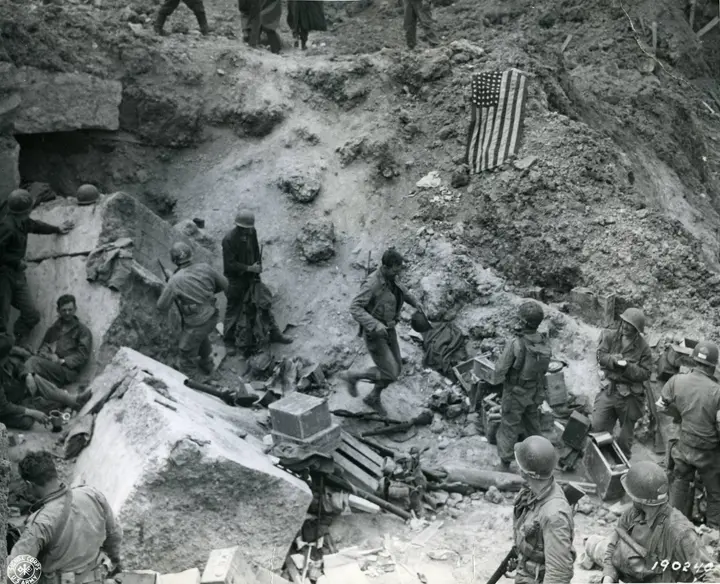
- The Boys of Pointe du Hoc225 Rangers climbed a sheer cliff under fire and destroyed the guns aimed at the D-Day beaches.100ft of cliff
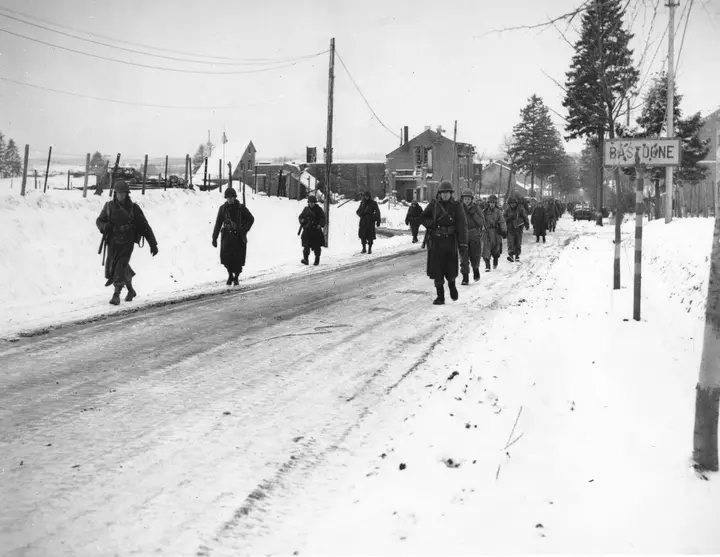
- BastogneSurrounded and told to surrender, the 101st Airborne’s acting commander sent back one word.Nuts!the reply
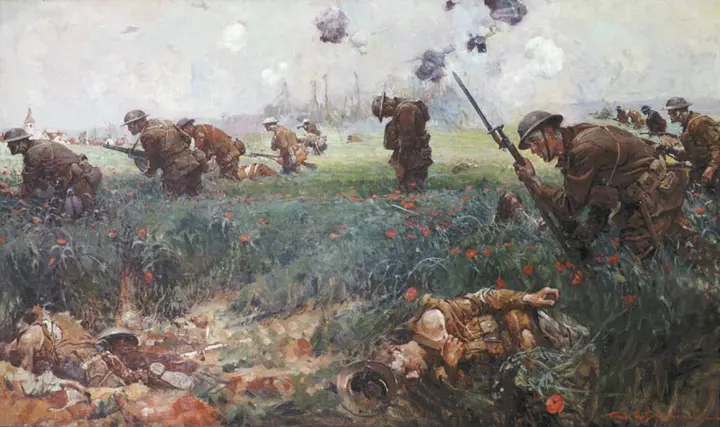
- Belleau WoodTold to fall back, a Marine captain answered “Retreat? Hell, we just got here.” Then the Marines took the wood.26days
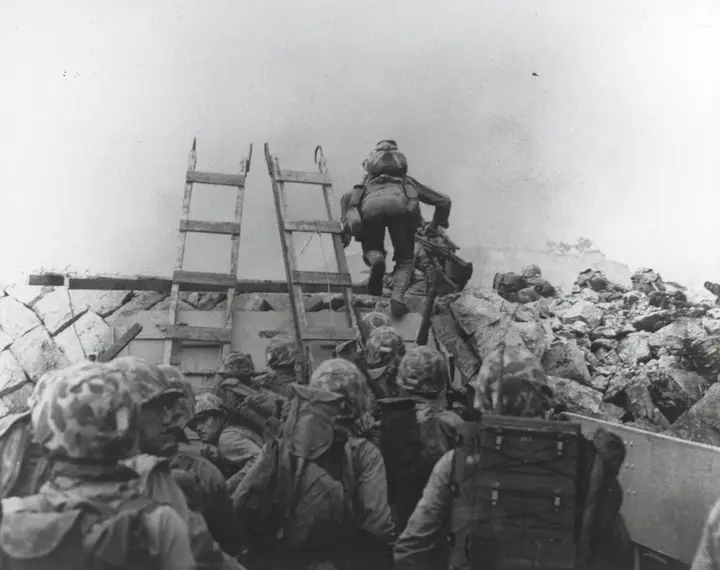
- InchonMacArthur landed behind enemy lines on a 31-foot tide, and Marines climbed the seawall on ladders to turn the Korean War.12days from the seawall to Seoul


Free, with no ads. Support the museum →