Normandy, France · 6 June 1944 · 2nd Ranger Battalion
The Boys of Pointe du Hoc
Six German guns. A hundred feet of cliff. Two hundred and twenty-five Rangers sent straight up it.

The moment · 07:10 · 6 June 1944
Forty minutes late, the Rangers hit the cratered beach under a hundred feet of rock. Rockets fire the grapnels. Ropes catch. From the edge, Germans cut lines and roll grenades down. The Rangers keep climbing, hand over hand, stacking ladders where ropes fail. By 07:45 every man is up.
Praise the Lord.Lt. James Eikner’s radio code: all men up the cliff
Six German 155 mm guns sat on a point of rock between Omaha and Utah beaches, with the range to shell both. They had to be gone before the landings. The Army gave the job to the 2nd Ranger Battalion under Lt. Col. James Earl Rudder. The only way in was straight up.
Wrong point, wrong time
Companies D, E and F are supposed to be on the beach. Heavy seas have already swamped one landing craft carrying Capt. Harold Slater and 20 men of D Company, and sunk a supply boat. Now the guide craft is heading for Pointe de la Percée, three miles east. Rudder spots it and turns the flotilla west, running along the German-held coast under fire. A 20 mm gun hits one of the DUKWs.
Forty minutes late
The naval bombardment has lifted and the defenders are back on the cliff edge. Nine landing craft ground along 500 yards of cratered beach. The destroyer USS Satterlee closes to 2,500 yards and rakes the cliff top with her 5-inch guns. Rocket-fired grapnels launch ropes up the face. Some fall short, soaked and heavy. The rest catch.
Hand over hand
Germans cut ropes and roll grenades over the edge. The Rangers climb anyway. Pfc. Harry Roberts goes up a hand line in about 40 seconds. Where the ropes fail, men stack 16-foot sections of steel ladder on the rubble and climb those. The DUKWs with their 100-foot London fire ladders bog down in the craters. Within 30 minutes of touchdown the assault force is on top.
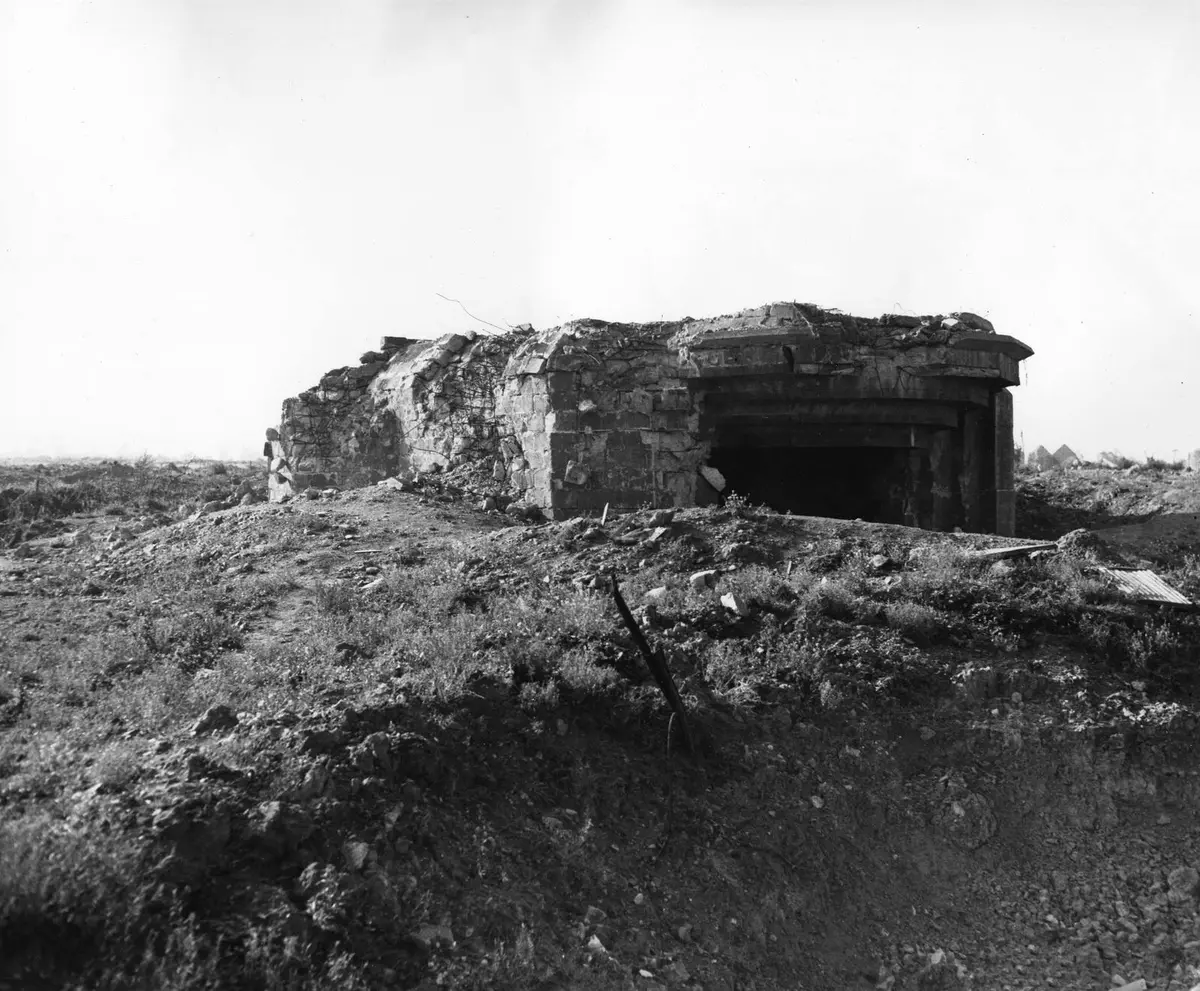
Shattered German gun casemate at Pointe du Hoc, September 1944. U.S. Army Signal Corps (111-SC-275925) / National Archives. All men up the cliff
Rudder climbs up and sets his command post in a crater at the cliff edge. The Point is a moonscape of bomb and shell holes. Lt. James Eikner radios the code for all men up the cliff. When German artillery starts homing in on his radio, he switches to signal lamps and keeps the destroyers firing where the Rangers need it. Snipers work the Point all day, and German fire hits Rudder in the thigh.
Eikner’s code for “all men up the cliff”Praise the Lord.
The road is cut
Small groups of Rangers push inland through craters and hedgerows, with German shells falling behind them all the way. At 08:15, barely an hour after landing, about 50 of them reach the coastal highway and cut it. First Sgt. Leonard Lomell puts the 20 men of D Company along the road on the west flank, facing Grandcamp. Patrols go out at once.
Found and finished
The casemates are empty. Lomell and Staff Sgt. Jack Kuhn follow tracks down a sunken lane and find five 155s hidden in an orchard, aimed at Utah Beach, shells stacked and ready. Kuhn covers. Lomell melts the gears of two guns with thermite grenades and smashes the sights. They run back for more thermite and finish the rest. A Company E patrol under Staff Sgt. Frank Rupinski sets the powder charges ablaze.
Mission accomplished
Rudder has heard nothing from Omaha Beach. Between noon and 13:00 he sends his report three ways: by radio, through the Satterlee, and by carrier pigeon. The answer relayed back is blunt: no reinforcements available. The Satterlee fires 164 salvos for the Rangers that day. At about 16:00 a German attack gets within 40 yards of the Rangers’ line before Staff Sgt. Herman Stein’s BAR and Sgt. Eugene Elder’s mortar break it up.
Rudder’s message to the fleetLocated Pointe du Hoc. Mission accomplished. Need ammunition and reinforcements. Many casualties.
The night attacks
At 21:00 a 5th Ranger platoon under Lt. Charles Parker walks in from Omaha Beach after fighting four miles across country. The Germans come at the 85 Rangers holding the highway, opening each attack with whistles and shouted names. The Rangers throw them back at 23:30 and again at 01:00. The third attack, near 03:00, breaks the line. About 50 Rangers make it back to the Point. A dozen more lie hidden under a hedgerow until the relief reaches them.
They held
Cut off and short on ammunition, the Rangers hold a strip of cliff top through 7 June with naval gunfire, two mortars and captured German machine guns. Boats bring in food, ammunition and about 30 reinforcements that afternoon. At about 10:00 on 8 June the 5th Rangers and the 116th Infantry attack with tanks, and the Point is clear by noon. About 90 of the 225 can still fight. The point never fell.
The Rangers

Texas A&M graduate, teacher and football coach before the war. Took command of the 2nd Rangers in 1943 and led the climb at Pointe du Hoc himself. Wounded twice, he ran the fight from a crater on the cliff edge until relief came.

Shot in the side wading ashore, he climbed anyway and led D Company to the highway. With Kuhn covering him, he found the five hidden 155s in an orchard and wrecked them with thermite. Distinguished Service Cross; Silver Star at Hill 400.

At about 16:00 on D-Day he spotted a German squad with a machine gun closing on the Point. He opened up with his BAR at 40 yards, broke up the lead group and bought the mortar crew time to finish the attack.

Pediatrician who volunteered for the Rangers in 1943. Waded in at Pointe du Hoc with medical supplies packed in a waterproofed mortar shell case and treated the wounded under fire for two days. Killed tending wounded at Hill 400 in December 1944.
By the numbers
In pictures


Watch, listen, see
Films, photographs and first-hand accounts from across the web. Each opens in a new tab.

President Reagan’s full address on the cliff top, 6 June 1984, with 62 of the Rangers seated in front of him.
Reagan Library · YouTube
Lomell tells how he and Kuhn found the hidden guns and destroyed them.
American Battle Monuments Commission
Today’s 75th Ranger Regiment scales the same cliff in 2019.
U.S. Army · YouTube
The full interview with the sergeant who put the guns out of action.
C-SPAN · National WWII Museum
Both men, side by side, on the climb and the orchard.
HistoryNet
Rangers show the ladders they used to scale the cliff, June 1944.
Naval History and Heritage Command
The President with surviving Rangers on the point, 6 June 1984.
National Archives
The Army’s own after-action history of Rudder’s force, written from interviews with the men.
War Department, 1946“These are the boys of Pointe du Hoc. These are the men who took the cliffs.”
President Ronald Reagan, at Pointe du Hoc, 6 June 1984
After
Rudder was wounded twice on D-Day and never gave up command. He and Lomell both received the Distinguished Service Cross, and the battalion received the Presidential Unit Citation. Lomell and Kuhn entered the Ranger Hall of Fame together in 1994.
The Rangers fought on through Brest and the Hürtgen Forest, where they took and held Hill 400 in December 1944. Rudder led the 109th Infantry in the Battle of the Bulge, then went home to Texas, became president of Texas A&M and retired a major general. Lomell became a lawyer in Toms River, New Jersey. Kuhn became chief of police in Altoona, Pennsylvania.
Forty years later, sixty-two of the surviving Rangers sat on the point while the President of the United States told the world what they had done.
Primary sources
- Small Unit Actions: Pointe du Hoc. War Department Historical Division, 1946.
- Omaha Beachhead. War Department Historical Division, 1945.
- Remarks at Pointe du Hoc, President Ronald Reagan, 6 June 1984.