Off Samar, the Philippines · 25 October 1944 · Taffy 3
No Higher Honor
Six small carriers and seven escorts stood between Japan’s battle fleet and the Leyte beachhead. The escorts turned and charged.

The moment · About 07:40 · 25 October 1944
Six slow carriers are running for their lives, Japanese shells landing astern in geysers of dyed water. Sprague orders his escorts to attack. Hoel, Heermann and the little Samuel B. Roberts turn toward a line of battleships and cruisers. Johnston, already torn open, follows them in.
A fight against overwhelming odds from which survival could not be expected, during which time we would do what damage we could.Lt. Cmdr. Robert Copeland, recording what he told the crew of Samuel B. Roberts
On 20 October 1944 MacArthur’s army landed on Leyte. Five days later, with Halsey’s fleet drawn north by a decoy, Japan’s Center Force came down the coast of Samar to smash the beachhead. In its way stood Taffy 3: six small escort carriers built to support troops and hunt submarines, and seven thin-skinned escorts. They fought anyway.
Pagodas on the horizon
Daybreak finds Taffy 3 about 50 miles east of Samar, launching routine patrols for the troops on Leyte. At 06:37 a patrol pilot reports a Japanese fleet coming down the coast. It has four battleships, including Yamato, six heavy cruisers, two light cruisers and eleven destroyers. Halsey’s battleships are far to the north. Minutes later the first heavy shells land between Johnston and Samuel B. Roberts, throwing up green and purple geysers.
Run, launch, call for help
Rear Adm. Clifton Sprague turns his carriers east into the wind and launches every plane he has. Each carrier has a single 5-inch gun on the stern and a top speed of about 17 knots. The destroyers and destroyer escorts pour black and white smoke between the carriers and the enemy. Sprague radios for help in plain language. A rain squall hides the carriers for about ten minutes.
Evans goes in alone
Without waiting for orders, Cmdr. Ernest Evans lights off all boilers, makes smoke and opens fire at 18,000 yards. He closes to 10,000 yards and fires all ten torpedoes. One blows the bow off the heavy cruiser Kumano and knocks her out of the battle. Around 07:30 three 18.1-inch shells from Yamato tear into Johnston, cutting her to one engine and hand steering. Evans, bleeding and missing fingers, keeps fighting.
Line up and let’s go
Sprague orders his screen to attack with torpedoes. Cmdr. William Thomas, leading the screen from Hoel, forms up the destroyers. Cmdr. Leon Kintberger takes Hoel between a column of battleships and a column of cruisers. Heermann follows. Samuel B. Roberts, a destroyer escort built to hunt submarines, falls in behind them. Johnston, with her torpedoes gone, comes along to add her guns.
Cmdr. Thomas to the destroyersLine up and let’s go.
Fought like a battleship
Copeland takes Samuel B. Roberts to within 4,000 yards of a heavy cruiser to fire his torpedoes, then turns his two 5-inch guns on the cruiser Chikuma. Heermann’s torpedo attack forces Yamato to turn away and lose precious minutes. In smoke and rain the escorts dart in and out, firing as fast as their guns will load. The Japanese report Johnston as a heavy cruiser.
Planes without bombs
Wildcats and Avengers from Taffy 3 and Taffy 2 attack without letup. Avengers drop depth bombs on Japanese ships. Fighters strafe battleships. Planes with no weapons at all keep making runs to draw fire. White Plains’ stern gun lands a shell on the cruiser Chokai. Gambier Bay, on the exposed flank, is hit from 08:10, floods and falls behind. She capsizes at 09:07.
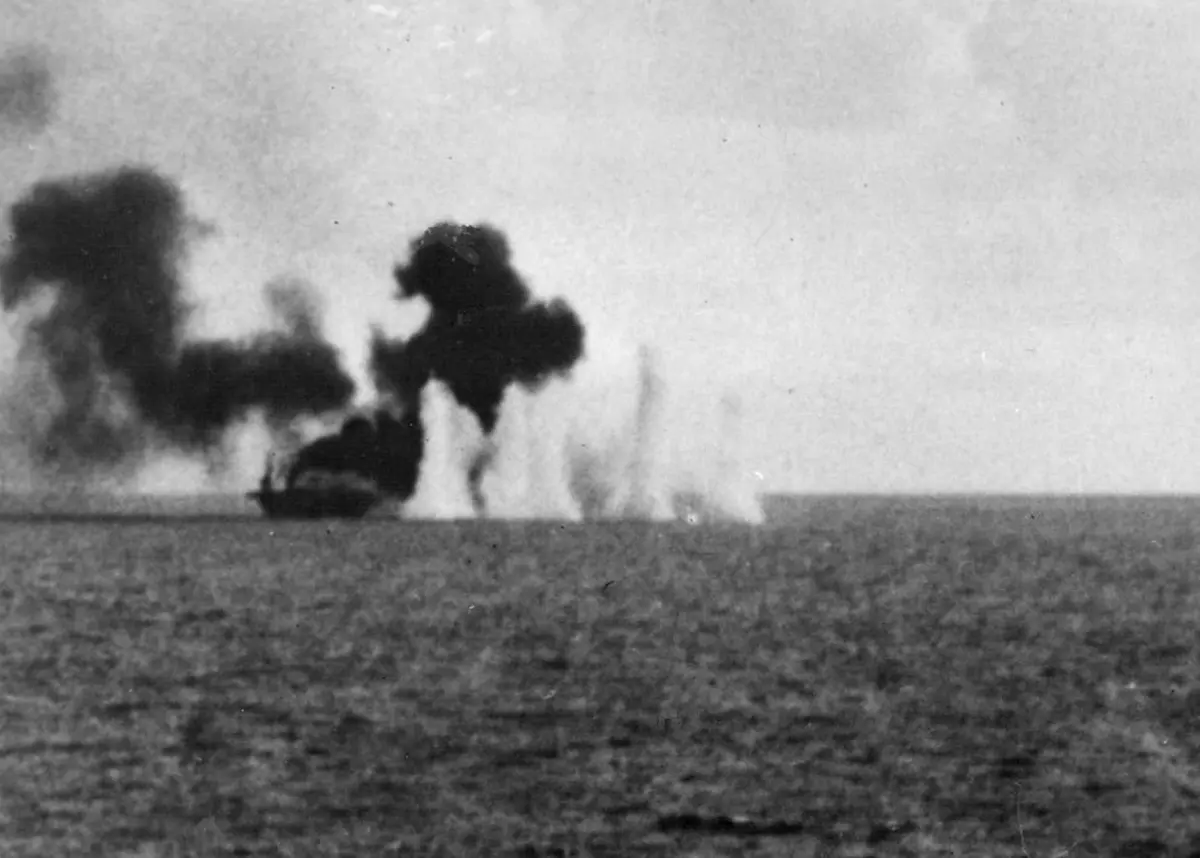
USS Gambier Bay is straddled by Japanese shells as she falls behind the formation off Samar, 25 October 1944.. U.S. Navy / National Naval Aviation Museum. Shot from under them
Hoel has fired all ten torpedoes and taken more than 40 hits. Her after guns are wrecked, but each forward gun fires more than 250 rounds. By 08:40 she is dead in the water and Kintberger orders abandon ship. Men have to be sent forward to chase the gun crews out of their mounts. She sinks at 08:55. Of her crew, 86 survive.
The last round
Three 14-inch shells from the battleship Kongo tear open the destroyer escort. Only the after 5-inch gun, captained by Gunner’s Mate Third Class Paul Carr, is still firing. Its breech explodes. Carr, torn open and dying, is found holding the last shell and trying to load it. A shipmate takes it from him twice. Copeland orders abandon ship at 09:10.
The fleet turns back
About 08:50 Johnston breaks up a torpedo attack by the light cruiser Yahagi and a column of destroyers. Then, with victory in sight, Admiral Kurita recalls his fleet and turns north. Evans conns his wreck from the fantail, shouting orders down a hatch to men steering by hand. Johnston goes dead in the water and is abandoned at about 09:45. A Japanese captain salutes as she sinks.
Rear Adm. Sprague, in his action report…the definite partiality of Almighty God.

The men

Naval Academy class of 1918 and an early naval aviator. He commanded the tender Tangier at Pearl Harbor and commissioned the carrier Wasp. Off Samar he launched every plane he had, sent his escorts against a battle fleet, and kept his carriers fighting.

Oklahoman of Cherokee and Creek descent, Naval Academy 1931, who commanded the old destroyer Alden early in the war. He charged the Japanese fleet before anyone ordered it, then fought his shattered destroyer from the fantail until she went down. He was never found.
Medal of Honor citation
For conspicuous gallantry and intrepidity at the risk of his life above and beyond the call of duty as Commanding Officer of the U.S.S. Johnston in action against major units of the enemy Japanese fleet during the battle off Samar on 25 October 1944. The first to lay a smokescreen and to open fire as an enemy task force, vastly superior in number, firepower and armor, rapidly approached. Commander Evans gallantly diverted the powerful blasts of hostile guns from the lightly armed and armored carriers under his protection, launching the first torpedo attack when the Johnston came under straddling Japanese shellfire. Undaunted by damage sustained under the terrific volume of fire, he unhesitatingly joined others of his group to provide fire support during subsequent torpedo attacks against the Japanese and, outshooting and outmaneuvering the enemy as he consistently interposed his vessel between the hostile fleet units and our carriers despite the crippling loss of engine power and communications with steering aft, shifted command to the fantail, shouted steering orders through an open hatch to men turning the rudder by hand and battled furiously until the Johnston, burning and shuddering from a mortal blow, lay dead in the water after 3 hours of fierce combat. Seriously wounded early in the engagement, Commander Evans, by his indomitable courage, and brilliant professional skill, aided materially in turning back the enemy during a critical phase of the action. His valiant fighting spirit throughout this historic battle will endure as an inspiration to all who served with him.

Tacoma lawyer and Naval Reserve officer who joined the reserve as an enlisted man in 1929. Hands cold with fear, he led the destroyer escorts into the attack and fought his ship until she was shot to pieces.
Navy Cross citation
The President of the United States takes pleasure in presenting the Navy Cross to Robert Witcher Copeland, Lieutenant Commander, U.S. Navy (Reserve), for extraordinary heroism and distinguished service in the line of his profession as Commanding Officer of the Destroyer Escort U.S.S. SAMUEL B. ROBERTS (DE-413), in a surface action with a large task force of the Japanese Fleet off the Island of Samar, in Philippine waters, during the Battle of Leyte Gulf on 25 October 1944. Against an enemy force vastly superior in numbers, armament and armor, with cool deliberation Lieutenant Commander Copeland closed to within 4,000 yards of a heavy cruiser to deliver a torpedo attack on the rapidly advancing enemy who had taken him under fire from their large caliber guns. By his heroic action, he thus diverted enemy fire to himself from the almost defenseless vessels which he was protecting. Although his ship was lost in this engagement, his heroic actions were instrumental in turning back, sorely crippled, a vastly superior enemy force. His extraordinary courage and magnificent fighting spirit in the face of terrific odds will live forever in the memory of the officers and men who served with him that day. His conduct was in keeping with the highest traditions of the Navy of the United States.

Oklahoman who joined the Navy in May 1942. Gun captain of the after 5-inch mount, he kept it firing until it blew apart, then tried to load the last shell as he was dying. Awarded the Silver Star posthumously.
By the numbers
In pictures


Watch, listen, see
Films, photographs and first-hand accounts from across the web. Each opens in a new tab.

The Navy’s director of naval history tells how Taffy 3’s escorts and pilots turned back Kurita’s fleet.
Battleship New Jersey Museum
The 2022 dives that found Samuel B. Roberts more than four miles down, her guns still in place.
Caladan Oceanic
The story of Samuel B. Roberts, the destroyer escort that charged a Japanese battle line.
Battleship New Jersey Museum
The Navy’s director of history on why Samar ranks as the most gallant action in Navy history.
Naval History and Heritage Command
The battle hour by hour, illustrated with official photographs taken from the carriers under fire.
Naval History and Heritage CommandJohnston’s war from commissioning to her last fight, drawn from her war diary and survivors’ reports.
Naval History and Heritage Command
The official history of Copeland’s destroyer escort, from her Houston launching to her stand off Samar.
Naval History and Heritage Command
An escort carrier sailor’s memories of the Japanese guns, the destroyers’ charge and the kamikaze attack that followed.
The National WWII Museum“In no engagement of its entire history has the United States Navy shown more gallantry, guts and gumption than in those two morning hours between 0730 and 0930 off Samar.”
Rear Adm. Samuel Eliot Morison, History of United States Naval Operations in World War II
After
Taffy 3 received the Presidential Unit Citation. Ernest Evans was awarded the Medal of Honor, the first Native American in the U.S. Navy to receive it. Copeland, Kintberger, Thomas and Sprague received the Navy Cross. Rescue ships pulled 1,150 survivors of the four sunken ships from the sea. A rescuer checking one raft shouted a test question: who won the World Series? The answer came back: the St. Louis Cardinals.
The Navy named frigates for Sprague, Copeland and Carr. A later Samuel B. Roberts struck a mine in the Persian Gulf in 1988. Her sailors touched a plaque bearing the names of the first ship’s crew as they fought the fires, and saved her. Her captain answered a question about abandoning ship with the ship’s motto: No Higher Honor.
In 2021 explorers filmed Johnston at 21,180 feet. In 2022 they found Samuel B. Roberts deeper still, more than four miles down, the deepest shipwreck ever located.
Primary sources
- H-Gram 036: “No Higher Honor”: The Battle off Samar, 25 October 1944. Naval History and Heritage Command.
- The Battle off Samar: The Sacrifice of “Taffy 3”. Naval History and Heritage Command.
- Johnston I (DD-557), Hoel I (DD-533) and Samuel B. Roberts I (DE-413). Dictionary of American Naval Fighting Ships, Naval History and Heritage Command.
Keep exploring
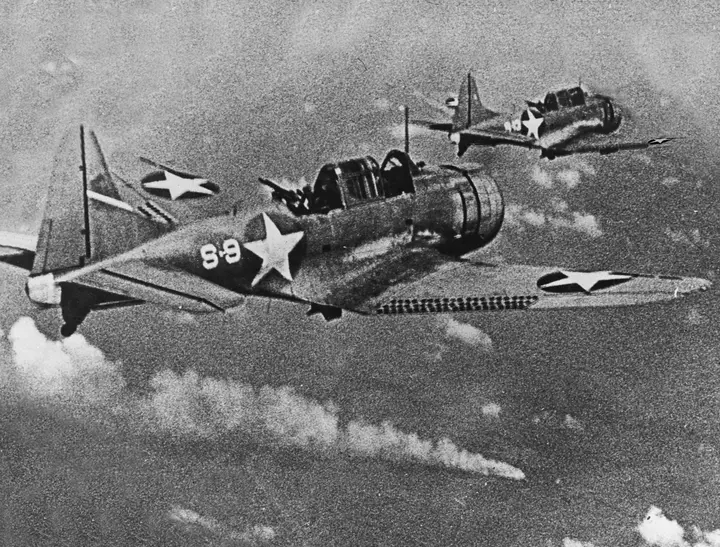
- MidwaySix months after Pearl Harbor, American dive bombers set three Japanese carriers burning in a few minutes. Before dark they got the fourth.4carriers sunk
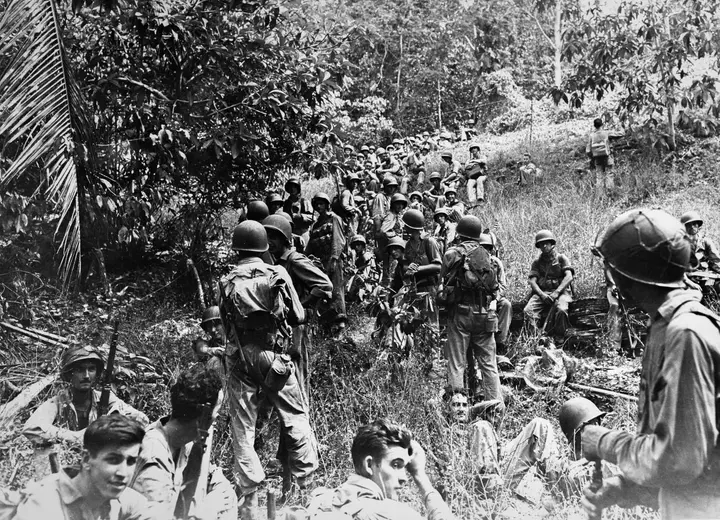
- GuadalcanalThe Marines took the island’s airfield, named it Henderson Field and held it against everything Japan threw at them.6months
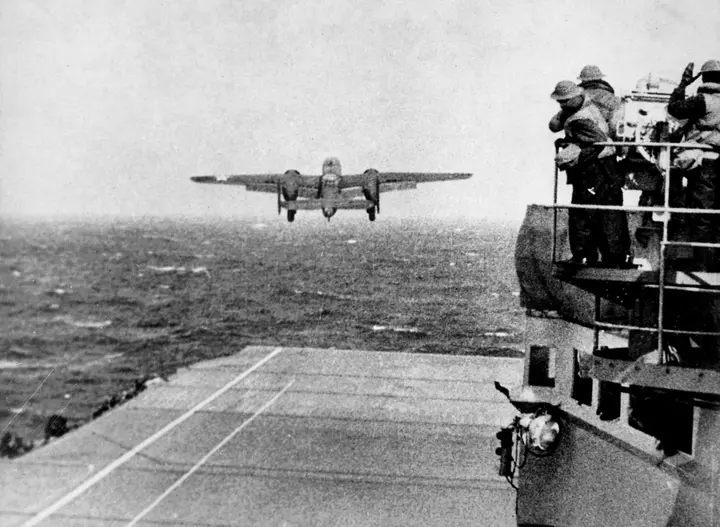
- Thirty Seconds Over TokyoFour months after Pearl Harbor, 80 volunteers flew Army bombers off a Navy carrier and struck Japan.16B-25 bombers
- The Boys of Pointe du Hoc225 Rangers climbed a sheer cliff under fire and destroyed the guns aimed at the D-Day beaches.100ft of cliff


Free, with no ads. Support the museum →