Menlo Park, New Jersey, and Pearl Street, New York · 4 September 1882 · Edison and his Menlo Park men
As Bright as Day
In three years Thomas Edison and his men went from a cotton thread glowing in a glass bulb to a power station lighting the Wall Street district. The electric age switched on at Pearl Street.

The moment · 3 p.m. · 4 September 1882
Four years of work come down to one signal. Edison stands in the Wall Street offices of Drexel, Morgan & Co. Half a mile away at 257 Pearl Street, John Lieb closes the switch. Jumbo No. 9 takes the load. The lamps of the First District come on.
In a twinkling, the area bounded by Spruce, Wall, Nassau, and Pearl Streets was in a glow.New York Herald, 5 September 1882
In 1878 New York lit its homes and offices with gas. Electric arc lights existed, but they were blinding and fit only for streets and big halls. Thomas Edison promised a small, steady electric lamp for every room, fed from a central station through mains under the street, like gas. Nobody had built any piece of that system. Edison and his men built all of it.
The invention factory
Thomas Edison, 29 years old, moves into a new two-story laboratory at Menlo Park, New Jersey, a hamlet on the Pennsylvania Railroad between New York and Philadelphia. The building cost $2,500. Swiss machinist John Kruesi runs the machine shop and turns Edison’s rough sketches into working models. By the spring of 1878 the staff is 25 men, and the phonograph, built in that shop, has made Edison famous.
A light for every room
In September 1878 Edison sees an arc-light system at a Connecticut shop and sets out to beat it: a small, steady lamp for homes and offices, fed from a central station through mains under the street, just like gas. The New York Sun prints his plan on 16 September. Drexel, Morgan & Co. and other backers put up $50,000, and he hires the physicist Francis Upton to work the numbers.
Lamp No. 9
After a year spent on costly platinum, the team tries carbon. Charles Batchelor carbonizes a piece of ordinary cotton thread, thirteen thousandths of an inch thick, seals it in a glass bulb and pumps out the air. At 1:30 in the morning it goes on the battery. It glows through the night and into the afternoon. After 13½ hours they turn up the current until it shines like three gas jets.
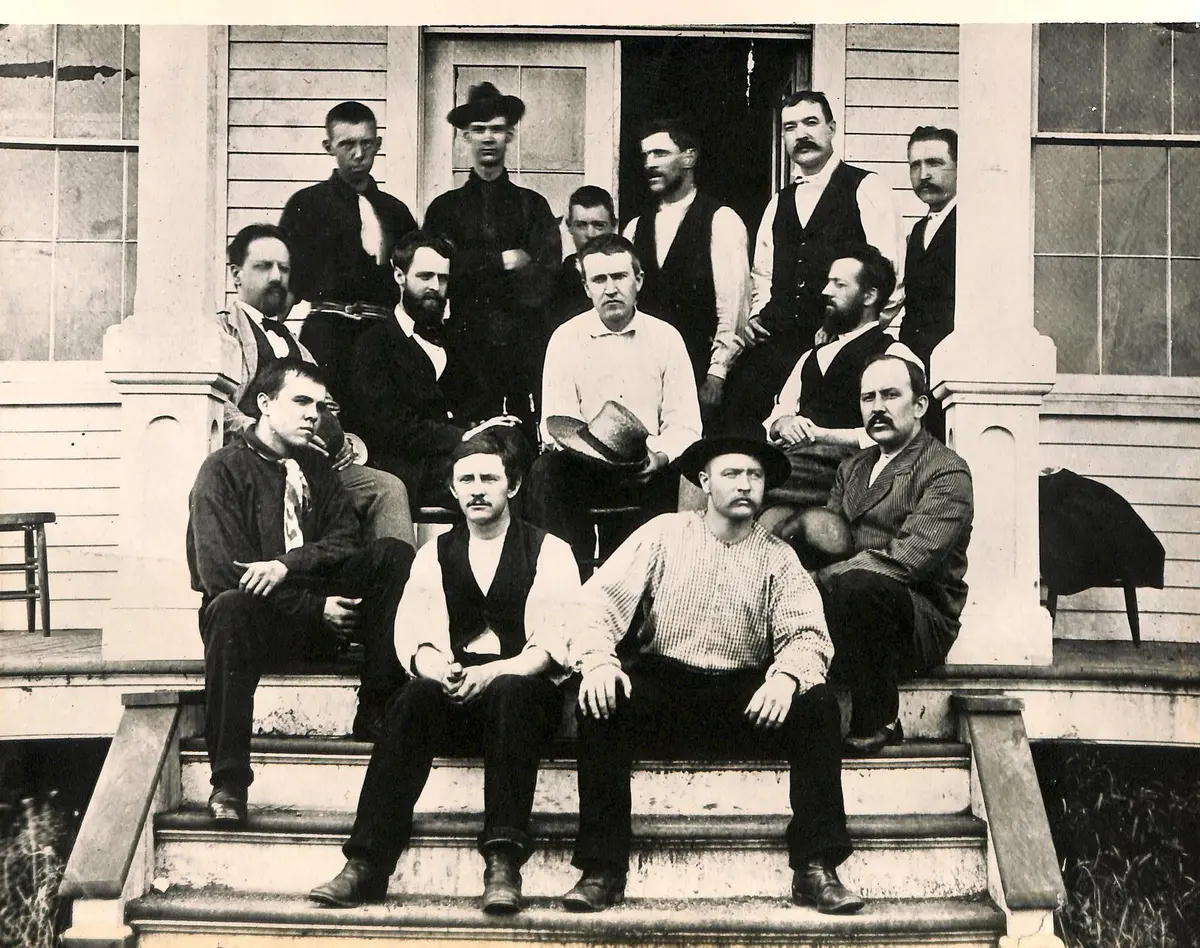
Edison with his Menlo Park team on the laboratory porch, Francis Upton and Charles Batchelor beside him. Thomas Edison National Historical Park / National Park Service. Charles Batchelor’s notebook, 22 October 1879Some very interesting experiments on straight carbons made from cotton thread.
A cardboard horseshoe
On 1 November Edison signs the patent application for a high-resistance carbon filament. It becomes U.S. Patent 223,898. The lab carbonizes everything in reach: paper, wood, cork, celluloid, fishing line, coconut hair. On 16 November Upton writes home that they have the first lamp that answers the purpose: a horseshoe of charred cardboard about an inch high, as bright as a good gas burner.
The public sees it
On 20 December Kruesi orders the shop to have everything ready by New Year’s Eve: lamps, chandeliers, a meter, ten street lights. Poles carry lamps down the road to the depot. On the night, the railroad runs extra trains from east and west, and hundreds come through a storm. Twenty-five lamps light the laboratory, eight the office, and twenty more the street and nearby houses.
From a lamp to a system
A lamp is not enough. Edison needs dynamos, mains, meters, fuses, sockets and switches, and a factory to make lamps by the thousand. The staff builds a full-scale model of the underground system at Menlo Park. In July they test bamboo filaments, which become the standard. On 1 October the lamp factory starts commercial production. In December Edison organizes the Edison Electric Illuminating Company of New York.
Under the streets
Edison picks the First District, about half a mile on a side, from Wall Street north to Spruce and from Nassau Street to the East River. In spring 1881 his crews start digging. Kruesi’s Electric Tube Company lays about 80,000 feet of copper conductors in iron pipe under the streets. Into 255 and 257 Pearl Street go six Jumbo dynamos, 27 tons each, good for about 1,200 lamps apiece.
Switch on
Edison gives the signal from the offices of Drexel, Morgan & Co. At Pearl Street his chief electrician, 22-year-old John Lieb, closes the switch, and Jumbo No. 9 is the first dynamo on the line. About 400 lamps are wired so far. At The New York Times, 27 lamps light the editorial rooms and 25 the counting room. When darkness falls at seven, the paper calls them as bright as day.
The New York Times, 5 September 1882The giant dynamos were started up at 3 o’clock in the afternoon, and, according to Mr. Edison, they will go on forever unless stopped by an earthquake.
The first electric bill
Edison will not bill anyone until the system runs reliably. The meter is a set of glass jars holding zinc plates. Current carries zinc from one plate to the other, and each month the plates are weighed. The first bill goes to the Ansonia Brass and Copper Company, for about $50. By 1884 Pearl Street serves more than 500 customers and 10,000 lamps.

The Menlo Park men

Ohio-born telegraph operator who taught himself electricity and became the country’s top telegraph inventor. Built the Menlo Park laboratory at 29 and invented the phonograph there. Then designed the whole lighting system and served as his own chief engineer at Pearl Street.

Manchester-trained machinist who joined Edison in Newark in 1871 and became his hands at the bench. On 22 October 1879 he carbonized the thread for Lamp No. 9 and logged the run that proved carbon worked. In 1881 he took the system to Paris.

Bowdoin and Princeton graduate who studied in Berlin under Hermann von Helmholtz. Hired in 1878 to put Edison’s ideas into numbers, he ran the calculations on lamps, dynamos and copper. At the end of 1880 he took charge of the Menlo Park lamp factory.

Swiss-born machinist who turned Edison’s sketches into working machines, the tinfoil phonograph among them. He drove the shop to finish the New Year’s Eve demonstration, then in 1881 took over the Edison Electric Tube Company and laid the mains under the First District.
By the numbers
In pictures


Watch, listen, see
Films, photographs and first-hand accounts from across the web. Each opens in a new tab.

How Edison’s Menlo Park lab went from gas and arc lights to the incandescent lamp and the system behind it.
IEEE REACH
A tour of the Menlo Park laboratory, rebuilt by Henry Ford at Greenfield Village in Dearborn, Michigan.
The Henry FordThe 22 October 1879 lab entry recording the carbonized cotton thread that glowed through the night.
Thomas A. Edison Papers, RutgersJohn Kruesi’s 20 December 1879 shop order: lamps, chandeliers, a meter and street lights, done by 31 December.
Thomas A. Edison Papers, Rutgers
A New York front page given over to Edison and his electric light, days after the Menlo Park demonstration.
Thomas A. Edison Papers, Rutgers
The only surviving Pearl Street dynamo, the first to put power on the line on 4 September 1882.
The Henry FordThe engineers’ record of the first central station: the First District, the Jumbos, the mains and opening day.
IEEE / ETHW
Thousands of historic photographs of Edison, his staff, his laboratories and his inventions, from Thomas Edison NHP.
National Park Service“It was a light that a man could sit down under and write for hours without the consciousness of having any artificial light about him.”
The New York Times, 5 September 1882
After
Pearl Street ran for more than seven years with a single three-hour interruption. A fire gutted it on 2 January 1890, and Edison’s men restored service in 11 days. Jumbo No. 9 survived. It stands today in Greenfield Village at The Henry Ford in Dearborn, Michigan. The Edison Electric Illuminating Company of New York grew into Con Edison.
The system spread fast. On 4 July 1883 Edison opened the first three-wire central station in Sunbury, Pennsylvania, cutting the copper a city needed. Brockton, Massachusetts, followed with the first three-wire underground system that October. Edison’s manufacturing companies became Edison General Electric in 1889 and, in 1892, General Electric.
In 1929 Henry Ford rebuilt the Menlo Park laboratory at Greenfield Village. For Light’s Golden Jubilee that October, Edison, 82, came back to it with President Herbert Hoover and his old assistant Francis Jehl to light the carbon lamp once more.
Primary sources
- Charles Batchelor, notebook entry, Menlo Park, 22 October 1879. The Papers of Thomas A. Edison, Doc. 1831. Thomas A. Edison Papers, Rutgers University.
- “Edison’s Electric Light: The Times Building Illuminated by Electricity.” The New York Times, 5 September 1882, p. 8.
- IEEE Milestone: Pearl Street Station, 1882. Engineering and Technology History Wiki.