U.S. Capitol, Washington · 24 May 1844 · Samuel F. B. Morse and Alfred Vail
What Hath God Wrought
A portrait painter with a wire and a key sent four words forty miles in an instant. From that morning on, news no longer had to wait for a horse or a train.

The moment · 8:45 a.m. · 24 May 1844 · The Capitol
A small group of guests gathers in the Capitol. Morse sits at the instrument and taps out four words chosen by Annie Ellsworth. Forty miles away in Baltimore, Alfred Vail reads them off the paper tape without an error. Moments later the same words come clicking back.
What hath God wrought?The first message, Numbers 23:23, sent by Samuel F. B. Morse
In 1844 news moved only as fast as a horse or a train could carry it. Samuel F. B. Morse, one of America’s finest painters, believed an electric current could carry words down a wire in an instant. After twelve years of work and near poverty, Congress gave him $30,000 to prove it on a line from Washington to Baltimore.
The letter that came too late
Morse is in Washington painting the Marquis de Lafayette for the City of New York. At home in New Haven, his wife Lucretia dies suddenly on 7 February, shortly after the birth of their third child. His father writes the next day. He expects the letter to reach Samuel the day after her funeral. By the time Morse gets home, she is buried.
An idea at sea
Morse sails home from Le Havre after nearly three years painting in Europe. At dinner, Dr. Charles T. Jackson of Boston describes the new electromagnets and how current passes instantly through any length of wire. Morse answers that if electricity can be made visible anywhere in a circuit, he sees no reason intelligence cannot be sent instantly by it. He starts sketching signs of dots and lines.
A professor, a chemist and a machinist
Morse, now a professor of painting at the University of the City of New York, builds a crude sender and receiver. Chemistry professor Leonard Gale shows him Joseph Henry’s work and Henry’s relay, which lets a weak signal be renewed down the line. In September 1837 young Alfred Vail sees a demonstration and signs on to build the instruments at his own expense at his family’s Speedwell Ironworks.
A patient waiter is no loser
Vail’s improved instruments send a message through two miles of wire strung around the Speedwell factory. Judge Stephen Vail, Alfred’s father, dictates the words. In February Morse sets up in the House Commerce Committee room and demonstrates for members of Congress, President Martin Van Buren and his cabinet. The committee recommends $30,000. Then Congress, hit by the Panic of 1837, sits on the bill for four years.
Passed by six votes
Morse is back in Washington, nearly broke, running wire between committee rooms to show members how it works. On 23 February the House passes the $30,000 test line by 89 votes to 83. The Senate approves it in the final hours of the session, and President John Tyler signs it on 3 March. Morse chooses Baltimore, 40 miles away along the Baltimore and Ohio Railroad.
Pipe, then poles
Ezra Cornell’s plow cuts a trench and lays the wire underground in pipe. Then the insulation fails. Cornell studies electricity all winter and concludes buried wire will not work. In spring 1844 he strings the line overhead on poles instead. Morse finds he can use the earth itself as half the circuit, so one wire does the work of two.
Faster than the train
The wire has reached Annapolis Junction, 22 miles from Washington. In Baltimore the Whig convention nominates Henry Clay. Vail gets the ticket from passengers on the Washington train and taps it to Morse at the Capitol. The Frelinghuysen news goes out and its receipt comes back in two minutes and one second. Washington has the news an hour and four minutes before the train arrives.
Vail to Morse, from Annapolis JunctionThe ticket is Clay and Frelinghuysen.
What hath God wrought
The line is finished to the railroad depot in Baltimore. Morse has promised the first message to Annie Ellsworth, daughter of his Yale classmate Henry L. Ellsworth, the Commissioner of Patents. With her mother she picks a verse from Numbers 23:23. Morse taps it out in dots and dashes. Vail receives it in Baltimore without an error and flashes it straight back.
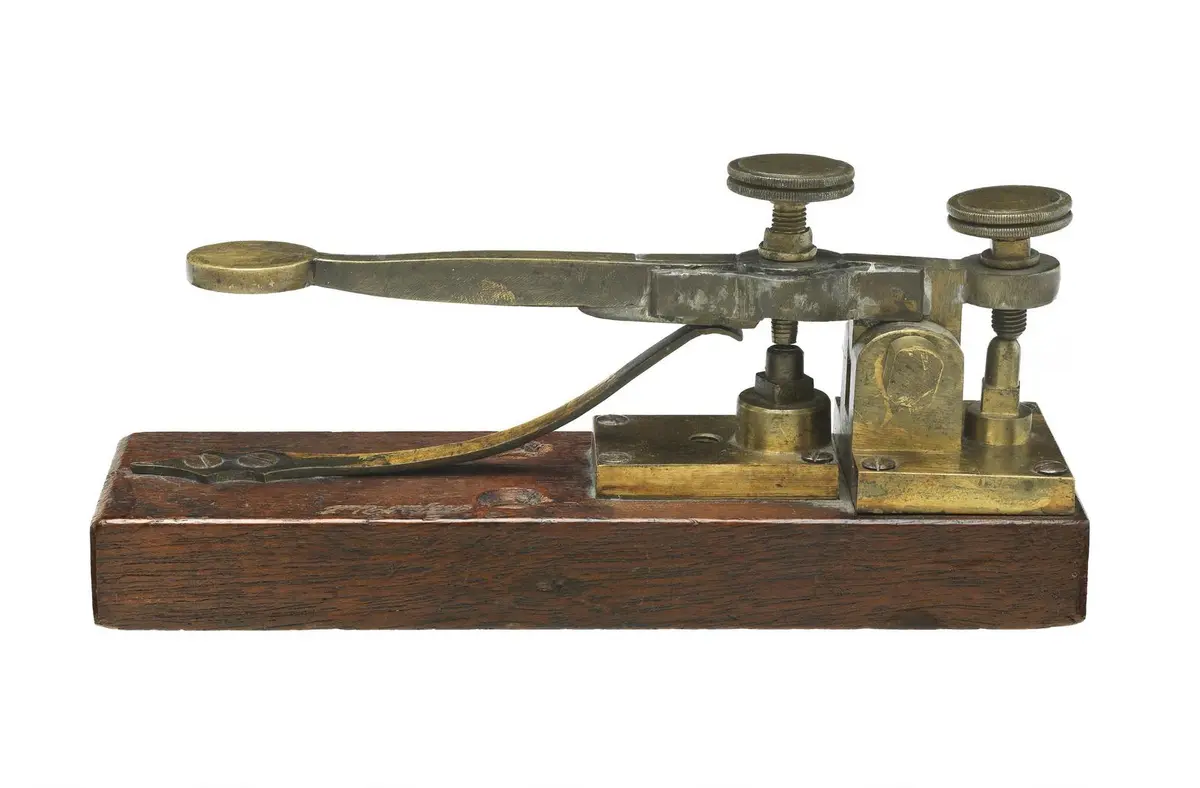
A Morse-Vail telegraph key, the lever-style sending key Alfred Vail developed for Morse’s system.. National Museum of American History, Smithsonian Institution. Morse to Vail, Washington to BaltimoreWhat hath God wrought?
The wire talks politics
The Democrats meet in Baltimore and Vail wires the balloting to the Capitol as it happens. When James K. Polk is nominated, hundreds outside Morse’s window cheer the telegraph. Senator Silas Wright, nominated for vice president, refuses by wire from the Capitol. Doubting delegates send a committee by train to check. A former scoffer, Rep. Cave Johnson, comes to Morse: “Sir, I give in. It is an astonishing invention.”
The builders

Yale graduate and portrait painter who founded the National Academy of Design and served as its first president. At 41 he conceived the electromagnetic telegraph at sea, then spent twelve years proving it. He tapped out the first message himself.

Son of the Speedwell Ironworks family of Morristown, New Jersey. He built Morse’s working instruments at his own expense, including the sending key, and worked with Morse as the dot-and-dash code took shape. He received the first message and sent it back.

Scientist whose 1831 electromagnet for Yale held more than 2,000 pounds. His relay showed how to renew a signal along a long line. In 1842 he wrote that science was now fully ripe for the telegraph. In 1846 he became the first Secretary of the Smithsonian.

Ithaca carpenter and mechanic who designed a plow to lay telegraph wire. Morse hired him at $1,000 a year. When the buried wire failed, Cornell put the line on poles in time for May 1844. He became Western Union’s largest stockholder and founded Cornell University.
By the numbers
In pictures


Watch, listen, see
Films, photographs and first-hand accounts from across the web. Each opens in a new tab.

The original paper tape of “What hath God wrought?” with Morse’s handwritten note crediting Annie Ellsworth.
Library of Congress
A dramatized short from PBS’s Breakthrough series on how Morse set out to beat distance with a wire.
PBS
The Smithsonian’s American history museum on how the telegraph and telephone transformed American life.
National Museum of American HistoryJosh Levy, curator of the Samuel F. B. Morse Papers at the Library of Congress, on the code’s early days.
Chatham Marconi Maritime Center
How Morse won over Congress, built the line and sent the first message from the Capitol.
U.S. Senate Historical Office
Biographer Kenneth Silverman on Morse’s life as painter, professor and inventor of the telegraph.
C-SPAN BooknotesAlfred Vail’s 1845 illustrated description of the Washington–Baltimore line and its instruments.
Internet ArchiveMorse’s letters and journals from 1832 on, including his account of the first message and the conventions.
Project Gutenberg“That sentence of Annie Ellsworth’s was divinely indited, for it is in my thoughts day and night. “What hath God wrought!””
Samuel F. B. Morse, letter to his brother Sidney, 31 May 1844
After
Congress added $8,000 to keep the line running for another year under the Post Office, and in 1847 it went to private hands. Private money took it from there. Rival lines merged into Western Union, a name Ezra Cornell insisted on. Two decades after the first message, 100,000 miles of wire tied American towns and cities together.
On 24 October 1861 the wire joined the Atlantic and the Pacific at Salt Lake City, and the Pony Express shut down two days later. New York merchant Cyrus Field kept pushing a cable across the ocean floor. One carried Queen Victoria’s greeting to President Buchanan in 1858 before it failed. On 27 July 1866 the Great Eastern landed a cable at Heart’s Content, Newfoundland, that stayed.
Telegraph operators across the country helped pay for a bronze statue of Morse in Central Park, unveiled on 10 June 1871. That night at New York’s Academy of Music, every line was cleared for his farewell message to operators worldwide, and Morse tapped out his own name. He died on 2 April 1872. A plaque placed at the Capitol for the 1944 centennial marks the first message.
Primary sources
- Samuel F. B. Morse, His Letters and Journals, ed. Edward Lind Morse, vol. 2. Boston: Houghton Mifflin, 1914.
- “What Hath God Wrought”: Morse’s Telegraph in the Capitol. U.S. Senate Historical Office, 7 May 2024.
- First telegraphic message, 24 May 1844. Samuel F. B. Morse Papers, Manuscript Division, Library of Congress.