Kill Devil Hills, North Carolina · 17 December 1903 · Wilbur and Orville Wright
Success Four Flights
Two bicycle makers from Dayton paid their own way, wrote their own science and built their own engine. Then, on a freezing beach in North Carolina, they flew.

The moment · 10:35 · 17 December 1903
Ice sits in the puddles. A north wind gusts to 27 miles an hour. Orville takes the controls. Wilbur runs alongside, holding the wingtip. Forty feet down the rail, the Flyer lifts into the wind. Twelve seconds later it touches down 120 feet away.
In 1899 two brothers who built bicycles in Dayton, Ohio, wrote to the Smithsonian for everything it had on flight. They had no college degrees, no government money and no backers. In four years they built a wind tunnel, wrote their own tables, invented the controls every airplane still uses and built their own engine. Then they flew.
The bicycle shop
Wilbur, 25, and Orville, 21, open the Wright Cycle Exchange on West Third Street. By 1896 they are building their own bicycles, the Van Cleve and the St. Clair. The shop teaches them light frames, chain drives and precision work, and its profits pay for everything that follows. On 30 May 1899 Wilbur writes to the Smithsonian asking for whatever it has published on flight.
The wind tunnel
The 1901 glider makes about a third of the lift the best published tables promised, and Wilbur comes home from Kitty Hawk discouraged. So the brothers build their own wind tunnel in the shop: a wooden box six feet long and 16 inches square, a fan, and balances made from hacksaw blades and bicycle spoke wire. By December they have tested about 200 wing shapes and written the most accurate lift tables in the world.
Pitch, roll and yaw
The 1902 glider, 32 feet tip to tip, is built from their own numbers, and it flies the way the numbers say. When it skids in turns, Orville proposes a movable rear rudder and Wilbur ties it to the wing-warping controls. Now a pilot can control the machine in all three axes, as every airplane since has done. They make between 700 and 1,000 glides. The best goes 622 feet in 26 seconds.
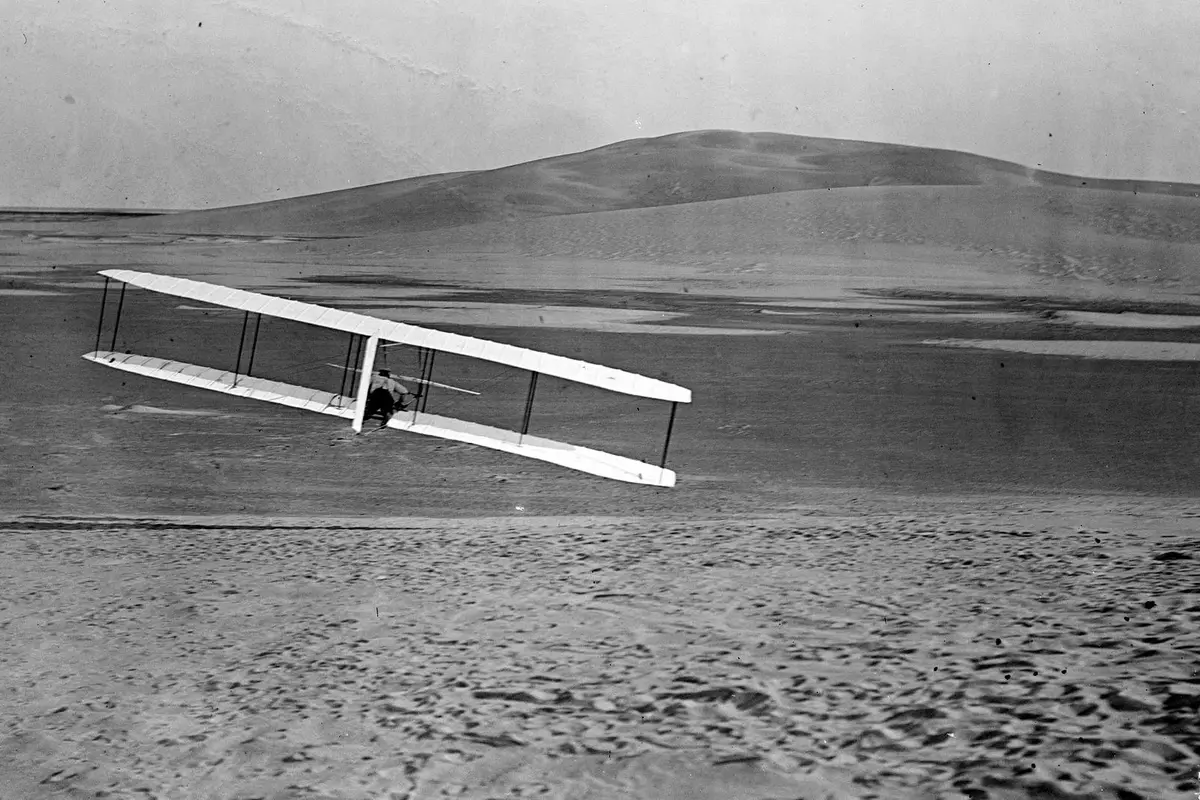
Wilbur Wright banks the 1902 glider into a right turn while gliding from No. 2 Hill, Kill Devil Hills, N.C., October 24, 1902. Wright brothers / Library of Congress (Wright Brothers Negatives). Build your own engine
No manufacturer can sell them a light engine of 8 horsepower, so they build one. Charlie Taylor, their shop mechanic, machines it in six weeks on a lathe and a drill press, around a crankcase cast in aluminum. On the test block it makes 16 horsepower, settling to 12. The brothers treat a propeller as a wing that turns, work out the math themselves and carve two from spruce, each eight and a half feet long.
Waiting on the shafts
The brothers reach their camp on the Outer Banks and find a storm has knocked their old building off its posts. They repair it, build a hangar and assemble the Flyer. Propeller shafts fail twice. Orville goes home to Dayton to make new ones of spring steel and is back on 11 December. Three days earlier, in Washington, the Smithsonian’s Aerodrome, built with $50,000 of War Department money, dropped into the Potomac for the second time.
The coin toss
There is too little wind to start from level ground, so they lay the track 150 feet down the side of the big hill. A coin toss gives Wilbur the first try. The Flyer lifts off the rail, climbs too steeply, stalls and settles into the sand 105 feet below after three and a half seconds. A skid breaks. Nothing serious. The engine and the launch both work.
Wilbur’s letter home, 14 December 1903There is now no question of final success.
Twelve seconds
A north wind gusts to 27 miles an hour and ice sits in the puddles. Three men from the lifesaving station, a lumber buyer and a teenage boy have come to help. Orville takes the controls. Wilbur runs alongside holding the wingtip. After a 40-foot run the Flyer lifts into the wind, and John Daniels squeezes the camera bulb. Twelve seconds later Orville lands 120 feet away. A man has flown a powered airplane.
Four flights
At 11:20 Wilbur flies about 175 feet. At 11:40 Orville goes about 200 feet in 15 seconds, fighting a gust that tips him sideways. At noon Wilbur takes off again. The first few hundred feet pitch up and down, then the Flyer settles and flies steady over the sand. He covers 852 feet in 59 seconds. Back at camp a gust flips the parked Flyer with Daniels caught inside. He walks away bruised. The Flyer never flies again.
Inform press
After lunch the brothers walk four miles to the weather station at Kitty Hawk and wire their father, Bishop Milton Wright, in Dayton. The message runs through Norfolk to Western Union. Along the way the operators turn 59 seconds into 57 and misspell Orville’s name. Their brother Lorin carries the news to the Dayton papers. The brothers are home on 23 December, in time for Christmas.
Orville’s telegram to his fatherSuccess four flights thursday morning all against twenty one mile wind started from Level with engine power alone average speed through air thirty one miles longest 57 seconds inform Press home Christmas.

The brothers and their crew

Born in Indiana in 1867, the elder brother and the strategist. He wrote to the Smithsonian in 1899, flew the 852-foot flight at Kitty Hawk and amazed France with his flying at Le Mans in 1908. Died of typhoid in 1912, age 45.

Born in Dayton in 1871. Ran a print shop before the bicycle business. Proposed the movable rudder, set up the camera and flew the first twelve seconds. In 1908 at Fort Myer, Virginia, he flew for more than an hour. Lived until 1948.

Born in Illinois in 1868. Hired in 1901 to run the shop while the brothers were at Kitty Hawk. Built the 1903 engine in six weeks and kept Wright engines running for years. The FAA’s highest award for aviation mechanics bears his name.
By the numbers
In pictures


Watch, listen, see
Films, photographs and first-hand accounts from across the web. Each opens in a new tab.

Curator Emeritus Tom Crouch reads the hidden details in John T. Daniels’s famous photo of the first flight.
Smithsonian National Air and Space Museum
A detailed 3D scan of the original Wright Flyer, the world’s first successful powered airplane.
Smithsonian 3D Digitization
The Dayton Aviation Heritage park’s feature film retells the Wrights’ story with reenactments and flying replicas.
National Park Service
Tour the Dayton bicycle shop where the brothers built their flying machines, now preserved at Greenfield Village.
The Henry Ford
High-resolution scans of the brothers’ glass plates: gliders, the 1903 Flyer, camp life at Kitty Hawk, Dayton.
Library of Congress
Orville’s telegram home to Bishop Milton Wright announcing the first flights and asking him to inform the press.
Library of Congress
Orville’s pocket-diary account of all four flights, with wind speeds, distances and the witnesses’ names.
Library of Congress
A swatch of the 1903 Flyer’s wing muslin rode NASA’s Ingenuity helicopter on the first powered flight on Mars.
NASA / JPL-Caltech“This flight lasted only 12 seconds, but it was nevertheless the first in the history of the world in which a machine carrying a man had raised itself by its own power into the air in full flight, had sailed forward without reduction of speed and had finally landed at a point as high as that from which it started.”
Orville Wright, “How We Made the First Flight,” Flying, December 1913
After
The brothers went home and kept building. On 5 October 1905, over a cow pasture outside Dayton called Huffman Prairie, Wilbur flew 24 miles in 39 minutes. Their patent on the control system was granted in 1906. In 1908 Wilbur amazed crowds in France and Orville flew for more than an hour at Fort Myer, Virginia. In 1909 the Army bought a Wright for $30,000, the world’s first military airplane.
The 1903 Flyer has been at the Smithsonian since 17 December 1948, 45 years to the day after it flew. Neil Armstrong carried pieces of its wing fabric and propeller to the Moon in 1969. In 2021 a swatch of that fabric rode NASA’s Ingenuity helicopter on the first powered flight on another planet. NASA named the spot on Mars Wright Brothers Field.
A 60-foot granite monument stands on Big Kill Devil Hill. Its inscription honors a conquest of the air “conceived by genius, achieved by dauntless resolution and unconquerable faith.”