Crystal Palace, New York · May 1854 · Elisha Otis and his sons
Cut the Rope
Elisha Otis stood on his own platform above a New York crowd, cut the only rope holding it up, and stayed right where he was. Every American skyscraper rides on that moment.

The moment · May 1854 · Crystal Palace, New York
The platform hangs from a single rope on the floor of the Crystal Palace. Elisha Otis runs it up above the crowd and stands on it himself. He cuts the rope. Iron catches snap into the toothed rails. The platform stays where it is.
In 1852 an elevator was a platform on a rope. When the rope broke, whatever stood on it fell. Nobody wanted to ride one, and nobody put offices higher than a man would climb. Elisha Otis, a mechanic in Yonkers, New York, built a platform that could not fall. Then he had to make the country believe it.
A hoist that cannot fall
Elisha Graves Otis, a Vermont-born mechanic, takes charge of the machinery at a new bedstead factory on the Yonkers waterfront. The plant needs a hoist to lift heavy equipment to its upper floor. Otis builds one with a wagon spring held tight by the pull of the rope itself. If the rope ever breaks, the spring flies open and throws iron catches into toothed racks on the guide rails.
The first sale
Otis sells his first elevator, a machine for hauling freight. New York manufacturers have seen the hoist at the bedstead works and want their own. Otis leaves the factory, leases part of its building and sets up his own shop. His elder son Charles, a teenage machinist at his side, soon urges him to drop every other line of work and build safety elevators alone. No one in the country does that yet.
He cuts the rope
P. T. Barnum has taken over America’s world’s fair, the Exhibition of the Industry of All Nations, and reopens its glass-and-iron Crystal Palace in May on the site of today’s Bryant Park. Otis’s elevator stands in a prominent place on the floor. Otis rides the platform up, stands on it, and cuts the rope. The catches bite and the platform holds. The Otis company has always told it that he called out, “All safe, gentlemen, all safe.”
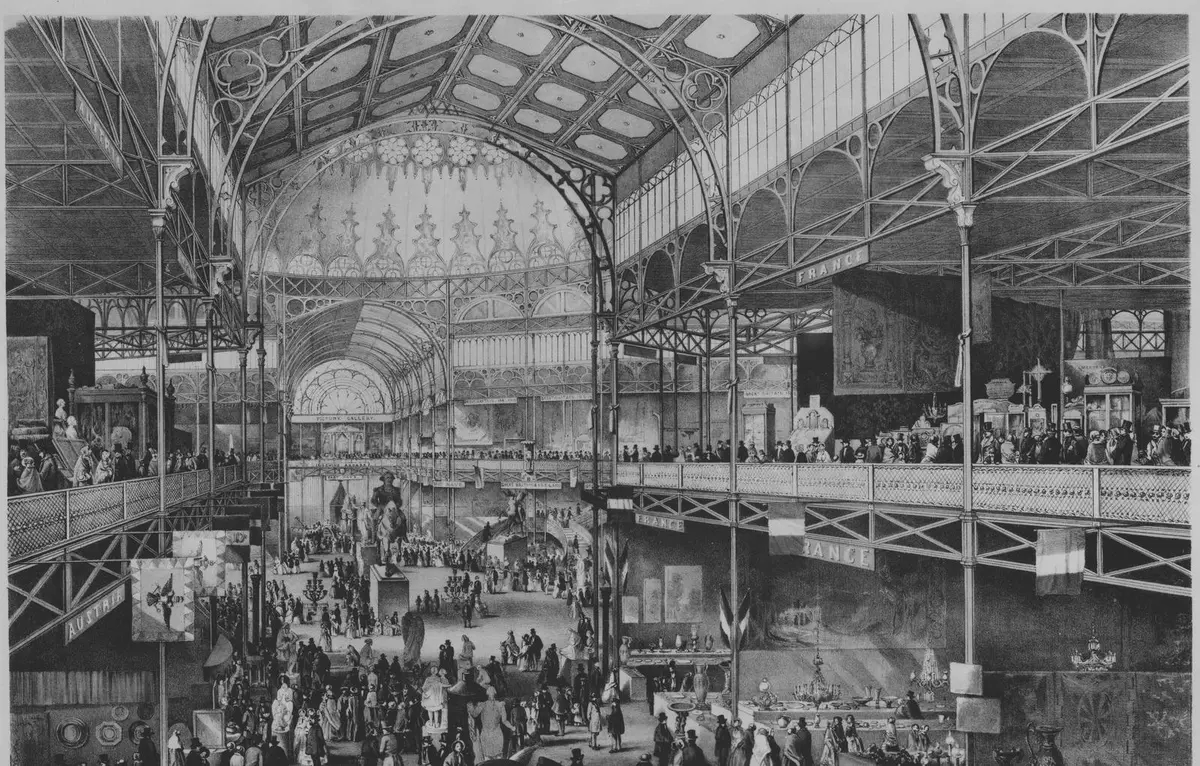
Inside the New York Crystal Palace, 1853: the great hall and galleries where Otis showed his safety elevator. Lithograph by Charles Parsons.. Charles Parsons / The Metropolitan Museum of Art. New-York Daily Tribune, 30 May 1854The apparent daring of the inventor, who, as he rides up and down upon the platform occasionally cuts the rope by which it is supported.
The orders come
On 25 November 1854 Scientific American prints a diagram of the safety catch and explains it to the nation’s mechanics. The publicity works. Otis’s shop has six to ten men in 1854, and the company sells 15 elevators in 1855. Every one of them so far carries freight: crates, barrels, bales and machinery. No one has yet trusted Otis with people.
Going up
Eder V. Haughwout sells cut glass, silver, clocks and chandeliers from a new five-story cast-iron palace at Broadway and Broome Street. On 23 March 1857 Otis puts in his first passenger elevator, the first in any New York store built for the use of customers. A steam engine in the basement lifts the car at about 40 feet a minute. The building is no taller than its neighbors. Haughwout wants the elevator anyway, to bring shoppers in to see it.
Patent 31,128
The Patent Office grants Otis U.S. Patent 31,128 for an improvement in hoisting apparatus. It covers the hooked pawls and toothed racks that catch a falling platform, the controls worked by a rope from the car, and a counterweight. He has also designed his elevator its own steam engine, so it runs only when the car moves. Twelve weeks later, on 8 April 1861, Otis dies of diphtheria in Yonkers. He is 49.
Otis’s patent, stating its aimA hoisting apparatus which may have its weight or load stopped at any desired point and a brake automatically and simultaneously applied.
Two brothers and $1,500
The war has come, trade has collapsed and the business is buried in debt. Charles Otis, 26, has saved about $1,500. Norton, 21, has a few hundred dollars. They put in all of it and build nothing but elevators. Their first two orders come to $70. Wartime freight brings more. Sales reach $15,000 in 1862 and $80,000 in 1865. In 1867 they make Otis Brothers & Co. a stock company, Charles president and Norton treasurer.
The top floor sells
The Equitable Life Assurance Society opens its new headquarters, seven stories and about 130 feet tall. No New York office building has ever risen above four stories, because nobody would climb higher. Henry B. Hyde, the society’s president, is told not to bother with elevators. He puts them in anyway, the first passenger elevators in any office building in the world. Architect George B. Post takes an office on the top floor himself to prove the point.
792 feet
In 1903 Otis brings out the gearless traction machine, an electric elevator fast and strong enough for any height. Ten years later President Wilson presses a button in Washington and lights up the Woolworth Building on Broadway, 792 feet tall, the tallest building in the world. Twenty-six Otis gearless traction elevators serve it, the express cars running at more than 600 feet a minute. Fifty-nine years after the rope was cut, New York has its skyline.
The inventor and his sons

Vermont farm boy who became a builder of wagons, mills and machinery before he came to Yonkers in 1852. He invented the safety catch, rode it at the Crystal Palace and cut the rope himself. Patented it in January 1861 and died that April.

Went to work in his father’s shop at 13 and urged him to build nothing but safety elevators. In 1861 he put his $1,500 in savings into the failing business, took out more than fifteen patents and led the company until 1882.

Joined his father’s factory at 17 and put everything he had into it beside his brother in 1861. Spent years traveling the United States and Canada selling Otis elevators. Later mayor of Yonkers and a congressman from New York.
By the numbers
In pictures


Watch, listen, see
Films, photographs and first-hand accounts from across the web. Each opens in a new tab.

How the Otis safety elevator took away the last limit on how tall Americans could build.
National Geographic
The company Elisha Otis founded tells its story, from the first sale in 1853 to the Crystal Palace.
Otis Elevator Co.
A short history of Otis’s safety elevator and why skyscrapers could not rise without it.
IEEE REACH
A tour of the 1913 Gothic tower that stood as the tallest building in the world.
New York Landmarks Conservancy
The New-York Daily Tribune of 30 May 1854, reporting Otis cutting his own rope at the Crystal Palace.
Library of Congress, Chronicling AmericaThe original drawing for Patent 31,128, the first elevator with a safety catch against a broken cable.
National ArchivesThe 1965 designation of the store that installed New York’s first passenger elevator built for customers.
NYC Landmarks Preservation Commission
Otis Brothers & Co.’s illustrated catalog of hydraulic, electric, steam and belt elevators.
Internet Archive“If the rope should break, or be loosened from the driving shaft, or disconnected from the motive power accidentally, the platform will be sustained, and no injury or accident can possibly occur.”
Scientific American, describing the Otis elevator, 25 November 1854
After
The brothers sold the business in 1882, when it was doing more than a million dollars a year. In 1898 it became the Otis Elevator Company. Otis elevators went up the Washington Monument and two legs of the Eiffel Tower, and in 1907 into the Statue of Liberty.
In 1931 the Empire State Building opened at 1,250 feet, built in 410 days, and Otis elevators carried its people to the top. That story has its own room in this museum.
The Haughwout Building still stands at Broadway and Broome Street, a New York City landmark since 1965. Every safety elevator built since works on the idea Elisha Otis cut a rope to prove: if the rope fails, the car holds.
Primary sources
- “Science, Industry and Invention: Machinery at the Crystal Palace.” New-York Daily Tribune, 30 May 1854, p. 6. Library of Congress, Chronicling America.
- E. G. Otis, Improvement in Hoisting Apparatus. U.S. Patent 31,128, 15 January 1861.
- J. Thomas Scharf, History of Westchester County, New York (Philadelphia: L. E. Preston & Co., 1886), “Yonkers”: Otis Brothers & Co. and the Otis family.
Keep exploring
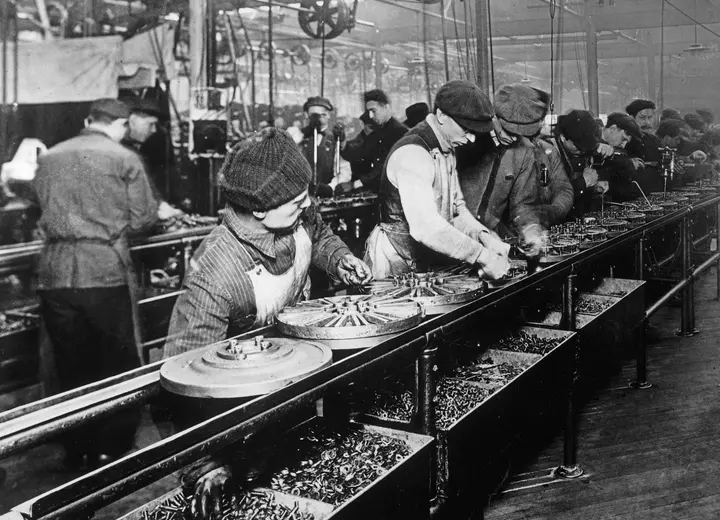
- The Moving Assembly LineHenry Ford put the Model T on a moving line and cut the work to build a chassis from twelve and a half hours to an hour and a half.93minutes per chassis
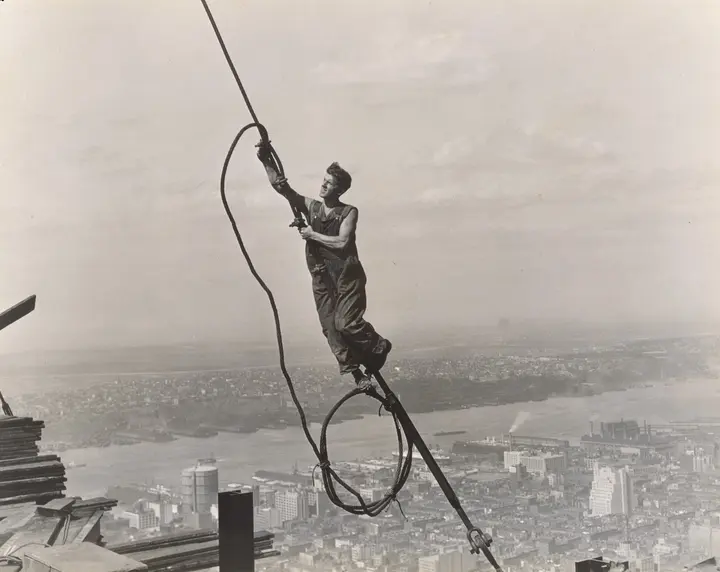
- Empire State Building102 stories in 410 days. The tallest building on earth for nearly forty years.410days
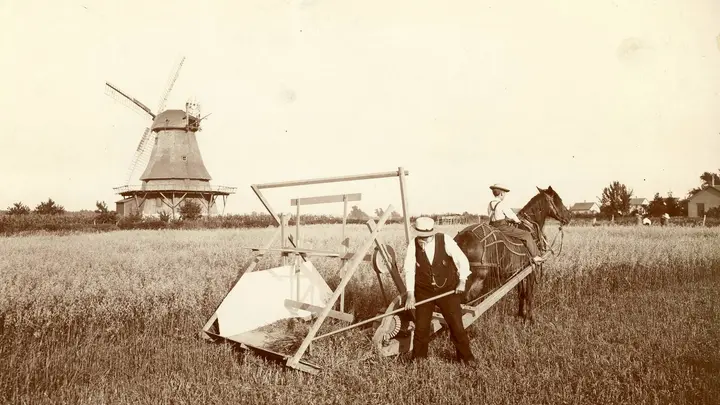
- The ReaperCyrus McCormick’s horse-drawn reaper freed the farmer from the cradle and sickle and fed a growing nation.15 acresa day, vs. 2–3 by hand
- Edison Lights New YorkEdison made a bulb that lasted, then built the power station, wires and meters to light a city with it.400lamps lit the first night


Free, with no ads. Support the museum →