Cape Canaveral, Florida · 31 January 1958 · Army Ballistic Missile Agency, JPL, University of Iowa
Eighty-Four Days
The Army got the order on 8 November 1957. Eighty-four days later a Jupiter-C put America’s first satellite in orbit, and its Geiger counter found something nobody knew was there.

The moment · 00:41 EST · 1 February 1958
In the Pentagon, Pickering, Van Allen and von Braun wait for word from California. Explorer 1 is due over the tracking station at 12:41. The minute comes and goes. Nothing. One minute late. Five. Eight. Then California hears it. America is in orbit.
On 4 October 1957 the Soviet Union put Sputnik in orbit. That night in Huntsville, the Army’s rocket team said it could answer. On 8 November it got the order. The Army Ballistic Missile Agency would build the rocket, the Jet Propulsion Laboratory the satellite, and a physicist in Iowa the science. They had a deadline of 90 days. They needed 84.
The starting gun
Sputnik goes up the same evening Secretary of Defense designate Neil McElroy is visiting Redstone Arsenal. Wernher von Braun tells him the Army can put a satellite in orbit in 60 days. Major General John Medaris, who commands the Army Ballistic Missile Agency, makes it 90 to be safe. The rocket already exists. In September 1956 a Jupiter-C flew about 3,300 miles down the Atlantic range.
Go
McElroy, now Secretary of Defense, gives the Army the green light. In Huntsville, von Braun’s team takes Jupiter-C number RS-29 and readies it to fly. In Pasadena, William Pickering’s JPL builds the satellite, its radios and the solid-fuel upper stages. At the State University of Iowa, James Van Allen and graduate student George Ludwig fit a cosmic-ray Geiger counter into a steel tube about six inches across.
Weather holds
The Jupiter-C stands on Launch Complex 26A at Cape Canaveral, about 70 feet tall, with the satellite bolted to the top of its spinning upper stages. Explorer 1 is 80 inches long and weighs about 31 pounds, more than half of it instruments. Heavy thunderstorms and high winds at altitude scrub the launch two nights running. The crews wait.
Liftoff
The first stage lights and burns for about two and a half minutes. On top, a tub of 15 small solid rockets spins at up to 750 revolutions a minute to hold its aim. At the peak of the climb, ABMA physicist Ernst Stuhlinger sends the radio signal that fires them: a ring of 11, then 3, then 1. About seven minutes after liftoff, Explorer 1 is in orbit.
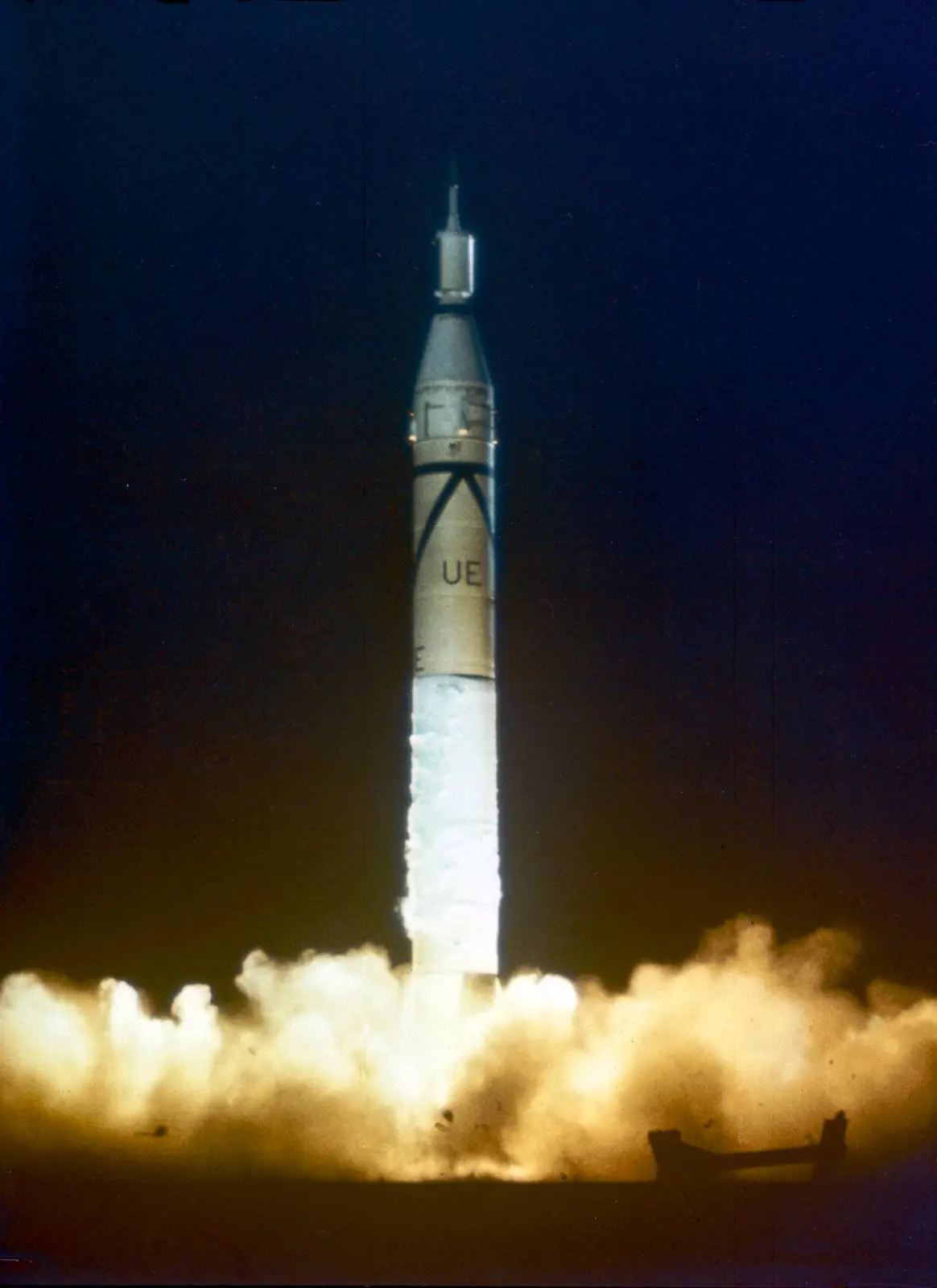
The Jupiter-C lifts Explorer 1 off Launch Complex 26A at Cape Canaveral, 31 January 1958. NASA / Marshall Space Flight Center. California hears it
In the Pentagon war room, Secretary of the Army Wilber Brucker waits with Pickering, Van Allen, von Braun and a handful of generals. The signal is due at 12:41 a.m. It comes eight minutes late, because Explorer 1 has gone higher than planned: 224 miles at its lowest, 1,575 at its highest. A JPL tracking station in California has picked it up.
Pickering, remembering the waitThere was a period of eight minutes there, which is the longest eight minutes I’ve ever spent in my life.
Hold it high
At 12:52 a.m. President Eisenhower announces that the United States has a scientific satellite in orbit. The three men are rushed to the National Academy of Sciences for a press conference in the middle of the night. Pickering, Van Allen and von Braun lift a full-size model of Explorer 1 over their heads. The photograph runs around the world.
Sirens on the square
Huntsville does not wait for morning. Sirens wail and thousands of people pour into the courthouse square to celebrate the town’s rocket. The Huntsville Times prints a satellite extra under a banner headline: “Jupiter-C Puts Up Moon.” America’s answer to Sputnik came from a small Alabama town that would soon be known as Rocket City.
The counter goes quiet
Explorer 1’s Geiger counter reads normal cosmic rays low in its orbit. Then, more than 1,200 miles up over South America, it drops to zero. On 26 March Explorer 3 goes up carrying a tape recorder Ludwig built, and it records the same pattern. Graduate student Carl McIlwain blasts a spare tube with x-rays in the lab and it goes silent too. The counter was not broken. It was swamped.
Note on Van Allen’s door, from physicist Ernie RaySpace is radioactive.
The Van Allen belts
At a joint meeting of the National Academy of Sciences and the American Physical Society, Van Allen announces that the Earth is wrapped in a zone of charged particles held by its magnetic field, at least a thousand times more intense than cosmic rays alone. The press names them the Van Allen belts. It is the first great scientific discovery of the Space Age, and it is American.

The team

Came to the United States in 1945 and became a citizen in 1955. His Huntsville team turned the Army’s Redstone into the Jupiter-C and promised a satellite in 60 days. He later built the Saturn V that carried Americans to the Moon.

New Zealand-born Caltech engineer who became an American citizen in 1941 and ran JPL for 22 years. His lab built Explorer 1, its radios and its upper stages, and tracked it from California. Under him JPL went on to Venus and Mars.

Iowa-born Navy officer in World War II who helped develop the radio proximity fuze. His Geiger counter rode on Explorer 1. When it went silent high over South America, he worked out why and found the radiation belts that bear his name.
By the numbers
In pictures


Watch, listen, see
Films, photographs and first-hand accounts from across the web. Each opens in a new tab.

The Army’s own 1958 television report: building the rocket and satellite, launch night and the press conference.
NASA Marshall Space Flight Center
Film from the Cape Canaveral blockhouse as the Jupiter-C lifts Explorer 1 into orbit.
NASA History
JPL’s compilation of the original newsreel coverage of America’s first satellite.
NASA Jet Propulsion Laboratory
How JPL answered Sputnik with Explorer 1, with interviews with director William Pickering.
NASA Jet Propulsion LaboratoryJPL’s director on working with von Braun’s team, launching Explorer 1 and finding the radiation belts.
Caltech Archives
Explorer 1’s backup, once tested in Van Allen’s Iowa lab, on display in Washington.
Smithsonian National Air and Space Museum
The President’s statement, issued at 12:52 a.m., that the United States had a satellite in orbit.
The American Presidency Project
NASA’s gallery of Explorer 1 photographs: the builders, the rocket, the launch and the celebration.
NASA“The United States has successfully placed a scientific earth satellite in orbit around the earth.”
President Dwight D. Eisenhower, statement of 1 February 1958
After
Explorer 1 kept talking until its batteries ran down on 23 May 1958. It stayed up for twelve years and more than 58,000 orbits before it burned up over the Pacific on 31 March 1970. Its flight spare hangs in the National Air and Space Museum in Washington.
Six months after the launch, President Eisenhower signed the act that created NASA. JPL joined the new agency that December and went on to send probes to every planet in the solar system. Von Braun’s team followed in 1960 as the Marshall Space Flight Center and built the Saturn V.
Van Allen’s instruments flew on dozens more spacecraft, including Pioneer 10 and 11 past Jupiter and Saturn. In 2012 NASA launched twin satellites to study his belts up close. They were named the Van Allen Probes.
Primary sources
- Explorer 1 mission overview. NASA Science.
- Celebrating 65 years of the Army in space: The launch of Explorer I. U.S. Army Space and Missile Defense Command.
- Statement by the President Announcing the Successful Launching Into Orbit of an Earth Satellite, 1 February 1958. The American Presidency Project.
Keep exploring
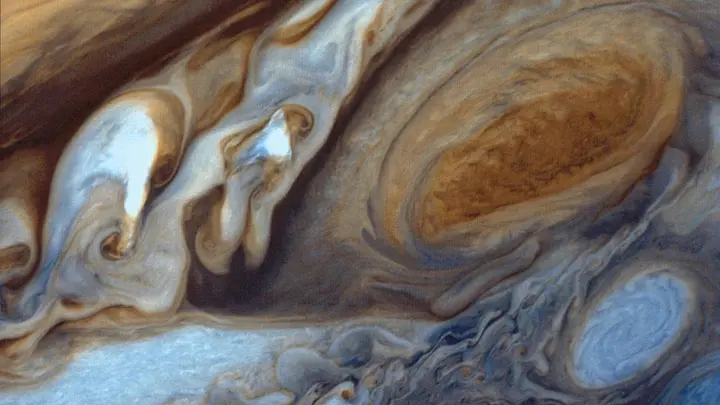
- VoyagerBetween them, two probes toured Jupiter, Saturn, Uranus and Neptune, then became the first human-made objects in interstellar space.16Bmiles and counting
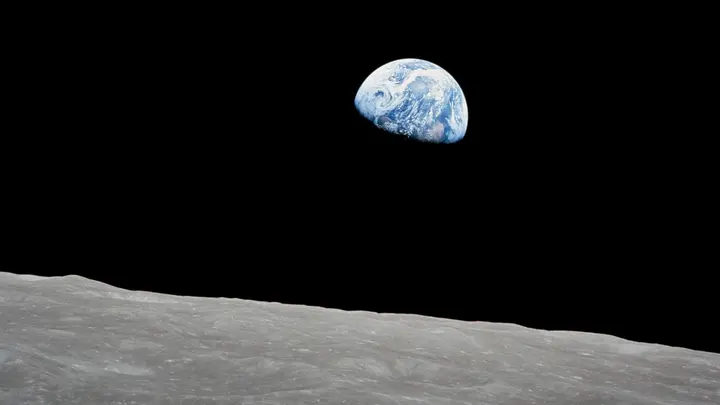
- EarthriseThree Americans left Earth’s orbit for the first time, circled the Moon on Christmas Eve, and read Genesis to the world.1sthumans to orbit the Moon
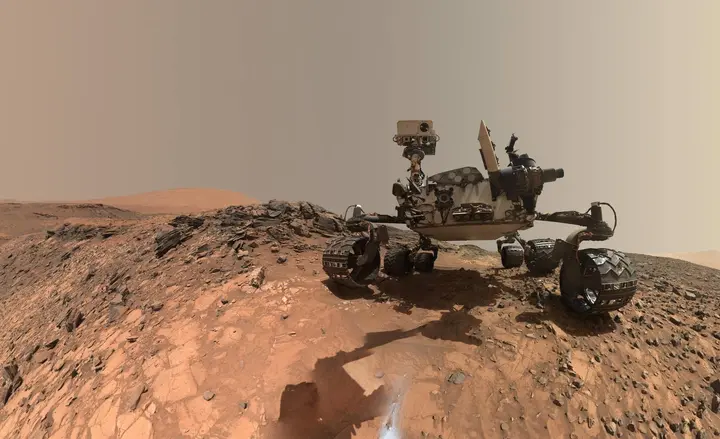
- Curiosity Lands on MarsA sky crane hovered over Mars and set a car-sized laboratory gently on the surface.1ton rover lowered on nylon cords
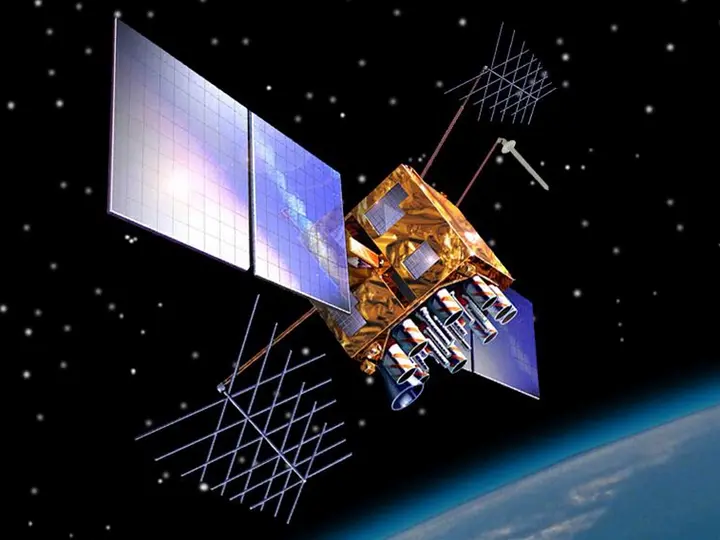
- GPSBuilt by the Pentagon to guide ships, planes and bombs, then given to the whole world for free.24satellites


Free, with no ads. Support the museum →