Cape Canaveral and Earth orbit · 20 February 1962 · Lt. Col. John H. Glenn Jr., USMC
Godspeed, John Glenn
Ten months after a Soviet cosmonaut circled the planet, a Marine from small-town Ohio rode an Atlas into orbit, flew his ship by hand and came home through fire.

The moment · 14:31 EST · 20 February 1962
The spent retropack is still strapped over the heat shield, and nobody knows if the shield is loose. Friendship 7 slams into the atmosphere. A strap flaps past the window. Burning chunks stream by. Glenn wonders if it is his heat shield, and keeps flying.
This is Friendship 7. A real fireball outside.John Glenn, during reentry
On 12 April 1961 the Soviet Union put Yuri Gagarin in orbit. That August, Gherman Titov circled the Earth for more than a day. America had two suborbital hops of about 15 minutes each. The country needed a man in orbit. NASA picked a 40-year-old Marine lieutenant colonel from New Concord, Ohio, named John Glenn.
Scrubbed at the pad
The flight was first planned for December 1961. On 27 January, Glenn lies on his back in Friendship 7 for more than five hours. Then mission director Walt Williams cancels at T-minus 20 minutes. The clouds are too thick for the tracking cameras. Days later, technicians find fuel leaking into a bulkhead cavity between the Atlas tanks. The launch slips into February. Glenn keeps training: almost 60 hours in the procedures trainer and 70 simulated missions.
Into the capsule
Glenn is up at 02:20 for steak and scrambled eggs. At 06:03 he climbs into Friendship 7. The holds pile up. A part in the Atlas guidance system has to be replaced. One of the 70 bolts on the hatch is broken, and Williams orders it fixed. A fuel valve sticks at T-minus 22 minutes. Glenn’s pulse stays between 60 and 80. Some 100 million Americans are watching on television, and 50,000 more stand on the beaches.
Liftoff
After two hours and 17 minutes of holds, the Atlas lights its engines and 360,000 pounds of thrust lift it off Launch Complex 14. In the blockhouse sits backup pilot Scott Carpenter, who has trained beside Glenn for months. Glenn calls out over the roar: “Roger. The clock is operating. We’re underway.” Seconds later: “Little bumpy along about here.”
Scott Carpenter, in the blockhouseGodspeed, John Glenn.
Through the gates
The sustainer engine shuts down five minutes after liftoff, with Friendship 7 just seven feet per second short of the planned speed. Goddard’s computers say the orbit is good for almost 100 trips around the planet. The Cape gives Glenn a go for at least seven. The capsule turns around and he sees the spent Atlas tumbling a couple of hundred yards behind. “Oh, that view is tremendous!”
Glenn to the CapeRoger. Zero-g and I feel fine.
The fireflies
Over the Indian Ocean, Glenn becomes the first American to watch a sunset from orbit. Over Australia he sees the lights of Perth. “That was about the shortest day I’ve ever run into,” he tells Gordon Cooper. At sunrise over the Pacific, the capsule is suddenly surrounded by thousands of glowing specks. He calls them fireflies. “They look like little stars,” he reports. “A whole shower of them coming by.”
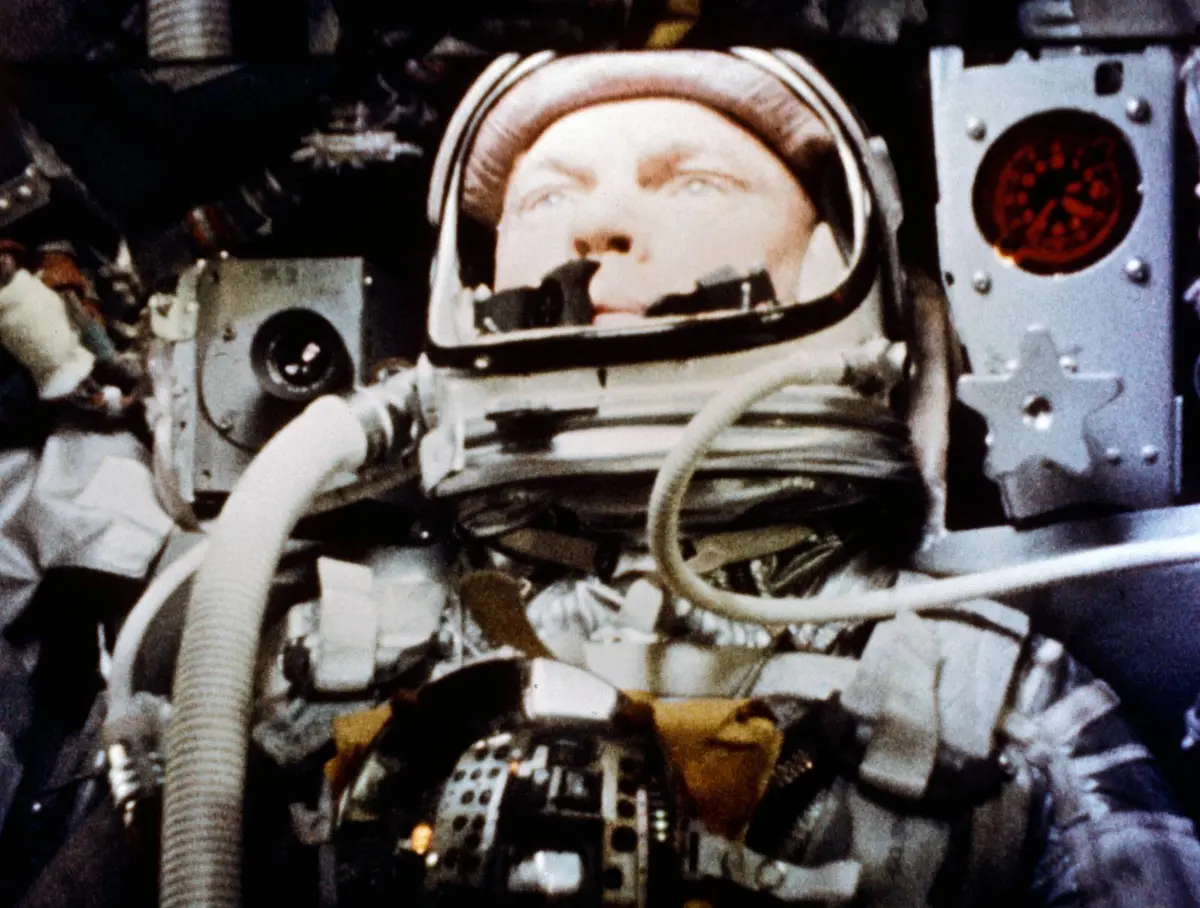
An onboard camera films Glenn in orbit aboard Friendship 7, 20 February 1962 (S62-00303). NASA. Pilot in the loop
A one-pound yaw thruster quits, and the capsule drifts to the right at a degree and a half per second. Glenn takes over by hand. Twenty minutes later the jet comes back and the opposite one dies. From here on he flies Friendship 7 himself, switching between manual and fly-by-wire to save fuel. A stuck valve had ended a chimpanzee’s orbital flight early three months before. A Marine pilot keeps this one going.
Segment 51
At the Cape, engineer William Saunders sees telemetry “segment 51” flash a warning: the heat shield and landing bag are unlocked. If true, only the straps of the retropack hold the shield on. Sites start asking Glenn to check his landing-bag switch. Spacecraft designer Max Faget says the pack can stay on if all three retrorockets fire. Flight director Chris Kraft orders a switch test. Operations director Walt Williams makes the call: keep the retropack on.
Retrofire and reentry
Wally Schirra radios from Point Arguello: “John, leave your retro-pack on through your pass over Texas.” The three retrorockets fire. “It feels like I’m going back toward Hawaii,” Glenn says. At 14:31 the capsule hits the atmosphere. Burning pieces of the retropack stream past the window, and the radio goes dead for four minutes and 20 seconds. Glenn’s fuel runs dry. The drogue chute pops out at 28,000 feet and steadies the ship.
Splashdown
Friendship 7 hits the Atlantic four hours, 55 minutes and 23 seconds after liftoff. The destroyer USS Noa has watched it come down and has it aboard within 21 minutes. Glenn blows the hatch, cutting his knuckles, the only injury of the flight. His first words outside: “It was hot in there.” President Kennedy calls him by radio-telephone aboard Noa. America has its man in orbit.
The team

Marine fighter pilot with 59 combat missions in World War II and 90 in Korea, where he shot down three MiGs in the war’s last nine days. In 1957 he flew coast to coast at supersonic average speed. First American to orbit the Earth.

Navy patrol pilot in the Korean War and one of the original seven Mercury astronauts. He trained beside Glenn for months, worked the launch from the blockhouse and sent him off with “Godspeed, John Glenn.” He flew Aurora 7 three months later.

NACA flight-test engineer from 1945 and NASA’s first flight director. He built the way Mission Control runs a flight. In the heat-shield scare he ordered the switch test that narrowed the problem and judged the warning a faulty sensor. He was right.

NACA engineer who led the X-1 flight-test team when Chuck Yeager broke the sound barrier. He ran operations for America’s first three manned flights. For Glenn’s, he scrubbed the clouded first try, had the broken hatch bolt fixed and made the retropack call.
By the numbers
In pictures


Watch, listen, see
Films, photographs and first-hand accounts from across the web. Each opens in a new tab.

NASA’s film of the first American orbital flight, from Project Mercury’s preparations to tracking stations around the world.
NASA
Film of the morning Glenn, strapped inside Friendship 7, rode the Atlas off the pad and into orbit.
NASA Kennedy Space Center
Sunrise and sunset as Glenn saw them, the reentry radio blackout explained, and the parachute opening.
NASA
NASA celebrates the 50th anniversary of the three orbits that opened a new era of American spaceflight.
NASAGlenn’s backup explains how the famous words came to him somewhere between ten and zero.
NASA JSC Oral History Project
Air-to-ground transcripts from every tracking station, from liftoff at the Cape to the recovery ship.
Ohio State University Libraries
The official transcript of Glenn talking with the ground, including his words through the fire of reentry.
National Archives
The capsule itself, on exhibit since NASA transferred it in 1963, now in the Boeing Milestones of Flight Hall.
Smithsonian National Air and Space Museum“We have a long way to go in this space race. But this is the new ocean, and I believe the United States must sail on it and be in a position second to none.”
President John F. Kennedy, the White House Rose Garden, 20 February 1962
After
Three days later President Kennedy flew to the Cape and pinned the NASA Distinguished Service Medal on Glenn. On 26 February, 250,000 people lined rainy streets in Washington before Glenn reported to a joint session of Congress. On 1 March an estimated four million New Yorkers turned out for his ticker-tape parade. Two days after that, 75,000 people packed his hometown of New Concord, Ohio, population 2,300.
The heat shield had never come loose. Engineers traced the warning to a loose switch. Friendship 7 toured 17 countries on what the press called its fourth orbit, then went to the Smithsonian on the first anniversary of the flight, beside the Wright Flyer and the Spirit of St. Louis. It is still on display in Washington.
Glenn retired from the Marine Corps as a colonel and served four terms in the U.S. Senate. On 29 October 1998, at 77, he flew again on the space shuttle Discovery. Scott Carpenter was on the radio once more: “Godspeed, John Glenn.”
Primary sources
- Swenson, Grimwood and Alexander, This New Ocean: A History of Project Mercury (NASA SP-4201), 1966.
- Results of the First United States Manned Orbital Space Flight, February 20, 1962. NASA Manned Spacecraft Center, 1962.
- Friendship 7 air-to-ground transcripts. The Ohio State University Libraries.