Cape Canaveral to interstellar space · 5 September 1977 · Voyager 1, Voyager 2 and JPL
A Present from a Small, Distant World
Two American probes flew past all four giant planets, carried a golden record of Earth, and kept going. Nearly fifty years later, they still answer when JPL calls.

The moment · 06:40 PDT · 20 April 2024
For five months Voyager 1 has sent back gibberish. One memory chip has failed, 15 billion miles away. Engineers split the code into pieces and beam it out. The reply takes 22 and a half hours. Just after 6:40 a.m., readable data comes back. A cheer goes up.
In 1965 a Caltech graduate student working at JPL found that Jupiter, Saturn, Uranus and Neptune would line up in the late 1970s, a chance that comes about once every 175 years. One spacecraft could use each planet’s gravity to fling it to the next. NASA built two, launched them in 1977 and sent them to see every giant world. Then they kept going.
Once every 175 years
On a summer assignment at JPL, Gary Flandro works out that the four giant planets will line up for a single flight he calls the Grand Tour. NASA approves two spacecraft in 1972 and names Ed Stone project scientist. Mission design manager Charley Kohlhase leads the team that studies more than 10,000 trajectories and picks two. Voyager 2’s path keeps the door open to Uranus and Neptune.
A message in a bottle
Each Voyager carries a 12-inch gold-plated copper record. A committee chaired by Cornell astronomer Carl Sagan has about six months to fill it: 115 images, the sounds of surf, wind, thunder, birds and whales, 90 minutes of music from many cultures and eras, and spoken greetings in 55 languages. A printed message from President Jimmy Carter rides along. The cover is etched with instructions for playing it.
President Carter’s message on the recordThis record represents our hope and our determination, and our good will in a vast and awesome universe.
Liftoff
Voyager 2 goes first, on 20 August, atop a Titan IIIE-Centaur from Cape Canaveral. Sixteen days later Voyager 1 follows on a faster path that will carry it past its twin. Each spacecraft weighs about 1,590 pounds, talks to Earth through a 12-foot dish antenna and runs on three plutonium generators that make 470 watts between them.
Volcanoes on Io
Voyager 1 sweeps 172,000 miles above Jupiter’s clouds and sends home close-ups of the Great Red Spot, a storm bigger than Earth. It finds a thin ring around the planet and two new moons. Four days later JPL navigation engineer Linda Morabito spots a plume rising off the edge of the moon Io. It is an erupting volcano, the first ever seen beyond Earth. Voyager 2 follows in July.
Titan, then on to Uranus
Voyager 1 passes close to Saturn’s moon Titan and finds a thick atmosphere that is 90 percent nitrogen. It also finds five new moons and a new ring. The Titan pass bends its path up and out of the plane of the planets. That month NASA approves sending Voyager 2 on to Uranus. It reaches Uranus on 24 January 1986, the first spacecraft ever to visit, and finds 10 new moons and two new rings.
Neptune and Triton
Twelve years after launch, Voyager 2 skims 2,980 miles over Neptune’s cloud tops, the closest pass of its journey. It finds six new moons, four rings and a giant storm called the Great Dark Spot. Then it turns to the moon Triton, the coldest world ever measured at minus 391°F, and finds a nitrogen ice volcano on its surface. The Grand Tour is complete.
The Pale Blue Dot
Voyager 1 is 3.7 billion miles from the Sun. Carl Sagan first asked for one last look home in 1981. Now the spacecraft turns its camera back and takes 60 frames, a family portrait of six planets. In one of them, Earth is a speck 0.12 of a pixel wide, caught in a scattered sunbeam. Thirty-four minutes later, Voyager’s cameras shut off for good.
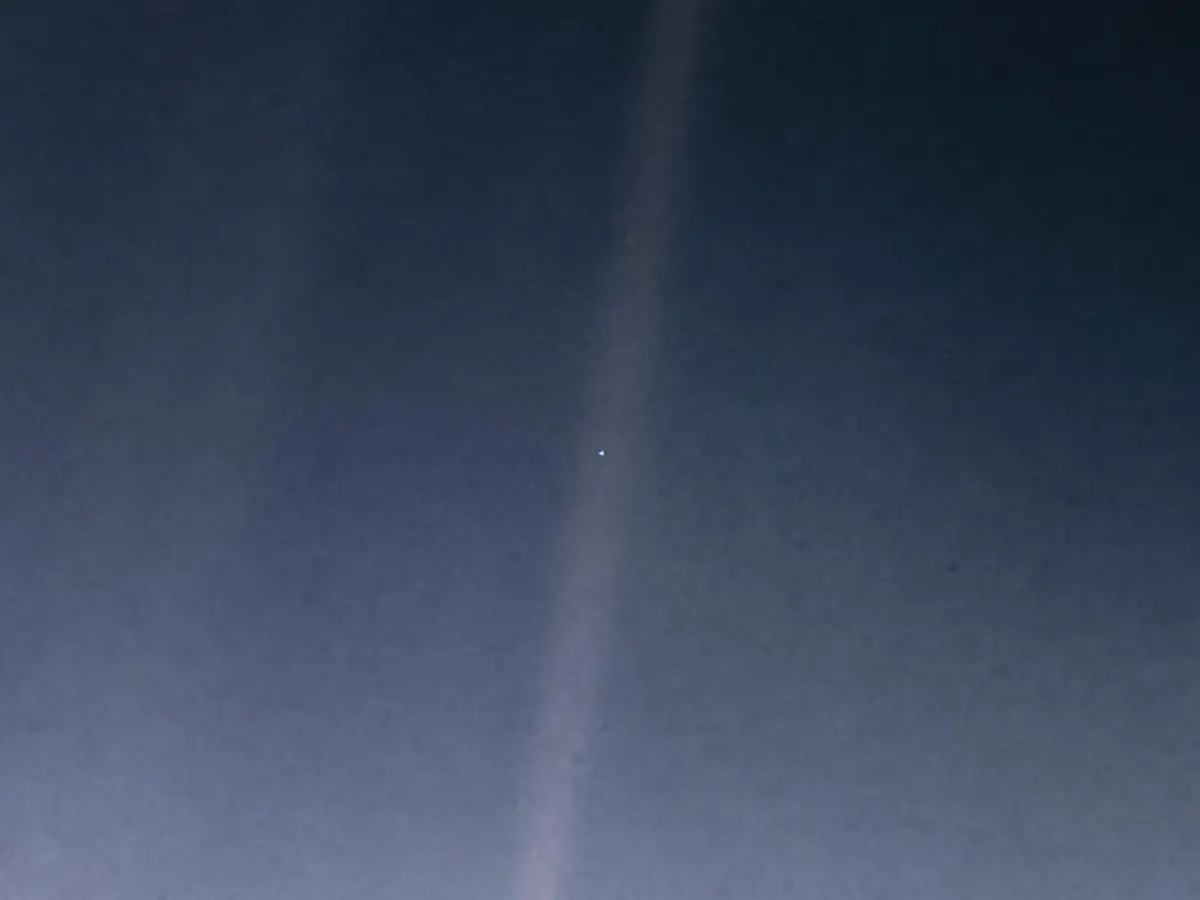
The Pale Blue Dot: Earth, a speck in a scattered sunbeam, photographed by Voyager 1 from 3.7 billion miles on 14 February 1990 (2020 reprocessing, PIA23645). NASA/JPL-Caltech. Carl Sagan, on the photographThat’s here. That’s home. That’s us.
Beyond the Sun’s bubble
About 11 billion miles out, Voyager 1 crosses the heliopause, the edge of the bubble of charged particles the Sun blows around itself. It is the first human-made object in interstellar space. Voyager 2 follows on 5 November 2018. They are the only spacecraft ever to work out there, and both are still sending data home from beyond the Sun’s reach.
Fixed from 15 billion miles
Since November 2023, Voyager 1 has sent only gibberish. Engineers trace it to one failed memory chip in its flight data computer. No single spot in memory can hold the lost code, so they split it into pieces and send it to new places on 18 April. Signals take 22 and a half hours each way. Two days later the spacecraft answers, healthy. By mid-June all four instruments are back.
The explorers

Iowa-born physicist who built science instruments for satellites from 1961. Voyager’s only project scientist for 50 years, he chose which observations flew and explained every discovery to the world. Directed JPL from 1991 to 2001. National Medal of Science.

Georgia Tech physics graduate and Navy officer on nuclear weapons teams aboard the carriers Essex and Independence. At JPL he designed missions from Mariner to Cassini. For Voyager his team sifted more than 10,000 trajectories and picked the two that flew.

Utah-born Caltech graduate student who, on a summer assignment at JPL, found the rare line-up of Jupiter, Saturn, Uranus and Neptune that made Voyager’s route possible. NASA awarded him its Exceptional Achievement Medal in 1998.

Cornell astronomer and member of the Voyager imaging team. He chaired the committee that made the Golden Record in about six months, and first asked in 1981 to turn Voyager’s camera back toward home. The result was the Pale Blue Dot.
By the numbers
In pictures


Watch, listen, see
Films, photographs and first-hand accounts from across the web. Each opens in a new tab.

JPL’s short film on the twin probes launched in 1977 and still sending data home.
NASA JPL
The Voyager team, current and retired, explains how it diagnosed and repaired a 1970s spacecraft from Earth.
NASA JPL
NASA’s August 1989 film of the Neptune encounter, with Voyager’s images and graphics of the flyby.
NASA
Voyager’s project scientist of 50 years on Voyager 2 reaching interstellar space in 2018.
NASA JPL
NASA’s odometers tracking how far both Voyagers are from Earth, with the status of every instrument.
NASA
The images, sounds, music and greetings in 55 languages that both Voyagers carry toward the stars.
NASA
The 1990 photograph of Earth from 3.7 billion miles, and the story of how it was taken.
NASAVoyager’s mission design manager on choosing two flight paths out of 10,000 for the Grand Tour.
Planetary Radio“This is a present from a small distant world, a token of our sounds, our science, our images, our music, our thoughts, and our feelings.”
President Jimmy Carter, message carried aboard Voyager, 1977
After
Ed Stone retired in 2022 after 50 years as Voyager’s project scientist. He had led the science through every planetary flyby and the crossing into interstellar space. He died on 9 June 2024, weeks after his spacecraft came back to life.
On 18 November 2026 Voyager 1 reaches one light-day from Earth, 16.1 billion miles. A command sent from JPL takes a full day to arrive. Nothing humans have built has ever gone so far.
Each Voyager loses about 4 watts of power a year, and engineers keep finding ways to stretch what is left. In 2026 they reworked Voyager 2’s power use to keep its three remaining instruments running at least another year. When the last one goes quiet, the Golden Records will keep sailing, carrying the sounds of Earth among the stars.
Keep exploring
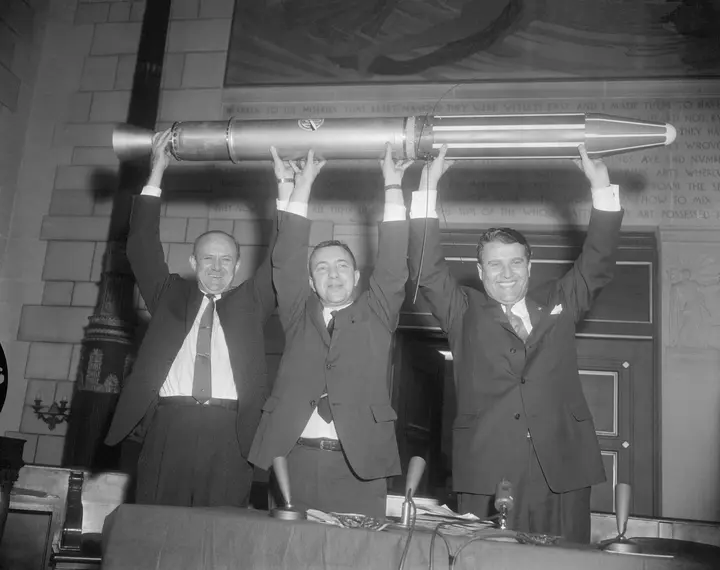
- Explorer 1America’s first satellite went up on a Jupiter-C and found the Van Allen radiation belts.84days from go to launch
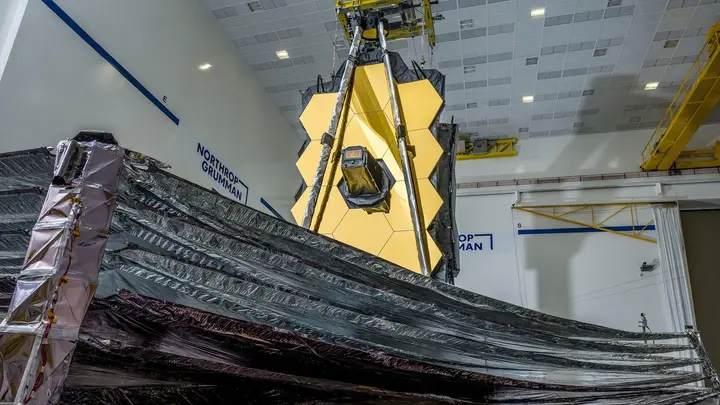
- The Webb TelescopeThe largest telescope ever launched unfolded itself in space and looked back to the first galaxies.344ways it could have failed
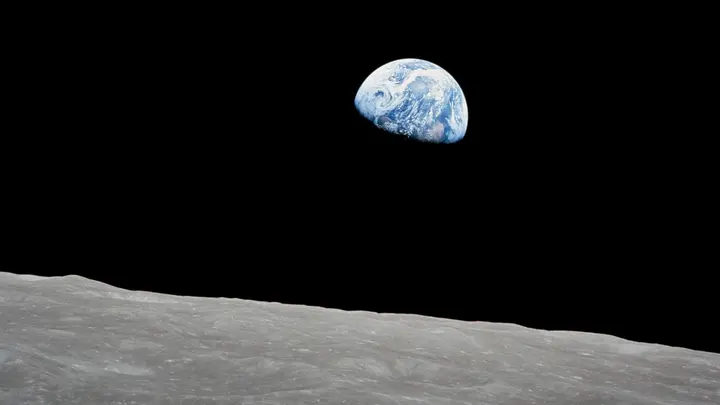
- EarthriseThree Americans left Earth’s orbit for the first time, circled the Moon on Christmas Eve, and read Genesis to the world.1sthumans to orbit the Moon
- First Flight on MarsA four-pound helicopter flew in air one percent as thick as Earth’s, 117 years after Kitty Hawk.39seconds in the air


Free, with no ads. Support the museum →