Gale Crater, Mars · 5 August 2012 · NASA Jet Propulsion Laboratory
We’re Safe on Mars
Curiosity was too heavy to bounce down on airbags. So JPL built a flying crane and lowered a one-ton laboratory onto Mars on a rope.

The moment · 22:31 PDT · 5 August 2012
A rocket-powered crane hangs 66 feet over Gale Crater and lowers a one-ton rover on three nylon cords. The wheels snap down and touch Mars at under two miles an hour. The cords are cut. The crane flies off to crash far away. In Pasadena, the signal arrives.
Touchdown confirmed. We’re safe on Mars!Allen Chen, landing operations lead, JPL
Curiosity weighed nearly a ton, five times as much as any Mars rover before it, and far too heavy to bounce down on airbags. Radio from Mars takes almost 14 minutes to reach Earth, so nobody could steer it in. JPL’s answer was a rocket-powered crane that would fly itself, hover over the ground and lower the rover on nylon cords.
Liftoff
An Atlas V rocket climbs off Space Launch Complex 41 at Cape Canaveral carrying the Mars Science Laboratory. Packed inside a heat shield 14.8 feet across, folded under a rocket backpack, rides Curiosity: a 1,982-pound rover with ten science instruments, built to find out whether Mars could ever have supported life. Ahead lies a cruise of 352 million miles and 36 weeks.
Rover on a rope
Airbags had bounced Pathfinder, Spirit and Opportunity onto Mars, but Curiosity would be far too big and heavy for them. JPL’s Rob Manning starts sketching another way: a rocket backpack that hovers over the ground and lowers the rover on cords. Miguel San Martín works out how to fly it. Adam Steltzner’s team builds and tests it. Years later Steltzner sums it up: “It is the result of reasoned, engineering thought. But it still looks crazy.”
Top of the atmosphere
The capsule hits the Martian air 78 miles up at about 13,200 miles per hour, and its heat shield heats to about 3,800 degrees. Small thrusters bank it through S-turns as it flies itself toward a target ellipse 12 miles long. Radio from Mars takes 13.8 minutes to reach Earth, and the whole landing takes about seven. When JPL hears that the capsule has hit the air, Curiosity is already on the ground, safe or wrecked.
Under the parachute
Still flying faster than sound, the spacecraft fires out the largest parachute ever built for a mission to another world: 51 feet across, on 80 suspension lines. High overhead, the Mars Reconnaissance Orbiter points its HiRISE camera and catches Curiosity swinging under the canopy from 211 miles away, one American spacecraft photographing another as it lands. About 24 seconds after the chute opens, the heat shield falls away and the radar starts reading the ground.
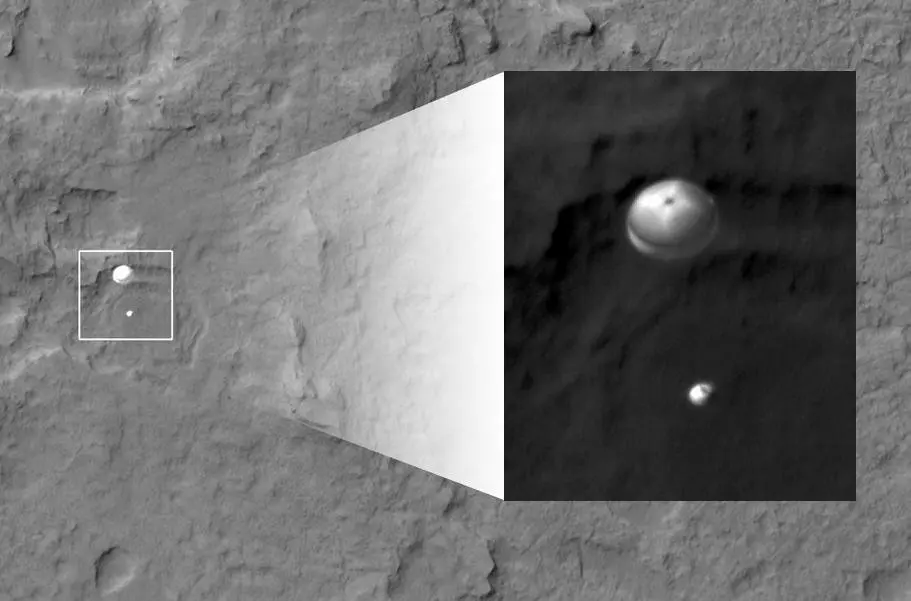
The Mars Reconnaissance Orbiter's HiRISE camera catches Curiosity hanging under its 51-foot parachute over Gale Crater, photographed from 211 miles away, 5 August 2012. NASA / JPL-Caltech / University of Arizona. Sky crane
About a mile up, the rover and its rocket backpack drop free of the parachute. Eight throttling engines light and slow the fall to 1.7 miles per hour. Four shut down. At about 66 feet, with 12 seconds to go, Curiosity drops away from the stage on three nylon cords and hangs 25 feet below it. Its wheels snap into place. When they touch, the cords are cut and the crane flies off to crash a safe distance away.
Tango Delta nominal
In the landing team’s war room, engineer Jody Davis sees the touchdown record on her screen and makes the call she has rehearsed: “Tango Delta nominal.” Eight seconds later David Way reports “RIMU stable”: the rover is not moving or tipping. Eight seconds after that Brian Schratz calls “UHF strong”: the radio is still loud, so the crane has flown clear. Allen Chen, the voice of mission control, makes it official.
Allen Chen, landing operations lead, to mission controlTouchdown confirmed. We’re safe on Mars!
Pictures from Gale Crater
The signal comes by way of the Mars Odyssey orbiter to NASA’s Deep Space Network dish at Canberra, Australia. Within minutes the first pictures arrive: thumbnails, shot through clear dust covers, of a wheel on Martian gravel and the rover’s own shadow in the afternoon sun. One shows a far-off plume of dust: the sky crane crashing, as planned. NASA science chief John Grunsfeld tells reporters the Seven Minutes of Terror has turned into the Seven Minutes of Triumph.
A call from Air Force One
President Obama phones the team at JPL from Air Force One to congratulate them. “It’s inspiring to all of us,” he tells them, and he says the photographs coming back are going to be remarkable and amazing. He also jokes about the mohawk that made flight director Bobak Ferdowsi famous on landing night. Engineers who spent more than a decade on seven minutes of flight listen to their president thank them.
President Obama, by phone to JPLIt’s inspiring to all of us.
Bradbury Landing
Curiosity drives for the first time: about 15 feet forward, a turn of 120 degrees, then about 8 feet in reverse. NASA names the spot Bradbury Landing for the author Ray Bradbury, who would have turned 92 that day. On the horizon stands Mount Sharp, three miles tall, the layered mountain Curiosity came to climb.
Hear it
The landing team

Played bass in new wave bands and failed high school geometry, then took an astronomy class after wondering why Orion had moved across the night sky. Earned a doctorate, joined JPL in 1991 and led the team that designed, built and tested the sky crane.

Grew up in Newtown, Pennsylvania, earned two degrees at MIT and joined the landing team in 2002. On landing night he was the voice of mission control, and his call told the world Curiosity had made it. He later led the landing of Perseverance.

Grew up in Argentina inspired by Apollo and Viking, then came to America to study at Syracuse and MIT. Ran guidance and control for Pathfinder, Spirit and Opportunity. Co-architect of the sky crane and deputy chief for Curiosity’s landing.

Caltech graduate and JPL engineer since the early 1980s. As chief engineer of Mars Pathfinder, he led the team that landed it on airbags in 1997. In February 2000 he worked on the first sky crane concept, and in 2007 he became Curiosity’s chief engineer.
By the numbers
In pictures


Watch, listen, see
Films, photographs and first-hand accounts from across the web. Each opens in a new tab.

Six weeks before landing, the engineers who built the sky crane walk through every step of the descent.
NASA Jet Propulsion Laboratory
NASA’s report from landing night, as a one-ton rover hanging from a rocket backpack touches down on Mars.
NASA
The rover’s own descent camera, from heat shield jettison to touchdown in Gale Crater.
NASA Jet Propulsion Laboratory
Engineers test the first-of-its-kind landing system before Curiosity ever left Earth.
NASA Jet Propulsion Laboratory
President Obama phones the Curiosity team from Air Force One, 13 August 2012, to congratulate them.
NASA
An orbiter 211 miles away photographs Curiosity hanging under its parachute on the way down.
NASA Jet Propulsion Laboratory
JPL’s account of the four calls that told the world Curiosity had landed safely.
NASA Jet Propulsion Laboratory
Drive the rover across Gale Crater and work its arm and mast in JPL’s 3D web app.
NASA Jet Propulsion Laboratory“Tonight, on the planet Mars, the United States of America made history. … It proves that even the longest of odds are no match for our unique blend of ingenuity and determination.”
President Barack Obama, statement on the Curiosity landing, 6 August 2012
After
The Mars Science Laboratory team won the 2012 Robert J. Collier Trophy, America’s top prize in aeronautics and astronautics. The Smithsonian’s National Air and Space Museum gave the landing team its Trophy for Current Achievement, and Adam Steltzner accepted it for them. Seven months after landing, NASA announced that a rock Curiosity had drilled, called John Klein, held sulfur, nitrogen, hydrogen, oxygen, phosphorus and carbon: ancient Mars could have supported living microbes.
The sky crane became the way America lands big rovers on Mars. In 2021 it set Perseverance down in Jezero Crater with the Ingenuity helicopter on its belly. Allen Chen led that landing, and Adam Steltzner was the mission’s chief engineer.
Curiosity was built for a two-year mission. Fourteen years later it is still driving. On 26 August 2026 it passed one kilometer, 3,281 feet, of climbing up Mount Sharp, reading the mountain’s layers of rock one by one, each younger than the last.
Keep exploring
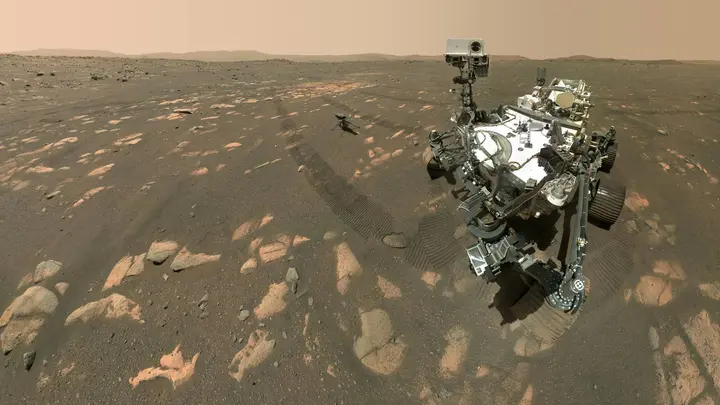
- First Flight on MarsA four-pound helicopter flew in air one percent as thick as Earth’s, 117 years after Kitty Hawk.39seconds in the air
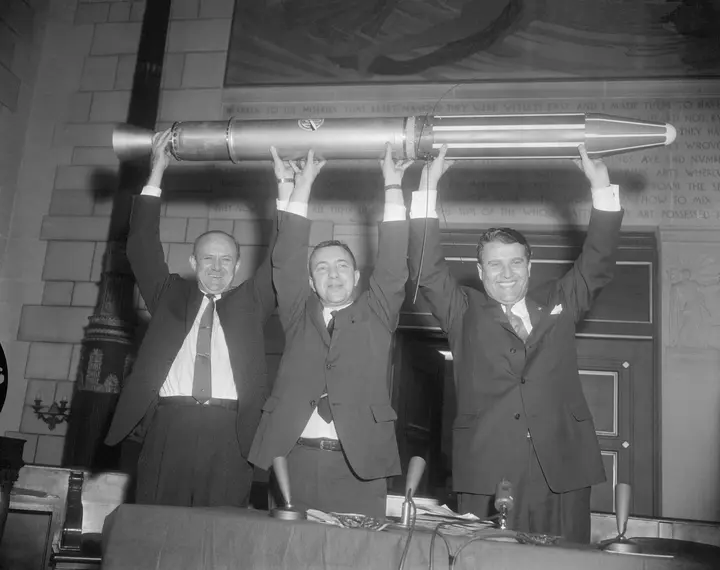
- Explorer 1America’s first satellite went up on a Jupiter-C and found the Van Allen radiation belts.84days from go to launch
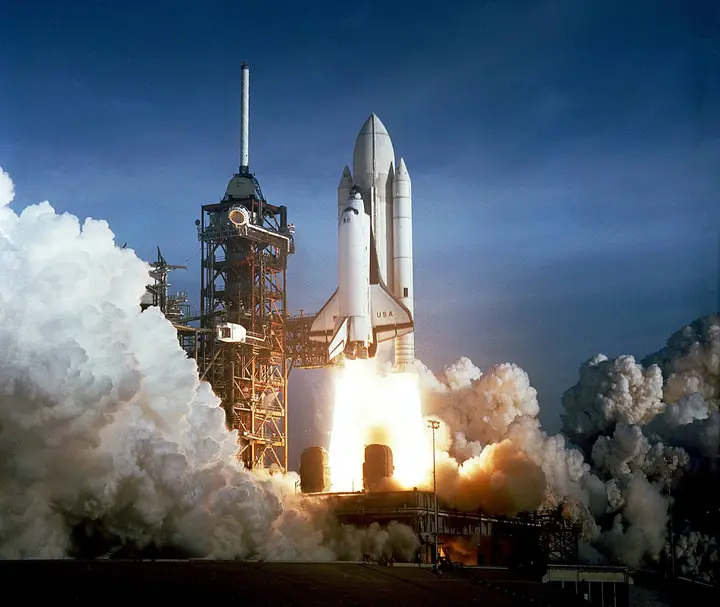
- ColumbiaTwo astronauts flew a brand-new winged spacecraft into orbit on its first flight and landed it like an airplane.1streusable spaceship
- The Rocket Comes HomeSpaceX landed an orbital booster upright in 2015. In 2024 it caught a 233-foot one in the arms of the launch tower.233 ftbooster caught


Free, with no ads. Support the museum →