Kennedy Space Center to Edwards AFB · 12 April 1981 · Young, Crippen
What a Way to Come to California
Two Navy pilots rode a brand-new winged spaceship into orbit on its very first flight, circled the Earth for two days and flew it home to a runway.

The moment · 07:00:03 EST · 12 April 1981
Two men sit on top of a spaceship that has never flown. Three main engines light, then the two solid rocket boosters, and once those light nothing can shut them down. Young’s heart rate holds near 90. Crippen’s climbs to 130. Columbia clears the tower.
Liftoff of America’s first space shuttle, and the shuttle has cleared the tower.Hugh Harris, NASA launch commentator
No American had flown in space in almost six years. For a decade NASA had been building a ship that would launch like a rocket, fly in orbit like a spacecraft, land like an airplane and then fly again. Every earlier American spacecraft had made its first flight empty. This one would carry two men the first time it left the ground.
One more day
Young and Crippen are strapped in on Pad 39A with the countdown running when a timing glitch between Columbia’s flight computers stops the clock. The launch team scrubs, and engineers track down the fault. The new launch date is 12 April, twenty years to the day after the first human flight into space.
Liftoff
About 600,000 people line Kennedy Space Center and the beaches nearby. The three main engines light first, then the two solid rocket boosters, which cannot be shut down once they fire. The 4.5-million-pound stack, with its white-painted tank, climbs off the pad. Crippen’s heart rate hits 130. Young’s stays near 90. He jokes that he is too old for it to go any faster.
Hugh Harris, Launch ControlLiftoff of America’s first space shuttle, and the shuttle has cleared the tower.
Boosters away
Once Columbia clears the tower, control passes to Houston, where flight director Neil Hutchinson’s Silver Team runs the climb. Two minutes and twelve seconds after liftoff the boosters separate and fall toward the Atlantic on parachutes, to be recovered and flown again. The main engines burn for eight and a half minutes. The tank drops away, and two burns of the orbital engines put Columbia in a circular orbit 170 miles up.
Dark squares
Crippen floats back to open the payload bay doors and tells Young it feels just like the simulator, except his feet aren’t on the floor. As the first door swings open he spots dark squares on the engine pods near the tail, where heat-shield tiles have shaken loose. The crew sends TV pictures to Houston. Engineers study them and judge that the missing tiles pose no danger on the way home.
A call from the Vice President
Houston wakes the crew with “Blast-Off Columbia,” a song written by a shuttle technician. They fire the maneuvering thrusters, test the flight controls and practice suiting up. Vice President George H. W. Bush calls and tells them their trip is going to ignite the excitement and the forward thinking for the country. Then they start getting Columbia ready to come home.
The fire of reentry
Flying tail first, Columbia fires its two orbital engines for 160 seconds and starts down. Near Guam it hits the upper air at 400,000 feet. For about sixteen minutes a sheath of plasma cuts off radio contact, and the leading edges of the wings reach 2,750°F. Crippen says it is like flying down a pink neon tube. With no engine power, Columbia glides and banks through S-turns to shed speed.
The coast of California
Radar picks Columbia up at 165,000 feet and ten times the speed of sound, 470 miles out. It crosses the California coast at 141,000 feet with 275 miles to go. Crippen looks down at the San Joaquin Valley, the Tehachapi pass and the dry lakebeds around Edwards, country he has flown over many times. He has never come in this way before.
Crippen to capcom Joe AllenWhat a way to come to California!
Wheels on the lakebed
A double sonic boom rolls over Edwards Air Force Base. Young flies a sweeping 210-degree turn to line up with Runway 23 on Rogers Dry Lake, and Crippen lowers the landing gear. The main wheels touch down at about 210 mph. Columbia rolls 8,993 feet and stops. “Do I have to take it up to the hangar, Joe?” Young asks. “We’re going to dust it off first,” Allen answers.
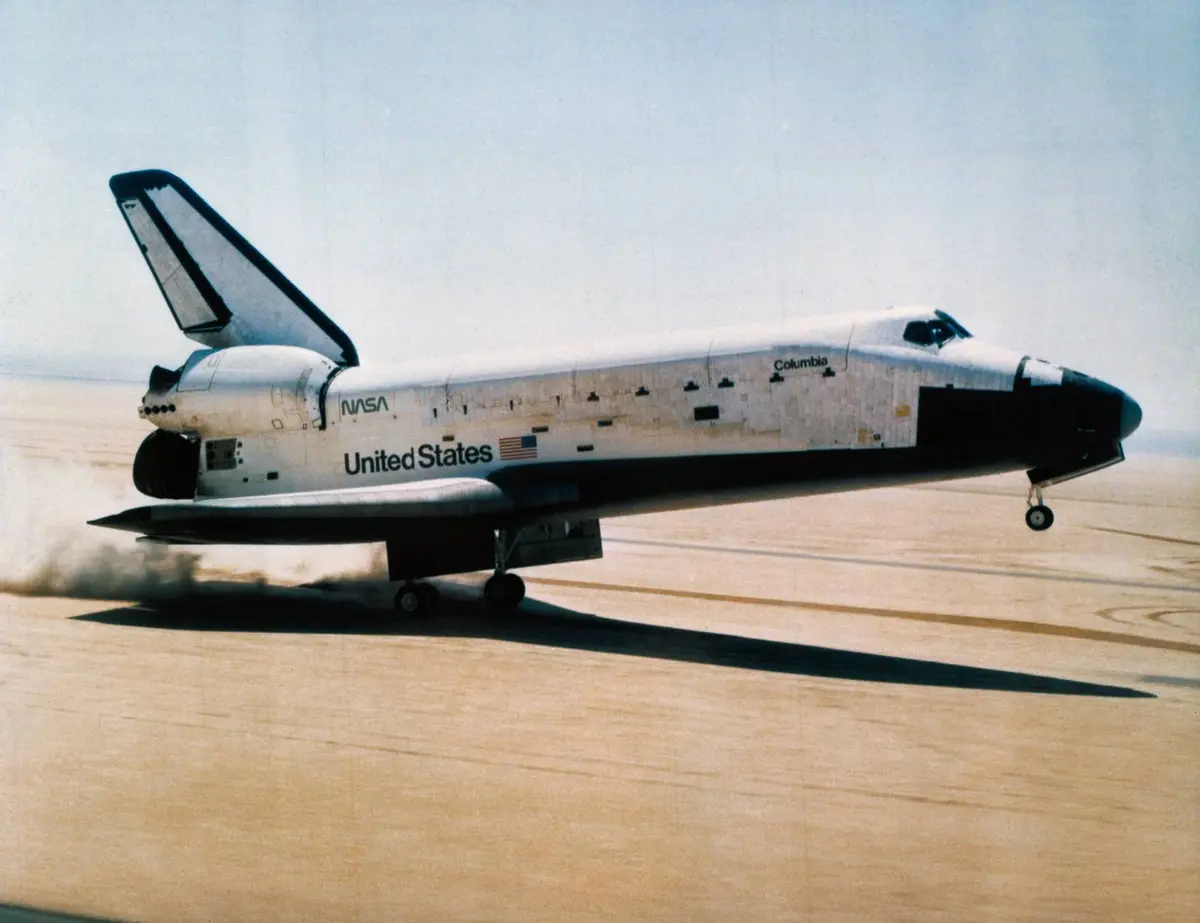
Columbia’s main wheels touch down on Rogers Dry Lake at Edwards Air Force Base, 14 April 1981, the first NASA spaceflight to end on a runway (S81-30746). NASA / Johnson Space Center. The walkaround
An hour and eight minutes after landing, Young climbs down the stairs and walks all the way around Columbia, looking it over. Crippen follows. Hundreds of thousands of people have gathered on the lakebed to watch. At the welcome ceremony, Young says the human race isn’t far from going to the stars. Crippen says waiting twelve years for his first flight was well worth it.
The crew and the team

Navy test pilot who set two world time-to-climb records in the F-4 Phantom in 1962. Flew Gemini 3 and Gemini 10, orbited the Moon on Apollo 10 and walked on it on Apollo 16. Then commanded the shuttle’s first flight.

Navy pilot who flew A-4 Skyhawks from the carrier Independence and trained for the Air Force’s Manned Orbiting Laboratory. Joined NASA when it was canceled in 1969 and waited twelve years for this flight. Later commanded three more shuttle missions.

Navy officer and Langley engineer who ran spacecraft landing and recovery for Mercury and Gemini. Managed the Space Shuttle Program from 1970 through the first flight, and pushed for the first launch to carry a crew.

Apollo and Skylab flight director, one of three Gene Kranz chose to run the shuttle’s first flight. His Silver Team took over in Houston the moment Columbia cleared the tower and ran the climb to orbit.
By the numbers
In pictures


Watch, listen, see
Films, photographs and first-hand accounts from across the web. Each opens in a new tab.

NASA’s 1981 film of the first flight: liftoff, two days aboard Columbia and the lakebed landing.
NASA+
Kennedy Space Center’s film of Columbia’s first launch from Pad 39A, the start of a 30-year career.
NASA’s Kennedy Space Center
The launch, Young and Crippen at work in orbit, and the huge crowds at Edwards for the landing.
NASAThe pilot recalls the countdown, the missing tiles, the neon-pink reentry and Young’s perfect landing.
NASA JSC Oral History Project
Crippen describes a launch like a catapult shot off a carrier and the landing at Edwards.
NASA Rocket Ranch podcast
NASA’s 1981 press kit: the flight plan, launch timeline, landing profile and crew biographies.
NASA
NASA’s history site for the first flight, with essays, a chronology, biographies and a photo gallery.
NASA History Office
President Reagan’s address to Congress two weeks after the flight, praising Young, Crippen and Columbia.
Ronald Reagan Presidential Library“The space shuttle did more than prove our technological abilities. It raised our expectations once more. It started us dreaming again.”
President Ronald Reagan, Address to a Joint Session of Congress, 28 April 1981
After
On 19 May 1981 President Reagan gave Young the Congressional Space Medal of Honor and presented both men with NASA’s Distinguished Service Medal. That November, Columbia flew again with a new crew, the first time any spacecraft had gone back to orbit.
The shuttle flew 135 missions over thirty years and carried 355 people from 16 countries into orbit. Shuttle crews launched the Hubble Space Telescope and went back five times to repair and upgrade it. They launched and retrieved satellites, flew laboratories in orbit and built the International Space Station.
Two crews were lost, Challenger’s in 1986 and Columbia’s in 2003, fourteen astronauts in all, and the nation honors them. Discovery, the fleet’s most-flown orbiter, now stands in the Smithsonian’s Udvar-Hazy Center outside Washington.