Burbank and Palmdale, California · 22 December 1964 · Lockheed Skunk Works, U.S. Air Force
Rule the Skies
Kelly Johnson’s Skunk Works designed a spy plane on slide rules, built it out of titanium and sent it over hostile ground at three times the speed of sound. No enemy ever shot one down.

The moment · 28 July 1976 · Beale AFB, California
Capt. Eldon Joersz and Maj. George Morgan line up on a straight course. The Blackbird runs past three times the speed of sound. Friction heats the titanium skin past 500 degrees. The spikes slide to hold the shock waves. 2,193 miles an hour. No jet has flown faster since.
By 1958 Soviet radar had tracked the CIA’s U-2 since its first overflight in 1956, and sooner or later a missile would reach it. The country needed a spy plane too high and too fast to stop. Lockheed’s Skunk Works designed one on slide rules and built it from a metal its machinists had to learn to cut. It cruised at more than three times the speed of sound.
A U-2 replacement
Lockheed’s Advanced Development Projects shop, nicknamed the Skunk Works, starts designing the CIA’s next spy plane. Its chief, Clarence “Kelly” Johnson, aims for Mach 3 above 90,000 feet. His engineers run the numbers on slide rules and mechanical calculators. On 29 August 1959 the CIA picks Johnson’s twelfth design, the A-12. The program’s code name is OXCART.
Kelly Johnson, 1958I want us to come up with an airplane that can rule the skies for a decade or more.
Learning titanium
Aluminum would soften in the heat of Mach 3, so Johnson builds in titanium: 93 percent of the structure by weight. At first 95 percent of the supplier’s metal is rejected, and some raw titanium is bought quietly from the Soviet Union. Drills break. Spot welds made in summer fail within weeks until the shop traces it to Burbank’s chlorinated tap water and switches to distilled. Cadmium-plated wrenches weaken bolts, so hundreds of toolboxes are purged.
The A-12 flies
The first A-12 reaches a secret test site in Nevada in crates, escorted by highway patrols. Lockheed test pilot Lou Schalk makes an unannounced hop on 25 April, then the official first flight on 30 April: 59 minutes, up to 30,000 feet. Johnson calls it the smoothest first flight of any airplane he has designed. In July 1963 an A-12 touches Mach 3 for the first time.
Spikes
Each Pratt & Whitney J58 puts out about 32,500 pounds of thrust, as much power as all four turbines of the liner Queen Mary. Two Buick racing engines on a cart crank it. In front of each engine sits a cone, the spike, that slides as far as 26 inches to hold the shock wave in place. Lockheed propulsion engineer Ben Rich tests the inlets in a NASA wind tunnel at night, when the grid can spare the power.
It leaks
No sealant can survive the fuel, the heat and the flexing, so the tanks leak on the ground, up to 60 drops a minute. Engineers accept it. The fuel, JP-7, is so stable that a lit match will not ignite it. The airplane takes off light, meets a tanker, fills up and climbs. Friction heats the skin to 500 or 600 degrees Fahrenheit, the metal expands and the leaks stop.
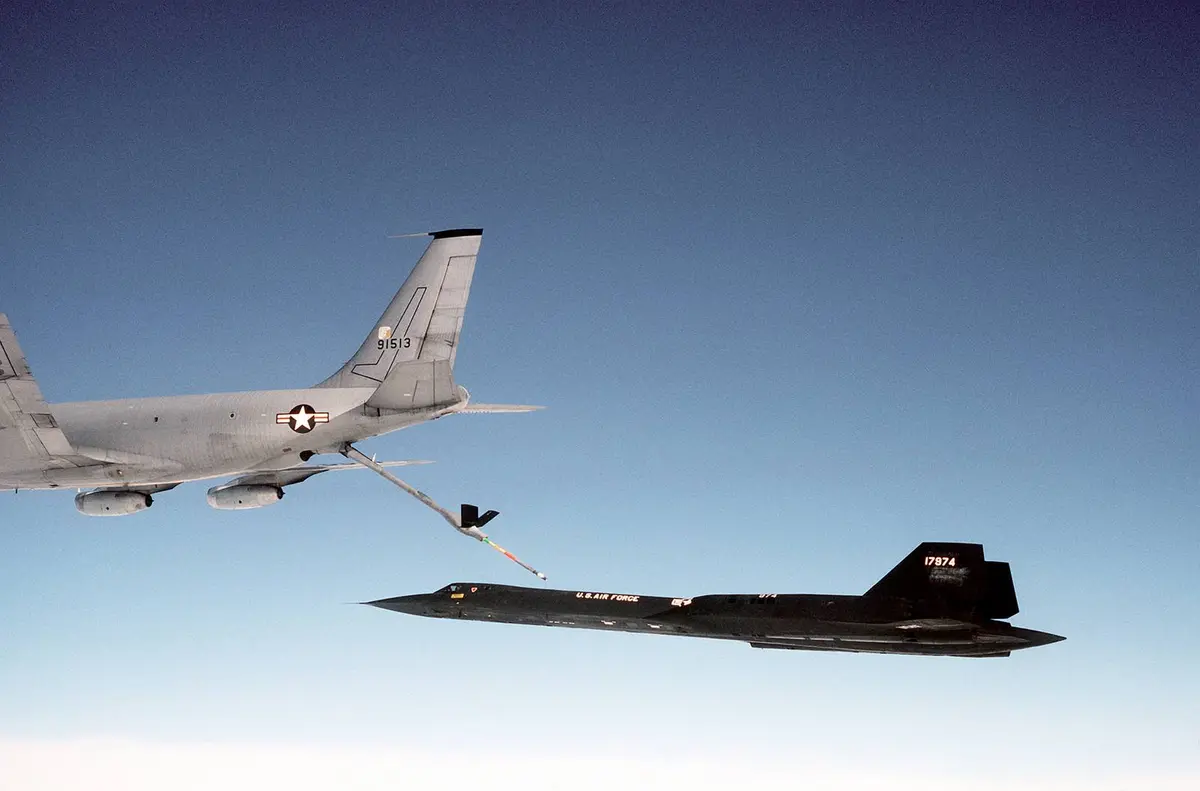
An SR-71 of the 9th Strategic Reconnaissance Wing slides in behind a KC-135Q tanker to take on fuel.. Ken Hackman / U.S. Air Force. The SR-71 flies
Five months after President Johnson announced it, the Air Force’s Blackbird is ready. It is longer and heavier than the A-12, with a second seat for a reconnaissance systems officer. At Air Force Plant 42 in Palmdale, California, Lockheed test pilot Bob Gilliland lifts the first SR-71 off the runway. By late 1967 the Skunk Works has delivered 31 of them to the Air Force.
Thrown clear above Mach 3
The same month the Air Force receives its first SR-71, Lockheed test pilot Bill Weaver flies a test sortie above Mach 3 at about 78,000 feet, with Jim Zwayer in the back seat. In a turn, the right inlet unstarts. The jet pitches up and comes apart around them. Weaver’s pressure suit and parachute carry him down to a New Mexico ranch, and the rancher flies him out by helicopter. Zwayer is killed.
Fastest and highest
Blackbirds have flown spy missions for eight years, from Okinawa and California. Enemy gunners fire missiles at them, and not one is ever lost to enemy action. Today two crews go for world records. Capt. Eldon Joersz and Maj. George Morgan fly 2,193.167 mph over a straight course. Capt. Robert Helt and Maj. Larry Elliott hold level flight at 85,068.997 feet. The speed record still stands.
One last run
The Air Force has retired the Blackbird, and SR-71 No. 972 is going to the Smithsonian. Lt. Col. Ed Yeilding and Lt. Col. J.T. Vida take it the fast way. They cross the coastline over California and reach the Atlantic 67 minutes 54 seconds later. Los Angeles to Washington takes 64 minutes 20 seconds. St. Louis to Cincinnati takes 8 minutes 32 seconds. They land at Dulles with four new records.

The builders and the crews

Born in Ishpeming, Michigan, in 1910. Joined Lockheed in 1933 and helped create about 40 aircraft, including the P-38, the P-80, the F-104 and the U-2. Led the Blackbird from first sketch to first flight. Two Collier Trophies and the Presidential Medal of Freedom.

West Point class of 1953 and a jet fighter pilot. On 21 March 1968 he and his RSO, Ed Payne, flew the first operational SR-71 mission, over North Vietnam from Kadena, Okinawa. Flew 116 combat missions in Phantoms and rose to four-star general, commanding Tactical Air Command.

Grew up in Hazen, North Dakota, and was commissioned through ROTC at North Dakota State in 1966. Flew more than 450 combat hours in the F-105 over Vietnam and Laos, then SR-71s at Beale. Flew 2,193 mph on 28 July 1976. Retired a major general.

Auburn electrical engineering graduate from Florence, Alabama. Flew RF-4 and F-4E Phantoms, then joined the SR-71 program in 1982 and flew 93 overseas reconnaissance missions. On 6 March 1990 he and J.T. Vida flew Los Angeles to Washington in 64 minutes 20 seconds.
By the numbers
In pictures


Watch, listen, see
Films, photographs and first-hand accounts from across the web. Each opens in a new tab.

SR-71 pilot Buz Carpenter walks around the Smithsonian’s Blackbird and explains how it flew.
Smithsonian National Air and Space Museum
Col. Buz Carpenter on how he earned a seat in the SR-71 and what flying it was like.
Smithsonian National Air and Space Museum
The first African-American to qualify as an SR-71 crewmember tells how he got there.
Smithsonian National Air and Space Museum
A visit to the A-12 at CIA headquarters, the single-seat spy plane that came first.
Smithsonian National Air and Space Museum
A close look at the Pratt & Whitney J58, the engine that pushed the Blackbird past Mach 3.
Air Zoo
NASA film of a Blackbird roaring off the runway at Edwards Air Force Base, California.
NASA Armstrong Flight Research CenterThe CIA’s declassified OXCART history: titanium, the J58, the test flights and the missions.
Central Intelligence Agency
Photos and history of SR-71 No. 972, flown coast to coast on its last flight in 1990.
Smithsonian National Air and Space Museum“The SR-71 aircraft reconnaissance system is the most advanced in the world. The aircraft will fly at more than three times the speed of sound.”
President Lyndon B. Johnson, announcing the SR-71, 24 July 1964
After
The Air Force retired the SR-71 at Beale on 26 January 1990. No. 972, the airplane Yeilding and Vida flew east, spent 24 years in service and 2,801 hours in the air. It stands today in the Smithsonian’s Steven F. Udvar-Hazy Center, beside the airport where it landed.
Congress brought a few Blackbirds back for the Air Force in the mid-1990s, and NASA flew them as Mach 3 research laboratories at Edwards. The last SR-71 flight took place on 9 October 1999.
Kelly Johnson died on 21 December 1990. Ben Rich, who tamed the inlets, ran the Skunk Works from 1975 to 1991 and built the F-117 stealth fighter. The speed record Joersz and Morgan set in 1976 still stands.
Primary sources
- David Robarge, Archangel: CIA’s Supersonic A-12 Reconnaissance Aircraft, 2nd ed. CIA Center for the Study of Intelligence, 2012.
- Peter W. Merlin, “Design and Development of the Blackbird: Challenges and Lessons Learned.” AIAA 2009-1522, NASA Dryden Flight Research Center.
- SR-71 Blackbird. NASA Facts FS-2008-6-030-DFRC, NASA Dryden Flight Research Center.