Mexico, India and Pakistan · 8 March 1968 · Norman Borlaug and the wheat breeders
Bread for a Hungry World
An Iowa farm boy bred a short, stubborn wheat in Mexico, then ran it through a riot and a war to feed India and Pakistan.

The moment · Summer 1965 · Sonora to Los Angeles
Thirty-five truckloads of seed wait in Sonora. The bank has frozen the payment for it over three misspelled words. Borlaug ships anyway. The convoy rolls north into Los Angeles as the Watts riots tie the city in knots. It reaches the dock just before the ship sails.
I decided to take the risk and go ahead.Norman Borlaug, on shipping the seed before the money cleared
In the mid-1960s India and Pakistan were living on shiploads of American wheat, and some experts had written India off to famine. An Iowa farm boy had spent twenty years in Mexico breeding a short, rust-proof wheat that out-yielded the old kinds two and three times over. In 1965 he set out to plant it across South Asia, in the middle of a war.
The rust lecture
Norman Borlaug grew up on a farm near Cresco, Iowa, learned his letters in a one-room school, and wrestled his way into the University of Minnesota. He meant to be a forest ranger. When the Forest Service put his job off for six months, he stayed on campus and heard Elvin Stakman lecture on rust, the fungus that eats wheat. Borlaug switched to plant pathology and earned his Ph.D. in 1942.
South to Mexico
The Rockefeller Foundation and the Mexican government have launched a farm program, directed by Stakman and George Harrar. Borlaug turns down a well-paid job at DuPont to run its wheat work. Mexico imports more than half the wheat it eats. Its farms average 750 kilos of grain a hectare, and rust wrecks the harvest year after year. Borlaug learns Spanish and works the fields with his own hands.
Two crops a year
Breeding a new wheat takes about ten years. Borlaug cuts that in half. He grows one generation in the summer in the highlands near Mexico City and the next in the winter in the Yaqui Valley near sea level. Wheat that thrives in both places ignores the length of the day, so it will grow almost anywhere. Five farmers come to his first field day. Within eight years, thousands come.
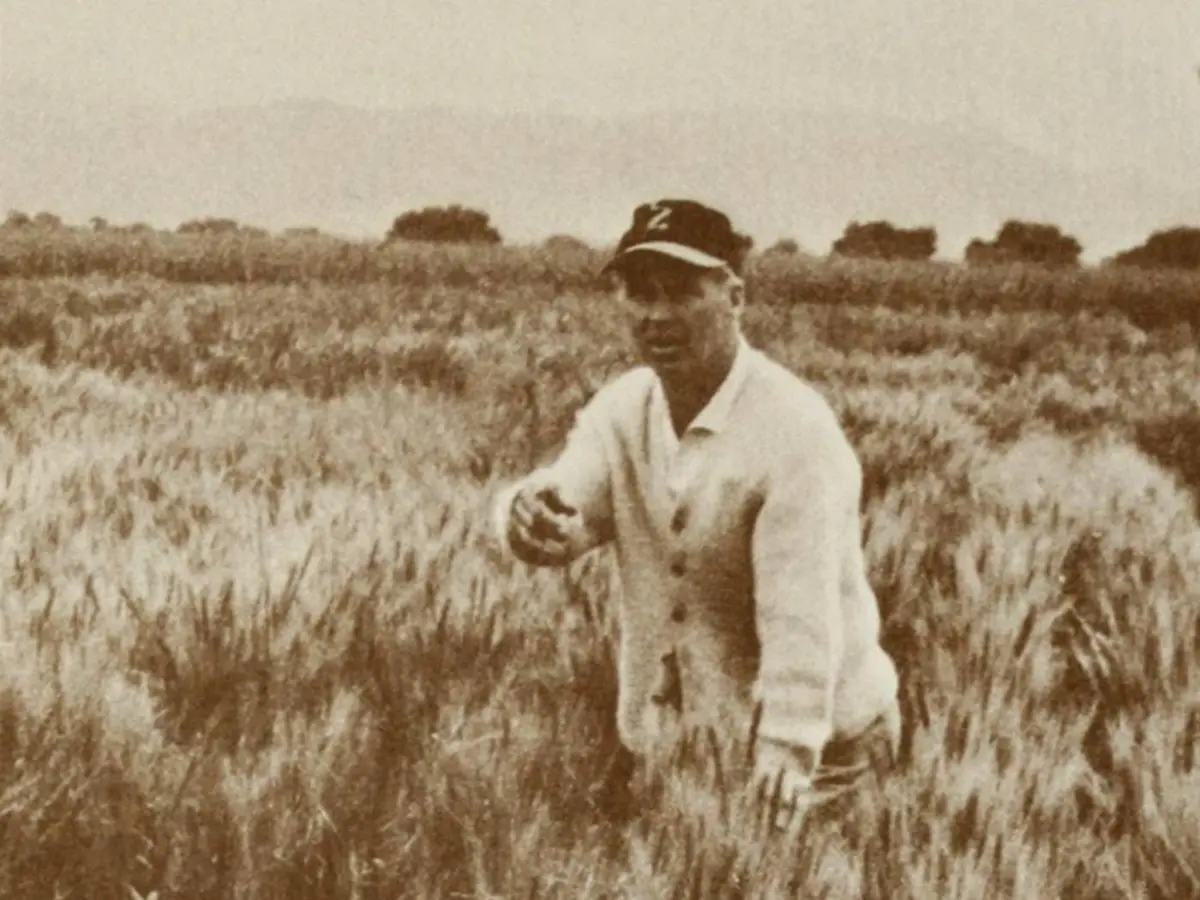
Norman Borlaug walks his test plots of Mexican wheat, as pictured in the 1970 USDA booklet Norman Borlaug: Hunger Fighter.. Don Paarlberg, Norman Borlaug: Hunger Fighter / U.S. Department of Agriculture and USAID (PA 969, 1970). The dwarf gene
Heavy with grain, Borlaug’s tall wheat falls over in the wind. He needs a short plant. USDA breeder Orville Vogel at Washington State has one: Norin 10, a dwarf wheat from Japan, crossed into American lines. Vogel sends Borlaug his early crosses in 1953. Borlaug spends years crossing them into his rust-proof Mexican wheats. The new dwarfs can yield 9,000 kilos a hectare, double the old ceiling.
Mexico feeds itself
In 1956 Mexico grows all the wheat it needs for the first time. Then come the dwarfs. Pitic 62 and Penjamo 62 reach farmers, and within seven years the national average yield doubles. By 1963 more than 95 percent of Mexico’s wheat grows from Borlaug’s seed. Over his years there, the national harvest grows sevenfold, and Mexico starts selling wheat abroad.
The mislabeled plot
Indian geneticist M. S. Swaminathan sees what the Mexican dwarfs can do and invites Borlaug to India. In Pakistan, two of Borlaug’s former trainees have quietly mislabeled one of his wheats and fed it 120 pounds of nitrogen instead of the allowed 40. The result is phenomenal. After a year of trials, India orders 250 tons of seed and Pakistan 350, enough to plant on real farms.
The convoy
The seed fills 35 trucks. Then the bank balks: the letter of credit, about $170,000, has three misspelled words, and payment is held up. Borlaug ships anyway. The convoy rolls north into Los Angeles during the Watts riots, gets caught in the traffic snarl, and reaches the harbor just before the freighter leaves for Bombay and Karachi.
Borlaug, on the frozen paymentI decided to take the risk and go ahead. It was the best decision I ever made in my life.
War breaks out
With the seed at sea, India and Pakistan go to war. To keep either side from seizing the other’s share, the cargo is unloaded at Singapore and sent on in separate ships. Bad fumigation has killed much of the seed, and it comes up thin on 7,000 acres in India and 10,000 in Pakistan. Each plant sends up stem after stem. By harvest the fields look almost full.
A name for it
India has bought 18,000 tons of Mexican seed and Pakistan 42,000. Record harvests are coming in. William Gaud, head of the U.S. Agency for International Development, tells a Washington audience that Pakistan will harvest the new wheat from 3.5 million acres this spring. That year West Pakistan grows all its own wheat for the first time, two years ahead of Borlaug’s forecast.
USAID Administrator William GaudIt is not a violent Red Revolution like that of the Soviets, nor is it a White Revolution like that of the Shah of Iran. I call it the Green Revolution.
The breeders

Iowa farm boy and Minnesota wrestler with a Ph.D. in plant pathology. He spent twenty years in Mexico breeding rust-proof dwarf wheat, then carried it to India and Pakistan himself. Nobel Peace Prize, 1970.

Nebraska-born USDA agronomist who spent his whole career at Washington State. He crossed Japan’s Norin 10 dwarf into American wheat, bred the semi-dwarf Gaines, and in 1953 sent Borlaug the lines that made the Mexican dwarfs.

Head of plant pathology at Minnesota and a pioneer in the war on wheat rust. His lecture pulled Borlaug out of forestry, he trained him for his doctorate, and he co-directed the Mexican program that brought Borlaug south.
By the numbers
In pictures


Watch, listen, see
Films, photographs and first-hand accounts from across the web. Each opens in a new tab.

The university’s October 2009 memorial tribute to the alumnus whose wheat fed India and Pakistan.
University of Minnesota
The Nobel Prize’s short film on Borlaug, science and the farmers he trained in the field.
Nobel PrizeBorlaug’s Nobel Lecture of 11 December 1970, with the harvest numbers from Mexico, India and Pakistan.
NobelPrize.org
The government’s 1970 profile: the dwarf gene, the 35-truck convoy and the war-time planting.
USDA and USAID, 1970
Borlaug recalls the seed shipments, the war and the morning his wife brought the Nobel news.
Academy of AchievementPresident Bush’s remarks in the Capitol Rotunda, 17 July 2007, honoring “the man who fed the world.”
George W. Bush White HouseIowa’s bronze of Borlaug at work in a Sonora wheat field, unveiled in the Capitol in 2014.
Architect of the CapitolHow the Norin 10 dwarf gene traveled from Japan through Pullman and Mexico to South Asia.
CIMMYT“If you desire peace, cultivate justice, but at the same time cultivate the fields to produce more bread; otherwise there will be no peace.”
Norman Borlaug, Nobel Lecture, Oslo, 11 December 1970
After
In October 1970 Margaret Borlaug rode out to the test fields in the Toluca Valley to tell her husband he had won the Nobel Peace Prize. He did not believe her until the newspapermen arrived. In Oslo the committee honored him for having helped, more than any other single person of his age, to provide bread for a hungry world.
The harvests kept climbing. India’s wheat crop rose from 12.3 million tons in 1965 to 20 million in 1970, and by 1974 India grew all the cereal it needed. President Ford awarded Borlaug the Presidential Medal of Freedom in 1977. In 2006 Congress found that his work had saved more than a billion people, and in 2007 it gave him its Gold Medal.
Borlaug founded the World Food Prize in 1986 and kept working into his nineties. He died in Dallas in 2009 at 95. Iowa sent his statue to the U.S. Capitol in 2014. Its pedestal reads: The man who saved a billion lives.
Primary sources
- Norman E. Borlaug, “The Green Revolution, Peace, and Humanity,” Nobel Lecture, 11 December 1970.
- Don Paarlberg, Norman Borlaug: Hunger Fighter. U.S. Department of Agriculture with the U.S. Agency for International Development, PA 969, 1970.
- Congressional Tribute to Dr. Norman E. Borlaug Act of 2006, Public Law 109-395.