Steele’s Tavern, Virginia · July 1831 · Cyrus and Robert McCormick
The Virginia Reaper
A 22-year-old Virginian put a horse to work at harvest. His machine cut as much grain in a day as five of the best men with cradles, and the wheat fields of the West opened up behind it.

The moment · Late July 1831 · John Steele’s farm, Virginia
Cyrus McCormick, 22, sends his machine into a field of late oats. The reel sweeps the stalks back. The toothed blade chatters side to side and shears them off. A man on foot rakes the cut grain off the platform. By the end, about six acres are down.
Before 1831, grain was cut by hand. The best man with a cradle could cut two or three acres of wheat a day, and the crop had to come in within about ten days of ripening. That limit capped how much any family could grow. A young Virginian named Cyrus McCormick built a horse-drawn machine that broke it, then spent twenty years carrying it west and across the ocean.
The father’s machine
Robert McCormick’s family farms total 1,800 acres in the Valley of Virginia. He runs sawmills and flour mills and builds his own hemp brake, clover sheller and threshing machine. As early as 1809 he starts on a horse-drawn reaper. He tries rotary saws, then curved sickles against a reel. None of it cuts grain well enough. After a last failed test in the early harvest of 1831, he gives it up.
A new principle
His eldest son Cyrus, 22, takes up the problem with a different idea. A straight blade, driven side to side by a crank off the main wheel, will shear the stalks against fixed fingers. The horse walks beside the grain, not through it. Jo Anderson, enslaved on the farm, carries loose grain to the shop so Cyrus can watch his models cut. Blacksmith John McCown forges a serrated blade, and Cyrus adds a reel and a divider.
Six acres of oats
The finished machine goes to the neighboring farm of John Steele, near Steele’s Tavern. One horse pulls it. A wooden wheel two feet across drives the knife. The reel lays the cut oats on a platform, and a man walking alongside rakes them off for the binders. By the end of the trial about six acres are down. No more than three or four people outside the family see this first public trial.
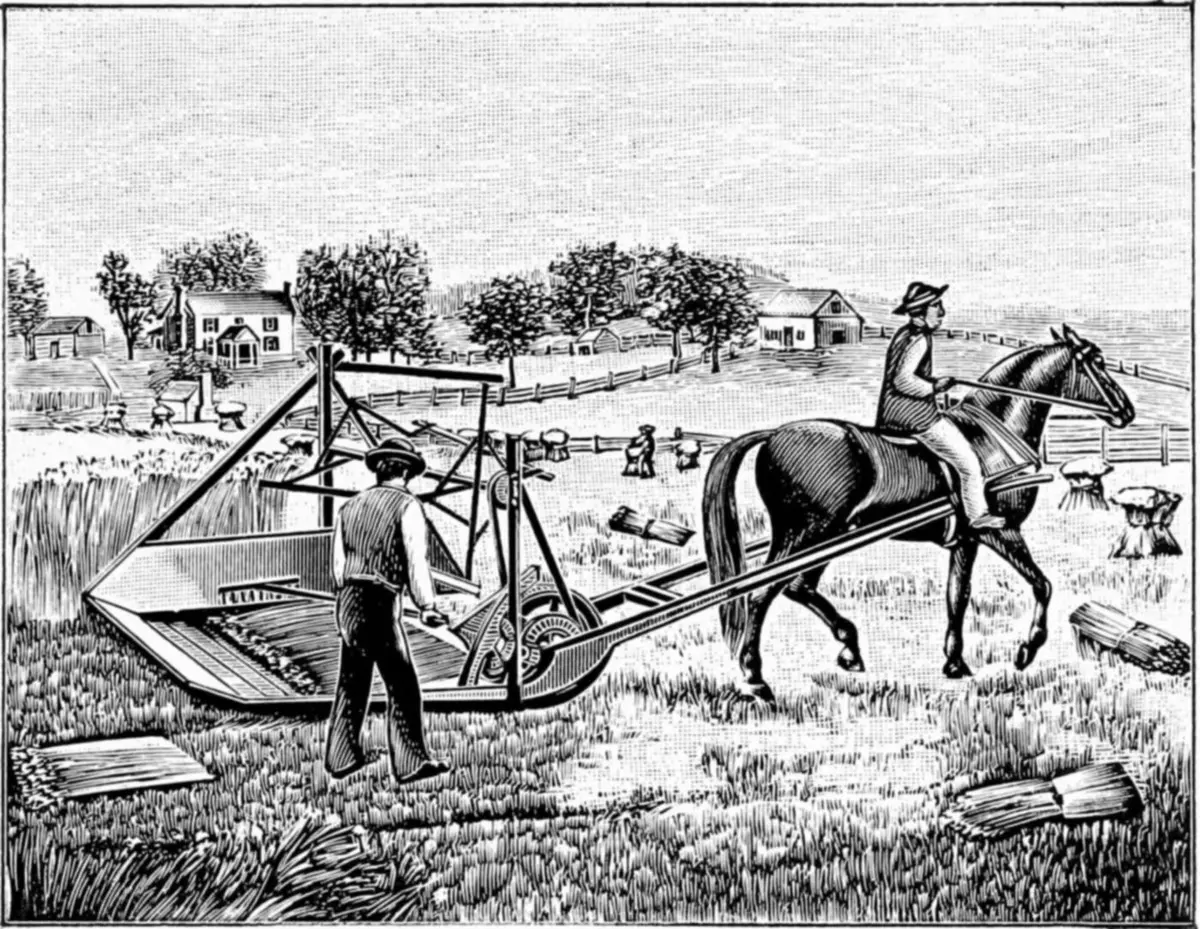
The original McCormick reaper as built in 1831: one horse, a reel, a vibrating blade and a platform raked off by a man on foot.. Reuben Gold Thwaites, Cyrus Hall McCormick and the Reaper (State Historical Society of Wisconsin, 1909), via Internet Archive. Twelve acres a day
Cyrus keeps improving the machine. In 1833 two horses pull it for the first time. That September the Lexington Union prints testimonials from neighbors. James McDowell, later governor of Virginia, figures it will cut about twelve acres a day. Jo Anderson walks beside it raking off the cut wheat. When a reaper by Obed Hussey of Ohio appears in print, Cyrus answers in the same magazine. His patent, signed by President Andrew Jackson, follows on 21 June 1834.
McCormick to the Mechanics’ Magazine, May 1834…invented by me, and operated on wheat and oats in July, 1831.
Fifteen acres or your money back
Cyrus will not sell a reaper until he is sure of it. He sells one in 1840, none in 1841, seven in 1842, 29 in 1843 and 50 in 1844. His 1842 notice, signed from Steele’s Tavern, sets the price at $100 and warrants fifteen acres a day. If a machine falls short, the buyer can send it back. In the fall of 1844 he tours the West and finds his real market on the open prairie.
A factory on the river
The wheat is in the West, so the factory goes there too. Cyrus and partner Charles M. Gray buy lots near the Chicago pier from William B. Ogden, the city’s first mayor, and build a works with a steam engine. They make 500 reapers for the 1848 harvest. The firm makes 1,500 for 1849. That September Cyrus buys out his partners for $65,000. By 1850 about 120 men work in the brick factory on the river.
The Council Medal
At the Great Exhibition in London’s Crystal Palace, the Times mocks the American machine as “a cross between a flying machine, a wheelbarrow and an Astley chariot.” Then it goes to the field. On 24 July at Tiptree Heath, in pouring rain, it cuts green wheat at a pace the jury puts at twenty acres a day. The crowd cheers. On 6 August, on Philip Pusey’s farm, it wins again. The jury awards it the Council Medal.
Bread for the Union
In 1856 McCormick sells 4,095 machines, and rival makers build thousands more. When war comes, young men leave the farms by the thousands to fight for the Union. The reapers stay in the fields and bring the harvest in with fewer hands. In 1861 and 1862 the United States ships 68.5 million bushels of wheat and 9.2 million barrels of flour abroad, worth $133.6 million.
The inventors

Eldest son of Robert McCormick, born at Walnut Grove. At 22 he built the reaper his father could not, then spent nine years perfecting it before he offered it for sale. He moved the business to Chicago and won the Council Medal in London.

Virginia farmer who ran sawmills and flour mills and invented a hemp brake and a threshing machine. He worked on a reaper for twenty-two years. When it failed, he backed his son and helped build the 1831 machine in the farm shop.
By the numbers
In pictures


Watch, listen, see
Films, photographs and first-hand accounts from across the web. Each opens in a new tab.

The original Patent Office drawing for McCormick’s Improved Reaping Machine, patented 21 June 1834.
National Archives
Jo Anderson’s 1885 account of the first models in the shop and raking off cut wheat in the field.
Encyclopedia Virginia
McCormick’s Staunton newspaper notice: $100, fifteen acres a day warranted, with letters from satisfied farmers.
Encyclopedia Virginia
Film of the 1966 ceremony at Walnut Grove honoring the farm where the reaper was perfected.
Virginia Tech
The 1851 illustrated guide to the Great Exhibition, with its engraving of McCormick’s American reaping machine.
Internet Archive
The agricultural engineers’ 1972 landmark plaque for the reaper at Walnut Grove, and what it says.
ASABEWilliam T. Hutchinson’s 1930 biography, built from the McCormick papers, sworn testimony and newspapers.
Internet Archive
The first report of the new Department of Agriculture, crediting reapers with saving the wartime harvest.
Internet Archive“During the past year the crops could not have been secured, owing to the absence of so much farm labor, had it not been for the great increase of reapers.”
Report of the Commissioner of Agriculture for the Year 1862
After
Fire destroyed the Chicago works in October 1871. McCormick rebuilt on a far larger scale, and the new factory opened in 1873. France gave him the Legion of Honor, and in 1878 the French Academy of Sciences elected him a corresponding member as having done more for agriculture than any other living man.
Cyrus McCormick died at his home in Chicago on 13 May 1884. In 1902 his company, by then the largest of its kind in the world, joined four rivals to form International Harvester.
The blacksmith shop and gristmill at Walnut Grove still stand. The family gave the farm to Virginia Tech in 1954, and it is a National Historic Landmark. A 1972 plaque there marks where Cyrus McCormick “invented and in 1831 demonstrated the first successful reaper to introduce the era of farm mechanization.”
Primary sources
- William T. Hutchinson, Cyrus Hall McCormick: Seed-Time, 1809–1856. New York: Century, 1930.
- Reuben Gold Thwaites, Cyrus Hall McCormick and the Reaper. State Historical Society of Wisconsin, 1909.
- Report of the Commissioner of Agriculture for the Year 1862. Washington: Government Printing Office, 1863.
Keep exploring
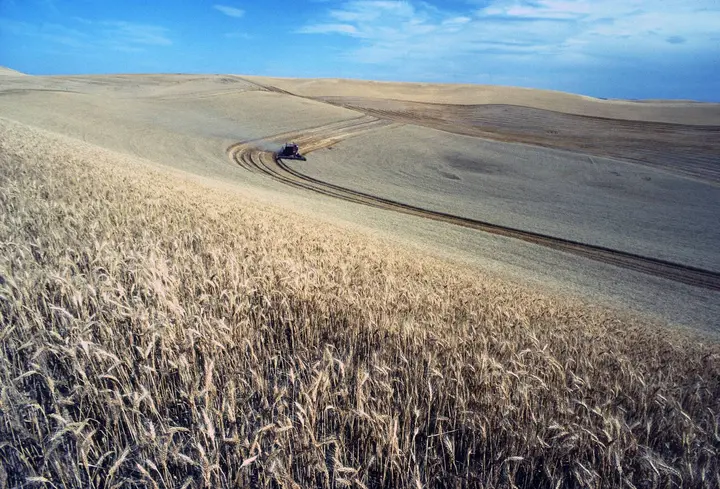
- The Green RevolutionNorman Borlaug, an Iowa farm boy, bred the wheat that nearly doubled harvests in India and Pakistan.1Blives
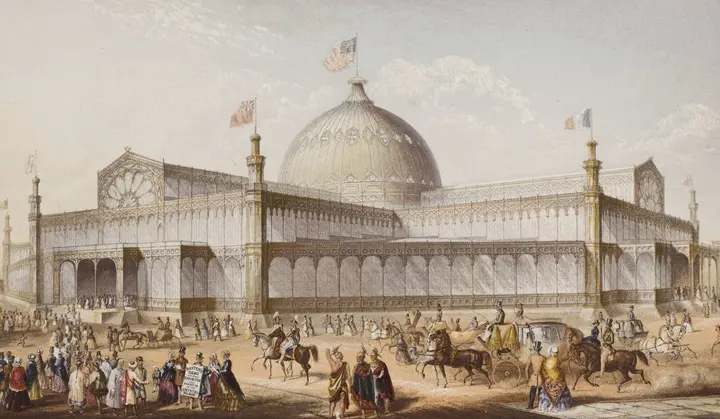
- The Safety ElevatorElisha Otis cut the rope over a crowd in New York and his platform held. Skyscrapers followed.792 ftWoolworth, built on it by 1913
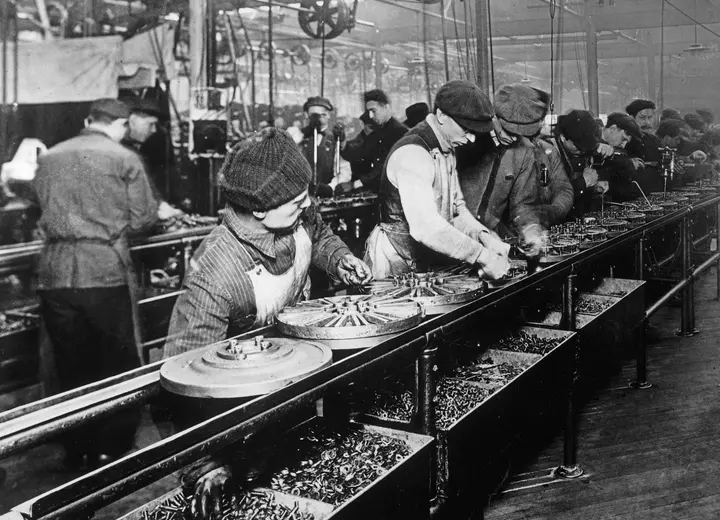
- The Moving Assembly LineHenry Ford put the Model T on a moving line and cut the work to build a chassis from twelve and a half hours to an hour and a half.93minutes per chassis
- What Hath God WroughtSamuel Morse tapped four words from Washington to Baltimore, and from that morning on the news no longer had to wait for a horse or a train.40miles, instantly


Free, with no ads. Support the museum →