Washington and the Great Plains · 20 May 1862 · Lincoln, Grow and the homesteaders
Free Homes for Free Men
Any American willing to live on 160 acres and farm it for five years could own it, free. Galusha Grow fought ten years for the law. Lincoln signed it. The settlers did the rest.

The moment · 12:10 a.m. · 1 January 1863
New Year’s Eve in Brownville, Nebraska Territory. Daniel Freeman is due in St. Louis, and the Homestead Act takes effect at midnight. At the party he finds the land office men and talks a clerk into opening up. Ten minutes past twelve, he files Application No. 1.
Before one o’clock Homestead Entry No. 1 was signed and I went away to St. Louis a happy lad.Daniel Freeman, recalling the night
In 1862 the United States held about a billion acres of public land, and the government sold it at $1.25 an acre, cash. For ten years a Pennsylvania congressman named Galusha Grow had argued it should go free to anyone who would live on it and work it. With the Southern members gone from Congress, his bill finally passed.
A freshman’s first speech
Galusha Grow is 28, a first-term Pennsylvania Democrat, when he rises in the House to defend a homestead bill. Public land, he argues, belongs in the hands of the people who will live on it and work it, not speculators. On 12 May the House passes a homestead bill 107 to 56. The Senate lets it die. Grow keeps bringing it back.
Vetoed
Grow has left the Democrats for the new Republican Party, which stands for keeping slavery out of the territories. That February he tells the House the open West should be kept for free homes for free men. Congress finally sends a homestead bill to President Buchanan. He vetoes it. That summer the Republican platform demands a homestead law, and Abraham Lincoln runs on it.
With the South gone
Eleven states have left the Union, and their members have left Congress with them. Grow is now Speaker of the House. On 21 February he makes his final plea: the bill has been debated so long it ought to be ready. One week later the House passes it 107 to 16. The Senate approves it on 6 May with a few amendments, and the House accepts them.
Lincoln signs
President Lincoln signs An Act to Secure Homesteads to Actual Settlers on the Public Domain. Any citizen, or immigrant who has declared to become one, who is 21 or the head of a family and has never taken up arms against the United States may claim 160 acres of surveyed public land. Single women and widows qualify. Live on it five years, build, farm it, and it is yours. The fees come to $18.
Application No. 1
Daniel Freeman, a Union Army scout, is due to report in St. Louis. At a New Year’s Eve party in Brownville he meets the land office men and talks a clerk into opening early. Ten minutes after midnight he files for 160 acres on Cub Creek, near Beatrice. The register signs off on Homestead Application No. 1. That day 417 other settlers file claims across the country.
Daniel Freeman, recalling the nightBefore one o’clock Homestead Entry No. 1 was signed and I went away to St. Louis a happy lad.
Houses built of prairie
Out on the plains there are no trees. So homesteaders build with the ground itself. They plow about an acre of sod into strips a foot wide and four inches thick, cut them into three-foot blocks and stack them grass side down into walls two feet thick. In 1886 a Custer County settler named Solomon Butcher starts photographing them. He will make nearly 3,500 glass plates.
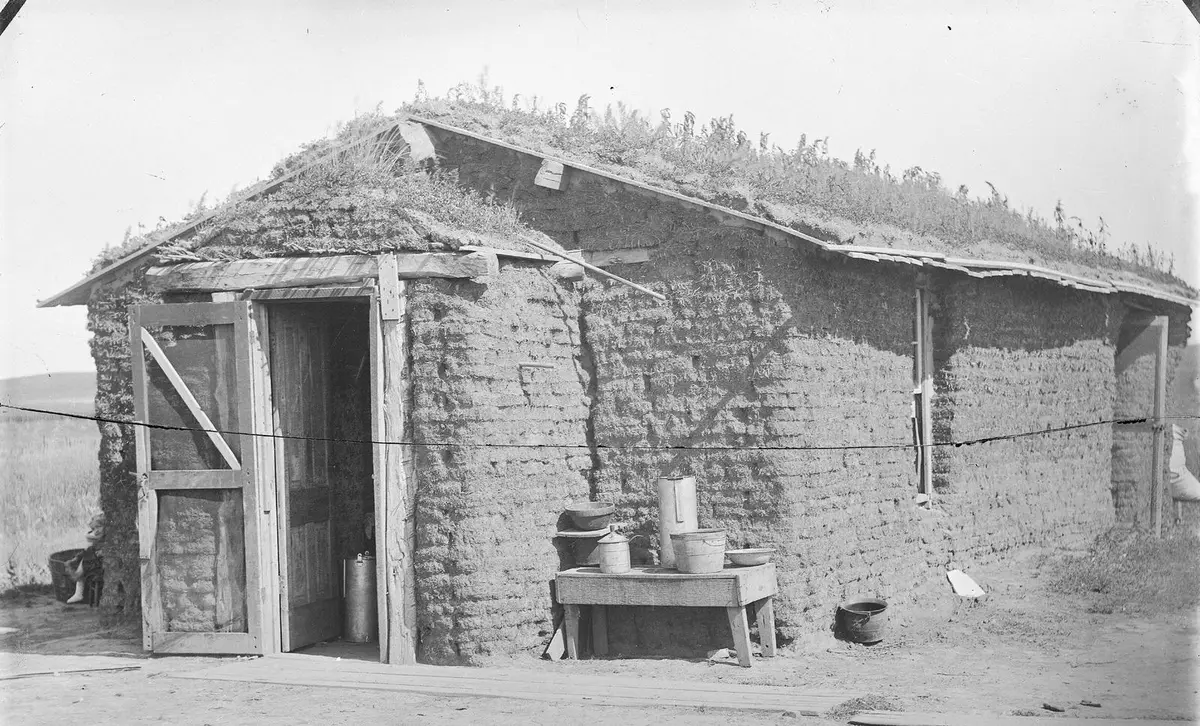
The old Mitchell ranch sod house in Custer County, Nebraska, photographed by Solomon Butcher on 4 August 1888.. Solomon D. Butcher / History Nebraska, via Library of Congress. Proving up
Freeman has brought his bride, Agnes Suiter, to the claim after proposing to her by mail. Five years after filing, he proves up. Like every homesteader, he brings two witnesses who swear he has lived on the land, built a home and raised crops. He pays the final $6 and receives Final Certificate No. 1. His patent, issued in the president’s name, follows in 1869.
The biggest years
Fifty years on, the rush is still building. In 1909 Congress doubles the claim to 320 acres on dry land across much of the West, and dry farming makes it pay. Montana entries jump from 7,500 in 1909 to nearly 22,000 the next year. In 1913 homesteaders claim 11 million acres, the most of any year. In states like Wyoming, Montana and the Dakotas, one homesteader in ten or more is a woman.
The last homestead
Ken Deardorff, a Vietnam veteran from Southern California, files in 1974 on 80 acres of Alaska wilderness 200 miles west of Anchorage, with no road in. He flies a 1945 tractor in, in three loads, and hauls it to his claim by dog sled. He clears stumps, grows vegetables in a two-month season and builds his own log cabin. He proves up in 1979. In May 1988 the last patent ever issued under the Homestead Act arrives in his mail.
The lawmakers and the homesteaders

Born in a Kentucky log cabin and raised on a frontier farm in Indiana. His father left Kentucky, Lincoln wrote, chiefly on account of the difficulty in land titles. He ran on a homestead platform in 1860 and signed the Act in May 1862.

Connecticut-born and raised in Pennsylvania, elected to Congress in 1850. His first speech, in 1852, was for free homesteads, and he pressed the cause for ten years. As Speaker he saw his own bill pass the House 107 to 16. Called the Father of the Homestead Law.

Ohio-born physician who came to Nebraska from Illinois. A Union Army scout, he filed minutes after midnight on the law’s first day. He and his wife Agnes raised eight children on the Cub Creek claim, which Congress made a national monument in 1936.

Southern California native and Vietnam veteran, wounded in action, with a degree in geography. In 1974 he claimed 80 acres on Alaska’s Stony River, built his own log cabin by hand, and in 1988 received the last patent ever issued under the Act.
By the numbers
In pictures


Watch, listen, see
Films, photographs and first-hand accounts from across the web. Each opens in a new tab.

Ken Deardorff walks his Alaska claim and tells how he built his cabin and proved up.
National Park Service
A look at the park on Daniel Freeman’s claim: the museum, a homestead cabin and restored tallgrass prairie.
National Park Service
How Black families used the Homestead Act of 1862 to build futures for generations to come.
National Park Service
The Custer County photographer whose 3,500 glass plates recorded homestead life on the Nebraska plains.
Library of Congress
The act Lincoln signed on 20 May 1862, offering 160 acres to settlers who would farm them.
National Archives
Daniel Freeman’s handwritten claim of 1 January 1863, with a full transcript.
National Archives DocsTeach
The National Archives’ history of the Homestead Act, from the first claims to the last.
Prologue, National Archives
Four million claims, 270 million acres, 30 states: the Homestead Act in hard numbers.
National Park Service“An allusion has been made to the Homestead Law. I think it worthy of consideration, and that the wild lands of the country should be distributed so that every man should have the means and opportunity of benefitting his condition.”
President-elect Abraham Lincoln, Cincinnati, 12 February 1861
After
In 1936 Congress made Daniel Freeman’s claim on Cub Creek the Homestead National Monument of America. In 2021 it became Homestead National Historical Park, with a Heritage Center, a homestead cabin of the 1860s and restored tallgrass prairie.
Union veterans, freed slaves, single women and immigrants from Norway, Sweden, Germany and Ireland all took up claims. Marking the law’s centennial in 1962, President Kennedy called it “probably the single greatest stimulus to national development ever enacted.”
Congress closed homesteading in 1976 and gave Alaska ten more years. In 2017 the park hauled Ken Deardorff’s tractor out of the Alaska bush and put it on display in Nebraska. Looking back on his years on the Stony River, Deardorff said it was not worth it in a monetary sense. “But in the sense of personal satisfaction and achievement, it was.”