Gettysburg, Pennsylvania · 19 November 1863 · President Abraham Lincoln
A New Birth of Freedom
Edward Everett spoke for two hours. Then Abraham Lincoln stood up and, in about two minutes, told a nation at war what it was fighting for.

The moment · Afternoon · 19 November 1863
Everett has spoken for two hours. The hymn ends. Lincoln rises on the crowded platform before some 15,000 people. He takes a pair of steel-framed spectacles from an old case, settles them on his nose, and draws a few sheets of paper from his coat. Then he begins.
Four score and seven years ago our fathers brought forth on this continent, a new nation, conceived in Liberty, and dedicated to the proposition that all men are created equal.President Abraham Lincoln
In July 1863 two armies fought for three days at Gettysburg and left roughly 10,000 men killed or mortally wounded. That fall the Northern states built a cemetery for the Union dead on the battlefield. The president was invited to add a few remarks after the main oration. He used them to say what the war, and the country, were for.
Three days in July
Robert E. Lee’s army invades Pennsylvania and collides with the Army of the Potomac at Gettysburg. For three days the armies fight across the fields and hills around the town, from the stand on Little Round Top to the repulse of Pickett’s Charge. Roughly 10,000 men are killed or mortally wounded. On 4 July Lee retreats toward Virginia. The Union dead lie in hasty graves all over the field.
A cemetery for the Union dead
David Wills, a Gettysburg attorney acting for Pennsylvania Governor Andrew Curtin, rallies the Northern states behind one national cemetery. They buy 17 acres on Cemetery Hill. William Saunders of the Department of Agriculture lays out the graves in semicircles, state by state, around a central monument, officers and privates side by side. Reburials begin on 27 October. At the White House, Lincoln studies the plan and calls it an admirable and befitting arrangement.
A few appropriate remarks
Edward Everett, the most celebrated orator in the country, was invited in September to give the main address. The ceremony, first set for 23 October, has moved to 19 November to give him time to prepare. Now Wills writes to the president. He makes clear the oration belongs to Everett. In a personal note sent the same day, he asks Lincoln to stay at his own house.
David Wills to the President, 2 November 1863It is the desire that, after the Oration, you, as Chief Executive of the Nation, formally set apart these grounds to their Sacred use by a few appropriate remarks.
The night before
Lincoln’s special train leaves Washington at noon and pulls into Gettysburg about nightfall. Wills gives him a large upstairs bedroom in his house on the town square. The streets are packed with visitors, and serenaders call for the president. He says a few words from the doorway and goes back upstairs to his speech. The first page is already written, on Executive Mansion paper. In this room he finishes it.
The procession
Dignitaries gather outside the Wills house at ten. Lincoln rides to the cemetery on a chestnut horse too small for his long frame, among soldiers, bands and officials. About 15,000 people are waiting. Around noon a camera on the field records the crowd packed around the platform. Eighty-nine years later, archivist Josephine Cobb finds Lincoln in the picture, bareheaded among the dignitaries on the platform.
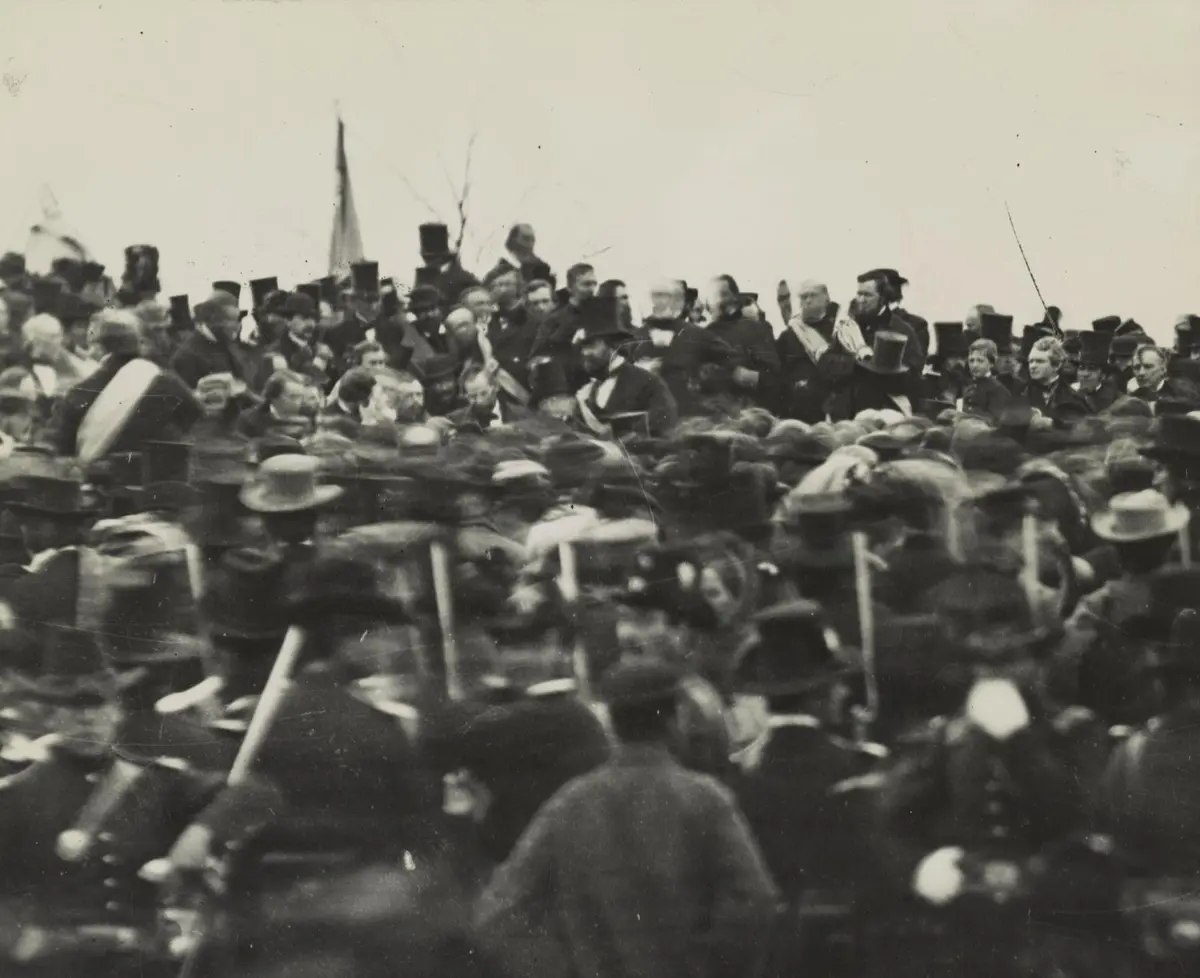
Lincoln, bareheaded near the center, sits among the dignitaries on the platform at Gettysburg about noon on 19 November 1863. Archivist Josephine Cobb found him in this plate in 1952.. Attributed to David Bachrach (also credited to the Mathew Brady studio) / Library of Congress. Two hours of Everett
A band plays, the Rev. Thomas Stockton prays, and the Marine Band plays Old Hundred. Then Everett rises. He has studied the reports of the battle and corresponded with its generals, and he speaks for two hours, from memory, more than 13,000 words. He carries the crowd through all three days of the fighting. A hymn written for the day by Benjamin B. French follows. Next on the printed program: Dedicatory Remarks, by the President of the United States.
Four score and seven years ago
Lincoln stands. The journalist John Russell Young watches him draw steel-framed spectacles from an old case and adjust them with care. He holds a few sheets of paper. His first sentence reaches back 87 years, to 1776 and the Declaration of Independence, and to its proposition that all men are created equal. The war, he says, is testing whether any nation so conceived and so dedicated can long endure.
The unfinished work
The ground is already consecrated, he says, by the brave men who struggled here. It is for the living to take up the unfinished work they so nobly advanced, so that the nation shall have a new birth of freedom. Ten sentences, about two minutes. The newspaper transcripts wired from Gettysburg mark applause five times, then long-continued applause as he sits down.
Lincoln at GettysburgThe world will little note, nor long remember what we say here, but it can never forget what they did here.
In two hours, in two minutes
The next day Everett writes to the president. He admires the eloquent simplicity and appropriateness of Lincoln’s words and puts them above his own. Lincoln answers the same day from the Executive Mansion. In their respective parts, he writes, Everett could not have been excused to make a short address, nor he a long one. He is pleased the little he said was not entirely a failure.
Edward Everett to Lincoln, 20 November 1863I should be glad, if I could flatter myself that I came as near to the central idea of the occasion, in two hours, as you did in two minutes.
The men

Born in a Kentucky log cabin and largely self-taught, he became a prairie lawyer, a congressman and the 16th president. Asked for a few appropriate remarks, he wrote about 270 words that told a nation at war what it was fighting for.

Former governor of Massachusetts, U.S. senator, secretary of state and president of Harvard, and the most famous speaker in America. He spoke for two hours from memory, then wrote Lincoln the next day that the president had said it better in two minutes.

Studied law under Thaddeus Stevens and practiced in Gettysburg. After the battle he led the drive for a national cemetery, organized the dedication, invited the president, and gave Lincoln the upstairs bedroom where he finished the Address.

Scottish-born horticulturist who served the Department of Agriculture for 38 years. He laid out the cemetery in semicircles by state around a central monument, officers and privates side by side. In 1867 he helped found the National Grange.
By the numbers
In pictures


Watch, listen, see
Films, photographs and first-hand accounts from across the web. Each opens in a new tab.

Historians Garry Adelman and Tim Smith retrace Lincoln’s November 1863 visit on the ground where it happened.
American Battlefield Trust
The library’s Lincoln historian on how the Address was written, delivered and preserved.
Abraham Lincoln Presidential Library and Museum
Historian Jared Frederick explains the speech’s main points and what it still means to Americans.
American Battlefield Trust
How an archivist spotted Lincoln in an 1863 glass-plate negative of the dedication crowd.
National Archives
The earliest known draft of the Address in Lincoln’s hand, with a full transcription.
Library of CongressDavid Wills’s letter of 2 November 1863 asking the president for a few appropriate remarks.
Library of CongressLincoln’s handwritten answer to Everett’s praise, written the day after Gettysburg, with transcription.
Massachusetts Historical Society
A 3D tour of the house where Lincoln stayed and put the finishing touches on the Address.
National Park Service“That government of the people, by the people, for the people, shall not perish from the earth.”
President Abraham Lincoln, Gettysburg, 19 November 1863
After
Five copies of the Address survive in Lincoln’s hand. He gave the first two to his secretaries John Nicolay and John Hay, and both are now at the Library of Congress. In 1864 he wrote three more to raise money for Union soldiers: for Everett, now at the Abraham Lincoln Presidential Library; for the historian George Bancroft, now at Cornell; and for Bancroft’s stepson Alexander Bliss. The Bliss copy is the only one Lincoln titled, dated and signed. It is kept in the Lincoln Bedroom at the White House.
The burials were finished in 1864. On 1 July 1869, six years to the day after the battle began, the Soldiers’ National Monument was dedicated at the center of Saunders’s semicircles. The cemetery Lincoln dedicated now holds more than 6,000 veterans of America’s wars.
When the Lincoln Memorial was dedicated in Washington in 1922, the Address was carved in full into its south wall.
Primary sources
- Gettysburg Address: exhibition of the Nicolay and Hay copies, the Wills invitation and Everett’s letter. Library of Congress.
- David Wills to Abraham Lincoln, 2 November 1863. Abraham Lincoln Papers, Library of Congress.
- History of the Soldiers’ National Cemetery. Gettysburg National Military Park, National Park Service.