Hudson River, New York · 15 January 2009 · US Airways Flight 1549
We’re Gonna Be in the Hudson
Geese took both engines at 2,818 feet over New York. Three and a half minutes later, Sully Sullenberger set the airliner down on the river, and the harbor’s boats brought every one of the 155 people home.

The moment · 15:29 EST · 15 January 2009
No power and no runway in reach. Sullenberger lines the gliding Airbus up on the Hudson while Skiles calls out height and speed. Flaps two. The ground warning keeps calling pull up. In the cabin, the flight attendants chant their commands. Then the water.
We’re gonna be in the Hudson.Capt. Chesley Sullenberger, to New York departure control
On a freezing January afternoon, US Airways Flight 1549 left LaGuardia for Charlotte with 150 passengers and five crew. Two minutes later a flock of Canada geese tore through both engines. Capt. Chesley Sullenberger had seconds to choose between runways he could not reach and the river below. He chose the river, and New York came out on the water to meet him.
Cleared for takeoff
LaGuardia tower clears Flight 1549 to take off from runway 4. First Officer Jeff Skiles is flying. It is the last leg of a four-day trip, and the first trip the two pilots have ever flown together. New York departure clears the Airbus A320 to climb to 15,000 feet. As it climbs, Sullenberger looks out the window and says, “What a view of the Hudson today.”
Birds
At 2,818 feet, Sullenberger calls out “Birds.” A second later the cockpit recorder picks up thumps and a shudder. Canada geese have gone into both engines, and both are rolling back. Sullenberger starts the auxiliary power unit, a call that keeps the airplane’s electrics and flight protections alive. Twelve seconds after the strike, he takes the controls with two words: “My aircraft.”
Sullenberger to New York departure control, 15:27:33Hit birds. We’ve lost thrust in both engines. We’re turning back towards LaGuardia.
The checklist
Skiles pulls the quick reference handbook and starts the Engine Dual Failure checklist. It was written for a failure at high altitude, with time to work it. They have none. The checklist calls for 300 knots to windmill an engine back to life. The jet peaks at 3,060 feet and never tops 214 knots. Skiles tries the relights anyway, one engine and then the other. Neither comes back.
No runway
Controller Patrick Harten offers LaGuardia runway 13. Sullenberger answers, “We’re unable. We may end up in the Hudson.” Harten offers runway 31, then runway 4. Sullenberger asks about Teterboro in New Jersey, and Harten gives him runway 1 there. Sullenberger judges it too far. Investigators later flew the return in simulators. With a realistic 35-second delay to size up the emergency, the flight back to LaGuardia did not make it.
Brace for impact
Sullenberger keys the cabin speaker: “This is the Captain. Brace for impact.” Up front, flight attendants Sheila Dail and Donna Dent start chanting, “Brace, brace, heads down, stay down.” Doreen Welsh is strapped into the rear jumpseat. In seat 19F, a passenger offers to brace a nine-month-old boy for his mother, and she hands him over. Seventeen seconds later Sullenberger tells the controller where they are going.
Sullenberger to New York departure control, 15:29:28We’re gonna be in the Hudson.
On the river
Skiles lowers the flaps and calls the numbers: 250 feet, 170 knots. The ground warning blares “pull up” over and over. Sullenberger asks, “Got any ideas?” Skiles answers, “Actually not.” Sullenberger raises the nose and touches the Airbus down at 125 knots, wings level, off the ferry terminal at Weehawken, about 8.5 miles from LaGuardia. The airplane holds together and floats.
Everyone out
Fifteen seconds after touchdown the overwing exits open. Dail and Dent open the front doors, and the slide/rafts fill. In the rear, water pours in. Welsh, her leg gashed, turns passengers forward over the seatbacks. Passengers on the wings stand in 41-degree water up to their waists. Sullenberger and Skiles hand out life vests, then Sullenberger walks the sinking cabin twice to make sure it is empty. Then the pilots step out onto a raft.
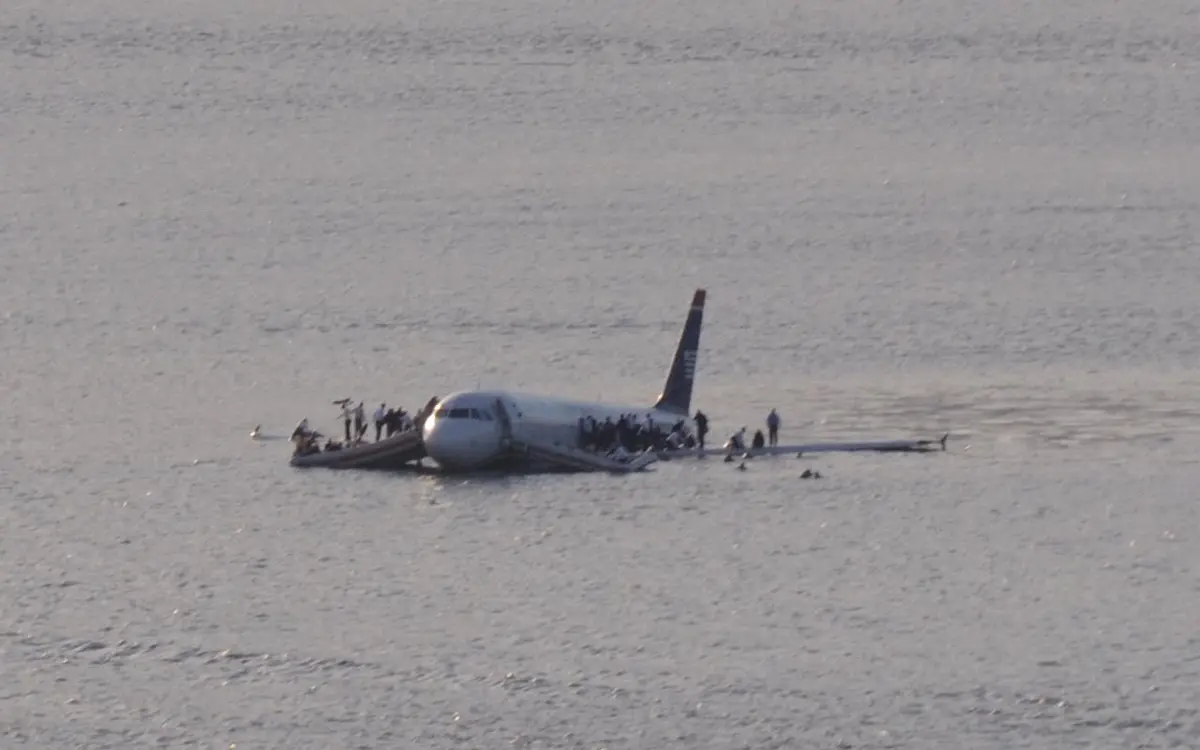
Passengers stand on the wings and crowd into the slide/rafts minutes after the ditching, before the first boat arrives. Greg L (Flickr). The ferries
NY Waterway Capt. Vincent Lombardi swings the Thomas Jefferson around without waiting for orders and is alongside in about three minutes. His deckhands lower a Jason’s Cradle and pull 56 people aboard. Six more ferries follow within ten minutes. An NYPD helicopter drops divers Michael Delaney and Robert Rodriguez into the river to save a woman too cold to climb out. An FDNY fireboat and Coast Guard boats close in. The Coast Guard takes command.
Not one lost
Twenty-four minutes after the ditching, the last boat pulls away with the last passengers off the wing. Ferry crews took 143 people off the airplane and out of the water. The fire department and the Coast Guard took the other 12. Passengers land on both sides of the river, in Manhattan and in New Jersey. Five are seriously hurt. All 155 are alive.
The crew and the rescuers

Air Force Academy class of 1973 and an F-4 Phantom fighter pilot, then nearly 29 years flying airliners, with 19,663 hours in his logbook. Chose the river, kept the airplane under control without power and set it down whole.

Son of two pilots, he started flying at 16 in Wisconsin. He had 15,643 hours, only 37 of them in the A320. Ran the engine restart checklist in the time he had and called out height and speed all the way down.

Montclair, New Jersey, native who worked his way up from deckhand to ferry captain. Turned the Thomas Jefferson toward the airliner on his own call, was first on scene and took 56 people off the wing. Played himself in the 2016 film Sully.
By the numbers
In pictures


Watch, listen, see
Films, photographs and first-hand accounts from across the web. Each opens in a new tab.

The NTSB animation of Flight 1549’s track and altitude, with the controller audio and cockpit words.
AVweb
The FAA’s recording of Sullenberger and controller Patrick Harten, from the mayday to “We’re gonna be in the Hudson.”
FAA, via Wikimedia CommonsSullenberger, his first officer and flight attendants tell the story of the landing for the first time.
CBS News, 60 Minutes
NYPD scuba detectives Michael Delaney and Robert Rodriguez describe jumping from a helicopter to save a passenger.
CBS News
The ferry line’s account of its crews, its boats and the 143 people they pulled from the Hudson.
NY WaterwayThe pilots, flight attendants and controller testify to the House aviation subcommittee, 24 February 2009.
C-SPAN
The full investigation, with flight data, the cockpit voice transcript and the evacuation timeline.
National Transportation Safety Board
The museum honors the five crew members of Flight 1549 with its 2010 Current Achievement Trophy.
Smithsonian National Air and Space Museum“We had a miracle on 34th Street. I believe now we have had a miracle on the Hudson.”
Governor David Paterson of New York, 15 January 2009
After
On 9 February 2009, Mayor Michael Bloomberg gave all five the keys to New York City. Britain’s Guild of Air Pilots and Air Navigators awarded the crew its Master’s Medal, and in 2010 the Smithsonian gave them the National Air and Space Museum Trophy.
The NTSB found that the decision to ditch on the Hudson gave the passengers the best chance to live, and it credited the pilots’ professionalism, the flight attendants’ work in the evacuation and the speed of the boats that answered.
The airplane never reached Charlotte that day. It got there in 2011 on a truck, and it sits today in the Sullenberger Aviation Museum, beside the runways at Charlotte Douglas, still in the condition the river left it.
Primary sources
- Loss of Thrust in Both Engines After Encountering a Flock of Birds and Subsequent Ditching on the Hudson River, US Airways Flight 1549. NTSB Aircraft Accident Report AAR-10/03, 4 May 2010, with cockpit voice recorder transcript.
- New York TRACON air traffic control transcript and audio, US Airways Flight 1549. Federal Aviation Administration, released 5 February 2009.
- US Airways Flight 1549 Accident. Hearing before the Subcommittee on Aviation, Committee on Transportation and Infrastructure, U.S. House of Representatives, 24 February 2009.